69daeebbf576e2f2b8bb5ec357b5b67d

Who or what inspired you to take up the piano and pursue a career in music?

I started to play the piano when I was 9, but the real “call” to music as a career came later, around 14… I liked almost all subjects at school, but none of them was giving me the same sensations that I felt while I was playing the piano, and sitting at my desk at school I found myself thinking what I would like to play, people I wished to play with or the next occasion to perform in public… therefore I understood that it could be worthwhile to spend my life making music.

Who or what were the most important influences on your musical life and career?

Among my teachers, the strongest influence is the Italian maestro Sergio Fiorentino. Besides being an exceptionally gifted pianist and musician, he was an extremely humble man, a true gentleman (the kind you can hardly find nowadays), one of the most positive people I’ve ever met. The most significant thing I took from his lessons is the importance of the natural flow of music, and to give priority to the composer rather than the interpreter: his Beethoven was German, his Rachmaninoff Russian, his Cimarosa Italian… He also had the most impressive technical skills I have ever heard, but he used them always as a tool to better realize musical ideas, never to show how huge his talent was.

What have been the greatest challenges of your career so far?

To push myself against the odds, and take the responsibility myself to make my dreams come true, with all the consequences that entails. I come from a very simple family. All I had was my wish to become a musician: no one in my family and friends could help me to fulfill my goals, neither with money nor with culture and advice. And despite a strong personality, sometimes you get tired, because if you really want something, soon or later you’ll find a way to pursue it. Never give up.

Which performances/recordings are you most proud of?

Well, I am hardly ever really proud of a performance; when it goes really well I feel a mix of happiness and adrenaline. It’s great to have been truly inside music, but what makes me particularly happy is when people tell me, after the concert, that they felt deep emotions flowing in the hall, and looking in their eyes I see they’re really moved. This is what music is for. Scientific studies discovered that during a musical performance the brains of musicians and audience tend to work at the same frequencies. This is simply amazing and proves that communication during a concert is not only intended in a metaphorical sense.

Which particular works do you think you perform best?

I feel very close to the late romantic repertoire, like some of Rachmaninoff’s works; I also feel comfortable with the Argentinian composers of the 20th century like Ginastera and Guastavino. It might have something to do with my Italian blood and my passionate temperament: I love the mix of the Latin character with the Progressive tendency in Ginastera and with the popular tradition in Guastavino, the result is an extremely characterized style with a perfect balance between such different elements.

How do you make your repertoire choices from season to season?

Until a couple of years ago I was more free to follow my fantasies and desires of the moment… Now with my concert activity increasing, I have to take into account my medium-to-long-term plans. Anyway, despite what I must play, I always struggle to take the time to study what I need for my personal growth and for my personal pleasure.

Also, I constantly try to keep some contemporary music in my recital programs. A few years ago, during my first playing of some preludes by a Finnish composer, some of his words introducing the composition impressed me: “there’s no old music and new music, there’s only new music, because every old music has been new music once”. This is why it has no meaning for me to play a concert without at least one piece by a living composer.

Do you have a favourite concert venue to perform in and why?

I don’t have a venue where I perform as a habit, for now. Nonetheless I felt a very special feeling with two audiences: in Prague and London. I was impressed by people’s education, elegance and sensitivity in Prague, and never felt so well understood, musically. And I fell in love with London, a deeply concentrated audience, no one was there for other reasons but listening (well) to music. And London is so energizing, an artist needs so many inputs… many people in central and south Europe don’t like London but I really do.

Favourite pieces to perform? Listen to?

At the moment I’m enjoying Rachmaninoff’s Elegy and the Cantos Populares by Carlos Guastavino. Among the pieces I often play with great pleasure, Liszt’s Paraphrase on the Quartetto from Verdi’s Rigoletto. It’s a masterpiece of the truly inspired Italian melody (what we call “cantabile”) and the perfect knowledge of conducting parts (Verdi used to keep on his bedside table the scores of Haydn and Beethoven’s string quartets).

I have to admit that I don’t really listen to classical music very often in my free time, but when I do it’s usually from my laptop or tablet. The internet is great for that: I also like to watch interviews and documentaries about people like Horowitz, Michelangeli, Rachmaninoff, from whose words we can learn so much about what music means in a life. I love that video in which Horowitz plays Schumann’s Traumerei in Moscow (when he went back to Russia to give a recital, the last one in his country, at the Conservatory): the atmosphere was so full of palpable emotion that many people in the audience couldn’t resist crying… no words were needed. That’s why music was considered by Schopenhauer the highest among the arts.

Who are your favourite musicians?

The ones who decide to take the courage to help others, without asking for something in exchange. Rachmaninoff helped so many musicians, and so did Schumann. It requires an effort, nowadays: we live in an extremely competitive world and it seems that every success of another musician is a missed one for another. I do not share that way of thinking: everyone’s success is a marked point for music, consequently a marked point for every musician.

But speaking of people I find inspiring, I very much like Maxim Vengerov’s performances and masterclasses; I also enjoyed watching Andras Schiff’s masterclasses on Beethoven Sonatas and the speech he gave about his performance of Bach’s Das Wohltemperierte Klavier. And, overall, what I can watch and watch without getting tired is Sergio Fiorentino. On the internet you can find not only his performances but also some “musical interviews” which will surprise you in many ways.
 
What is your most memorable concert experience?

Recently I debuted at Shanghai Symphony Hall. It was a great sensation and I was thrilled about performing in such a concert hall, walking down the corridors seeing on the walls the photos of the greatest concert musicians ever and thinking “I have been walking on the same ground in a while”. I was wondering if people would like my repertoire and my way of playing… then, after the last note and during the encores, the audience was so warm and enthusiastic that I completely forgot my doubts. I think that in the end when you put a true message inside your notes, it reaches the destination, regardless of how far the country and the local culture can be from yours.

What do you consider to be the most important ideas and concepts to impart to aspiring musicians?

In my opinion the most important thing to understand before deciding to dedicate your life to music is this: working with music is working on (and with) yourself, first. It requires great honesty, humbleness, a strong will and overall you should like the idea of starting a new research project every day, every time you deal with the same piece of music. You must develop the capability of listening to others and recognizing their own value. In other words, I believe you have to be a good human being first, then work hard to become a good musician.

Where would you like to be in 10 years’ time?

Still making music and traveling as much as possible. I like discovering new places, cultures, people, foods; I can’t get tired of that, and I can’t spend too much time in the same place.

What is your idea of perfect happiness?

Enjoy the beautiful moments of life, possibly sharing them with my loved ones.

What is your most treasured possession?

I think the less you possess the more free you are, and I love freedom. I tend to spend my money on life experiences rather than objects. Till some years ago I thought that my piano was my treasured possession, then, moving to another country without it, I discovered my treasure is music, which is inside me, not in a specific keyboard of 88 keys. Actually I like to think of myself not as a pianist, but as a musician who uses the piano.

What is your present state of mind?

Enthusiastic! I’m more and more involved in my new project, whose name is ‘Ritratti’ (Portraits). It’s a new recording, music around the idea of the portrait, by 20th century and contemporary composers, and a tour, in which I’ll meet other artists and work in collaboration with them. It will take me in US, Australia, Canada and even farther… I can’t wait.

Cristina Cavalli’s ‘Ritratti’ project is now live on the Indiegogo crowdfunding site. Full details here

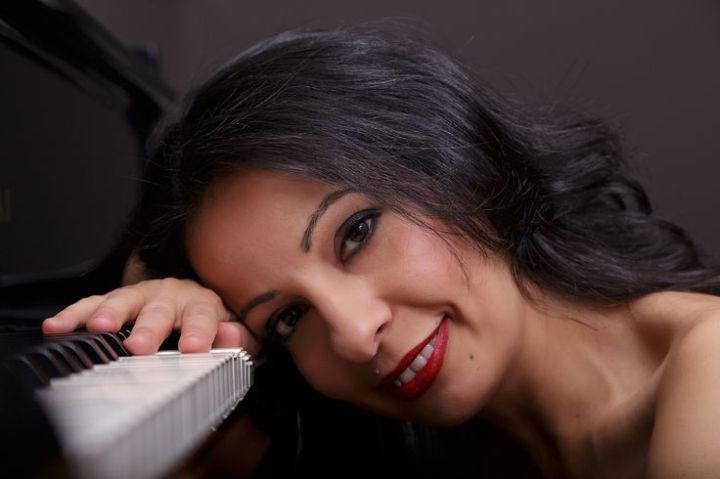
Cristina Cavalli, Italian born, began studying music with Lidia Palo Giorgi and graduated in Piano at the Conservatory “G. Nicolini” of Piacenza and in Chamber Music at the Conservatory “B. Maderna” of Cesena; alongside her academic path she attended courses and masterclasses with notable musicians, among which most important to her were the Italians Sergio Fiorentino, Pier Narciso Masi and Marisa Somma. She continued her studies at the Accademia Incontri col Maestro of Imola, where she obtained the Master Diploma in Chamber Music. She appears frequently in concerts both as soloist and as chamber music partner, in a repertoire ranging from the 17th century to contemporary music. Her interest in this latter has enabled her to enrich her musical experience by taking part in important events such as Contemporary Music in Streaming, Novurgia (Milan), Dentro la Musica (Rome, Accademia di Santa Cecilia) and Festival di Nuovo Musica (Reggio Emilia). Several works by European and American composers have been dedicated to her, and she is often asked to give the First Playing of new piano pieces (Milan, Shanghai, London, Helsinki, Belgrade, Rome among others). She has played for the Universities of Macerata, Piacenza and Bologna and has recorded for the Italian national TV channels RaiSat3, Canale10, and the Finnish Alfa TV; her performances have been broadcasted by Radio Vaticana, Radio Belgrade and many others.

As soloist and chamber musician she has appeared in important venues in Europe and Asia, including Shanghai Symphony Hall, Sala Verdi of Milan, Auditorium Parco della Musica of Rome, Wuxi Grand Theatre and Shandong Grand Theatre (Jinan) in China, Zus Concert Hall of Prague, Teatro Ateneo of Madrid, Teatro Cavallerizza of Reggio Emilia, St. James Piccadilly in London, Sala Eutherpe and Auditorio Caja España of Léon and Teatro Ruskaja of Rome, always drawing success and great feeling with the audience. She performed in United Kingdom, Netherlands, Finland, Italy, Germany, Spain, Serbia, Czech Republic, Macedonia, China and Inner Mongolia; last May 2015 she made her debut at Shanghai Symphony Hall with a very successful solo recital, carrying on her first China Tour with eight concerts and three masterclasses. Ms Cavalli is an official member of ECMTA, European Chamber Music Teachers’ Association (Helsinki), ILAMS, Ibero Latin American Music Association (London) and she is also Honorary Advisor of IIME, International Institute for Music Education (Honk Kong). Parallel with traditional concert activities, she is constantly collaborating with other artists to creative projects in which music is combined and synthesized with different arts. In 2010 she presented Mediterraneo, a musical journey along the coasts of the Mediterranean Sea, starting from some Italian music suggestions and ending with Flamenco. Between 2012 and 2014 she ran the artistic direction of Chamber Music in Italy (concerts and masterclasses in the beautiful island of Ischia) and Florestano in Roma (music and more in the heart of Rome). She is now engaged in her new project, Ritratti (Portraits).

In her vision, Ms. Cavalli privileges the development and diffusion of classical music among people of all ages, country and condition; because of this spirit of sharing, she is often involved in charity initiatives, seeing music as a powerful way to improve and enrich people and life, children’s life in particular.

Cristina currently lives in Madrid.

www.cristinacavalli.com

250px-johannespassion
First page of the autograph manuscript of St John Passion
Hearing J S Bach’s St John Passion in a Baroque church, as I did on Good Friday, connected this powerful and stirring work more closely to its original conception and performance. This was the annual Good Friday performance at St John’s Smith Square, a Baroque church in the heart of Westminster, given by Polyphony with the Orchestra of the Age of Enlightenment, conducted by Stephen Layton.

Bach composed his Johannes Passion (St John Passion) in 1724, the composer’s first year as director of church music in Leipzig. The work received its first performance on 7 April 1724, at Good Friday Vespers, at the St Nicholas Church. The work is in two sections, intended to flank a sermon, and the text, which retells the events of Good Friday leading up to Christ’s crucifixion, death and deposition from the Cross, is drawn from chapters 18 and 19 of the Gospel of John in the Luther Bible. To the modern audience, the text may seem arcane, and the unfolding narrative feels almost operatic, but to the congregation in Bach’s church, it would have been entirely familiar, as were the chorales which used well-known hymn tunes and texts. The work comprises choruses, chorales, arias and recitatives, with some highly effective and arresting “word painting” to reflect the meaning of certain words or passages.

In this performance, the role of St John the Evangelist was sung by Stuart Jackson whose tenor voice was eloquent, pure and mellifluous. Jackson was joined by Neal Davies, a sombre Christus, whose interplay with Roderick Williams’ Pilate was gripping and intense. Julia Doyle, Iestyn Davies, and Gwilym Bowen all responded with sensitivity to the spiritual substance of the text and the profound drama of the narrative. Julia Doyle’s soprano arias were especially luminous, while Iestyn Davies’ counter-tenor was clear and ethereal.

Polyphony sang with a full, rounded sound with impressively crisp diction which brought a dramatic immediacy to the text, for example in the chorus when Christ is brought before Pilate and the choir become the baying crowd. Stephen Layton drew a rich, colourful sound from the OAE with some particularly fine contributions from the woodwind and an elegant cello continuo. The pacing of the drama was also expertly judged by Layton with impactful and moving pauses and longer silences to allow the audience time to digest and reflect upon the highly charged and emotional narrative.

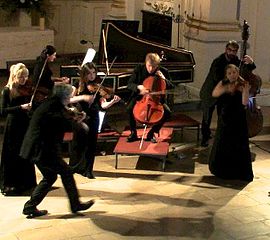
fda20c_c850cb4dd0214ff688db33d783c0140fMusic-in-Motion is a revolution in classical music performance, conceived and developed by conductor John Landor. The musicians perform without music stands or chairs, using movements and gestures designed to clarify the structure, drama and emotional impact of the music.


I met with John Landor to talk about early musical influences, significant teachers, the impetus for creating Music-in-Motion, and more…..


Who or what inspired you to pursue a career in music?

Although none of my family were professional musicians, my father was a keen jazz trumpeter in his youth, and my mother loved the arts and played piano. We had a rather large family of six children and we did a lot of singing as a family. I was born in the Midwest USA and I remember vividly evenings “on the porch” singing all the old American favourites like ‘She’ll Be Comin’ Round the Mountain’, all that homespun stuff.

All my siblings learnt musical instruments, so I just assumed it was something everyone did. I remember proudly carrying home my first violin, the sense of ownership of something special. But almost as soon as I started lessons the family moved around a lot, which meant that it was difficult to get any regular teaching. At age ten I ended up as a chorister at Westminster Cathedral Choir School. There was no violin teacher, so I spent every morning break teaching myself, and also started to compose little pieces.

At WCCS I absorbed the whole Italian Catholic choral tradition. With 10 services to sing each week we all essentially became professional musicians at an early age. Although I hated being away from home (we were all boarders) the music was my great solace.

Was violin your first study instrument at Royal Academy of Music?

No, I decided there wasn’t much point in pursuing it as I was never going to play at the level I wanted to. My first experience of conducting around age 15 (one of my own compositions at school) was an epiphany. I walked around for days in a state of bliss and knew from that moment that this was what I wanted to do. I went to Oxford University to get a music degree and spent all my time forming orchestras and conducting concerts and went on to the Academy for conducting and composition.

ld38439

Significant influences or teachers?

My huge inspiration was Ilya Musin. At 34, I took some time for an artistic ‘re-fresh’ and went to study for a few months with him at the St Petersburg Conservatory. It was a revelation. Musin didn’t speak English but he spoke what I felt was my musical language, far more than anything I had encountered in all my years of study. I really felt I had ‘come home’, and fell in love with Russia in the process – such a fascinating country and people, complex, difficult, but so beguiling. He was the first teacher who talked about ‘character’ in music and that was a light-bulb moment. In my classes at RAM everyone talked about the nuts and bolts of conducting, but no one said anything about character. If the character of the music is absorbed, everything else starts to happen on its own. It was a total Eureka moment. I spent three months in classes with astonishment, amazement and relief, and it had a deep impact on my conducting.

This experience helped in the creation of Music-in-Motion?

Yes, although not directly. My finding the concept of Music in Motion was a slow evolution. It all started with the Mini Maestro family concerts I gave at St Martin-in-the-Fields around 2000 with LMA Orchestra. Because the sightlines there are not ideal for small children I started to send the orchestra out into the audience to play, with the kids holding their music. It gave them a chance to hear and see professional musicians close-up. But an important by-product was that it showed me that musicians can play perfectly well together even if spread out over a relatively large area.

I also realized that audiences just love being close to, or even in the middle of, the musical action – they’d say “wow! An oboist is playing in my face while I’m holding the music!”. And that face-to-face interaction with their audience gave the musicians a real buzz too – they felt more that they were artists in their own right communicating as individuals as well as a collective.

Then it occurred to me that if the musicians were able to move around while playing, they could perform more like actors on a stage and I could ‘choreograph’ the movements to show the interactions in the music. We started doing demonstrations of this in my Meet-the-Music discovery sessions in the interval of some of our evening concerts. The audience reaction was so extraordinary, it was clear that we had found something that was unusually powerful and inspiring. Instead of a static group of musicians seated in front of music stands, here was a living, moving, breathing musical organism.

Since then I have realized that this way of playing has almost limitless uses. For a start it’s ‘educational’ almost by default as it makes clear visually what is happening in the music without need for verbal explanation. All those people who like (or want to like) classical music but are put off by traditional concerts might find this a great way in. And for any musician it’s a great training for general expressivity as it challenges them to think more about how they communicate.

What influences would you say led you to the idea of Music-in-Motion?

First, Lindsay Kemp’s work, which made me understand how important context is to a performance. Secondly, a performance by the Mark Morris Dance Company where I ‘saw’ as well as heard a fugue being performed – a musical ‘line’ of dancers animated each voice of the fugue in a way that was incredibly clear and expressive. And finally, and most directly, Jonathan Miller’s production of the St Matthew Passion. In the arias with obbligato instruments, both singer and instrumentalist stood face to face, and I found it so direct, human and intimate compared to how it is normally done – just amazing. That deeply impressed me.

Is there a historical precedent for this?

Not that I can find or think of! For an idea that seems so obvious to me now, I find it almost unbelievable that there seems to be no historical precedent. Of course there has been quite a lot of work in the past few decades where musicians move on stage with dancers or act while playing. But these I find essentially use music to enhance a theatrical experience – whereas I am using theatre to enhance a musical experience.

I want to emphasise that Music-in-Motion is about revealing and highlighting the choreography, drama and acting that is intrinsic to the physical act of playing music already – not adding show or gimmicks! I am acutely aware that the moment you add a dancer, actor, video projections or have artists painting during a musical performance, the music itself becomes background. It’s incredibly vulnerable to that. So, while I whole-heartedly endorse the concept of musical performance in these kind of theatrical or dramatic contexts, that is the complete opposite of what I am trying to achieve. In a nutshell: a theatre of music, not music of theatre!

Do you feel any music could undergo the Music-in-Motion treatment?

Undergo? I think ‘thrive with’ is more the phrase I would use!

I’ve been purposefully focusing on core repertoire that isn’t overtly ballet or dance-inspired. In the Bach double violin concerto where the ripieno music interjects we had the players stepping out and back like a backing group to the soloists. It made the structure of the music so crystal clear to the audience.

In Mozart’s Jupiter, there’s this little Alberti figure in the second violins accompanying the tune. Normally it barely features in the aural landscape, it simply fills in the harmony. But then we musicians know it is in fact a completely wonderful, busy little conspiratorial moment in its own right. So we got all the second violins to play it in a huddle. All the sudden it became a vital part of the performance, not just an accompanying figure.

I want every and any audience to be fascinated by the riches contained in every single bar of a Brahms Symphony or a late Beethoven quartet – and not needing to be a connoisseur to appreciate it to the fullest extent possible, even on a first hearing.

How do you find musicians respond to Music-in-Motion?

Funnily enough the only run-ins I’ve had were with double basses! They felt it was a gimmick. Mostly, musicians start out pleasantly bemused, but once they get a taste of the sense of liberation from the normal hierarchies of traditional performance they love it! It makes each member of the ensemble feel they really count as individuals. Of course a certain level of stagecraft needs to be learned if it is not all to look a mess and distract from the music.

Does it affect the sound?

Yes it does, in several ways. The sound is much better. Music stands block sound, so when they are all removed there is better overall projection of the music. Even when a player turns while playing, the acoustic changes, so there’s yet another aspect of Music-in-Motion that can be used to enhance the experience of listening. Though it must only be used to clarify the music.

What do you consider to be the most important ideas or concepts to impart to aspiring musicians?

Be yourself and know what you are communicating.

Because the space we need to play our instruments is relatively small and, after all, most instruments are attached to our bodies in some way, many musicians naturally tend to focus inwards. The next point of focus is “am I playing well?”, then “what would my teacher think?”, then “I hope I am living up to the composer’s expectation” then “will I get a good review?’ – and only then the ‘end-user’, the audience, is considered! Music-in-Motion starts with the audience. How can we inspire, delight and fascinate them with what we do? If we can do this, I have no fears about the future of classical music.

Music-in-Motion – Shostakovich String Quartet No.8 performed by the Konvalia Quartet


John Landor is Music Director of London Musical Arts Orchestra, based at St Martin-in-the-Fields. He has been developing a new concept in orchestral and ensemble performance called Music-in-Motion since 2013.

Musicians and ensembles interested in exploring the concept are warmly invited to apply for one of his Music-in-Motion Workshops held regularly in London. Further information here

about-sunwook

Who or what inspired you to take up the piano and pursue a career in music? 

Since  I was a child, I have been struck by the beauty of classical music. Even though I explored many areas including playing piano and violin, painting, calligraphy, Taekwondo (Korean martial art) and so on, only music stimulated me to practise constantly. It is definitely not easy to practise 4-5 hours every day without passion for music.

Who or what were the most important influences on your musical life and career? 

To be honest, competitions gave me a great motivation. I participated in many national competitions in Korea from a very young age and successful results made me realise that this is what I have to continue to work on. From 2004, I went to international competitions and finally won the Leeds Competition in 2006 at which point I decided to stop participating in competitions as it gave me the opportunity to give concerts on a regular basis. Since then, I have been exploring a variety of repertoires, learning about many composers and their music in depth and earning valuable experiences on the stage.

What have been the greatest challenges of your career so far? 

Each and every concert is a great challenge to me like an audition. I always try to learn and develop from every concert.

Which performance/recordings are you most proud of? 

I still vividly remember great experiences I had with many orchestras and conductors. Working with Sir Mark Elder (Halle Orchestra, Manchester), Kirill Karabits (Bournemouth Symphony Orchestra) and Myung-Whun Chung (former chief conductor of Seoul Philharmonic and Radio France Philharmonic Orchestra) were fantastic collaborations. Also I am very proud of my recording of Unsuk Chin’s Piano Concerto. It is an honour to play and record great works by highly respected living composers.

Which particular works do you think you play best? 

Beethoven and Brahms. I have been playing Beethoven’s Piano Sonatas (all 32!!), Piano Concertos, Violin Sonatas, Cello Sonatas, and also studied all his symphonies when I was a conducting student at the Royal Academy of Music. For Brahms, I have explored all his piano works, chamber music and symphonies etc. However, I am more excited to learn new repertoire including works by Janacek, Prokofiev, Schubert, Schumann, Mozart and Bach. I sometimes think that my life is lucky because it gives me an infinite challenge.

How do you make your repertoire choices from season to season? 

I make my programmes based on pieces which I would like to play with confidence. I include no more than 4 composers in one programme and the relationship between them in terms of their harmonies are very important. For example, if I start Beethoven E major sonata op.109, I put c# minor, op.27 no,2 ‘Moonlight’ for the next piece because E major and c# minor are relative.

Do you have a favourite concert venue to perform in and why? 

Wigmore hall in London, Philharmonie in Paris, Philharmonie in Berlin and Concertgebouw in Amsterdam. They have the most distinguished acoustics and extremely high quality keyboard instruments. They have truly the top level pianos I have ever played.

Favourite pieces to perform? Listen to? 

All Beethoven Sonatas, concertos and chamber music pieces by Brahms. It is quite interesting because most musicians in my generation love to play Tchaikovsky, Rachmaninoff, Prokofiev as well as Ravel and Chopin. However, I have played Tchaikovsky 1st and Rachmaninoff 2nd concertos only once in my life on the stage but more than 20 times for Beethoven 3rd, 4th and 5th.

Who are your favourite musicians? 

My greatest mentor is Andras Schiff, especially for Beethoven. I have been greatly influenced by him through his intellectual ideas on the structure and sound of Beethoven’s music as well as keyboard techniques and understanding the essence of composers.

What is your most memorable concert experience? 

In 2012, I played with London Symphony Orchestra for the first time as a replacement. I was so nervous because I was notified only 2 days before the concert but I think the concert was very successful with Maestro John Eliot Gardiner.

What do you consider to be the most important ideas and concepts to impart to aspiring musicians? 

This is my philosophy of being musician: Don’t aim to get large amounts of concerts, but do try to achieve good quality concertds. It is a long term/life-time project, don’t expect to have rapid improvements, just practice constantly on the regular basis.

Sunwook Kim’s new album of music by Franck and Brahms is now available on the Accentus Music label.

London-based Sunwook Kim came to international recognition when he won the prestigious Leeds International Piano Competition in 2006, aged just 18, becoming the competition’s youngest winner for 40 years, as well as its first Asian winner. His performance of Brahms’s Concerto No.1 with the Hallé Orchestra and Sir Mark Elder in the competition’s finals attracted unanimous praise from the press.

Full biography and website