Who or what inspired you to take up the violin and pursue a career in music?

I don’t remember starting playing the violin, but I can say when chose to pursue it. I have a clear memory of a freezing walk home from school when I was 12 or so, and deciding that there certain extremely ambitious things which I wanted to do with music. Everything has flowed from that moment. I would say that I choose the violin, more and more, every time I pick it up. A lot has been said about how long it takes to learn an instrument, but very little about how the instrument becomes our nature, how we, eventually, can allow the body and the instrument to interact in ways beyond our active control.

Who or what were the most important influences on your musical life and career?

This would be an enormous list, and I am loath to introduce a hierarchy. In addition so much of what I do and have done, is influenced by non-musicians. But I can say that I was lucky, from a very early age, to come into contact with some extraordinary older people, who challenged me to have the highest expectation and anticipation of what I should do, and of our obligations as artists. But let me list my teachers-all extraordinary musicians and human beings. My mother, Susan Sheppard, Beatrix Marr, Ralph Holmes, Manoug Parikian and Louis Krasner. And there’s one more; this is not facetious, my Yoga teacher, Nino Nanava.

Which performances/recordings are you most proud of?

…. there are some which I think are not bad! I love performing and recording with equal passion. I am blest to feel equally free on stage and in front of the microphone. I have never suffered from performance anxiety (perhaps I should have!), and feel, whenever I am performing to an audience or on the studio, I am more relaxed than at any other time. I think that I am proud of my cycles of recordings (Telemann, David Matthews, Beethoven, Tartini, George Rochberg, etc).

Which particular works do you think you perform best?

I would hope that it is whatever I am playing, at the moment I am performing it. However, the best performances, without doubt, are when I am collaborating with great friends. I do a lot of solo concerts (I don’t use the word ‘unaccompanied’- a solo pianist wouldn’t!), but of course, as a violinist, I relish sitting next to extraordinary pianists and harpsichordists. So I suspect that I probably perform best when I am on stage with an extraordinary collaborator, and with an audience (it does not matter what size-it’s a privilege to play for one person, or a hundred) taking part in the music.

How do you make your repertoire choices from season to season?

My repertoire choices don’t really work like that; I have projects which I pursue over very long term, and each choice of work or group of works will emerge from or join the slow development of those projects. So, right now, it’s the flow of Mozart Sonatas with Daniel Ben Pienaar, Henze Sonatas with Roderick Chadwick, Reicha Quartets with the Kreutzers, and the Abel Gamba solos which have been fascinating me for the past few days. And of course, there’s the ongoing weave of the works that emerge from my collaborations with living composers. Which is the material for another day!

Do you have a favourite concert venue to perform in and why?

This I can answer. No question – Wilton’s Music Hall, London. The acoustic is like playing inside a cello, the atmosphere of the hall is absolutely unique, and the audience is enthusiastic, adventurous and diverse. I don’t really like modern purpose built concert halls. That is just me. I am inspired by buildings and the people in them. Next month, I am playing a three day residency (all 30 Tartini Solo sonatas, and music by Xenakis, Glass, Evis Sammoutis) in an astonishing wooden chapel in the 18th Century Leprosy Hospital in Bergen (for the Bergen Festival). The whole project flows from my excitement about the building; its texture, sound, shape, light, colours and people. When I was young, I discovered that in his ’10 Books on Architecture’ (written for Julius Caesar) Vitruvius saw music as part of architecture, integral to it. That is an important point, and informs much of my feeling about venues. One of my favourite places to play, is at the dinner table, for friends, with the violin part of the conversation, the interplay. And of course, the best time, is my nocturnal practice space (I work from midnight to three or four most days), at my desk here in Wapping, with the silence of the city outside, the noise of the foxes under my window, and the Westminster Chimes (which of course came from William Crotch’s ‘Palestine’) drifting along the river into my open window.

Who are your favourite musicians?

My favourite musicians are my collaborators (performers and composers). They are the people that I continue to learn the most from, and there’s nothing more inspiring than the sharing of long-term shared discovery. As I talking to you, I have to say that a vital part of this, is that I have always had serious duo-partnerships with the most extraordinary piano players; they are all amazing artists and each of them continues to teach me so much. It’s an exciting list: Aaron Shorr, Jan-Philip Schulze, Roderick Chadwick, Olivia Sham, David Owen Norris, Julian Perkins, Daniel-Ben Pienaar … working on modern and period instruments. It’s worth pointing out that I am a frustrated pianist. I love the instrument so much, and I can’t do anything with it. But I can play the violin sitting next a great pianist, and bask in the glory of the instrument and those artists.

What is your most memorable concert experience?

Without question, it’s always the concert that I have just done, am doing, or are about to do. Right, now, today, in fact, I am getting ready to play a concert with the harpsichordist Julian Perkins, on three early violins! Sonatas by Biber, Tartini, Matteis, Telemann, and the two astonishing continuo sonatas in E minor and G Major by Bach. I can’t think of anything more exciting than that!

What do you consider to be the most important ideas and concepts to impart to aspiring musicians?

‘Aut viam inveniam aut faciam’. Literally, I will either find a way, or I will make one. My son would want me to own up the fact that Hannibal is supposed to have said that….

However, I recently found (folded into some music), an amazing thing. As a child, I was very lucky to study with the violinist Beatrix Marr (until I went to Ralph Holmes at 12). At some point when I was 10 or 11, she handed me the typescript of a book on violin playing which she was writing. It was never published, and I confess, that at the time I never read it – it was beyond me. But a week or so ago, I read it for the first time, and was profoundly moved. Here’s a sample, which is a great way to finish, I think:

“…in the case of our own playing, it is all too easy to be impatient when things seem to be going badly, instead of using analysis, and looking hopefully to the next day, or the future. There always is another day, and who knows what miracle it may bring?” 

(Beatrix Marr ‘Practice’)

What is your present state of mind?

Well, I am filling this in 15 minutes after wrapping an inspiring recording project, playing the piano/violin music written for me by my long-time collaborator Thomas Simaku, with the astounding Roderick Chadwick. So my arms hurt, but I have a good cup of verbena tea and am planning on lying on the floor for an hour. The process of recording is a treasured and regular activity for me, and I always run the sessions as a workshop, a place of discovery and invention.

 www.peter-sheppard-skaerved.com

It’s good to see Trinity College London extending its publishing programme to include more books for pianists, including collections of pieces from beginner to advanced level, and a compilation of piano exercises, selected from past exam syllabuses, all of which offer excellent resources for teachers and students alike.

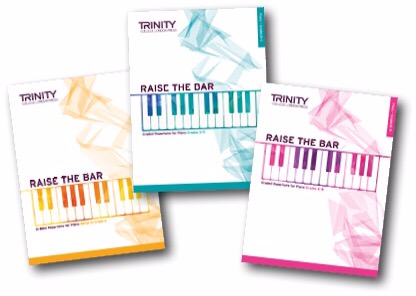
Raise the Bar is a new series of graded pieces from Initial to Grade 8 showcasing favourite repertoire from past Trinity exam syllabuses. Edited by acclaimed teacher, pianist and writer Graham Fitch, each book contains an attractive selection of pieces in a range of styles and periods. Teaching notes for each piece are included, highlighting aspects such as technical challenges, structure, rhythm and expression, and each book contains a summary at the back containing the composer, title, key, time signature, tempo markings and characteristics of each piece. There is a good range of music to suit all tastes and the teaching notes can be used as a springboard for further discussion between teacher and student or a basic starting point for independent study. These books provide useful additional repertoire for students preparing for exams or simply for playing for pleasure and broadening one’s repertoire and knowledge of different style of music.


Piano Dreams is an attractively-designed series of books containing pieces for beginner and early intermediate pianists composed by Anne Terzibaschitsch. The pieces will particularly appeal to younger children with their imaginative titles and fun illustrations. Programmatic text weaves elements of story-telling into the pieces to stimulate the player’s imagination and encourage more expressive and colourful playing. There are notes on each piece highlighting aspects of technique or expression. In addition to the solo pieces, there are two books of piano duets in the same format.

I am a big fan of Trinity’s Piano Exercises which students learn as part of their grade exams. The exercises are designed to develop particular aspects of piano technique and many directly relate to pieces in the exam syllabus, offering the teacher the opportunity to introduce students to the concept of the ‘Etude’ or Study.  This new compilation of selected exercises ranges from Initial to Grade 8 and each has a descriptive title to inspire students to interpret the music imaginatively (thus reinforcing the idea behind Etudes by Chopin and Liszt – that pieces should be both challenging and musical, testing technique and musicality). These exercises provide a useful resource for developing secure technique and can be used alongside repertoire to inform and extend students’ technical and musical capabilities.

More information about Trinity College London music publications here

Concerts for Syria facilitates and promotes fundraising concerts and music events that support Syrian refugees.

After more than four years of conflict the ensuing refugee crisis has become one of the greatest humanitarian crises of today, affecting each and every one of us. Today 12 million Syrians have fled their homes because of conflict, 6 million of whom are children, and c.4 million Syrians in total are now refugees.

As musicians we have the tools and the opportunities to raise much-needed funds for refugees and to raise awareness of their situation and ways in which we can help.

The aim of this project is to harness the power of these tools and opportunities and seek to make a difference through music-making.

Fatima Lahham, founder of Concerts for Syria says:

I’m part-Syrian myself (and a postgraduate recorder player at the RCM, London), and have found not only that lots of musicians would like to support this important cause, but also that many concert venues would be happy to facilitate collections at events. To bring these two factors together I decided to start up Concerts for Syria in October 2015.

We help to organise concerts, as well as advertising and promoting them, and assisting performers and venues with the whole collection process. In the last 6 months we’ve been involved with venues such as the Foundling Museum in London, the Keble Early Music Festival in Oxford, St Albans Cathedral, and Great St Mary’s Church in Cambridge. A wide range of musicians have expressed interest in getting involved, with my own chamber ensemble, IMPROVISO performing at several of the concerts.

My aim for the next six months and further ahead is to really expand and reach new musicians and audiences, as well as to look at securing funding for future, more ambitious projects.

The tragic crisis that faces new generations of Syrian children today is not one that can be ignored nor one that will disappear soon. As musicians we have the privilege of being able to communicate with so many diverse groups of people around the world, and this project seeks to harness that power by raising awareness, collecting funds, and making a difference through music-making.

Anyone interested in getting involved in any capacity is encouraged to contact us via:
concertsforsyria@gmail.com

concertsforsyria.com

Ever since its reinvention as a concert hall, St John’s Smith Square has played a pivotal role in supporting the most promising young musicians. Simon Rattle, Steven Isserlis, Nigel Kennedy and Jacqueline du Pré are just a few of the musicians who performed at St John’s Smith Square before going on to begin internationally renowned careers.

St John’s Smith Square Young Artists’ Scheme 2016/17

“The Young Artists’ Scheme at St John’s Smith Square is a vital part of our mission as one of the UK’s leading concert halls. By investing in the development and nurturing of exceptional talent we are helping to ensure that music making and creative opportunity is refreshed and renewed for future generations. It is also, of course, incredibly exciting simply to observe the young performers as they develop across the course of their involvement with the scheme and a real reward for our audiences to be able to share this process of development.” – Richard Heason: Director, St John’s Smith Square

Pianist Christina McMaster is amongst the line up of the 2016/17 Young Artists’ Scheme (which also includes the Minerva Piano Trio, harpist Oliver Wass and the Ferio Saxophone Quartet). A champion of contemporary repertoire, Christina has been praised for her innovative programming, and her collaborations with a diverse mix of genres and arts, recently working with the Brodowski Quartet, violinist Lizzie Ball, rapper Tor Cesay, director Richard Williams, actors from Central Saint Martin’s and a number of designers for London Fashion week. She also commissions and performs a wide range of new music, and has worked with established composers including Sir Harrison Birtwistle, Sir Peter Maxwell Davies, Tansy Davies and Stephen Montague as well as emerging composers – collaborating most recently with Freya Waley-Cohen and Richard Bullen.

christina2bmcmaster

Christina launched her debut album ‘Pinks & Blues’ in October 2015 on her own label to a sell-out audience at St James’ Theatre, the album is a fusion of jazz and blues influenced classical and contemporary music with two new commissions.

“Thanks to the St John’s Smith Square Young Artists’ Scheme I am able to design and deliver my ambitious vision of an exciting ‘mini-festival’ across 2016/17 season with an array of concerts from solo piano music by Bartók, Scarlatti, Ligeti, Debussy, to a concert where 120 school children take over the galleries of SJSS! Responding to the building’s rich history I’ll perform music by Dowland, Shostakovich, Britten and Birtwistle with the Ligeti Quartet; and the brilliant sisters Kristine and Margarita Balanas will join me for piano trios by Schumann and Arvo Pärt. The scheme has also provided the wonderful opportunity to commission new music by Richard Bullen and Ayanna Witter-Johnson; Ayanna will pay homage to one of her heroines in celebration of International Women’s Day alongside some of my musical heroes including Ruth Crawford-Seeger, Charles Ives and Meredith Monk.”  –

Christina McMaster

Meet the Artist……Christina McMaster

Review of Pinks & Blues

St John’s Smith Square Young Artists’ Scheme


