The BBC’s biennial Young Musician competition reached its thrilling climax in an absorbing, nail-biting and inspirational final concert at London’s Barbican on Sunday 15th May and I was privileged to be a member of the audience for this wonderful celebration of shared music making.

In the nearly 40 years since it was founded, the prestigious competition to find the nation’s top young classical talent has become something of a national treasure. It has “discovered” many fine musicians, including Nicholas Daniel (oboe), Emma Johnson (clarinet), Freddy Kempf (piano), Guy Johnston (cello), Jennifer Pike (violin) and Benjamin Grosvenor  (piano), to name but a very few, and continues to inspire and support aspiring young musicians. The programme also regularly poses important questions about child prodigies, the hot-housing of talented children, private education, specialist music schools and music education in the UK, but fundamentally the competition emphasises the joy and pleasure that music brings to those who play it, engage with it and listen to it. This was particularly evident at the Barbican on the afternoon of the final where there were activities for eager young musicians of all ages and abilities ahead of the final concert and during the intervals.

In the old days, when I watched the programme avidly as a teenage piano student (frustrated that I was never quite good enough to enter the competition), it was all rather wooden, cringeworthy, and geeky. In recent years, the programme has had a glitzy makeover and now bears more than a passing resemblance to shows like Britain’s Got Talent and The Voice, though the format remains the same with talented young people competing in instrumental categories (keyboard, woodwind, brass, strings and percussion) to be selected for the semi-final and then the grand final. In a neat piece of continuity, Clemency Burton-Hill, daughter of the competition’s co-creator Humphrey Burton, was presenter of this year’s television coverage and final concert.

This year’s finalists were French horn player Ben Goldscheider (18), saxophonist Jess Gillam (17) and cellist Sheku Kanneh-Mason (17). All the category finals revealed some incredibly talented and dedicated young musicians, and what I found most reassuring was that all the young people involved in the competition expressed a real passion for their music. I am a firm believer that if one does not love it – whether one is a professional or amateur musician – there is little point in doing it! The range of instruments played and repertoire performed begs the question of how one chooses between one young musician and another because each instrument and its repertories presents its own unique technical, artistic and emotional challenges. In the final stages of the competition, technical mastery of one’s instrument is a given, and in the end the judgement comes down to aspects such as communication, stage presence and musicality. All three young finalists displayed these qualities in spades in their individual and very distinctive performances.

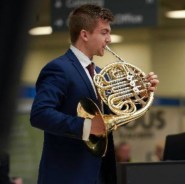
It is very hard to go first, and I felt Ben Goldscheider  was quite nervous. The French horn does not lend imageitself to much physical movement or gestures on stage., but his performance of Richard Strauss’s Horn Concerto no. 2 displayed concentration, fine intonation and a clear purpose.
cge-pcrwcaeji00Jess Gillam, a finalist in the 2014 competition, bounded onto the stage and mesmerized us in silver sequined leggings and Michael Nyman’s Where the Bee Dances. Her stage presence is charismatic, infectiously extrovert, and highly expressive – as is her sound which ranged from vibrant and imaginative to haunting and delicate. She was assured and very comfortable on stage, interacting enthusiastically with the orchestra and lifting the sound out of her instrument and into the audience. At just 17 she has already had a good deal of performing experience and this came across very clearly in her confident, colourful and technically assured playing

From his first notes of Shostakovich’s Cello Concerto no. 1 Sheku Kanneh-Mason was authoritative, thoughtful and totally committed. This music is a sophisticated choice for a teenager and Sheku rose to the technical and emotional challenges presented by Shostakovich’s music with an impressive maturity and musical insight. His modesty, evident throughout the competition, allowed him to stand back from the music and the resulting performance was intense and highly-charged.

While the jury were deliberating we were treated to a lively and witty performance of the first movement of Prokofiev’s Piano Concerto no. 3 by the 2014 winner, pianist Martin James Bartlett.

89701006_winner_bbc_young_musician_2016_04
Sheku Kanneh-Mason (photo: BBC)

Sheku Kanneh-Mason was awarded the top prize, but ultimately all three finalists are winners: to have reached the final of this competition is a credit to their dedication, passion and commitment to their music, and through this experience they all have the potential to be huge role models for a younger generation. Ben, Jess and Sheku are enormously talented, down-to-earth and likeable (all three attend state schools), and one hopes that they are given the opportunity to inspire young people from all walks of life to engage with and explore the wonders of classical music.


(This is a longer version of an article first published on Bachtrack.com. I am grateful to my friend and piano teaching colleague Rebecca Singerman-Knight for her input, and her company at the final).


Cellist Sheku Kanneh-Mason, 17, is winner of the 2016 BBC Young Musician. Sheku gave an intense, highly committed and extremely mature performance of Shostakovich’s Cello Concerto no. 1 in E flat in the final of this year’s competition at London’s Barbican.


Congratulations also to the other finalists Jess Gillam and Ben Goldscheider

A longer article on the competition to follow. 


Who or what inspired you to take up the recorder and pursue a career in music?

From a young age I was fortunate enough study with very inspiring teachers – although in the first place I came to the instrument by chance. A childhood friend of mine wanted to learn to play the instrument but did not want to go to the lessons on his own. Further along the way I was also extremely lucky to be given the opportunity to play with other musicians of my age and the chance to experience manifold concert situations in Germany and abroad. When I was old enough to start thinking about what I would like to do for a living, I could not imagine my life without playing recorder and making music everyday…

Who or what were the most important influences on your musical life and career?

There were several, including studying at three different conservatoires, attending master classes with numerous renowned musicians. Most recently, being chosen as St John’s Smith Square Young Artist for the 2015/16 season has been a major influence and given a boost to my musical development and career!

What have been the greatest challenges of your career so far?

Making potentially life and career changing decisions, such as deciding to complete a Master of Music in London, rather than somewhere “at home”.

Which performance/recordings are you most proud of?

My two solo CDs: “Upon a Ground” (2012, https://open.spotify.com/album/68Qaixt8WbErB9MpwE3miK), which was the first CD I ever recorded on my own, solely with the wonderful support of the four other musicians playing on the recording. My second CD, “Cantata per Flauto” was released in April this year (here’s a review: https://andrewbensonwilson.org/2016/04/07/tabea-debus-cantata-per-flauto/), and I launched it at St John’s Smith Square with a fantastic ensemble playing with me (https://www.youtube.com/watch?v=-oeUH206Im0)

Which particular works do you think you perform best?

That’s very had to say.., It’s always the questions if the works that I would identify as the ones “I perform best” actually come across like that to an audience. I particularly enjoy baroque music by Johann Sebastian Bach and Georg Philipp Telemann, but I also love to perform contemporary music for recorder solo or chamber music ensembles – these pieces require a completely different approach to the learning process and the presentation.

How do you make your repertoire choices from season to season?

I have an long and ever-growing list of pieces I want to play or arrange for my instrument, and I therefore try to include at least a few of those into programmes I am planning. Of course there are many other factors to consider: the venue, its size, the occasion and the audience who will be listening, the scope to bring in other musicians, a possibly already existing overall theme. And finally I always strive to include different facets of recorder repertoire, old and new, solo and chamber music etc.

Do you have a favourite concert venue to perform in and why?

I could not say I have a favourite venue! Smaller venues, such as an art gallery, a chapel or small concert room have an intimacy and direct exchange with the audience which I value very highly. On the other hand, larger spaces, like London’s St John’s Smith Square, are fantastic as well, as they challenge the projection and presence of the performer in a very different way.

Favourite pieces to perform? Listen to?

Probably music by Georg Philipp Telemann – he played recorder himself and through his music one can feel this deep understanding of the instrument’s capacity and special qualities. He has his very own musical language, which is still very flexible and changeable, which for me as a performer opens many doors to creatively engaging with his music. At the moment I often listen to JS Bach Cantatas, as this might related to a future project I am thinking about putting together, but I love music by Henry Purcell, especially his (semi-) operas.

Who are your favourite musicians?

Too many to name all…

What is your most memorable concert experience?

It’s hard to choose one! Perhaps playing as part of the Singapore Youth Festival in 2011 – we were preforming in a huge venue, but it almost seemed as if the audience was with us on stage. There was a lot of spontaneous applause, even in the middle of a movement, which is how it should be! One should be allowed to show and react when something is enjoyable and fun, or even the opposite…

What do you consider to be the most important ideas and concepts to impart to aspiring musicians?

Travelling and having lessons with as many different professionals as possible would be a vital advice – both for the own instrument and others. Also, one can gather so many ideas and concepts by collaborating with other instrumentalists, singers and composers and by embracing different styles of music from medieval to contemporary.

What do you enjoy doing most?

Arranging new repertoire for the recorder is definitely a favourite! I get very excited when there is the chance to include something “new” in a concert programme, to discover repertoire primarily intended for other instruments and make this repertoire my own.


Tabea Debus had her first recorder lessons with Gudula Rosa at the Westfälische Schule für Musik, Münster. Since then she has received many special prizes, including awards from the Deutsche Stiftung Musikleben, the Manfred Vetter Society, the Ministry of Family, Women and Youth as well as the Irino Foundation.

More about Tabea here

Schubert’s Winterreise, published in 1828, the year of the composer’s death at the age of 31, is often described as the greatest song-cycle ever written, and its central themes and preoccupations – love and loss, life and death – resonate through the centuries and continue to have a deeply emotional and philosophical impact today.
German composer Hans Zender’s ‘Winterreise’ is not a transcription of Schubert’s original for small orchestra. It is a “composed interpretation”, a work in its own right, which reflects and refracts the original song-cycle. Its orchestration takes the listener from Schubert’s Vienna, through Mahler and Schoenberg to the cabaret of Weimar Berlin and Kurt Weil. In this way, it challenges received notions of authenticity, historical accuracy and interpretation, and the relationship between performer, composer and audience. If anything, Zender’s Winterreise is even bleaker than Schubert’s with its strong Expressionist flavour and rich sonic associations with contemporary repertoire and instrumentation.

(photo: Hugo Glendinning)

In this production at London’s Barbican Theatre, the music and its narrative are staged by director, designer and video artist Netia Jones using striking black-and-white film, projections, haunting shadows, and chiaroscuro. The video screen is slashed into jagged shards, like a broken mirror, onto which are projected images of frost, a river, bare branches, a lonely snowy landscape through which a solitary figure, Schubert’s tragic “fremdling”, trudges.

Read my full review here


