14246578708947

Style

 Getting all the notes of a piece under our fingers is only the first step on the way to performing. It’s what happens after this that engages the listener and makes the performance memorable. Of course, we naturally want to be different and make our playing stand out from the crowd, but it’s no good if we go a little overboard and play in the wrong style. Style is very important, and can be quite subjective. It’s something that we can always look into at a greater depth, and just one reason why musicians are always students.

Style is often dictated by the period in which the music was written. You wouldn’t expect a character in ‘Downton Abbey’ to come into a scene wearing a pair of skinny jeans, would you? Similarly, you wouldn’t want to play a piece in such a way that the listener is no longer able to understand how it could have been written in a certain period. The tone we use has a huge bearing on style. Recently, I played the beginning of the Prelude from Bach’s Partita in B flat major (BWV 825) to one of my teachers, and his first comment was that I needed to alter my tone. The sound I was producing would have been far more suited to the work of a romantic composer such as Brahms, so I needed to lighten my touch in order to make my style more appropriate for the work. The same principle can be applied to flexibility; a performer may choose to pull the tempo around in a Chopin Nocturne to a degree that would be out of character in one of Domenico Scarlatti’s sonatas.

A good way to implement style is to think about the instrument for which the music was written. Yes, you’re probably going to be thinking “erm… piano”, but remember that our instrument has come a very long way from the first pianos of Cristofori in the 1700s. Of course, the music of Bach and Scarlatti would have been written for harpsichord, an entirely different instrument indeed! This does sometimes throw up disagreements over certain aspects of playing, such as the use of sustain pedal, but as long as you think generally about the instrument, then you will be far better off than if you’d disregarded the matter!

However, to play a piece stylistically doesn’t mean that you are to play in a certain way when it comes to interpretation. This is what brings originality to your playing, and makes the music as current now as it was when it was written. To demonstrate my point, below are two famous recordings of Bach’s Goldberg Variations (BMV 998), both recorded by Glenn Gould. The first was recorded in 1955, the second in 1981: both are examples of style fitting to Bach’s writing, but both recordings differ dramatically when it comes to Gould’s interpretation. You only need to listen to the opening few bars of the Aria to see my point:

Lewis Kesterton is a pianist currently studying at Birmingham Conservatoire. Read his blog here
img_4583
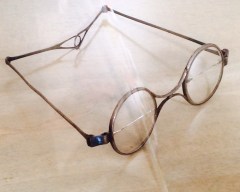
Schubert’s glasses

Schubert. This entry on the letter S would not be complete, for me at least, without a mention of Franz Peter Schubert, a composer whose music I have loved and lived with all my life: as a young child hearing my father play Der Hirt Auf Dem Felsem (‘The Shepherd on the Rock’) on the clarinet, my own LP of the ‘Unfinished’ Symphony, my first encounters with the Impromptus and Moments Musicaux for piano in my mid-teens, as a precocious student who could play the notes, but who understood little of where this music came from or its emotional depth. Returning to the piano in my late 30s after an absence of some 20 years, it was Schubert’s music to which I turned first, revisiting the Impromptus initially, and then the late piano sonatas, with the benefit of musical maturity (the result of a lifetime of listening and concert-going rather than playing at that time) and life experience. As an argumentative teenager, often to be seen at weekends on CND marches, the old radical Beethoven had been my hero, a composer who wore his heart on his sleeve and whose life-affirming music declaims his existence, at once full-bodied and triumphal, but also other-worldly and philosophical especially in his late works. Schubert speaks more quietly: his soundworld is introspective, and intimate. He takes us into his confidence, and he is often at his most tragic when writing in the major key. His music packs a vast emotional punch – the range of emotions expressed within a piano miniature, such as the Impromptu in f minor D935/1, are startling, their unexpectedness underlined by his daring use of harmony and his expansiveness (which Schumann described as his “heavenly length”), underpinned by an innate sense of musical geometry and architecture. As a consequence, there are many interpretative possibilities in his music.

If Beethoven is notable for his musical structures and energy, Schubert is the spinner of beautiful melodies, music which speaks of his life in Vienna, of socialising and music making with friends, country rambles and joie de vivre (think of the joyful holiday moods of the  ‘Trout’ Quintet), but always shot through with darkness and heartbreak. He had plenty of intuitions of mortality during his brief life: he contracted syphilis in 1822/23, at that time an incurable and shameful disease, and lived in a city on a continent wracked by revolution and war. These were turbulent times, both personally and politically, and his music reflects this in its emotional voltes faces – all those layers of feeling and chains of emotions – perhaps most strikingly expressed in the slow movement of the Sonata in A, D959 or in the Fantasy in F minor, D940.

Frances Wilson pianist, writer, teacher and author of The Cross-Eyed Pianist blog.

The Associated Board of the Royal Schools of Music (ABRSM) has launched a new performance diploma, the ARSM, designed as “a bridge between Grade 8 and the DipABRSM”. The new Diploma, ARSM (Associate of the Royal Schools of Music), is different to both Grade 8 and the DipABRSM in that it includes no supporting tests (technical work, sight-reading/quick study, viva (for DipABRSM) or programme notes). The repertoire list is taken from the DipABRSM syllabus, though much reduced, and candidates may include 10 minutes of own-choice repertoire of Grade 8 or above standard to create a recital programme lasting 30 minute in total. To all intents and purposes this “diploma” looks very much like a reinvented version of the Advanced Certificate or Trinity’s Advanced Performance Certificate.

Concerns about the new ARSM have been expressed by piano teachers via Piano Network UK, a large and very active Facebook group comprising piano teachers, pianists (professional and amateur) and piano lovers, of which I am co-administrator. I would like to share some of these views here. My colleague and friend Andrew Eales, who writes the excellent Piano Dao blog, will be publishing a more considered response to the ARSM, together with an interview with Penny Millsom of the ABRSM in which he hopes to clarify some of the issues raised below. 

Please note that any views expressed here are independent and my publishing them does not necessarily mean Andrew and I support or endorse them. They are drawn from a diverse range of British piano teachers of differing ages and experience. My own comments and views about the ARSM diploma are in italics.

Level of attainment, marking and assessment criteria

  • I find the fact that Distinction is set at 45/50 interesting (in comparison to 70/100 for the dip/Licentiate levels) – though I have yet to decide what this actually means, if anything, about the marking, relative standards required, contributions of the viva and quick study…
  • In my view, it is simply Grade 9. Something on easy terms just to get letters after people’s names. 
  • Any old examiner, presumably no requirement for them to be a specialist in your instrument. So the exercise itself is kind of worthless, and the marking will be pretty irrelevant. But here, have a qualification…

Is it really a “Diploma”?

  • It’s essentially a composite of other products/services that ABRSM already offer – an examiner who is already there to examine Grade 1 players, a repertoire list that already exists… from a business point of view it seems like a great idea because ABRSM don’t seem to have needed to do much at all to add this to their overall offer, but the market could be quite large.
  • I don’t understand why it is marketed at associate level
  • Doesn’t this just devalue the DipABRSM in performance? By all means have the equivalent of the Trinity Advanced Certificate but don’t call it a diploma when it so clearly isn’t!
  • Same repertoire as the DipABRSM. So like a diploma, minus the bits people complain about. So, not particularly educational. 
  • I just don’t think it is sufficiently rigorous to be called a Diploma
  • It claims “associate” status, but simply isn’t on that level. So it devalues genuine associate diplomas as a whole, and is misleading to potential students/parents.
  • By calling it a “diploma” ABRSM have blurred the boundaries between the graded amateur exams and the higher professional diplomas. And very few people, if any, outside the profession (parents of students for example) will appreciate the difference. My concern is that it may devalue the higher diplomas and lead to further dumbing down across all exams. I’m afraid I feel it is primarily driven by commercial interests on the part of ABRSM. 
  • One of the main purposes of a professional qualification – and especially having letters after one’s name – is so that prospective clients are reassured that we are properly qualified. 
  • Hard to believe that this will confer diploma status, and entitle the holders to put letters after their name. To the general public, there will be little difference between an ARSM and a FRSM, or anything in between
  • This is really just a money-spinner. I cannot understand the logic in it being marked out of 50, or am I missing something?! It doesn’t appear to be accredited at a particular level, and I agree with others that it shouldn’t really confer diploma status. 

Who it is for?

I can see this new Diploma suiting some of my more talented teenage students who would like to improve their performing skills and/or want a different challenge post-Grade 8. A number of adult amateur pianists whom I know have also commented that they would like to take this diploma because the format encourages one to “enjoy playing”. 

A couple of teachers who are keen to improve their performance skills have expressed an interest in taking the ARSM as a form of continuing professional development:

  • …to me it is simply about skill refreshing. I do appreciate others’ concerns but perhaps for piano teachers who haven’t done any serious practice in a while it could be a good thing?

If you have views on the new ARSM diploma please feel free to leave comments below or use the contact page to get in touch.

Source: ABRSM Media release – 4 August 2016

ABRSM is strengthening its current diploma offering with the addition of a new performance qualification, launched today (4 August). The new assessment, the Associate of the Royal Schools of Music (ARSM), has been launched to provide learners with an opportunity to develop and demonstrate their performance skills after Grade 8.

The new diploma will be available to take in all ABRSM practical exam venues worldwide from January 2017.

What is involved?

The exam can be taken by anyone who has passed ABRSM Practical Grade 8 or a listed alternative. ARSM is available in all instruments currently examined by ABRSM, including voice.

Within the challenge of performing a 30-minute programme, candidates are assessed on their musical communication skills, interpretation and technical delivery. Candidates will have to perform:

• at least 20 minutes of music chosen from the ARSM repertoire list (this is the same list set for DipABRSM);

• up to 10 minutes of music can be own-choice repertoire (of at least Grade 8 standard).

There are no written or spoken elements, and no sight reading, aural tests or scales.

John Holmes, ABRSM Chief Examiner said 

“The diploma, which is supported by the Royal Schools of Music, is suitable for musicians who are looking for a challenge after grades and will provide a meaningful goal to work towards.

ARSM is unique in focussing solely on practical performing skills – nothing more, nothing less. It’s about the art and craft of musical communication through a half-hour programme which you choose and put together according to your own individual musical strengths and enthusiasms.

As well as focussing on the playing or singing of your chosen items of repertoire, ARSM also involves assessment of the performance of your programme as a whole, giving you valuable feedback from two complementary perspectives.”

For more information about ARSM, visit www.abrsm.org/newdiploma

Jimmy-Lee-Guitar-Runaway-WildKat

Who or what inspired you to take up composing, and pursue a career in music?

I discovered my ability to compose almost by accident. I had always been active and in love with the performing arts, school plays, school and church choir’s amateur dramatics etc…. It all started for me when I began to write poetry, mostly autobiographical of childhood memories, life experiences and so on. Without any formal training, I found that I could create melodies by turning my poems into song; I seem to have a natural gift as a songwriter. The four pieces on the album ‘The Empty Room’ were written on guitar some time ago and although I was not able to transcribe them for symphony orchestra myself at that time, When I was eventually able to hear the music played by the ensemble I founded, I was more than delighted and promised myself that one day I would record and perform all of my music albeit ballads, folk, Americana but most importantly, orchestral.  That time came a few years ago. Since that time I have produced four albums, written over thirty songs poems and produced two musical stage productions from albums.. All have been well received and proven very popular with a variety of audiences. I am ‘at one’ when I am performing!

Who or what were the most significant influences on your musical life and career as a composer?

In my childhood and at school I became emotional, reflective and very thoughtful when I heard pleasing melodies and songs. I remember at school performing Schubert’s ‘Trout’, so beautiful and meaningful; also the songs of Stephen C Foster. I was captivated by their meaning and how simple it seemed to be able to tell a story and express emotion and events good or bad. In the early 60’s I was fortunate enough to share a flat in London with very talented musicians, with a wide range of musical interests from folk to orchestral and I attended many performances throughout London and yearned to play my part. I practised hard on guitar/vocals and played my first few gigs at the Troubadour and the Half Moon in Putney.. From then on I was hooked.

What have been the greatest challenges of your career so far?

To keep my desire to perform in check. I have dipped in and out of the music scene from the late 70s, performing in the UK, Europe and the USA but my sense of responsibilities’ to provide security for my young family always overruled my personal ambition. I have no regrets in pursuing a career in the commercial world, which was thankfully both enjoyable and successful.

What are the special challenges/pleasures of working on a commissioned piece?

The challenge is to understand what is required and to create something that will last, stand the test of time and be meaningful and pleasing not just to the audience but to yourself. I have no respect for transient music.

What are the special challenges/pleasures of working with particular musicians, singers, ensembles and orchestras?

I am not the greatest musician in the world and I am always in awe of the standard talent and ability of trained or gifted musicians. Sometimes I feel intimidated and inadequate but I am usually put at ease and enjoy that company enormously.

Which works are you most proud of?

Apart from my orchestral works, which I am enormously proud of, there is a ballad on my ‘Runaway’ album called Hard Man. It was a difficult song to write and sometimes too difficult to sing but the lyrics say it all. It is a song about my Father who suffered terribly in Burma during the WWI and carried the scars for life. It is both a criticism and a tribute to a man who was never able to be the Father that I know he could have been and wanted to be.

Who are your favourite musicians/composers?

There are many from Chopin, Mozart, Schubert, John Williams, Paul Simon, John Lennon, Adele, Leonard Cohen, Kris Kristofferson and many more!

What is your most memorable concert experience?

Hearing my orchestral works performed by a full symphony orchestra at the Guards Chapel in Wellington Barracks, London in November 2015

What do you consider to be the most important ideas and concepts to impart to aspiring musicians?

For me, all music must tell a story that would be both interesting and in some way moving. The story line/lyrics will often suggest music and the music will often suggest a story line or lyrics. The two are inseparable do not be swayed by what is in vogue follow your instincts your gifts are specific to you… create and never give up!

Where would you like to be in 10 years’ time?…….

Still alive and well.

What is your idea of perfect happiness?….

Contentment.

What is your most treasured possession?…

My health and my guitar.

What do you enjoy doing most?…

Snowboarding, wind-surfing, and performing but not at the same time !!!!

What is your present state of mind?…

Excited, apprehensive, confident and pleased that at this time in my life I still have a lot to look forward to.

From classical music to folk and country, Jimmy Lee has an exotic and diverse compositional style. Disregarding all barriers that stand between genres, Jimmy has pursued his love of music regardless of any rules. His career has taken him across the globe from bars and beer joints in America’s Mid West to London’s Wembley Arena. After taking a break from the music scene, Jimmy Lee founded the Blue Coconut Music Club and decided to take up his calling once again.

Jimmy Lee released his debut classical album for symphony orchestra in Spring 2016. Having caught the attention of the Director Music at The Army Corps of Musicians (CAMUS), Kneller Hall with the power and beauty of his music, Jimmy Lee begun a collaboration with the Military for his next project. The album was recorded by Abbey Road Studios at The Guards Chapel, Wellington Barracks and Birdcage Walk with combined military and civilian musicians.

Read more about Jimmy Lee here


