MusicHolidayItaly (MHI) was created by Gil Jetley, a pianist/teacher with a lifetime experience in music as a second career. (In 2012 he won First Prize at the prestigious International Chopin Competition for amateurs in Warsaw which takes place every three years.). I recently met up with Gil to talk about his piano courses, pianists, repertoire and the pleasures and challenges of playing the piano……

Piano courses and summers schools seem to be more popular than ever now, and MHI is coming up to its third year of summer masterclasses for amateur pianists. What makes yours different from other courses and summer schools?

Well, first, no-one else is doing this in Italy, and secondly, we run not just one masterclass a year but several from Easter to the end of October. We offer both traditional group masterclasses and our unique One-on-One courses which have the added flexibility of participants being able to choose their own dates. Another aspect that makes us different is that we think in terms of “guests” rather than “students” or “participants”. We’re focussed on music coaching of course, but as well as a valuable musical experience we aim to give guests a truly authentic Italian experience.

You mention One-on-One courses – what is a One-on-One course?

It’s a unique concept as far as I know, and ideal if you are shy about performing to a group. A minimum of four hours personal coaching every day, unlimited practise time, and pampered attention from dawn to dusk. We even chauffeur you to and from the airport. It’s a stress-free way to learn a lot in a short time. Actually, our One-on-Ones are more in demand than the more common group masterclasses, possibly because there’s nothing else quite like them.

Who are the tutors?

The main tutor is Course Director Gil Jetley, a pianist/teacher with a lifetime experience in music as a second career. Guest tutors for 2017 still to be confirmed include Martin Roscoe and for 2018 we anticpate having Noriko Ogawa.

What’s new for 2017?

Teacher Symposiums: a chance for piano teachers to meet and learn from colleagues, contribute their own teaching  experiences, and support each other in a relaxed inspirational setting.  Learn what repertoire others use, review piano methods, discuss how to teach adults, see how your colleagues deal with technique, how they teach theory, prepare students for exams, and which syllabuses they favour. Further information here

For a week in July we are offering a special dedicated course for adult amateur pianists with arthiritis – further details here

You mention you aim to give truly authentic Italian experience. What do you mean by that?

Local cuisine is of course central to any Italian experience. On both group masterclasses and One-on-Ones, we wine and dine guests each evening at locally renowned restaurants. If there’s a piano on hand our guests are welcome to give an impromptu cabaret – the locals love it, and it makes for a great social evening out.

Equally important is our location in the very heart of the Sibilini National Park. Even Italians consider this one of the most beautiful, unspoilt parts of Italy. After the morning masterclass is over we encourage guests to spend at least one afternoon sampling local life through a range of ‘add-ons’ we can arrange.

What kind of ‘add-ons’?

Italian cooking lessons at a local restaurant are very popular, as are guided wine trails. Also visits to the countless mediaeval hilltop towns, many with priceless art in their museums, galleries and churches. For the energetic we can take you on lakeside walks, through forest trails, or up mountain scrambles, all impossibly photogenic with a chance to snap a golden eagle, porcupine, wild boar or even a loan wolf! For a highlight to the week, how about opera under the stars in a Roman amphitheatre? There are so many attractions, often guests follow up a week of music with a few extra days holiday experiencing life the Italian way.

This slideshow requires JavaScript.

What about the accommodation?

As well as ensuite bedrooms at Montemuse (where the masterclasses take place) there is an organic farm with a restored farmhouse, family chalets and pool just five minutes away. So the whole family can come along on holiday too.

When is the best time to enrol?

Now! It’s really important to enrol early, ideally before Christmas, before the holiday booking season gets into gear. Remember the Sibilini Park is considered one of the most beautiful, unspoilt parts of Italy, and even though it’s far away from the tourist crowds, this region quickly gets booked solid for the summer. We’ve even had to cancel a scheduled course because all nearby accommodation was snapped up. So the earlier you enrol, the sooner we can reserve (and guarantee) your accommodation.

A word from previous participants?

We justly proud of the comments from our guests. You can check out more reviews on our website but here’s a sample from both our groups masterclasses and the One-on-Ones.

“Stunning, peaceful and inspirational”

“Great Director, made me feel incredible happy”

“Great teacher, patient, full of good energy, formidable”

“Perfect organisation”

“Lovely piano”

“Awesome meals, every evening a feast”

“Very, very enjoyable”

“Excellent value, both teaching and food!”

“Very satisfied, a fantastic musical experience”

And a final word from you, Gil?

There’s plenty of information and photos on our website so do take a look and explore the site. Especially do browse the reviews which should give you a good idea what to expect!

For further information about and booking please visit the musicholidayitaly website

There is absolutely no need to regret not having learned to play an instrument simply because it is truly never too late to do so. Sure, people like to tell themselves that they’re too old for learning something new, but that’s just not true because we never actually cease to learn new things.

The only thing that stands in the way of you playing the piano is making the conscious decision to learn how to play. To avoid the hassle of finding a piano teacher and rearranging your schedule to commit to lessons, piano-teaching apps such as flowkey  exist.

flowkey-piano-courses

Learning the piano has never been easier or more comfortable than it is in our day and age. Although no app can fully replace an experienced piano teacher, flowkey comes pretty close! flowkey teaches you all there is to know about playing the piano and reading sheet music in the comfort of your home. All you need to get started is a computer (PC, Mac, laptop) or tablet (iOS and Android) and your instrument (piano, digital keyboard, etc.). Open the app in your web browser or download the app for your tablet, sign up, and you’re all set.

HOW TO BEGIN YOUR MUSICAL JOURNEY

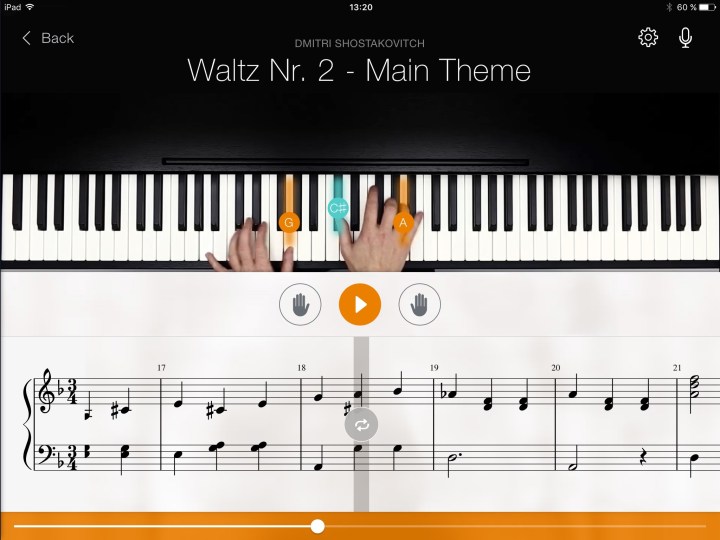
Signing up for flowkey is a quick and easy process. You answer three questions to enable the app to categorize your level of experience and create a specific learning plan just for you, and you’re all set to go. The way the app works is simple: you choose a piece of music and start learning it. “But how does that work,” you might ask, “if you have no experience reading sheet music?” Ah, not to worry: the app’s player not only shows you the sheet music that “flows” across your screen but also a bird’s-eye view of a professional pianist’s hands, playing the music. These keys are even highlighted with bright colors to make it easier to follow along visually.

flowkey-player

One very helpful feature of flowkey is that it provides you with real-time feedback while allowing you to learn at your own pace. You don’t have to be shy or embarrassed to repeat a difficult section an extra time: flowkey is a friendly piano teacher that accommodates you and adapts to your desires and wishes. Speaking of wishes, if there’s a particular song or piece of music that you’d like to learn which isn’t available in the flowkey library, you can always contact the support team to request your song wish which then gets recorded and released in one of the upcoming monthly song releases.

flowkey-songs-front-screen

The bottom line is that flowkey is a great tool for people of all ages and levels. The songs and courses are meant for both beginners and advanced piano students who can take on the challenge of learning a difficult Chopin prelude or perhaps completing the “Chords & Pop Piano” course to improve their improvisation skills. The best way to start (or continue) your musical journey and test out this revolutionary method is to try it out for yourself!

Find out more

This is a sponsored post. All information and images are supplied by flowkey


Disclaimer: The Cross-Eyed Pianist does not necessarily endorse organisations that provide sponsored posts which link to external websites, and does not endorse products or services that such organisations may offer. In addition, The Cross-Eyed Pianist does not control or guarantee the currency, accuracy, relevance, or completeness of information found on linked, external websites. However, every effort is made to ensure such information contained on this site is accurate at the time of publication.

327A2574

Who or what inspired you to pursue a career in music? 

It was my mother who first took me off to piano lessons age five although I can’t really say it was a particular calling at that age – I’m fairly sure I was going to be Prime Minister. It was not until I was a bit older and not really practising enough that my mum made me sign a contract promising that I would practise every day or the piano and the lessons would be gone! It was only then that I began to realise just what an important part of my life music was and became determined to dedicate myself to it further. Actually pursuing a career in music was never a particular ambition, however, until age 16 I was on the Chetham’s Piano Summer School and one of the professors simply said ‘why are you not here?’. Well, I didn’t have an answer so the next year I enrolled as a student and haven’t looked back since!

Who or what have been the most important influences on your musical life and career? 

I’ve been so lucky with my piano teachers over the years and they have all been hugely influential, but the person who really believed in my abilities as a pianist and really challenged me to be the best I could be, was John Railton. John was an astonishing man – with only one arm he managed to have a successful career as a pianist and conductor, recording for the BBC, conducting at the major concert halls and being the central point of many different communities music making. He had a total disregard for potential obstacles and just believed firmly that I would be a pianist – I really wouldn’t be here without him!

What have been the greatest challenges of your career so far? 

The biggest challenge for me is performance anxiety – I wouldn’t say I get crippling nerves but I have found it frustrating sometimes when I can’t achieve the same focus on the music because my mind is worrying about being worried! The challenge is to find techniques to control any anxiety and transform it from something destructive into a positive energy. As an accompanist I have also had to become very time efficient. Our job often involves learning lots of repertoire in very short periods of time and the ability to practise efficiently without getting injured is paramount.

Which performance/recordings are you most proud of?  

I recently launched the Devon Song Festival and I was so pleased with our inaugural concert. There was an unusual amount of pressure in organising the event, trying to keep the audience happy and performing but it went brilliantly and our reception was so enthusiastic. I’m so thrilled it was success and we can expand the festival next year.

Which particular works do you think you play best? 

I definitely feel most at home in the song repertoire, specifically German lieder and English song though I also love the sound world of cello and piano sonatas and am beginning to explore this further. I love playing with singers because I am able to find a deeper connection to the music when text is set. I rarely perform as a solo pianist these days but when I do it’s nearly always Russian: Rachmaninoff and Prokofiev being particular favourites!

Do you have a favourite concert venue to perform in and why? 

Last year I played at the Wigmore Hall for the first time and I absolutely loved it. It’s such an intimate space and from the piano it feels perfect as a hall for song. There is incredible clarity in the acoustic and you can really challenge yourself as to how quiet you can play and what extremes of articulation you can reach. It of course helps that the piano is absolutely beautiful too!

Favourite pieces to perform? Listen to? 

This year I’ve been working on Stephen Hough’s ‘Other Love Songs’ (for a performance at Wigmore in May 2016) and it is just the most brilliant cycle. It was written as a companion piece for the Brahms Liebeslieder waltzes and really cleverly picks up on themes from the original work but set to a wonderful selection of texts covering all forms of love and emotions from the heart-breaking to the comic. My personal highlight in the performance comes near the end where the pianists get to join in singing and my part is mostly just hitting the piano!

Who are your favourite musicians? 

I’m lucky enough to be taught by one of my favourite musicians, Eugene Asti. I have huge admiration for his attention to detail and respect for the score and the history of every work he plays. Importantly it is not only theoretical but you can really hear all that detail in his playing and it brings the music to life amazingly. Another is Iain Burnside, his playing is so robust and clear and I find his recordings of English song especially moving in their simplicity.

What do you consider to be the most important ideas and concepts to impart to aspiring musicians? 

I suppose as I’m still a student I would consider myself to be still aspiring! But I definitely think all young musicians need to think about more than just practise and performing. I’ve been working with Alisdair Hogarth recently and he has shown me the importance of being savvy when it comes to self-promotion and the commercial side of music making. He suggested that we should be spending as much time promoting performances and developing our career as we do practising. Whilst I can’t quite bring myself to do that just yet, I can see that when I leave music college, working hard to find performances and creating appealing programmes will be just as important as working on technique!

Where would you like to be in 10 years’ time? 

In ten years’ time I would like to be living in London enjoying a fledgling career as a song accompanist and working as a broadcaster for Radio 3. Basically, I would like to follow in the footsteps of Iain Burnside!

Originally from Devon, Natalie Burch initially studied with John Railton before moving to Manchester to study solo piano with Peter Lawson at Chetham’s School of Music. In 2014 she graduated with first class honors from King’s College London where she studied musicology and took lessons at the Royal Academy of Music with Daniel-Ben Pienaar and Andrew West.  Natalie is currently studying for a masters in accompaniment at the Guildhall School of Music & Drama under the tutelage of Eugene Asti and Andrew West.

Recent and future highlights include performing at the Wigmore Hall alongside Alisdair Hogarth and the Prince Consort, a new commission for the Leeds Lieder festival, rehearsal pianist for Tchaikowsky ‘Rococo Variations’ with Guy Johnston, a recital for the Elgar Society and a number of concerts and masterclasses as resident pianist for Opera Prelude.

Read more about Natalie here


My first visit to Spitalfields Music and the first time I’ve heard pianist Melvyn Tan live. More importantly, the concert included three premieres, by Rolf Hind, Judith Weir and Jonathan Dove, including a new addition to the ‘Variations for Judith’ which opened the evening.

Composed as a special gift for Judith Serota when she left the Spitalfields Festival in 2007 after nearly twenty years at the helm, the Variations comprise 11 short reflections on ‘Bist du bei mir’ (G H Stölzel arr. JS Bach, realised by David Titterington), composed by other Spitalfields Festival Artistic Directors, all people with whom Judith worked. An initial collection of seven variations was presented to Judith and a further four were added, all by composers associated with the Spitalfields Festival. The Variations hark back to a precedent probably set by J S Bach – a collection of short pieces of varying difficulty – and rather like Anna Magdalena’s Notebook, which Bach presented to his wife, the Variations for Judith were presented to Judith Serota to encourage and inspire her own piano studies.

The pieces which make up ‘Variations for Judith’ are often described as “music for amateur pianists”, and while they may be short and mostly roughly Grade 4-7 level, I would refute the suggestion that these pieces are exclusively the preserve of the amateur pianist. Nor should they be: the suite works very well as a complete concert piece. Each work is unique, portraying its composer’s distinctive compositional style and soundworld, yet they are all connected by the opening theme. In some variations the theme is obvious, in others it is fragmented or subtly veiled. The works are varied in their individual characters, some displaying sparkling wit and humour (those by Anthony Payne and Judith Weir, for example), while others are fragile, tender or lyrical (Thea Musgrave, Jonathan Dove).

home-page-title-image-final
Melvyn Tan

Pianist Melvyn Tan originally premiered the ‘Variations for Judith’ in June 2012 and he is evidently very at home with this music, adept at drawing out each variation’s individual character and alert to the swiftly changing moods of the pieces. In addition to a creating an appealingly translucent sound (helped by a beautiful Steinway D and the acoustic of the venue, St Leonard’s Church), his playing was gestural and sensitive: each miniature was elegantly shaped and coloured. The newest variation by Rolf Hind, premiered at this concert, began with a fleeting sound in the bass and stamping feet, before the main theme emerged. There were chiming bells and plangent bass chords, utilising the timbre and decay of the piano.

The Variations were followed by two more premieres of works by Judith Weir and Jonathan Dove. ‘I’ve turned the page….’ by Judith Weir was a witty musical take on the phrase “I’ve turned the page”, implying that one is start afresh, and each turn of the page in the score brought fresh ideas, from a boisterous dance (page 2) to a haunting twirling melody, then a frenetic rising figure, culminating in treble flourishes and clusters redolent of a Chopin Etude.

Jonathan Dove’s ‘Catching Fire’ was written as a birthday gift for Melvyn Tan (who turned 60 this year), a work which combines elements drawn from the toccata and perpetuum mobile genres, with passages which flicker and shimmer at the far reaches of the keyboard. At times the insistent throb of the music was almost industrial in its sound, while the clever use of repetition and pedal effects called to mind other instruments such as drums and horns rather in the manner of Somei Satoh’s atmospheric ‘Incarnation II’. Tan’s sensitive pacing, dynamic shading and colouristic nuancing ensured the work remained “musical” at all times, and the piece provided an interest complement to Liszt’s three Concert Etudes, which Tan executed with understated bravura.

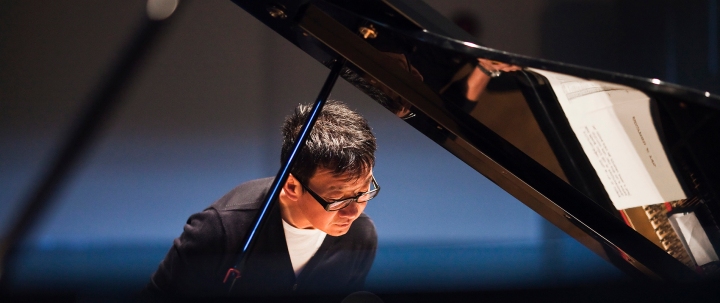
(picture of Melvyn Tan by Eoin Carey)