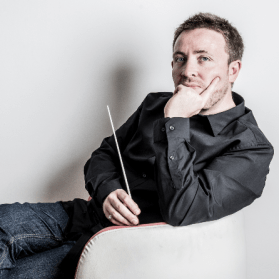
5f3e69_e385f87332164cdbbb4075d6aa12adf3Guest post by conductor and artistic director Tom Hammond

Two of my ambitions as a conductor are to maximise communication within ensembles (sounds simple, but isn’t), and to make concerto soloists feel like they are being accompanied by their own musical shadow.

If I can see the eyes, face, bows and fingers of the soloist I and the orchestra are accompanying, I can go with breath, speed of bow, a nod of a head or other subtle physical gesture… but when it’s a piano concerto, this is often impossible.

Nine times out of ten there’s no chance to see the fingers on the keyboard, I’m not close enough to hear inbreaths (which not every pianist makes audibly anyway) and if I try to lock on to eyes for an extra mode of communication – I can lose the connection with the orchestra. Basically – it’s all behind me!

In a recent performance of ‘Rhapsody in Blue’ I even had the acoustic challenge of a piano that was (on the biggest stick) projecting beautifully into the hall, but away from my ears and couldn’t necessarily hear every note. Quite scary when picking up ends of cadenzas, I can tell you….

My solution is often simply not to even try more than a little eye contact for starts and ends of movements, and then rely totally on my ears. That’s sometimes harder than it might sound, as piano concerti often contain the trickiest technical moments for conducting; bringing in a tutti or a solo instrument off the back of a cascade of rapid notes when, with a string concerto for example, you can also use visual contact as well as aural. Moments in the Rachmaninov Paganini Variations and indeed ‘Rhapsody in Blue’ can really sort the men and women from the boys and girls in conducting terms…

All this led to me wondering how pianists feel about working with orchestras and conductors, and what factors might help make a performance comfortable at the very least, and something special at best. Two pianists I am accompanying in the coming weeks – Stephen Hough and Alissa Firsova – took time out of their hectic schedules to answer a few questions.


May0031407 Stephen Hough for DT ArtStephen Hough

What worries you most before a new concerto project? Is it the instrument, the orchestra, the conductor or the piece of music?
I never worry about the instrument until I see it. But with a new piece there is the uncertainty of how it will actually sound (or rather feel) in that first rehearsal. No amount of preparation prepares you for the oboe or horn or violas coming at you from that particular angle on stage. And because a collaboration with a conductor is like a blind date well … when the mask comes off who knows what to expect!
Have you ever found the ‘perfect’ position on stage for being able to communicate with a conductor during performance? How much is eye contact desirable?
I normally have a good view of the conductor’s buttocks which doesn’t help much … No, but seriously I don’t need eye to eye contact but out of the corner of my eye I’m taking in body language all the time and at certain crucial moments THE STICK!

How much rehearsal time do you like to have?
As much as we need is nice, but not more. I don’t like thrashing the details out until everyone’s exhausted. A little spontaneity is essential. But with certain pieces decisions have to be made, especially with the great works, the Brahms and Beethoven concertos for example.

Which concerti would you like to direct from the keyboard, but have never had the chance?
I’d be curious to try the two Brahms sometime, if only to decide that it didn’t work.


5f3e69_d3be6bedc9d64af0897015aab598ebdcmv2-1Alissa Firsova

What worries you most before a new concerto project? Is it the instrument, the orchestra, the conductor or the piece of music?
“Worry” is not a feeling that comes to mind when embarking on a new concerto project, but rather “excitement”, “curiosity”, “joy” and “gratitude” for the opportunity to take on a challenge and join forces with the conductor and orchestra to explore a remarkable piece of music. However out of the 4, the greatest achievement and dedicated work lies in the process of learning the piece and trying to master it to the best possible ability. Then when meeting the conductor and orchestra for the first time, it becomes a celebration. A bit like a process of making a cake: taking good care of all the ingredients, cooking it at the right temperature and for the right amount time, and then, eating it – the party begins! What I love about musical interpretation is that it is endless. It is so interesting to be able to get to know a new conductor and their personality and see what their ideas are about the piece, when there is a chance to play though sections and explore different ideas, this is gold-dust. I think it’s always important to have an open approach, to try new things, to be flexible in being able to adapt to a different acoustic or instrument or time of day.

Have you ever found the ‘perfect’ position on stage for being able to communicate with a conductor during performance? How much is eye contact desirable?
I think it is ideal to have the opportunity for eye-contact, for those few “magic moments”. Other than that, the most important thing is the listening. When that is completely in sync and focus with everyone, then we might as well be blind-folded. But sometimes it’s nice to be able to communicate visually, to bring that other dimension and to respond to each other. I’ve always felt at home having the orchestra around me. It gives a great support and warmth, a feeling of being all in it together, and the conductor marries the soloist with the orchestra. The priceless moments are those spontaneous ones during the concert, where everyone suddenly takes time or creates a new nuance that didn’t happen in the rehearsals. Thats when you know total ‘oneness’ has been reached.

How much rehearsal time do you like to have?
Even though ideally one would like to have as much rehearsal time as possible, in order to keep trying different things and perfecting corners as well as getting used to the overall structure and pacing of the piece, it’s also important to leave room for the spontaneity and freshness for the concert. I like to have one rehearsal before the day of the concert, and one on the day, an extra rehearsal could be a bonus.

Which concerti would you like to direct from the keyboard, but have never had the chance?
 Mozart Piano Concertos No. 21 in C and No. 27 in B flat
Tom Hammond conducts piano concerti by Beethoven and Brahms, with Stephen Hough and Alissa Firsova respectively, on 18th March and 6th May. Full details here

‘Composed’ received its London premiere on 2 May 2017. The director is looking for futher London and UK screening opportunities – if you are interesting in hosting a screening, please get in touch via the contact page of this site

Performance Anxiety – for many musicians and performers it’s the fear which cannot, must not, speak its name, and together with injury and illness, it’s a major taboo. We don’t discuss anxiety because we’re not supposed to feel it. As highly trained individuals, musicians are supposed to sweep onto any stage, large or small, and perform with confidence, poise, and musical imagination, never betraying the slightest hint of nerves. As with injury, anxiety is often kept hidden and not discussed because sufferers fear (that word again) that admitting to it is a sign of weakness, technical or artistic, which may lead to loss of work and status, and the disapproval of colleagues, teachers, more senior musicians, critics and even audiences.

One of the crucial steps in coping with Performance Anxiety (and sufferers should not necessarily seek a “cure”) is accepting that it is something that happens to most performers, that it is normal, and that the physical symptoms are common to us all, driven by the body’s “flight or fight” response. ‘Composed’, an insightful new film by percussionist and film-maker John Beder, goes a long way in supporting this view, while opening up the discussion about performance anxiety in a sympathetic way.

Originally intended as a study of musicians’ use of beta blockers to subdue the symptoms of anxiety and how such drugs are perceived within the classical music community, ‘Composed’ takes a broad view, exploring the passion and motivation which drives people to become professional musicians, the root causes and symptoms of performance anxiety, the difference between practising and performing, music education, deep learning and proper preparation for auditions and performance, the fight or flight response, perfectionism and how hard musicians are on themselves. With contributions from musicians (soloists and orchestral players) and experts in the field of peak performance and performance anxiety, including Dr Noa Kageyama (creator of The Bulleproof Musician), Mike Cunningham (mind training coach), Gerald Klickstein (author of The Musician’s Way) and Professor Aaron Williamon (Professor of Performance Science at the Royal College of Music), the film offers a sensitive and honest account of the exigencies of the profession.

symptoms
(source: ‘Composed’ website)

Rather than present dry advice and one-size-fits-all coping strategies, the first-hand accounts of musicians, teachers and practitioners offer insightful personal anecdotes and solutions. The film also touches on the competitive nature of the conservatoire system, the ruthlessness of the professional career and how musicians, who tend to forge friendships and communities with others in the profession, find themselves competing with friends and respected colleagues at auditions for orchestral positions or concert bookings which can set up feelings of “inner turmoil of wanting to encourage your friends while secretly hoping the panel will favor your performance”(John Beder, film-maker). Such feelings can lead to self-doubt and anxiety.

The responsibility of teachers, mentors and institutions in supporting musicians is also explored. Until fairly recently, support for students suffering from performance anxiety was virtually non-existent in the conservatoire and music college system, except from a few enlightened tutors. Today, students have more resources at their disposal, including mindfulness and mind training, biofeedback, Alexander Technique, yoga and relaxation techniques, counsellors and hardware such as the Royal College of Music’s innovative performance simulator which allows students to perform before a virtual audience or audition panel.

There is also practical information about the physiological effects of beta blockers and commentaries by users, including a painfully honest account by a British cellist who also resorted to alcohol while still at music college to help her deal with debilitating performance anxiety.

It took John Beder two years to produce ‘Composed’. Originally, 61 musicians gave interviews for the documentary, though not all of them made the final cut, and Beder’s approaches to musicians were generally met with gratitude – “I wish we talked about this more” was a common response, proof that this is a subject musicians want to discuss in a more open forum. To hear musicians talk openly about their personal struggles, emotional limitations and coping mechanisms reminds us that we are very much not alone with our anxieties. The film is an empathetic and humane examination of the musician’s life and work, providing a greater understanding of the pressures, and pleasures, of the musical life, and is a potent reminder that musicians should “know themselves”, to appreciate their strengths and abilities, rather than continually comparing themselves to others. As such it makes an important and timely contribution to the study and understanding of performance anxiety.

“The film explores what without exception all of us, performers, have experienced and known well – first, love for our craft and stage, and then performance anxiety at the other end of this beautiful and exciting spectrum. Congratulations to the director John Beder and his team for completing this project and for inviting all of us to a meaningful and necessary conversation.”

Christoph Eschenbach, conductor

John Beder is currently looking for UK venues for future screenings of ‘Composed’. If you would like to host a screening or suggest a venue please contact John via this site or via the Composed website

‘Composed’ trailer

vhoyland-ii

Who or what inspired you to take up composing, and pursue a career in music?

Myself. But then Bernard Rands my tutor and Bill Colleran at Universal Edition (London/Vienna).

Who or what were the most significant influences on your musical life and career as a composer?

Bruno Maderna, Luciano Berio, Messiaen. Historically: J.S. Bach, Webern, and late Mahler.

What have been the greatest challenges/frustrations of your career so far?

They were the 4 major works written for the BBC Symphony Orchestra. I have at least 4 new works still waiting on first performances. But I remain patient.

What are the special challenges/pleasures of working on a commissioned piece?

Time. I work slowly and with painstaking care. My music is sometimes complex and it is crucial that performers receive as near perfect copy of performance materials as is possible. I do my best and I have a fine copyist. UE taught me this, way back in 1972.

What are the special challenges/pleasures of working with particular musicians, singers, ensembles and orchestras?

The pleasures are being there for rehearsals. Some conductors are exceptional (Sir Andrew Davis), some work seriously hard (Martyn Brabbins), others you may never wish to see again. New Music Ensembles, string quartets and solo performers have been the most satisfying to work with. Lifelong friendships are made.

Of which works are you most proud?

“WULF” for 24 voices (amplified) and 24 instrumentalists – yet to receive a first performance; “The Attraction of Opposites” for 2 pianos; the orchestral trilogy, “Vixen”, “Qibti” and Phoenix”; “Hey Presto!” written for BCMG conducted by Diego Masson, happiest of all.

How would you characterise your compositional language?

Proudly European but, like Bartok, drawing on cultures further afield and from the distant past.

How do you work?

In my music barn, composing, still, on manuscript paper. However, most work has been carried out in Sicily. The climate, the food and wines kept me going, and going well, so producing the goods. I also found plenty of time to read, to feed my imagination.

Who are your favourite musicians/composers?

Musicians such as Melinda Maxwell – oboe, Simon Limbrick – percussion, Rolf Hind – piano, BCMG, The Arditti Quartet. Composers I already listed as influential on my work. Still living? The works of Birtwistle, Ferneyhough, Tom Ades, David Sawer, Julian Anderson and Sam Hayden interest me.

What is your most memorable concert experience?

Experiences: Simon Rattle conducting all Mahler and some Messiaen with the CBSO, Symphony Hall, Birmingham.

What do you consider to be the most important ideas and concepts to impart to aspiring musicians?

Feed your imagination and let it run. I always ask myself the question “What if?” Be your own best critic and bin a lot.

Where would you like to be in 10 years’ time?

Where I am now.

What is your idea of perfect happiness?

Being with the right person and being amongst friends.

What is your most treasured possession?

It is my 40-year-old Pavoni, brass and copper, coffee machine.

What do you enjoy doing most?

Walking the hills.

What is your present state of mind?

Pensive.


Born in Yorkshire in 1945, Vic Hoyland’s earliest interests were in painting, calligraphy and architecture, but after completing an Arts degree at Hull University and a prize winning work was submitted to the BBC, he decided to concentrate on music. Wilfrid Mellers invited Vic to undertake a doctorate at the then new music department at York University where his tutors were Robert Sherlaw Johnson and Bernard Rands. From 1980-1984 he was Haywood Fellow at the Barber Institute, then after two years at York University he returned to Birmingham as a full-time lecturer responsible for MDD, an interdisciplinary programme between music, drama and dance. He was subsequently Professor in Composition at Birmingham until his retirement in 2011. In 2015 he was made Emeritus Professor, in recognition of his longstanding and valued contribution to the University of Birmingham.

Commissions have come from many festivals – Aldeburgh, Almeida, Bath, Cheltenham, Warwick and Stratford, Huddersfield, South Bank and York – from organisations such as the BBC Symphony Orchestra and ensembles such as Lontano, the Arditti Quartet, Lindsay Quartet, BCMG, Endymion and Vocem. Works prior to 1994 are held by Universal Edition (Vienna). Works after 1994 are held by Composers Edition. Works include In transit for large orchestra which, together with Vixen, was recorded by the BBC Symphony Orchestra for NMC records. Most of Vic’s music has been broadcast on BBC Radio 3. The Other Side of the Air and Token are also available on NMC records. The second work in his orchestral triptych, Qibti was premiered at the Barbican on 18 December 2003 and conducted superbly by Sir Andrew Davis.

Read more at Vic Hoyland’s website

The concert is complete, the applause is given generously. The performer bows, acknowledging the audience and their applause, and leaves the stage. The applause grows more enthusiastic and the performer returns once again to take a bow and thank the audience for their appreciation. As the performer leaves the stage again, the applause may begin to fade or increase in volume, at which point the performer will return to the stage, and a little faux-modest pantomime may ensure: “Me?”, the performer seems to indicate, “you want me to play again?”. The audience quickly settles into attentive silence and the performer returns to the piano. The first notes are heard, and you may whisper to your neighbour, asking them if they know what the piece is.

The word “encore” is French and has a variety of meanings – still, longer, yet, again, but not actually “play some more”. It entered the English language as a corruption of the Italian word “ancora” (“again”), and it was used from the early 18th century by audiences of Italian opera in London. Curiously, when French and German audiences request an encore they say “Bis” (‘twice’), which is what the Italians do as well. Encores are generally short pieces played at the end of the main concert. Many encore pieces are technically challenging and ostentatiously virtuosic, a beguiling or witty little treat tossed out to amuse and delight the audience, a final firework that sends everyone off on a high, or a calming salve after the pyrotechnics of the main programme. Encores should always feel totally spontaneous, though of course they must be practised and finessed.

“Applause is a receipt, not a bill” said the pianist Artur Schnabel, implying that no soloist should feel obliged to play an encore at the end of a concert, no matter how noisily the audience applauds, or rises to its feet. Indeed for some programmes an encore would be inappropriate. So you rarely hear an encore after a performance of the Goldberg Variations, or Beethoven’s or Schubert’s last three piano sonatas: such is the philosophy and otherworldliness of these works that to say anything else would be unbefitting. (Also, the performer is probably too tired to play anything else……)

The timing of the encore is important in creating anticipation and drama between soloist and audience. To play an encore after just one curtain call may seem a little over-eager. The pianists whom I quizzed in advance of writing this article were generally agreed that “third [curtain] call; one encore; short and scintillating” was appropriate. A further encore can be considered an additional treat, but there is nothing worse than the soloist who doggedly soldiers on and offers an encore, or encores, because they’ve prepared for it, even though the audience response does not necessarily warrant it. Most performers are generally alert to the finishing time of concerts as well, aware that some people have trains to catch, or simply want to get to the pub before closing time!

Russian pianists tend to be generous in their encores: in 2007 Evgeny Kissin famously gave not one, not two but twelve encores at his Carnegie Hall performance, tossing off piece after piece to his adoring audience. The concert finally ended at a quarter to midnight…… Grigory Sokolov is also magnanimous in rewarding his audiences with a slew of encores, including the complete Schubert ‘Moments Musicaux’ and sparkling miniatures by Jean-Philippe Rameau, as well as works by Bach, Chopin, Brahms and Scriabin.

13735_show_landscape_large_01
Evgeny Kissin
For the audience, an encore can offer a little more personal contact with the pianist. Performers are often more relaxed when they come to play an encore – the stress and strain of the main concert has passed, and they can unwind with a little bon bon of music, lightening the atmosphere for themselves and audience. Encores are often a chance to hear unfamiliar or unexpected repertoire, and a well-chosen encore can round off an evening very nicely. Some performers even specialize in encores, and build entire programmes and recordings based on them.

Amongst the most beloved piano encores are Liszt’s Transcendental and Paganini Etudes, specifically Feux-Follets and La Campanella, and not forgetting his Mephisto Waltz and Hungarian Rhapsodies, Schulz-Evier’s grandiose paraphrase of Strauss’s ‘The Beautiful Blue Danube’, Moszkowski’s exuberant Étincelles, ever-popular waltzes, impromptus, Nocturnes, Preludes and Mazurkas by Chopin, Schubert’s Impromptu in G-flat, Preludes by Rachmaninov, Debussy’s l’Isle Joyeuse, the two Arabesques and various Preludes, and etudes and paraphrases by Godowsky.

As a regular concert-goer, I’ve encountered some unusual encores, including a quotation by Horace, read by harpsichordist Mahan Esfahani after his performance of the Goldberg Variations at the 2011 BBC Proms, Dudley Moore’s ‘Colonel Bogey’ in the style of a Beethoven Sonata, played by Piers Lane at the Wigmore Hall, and described by the pianist as “a rather naughty piece!”, and at the Queen Elizabeth Hall in 2013, Polish pianist Piotr Anderszewski played Bach’s complete French Suite No. 5 as an encore. He had already played the work as part of the main programme, but he just “wanted to play it again”, and it was a truly delightful end to a very memorable concert.

Piers Lane/Dudley Moore Beethoven Sonata parody


Schulz-Evier – The Beautiful Blue Danube