The opening track of pianist Lucas Debargue’s debut album is a fleeting sonata by Scarlatti (K 208). It’s a miniature miracle of control, voicing and expression, its emotional impact helped in no small part by the pianist’s choice of tempo and tasteful use of rubato. Here and there he lingers over the more piquant harmonies or intervals, creating delicious moments of suspense and delayed gratification.

It’s a wonderful opener to a fine debut disc, and the tempo of the piece has the effect of drawing the listener in, encouraging concentrated engagement with music and performer. In a live performance, opening a concert with a slow or slower work can have a very special effect on the audience: it causes them to focus on the music, to listen intently.

Tempo can have a profound effect on the way we respond to music. Upbeat or rapid music can raise the heart rate, blood pressure and skin response, making us more excited, more alert (why else do people choose fast-paced music as the soundtrack to exercise such as running or cycling?). Conversely, slow music is often used for meditation or relaxation because it has the effect of slowing the heart rate which makes us feel more calm. Listeners, especially the non-specialist listener, will normally equate slowness in music, particularly in classical music, with seriousness or more profound emotional content, and a performer’s choice of tempo can deliberately lead the listener into a particular emotional realm.

Some well-known works now seem to come with “standardised” tempi which have been set in stone by certain performers, critics, teachers, recordings, scholars and so forth. Take the Marche Funèbre from Chopin’s Piano Sonata No 2, for example: more often than not this is played as a ponderous Lento which immediately evokes (for those of us of a certain age) the passing of Soviet leaders. It’s sombre and gloomy, but if the tempo is increased very slightly, in the right hands it becomes majestic and proud, the contrasting Trio lyrical and eloquent. Similarly, the funeral march from Beethoven’s Piano Sonata, Op 26 (which was played at Margaret Thatcher’s funeral): this is actually marked Maestoso (“majestic”) and too plodding a tempo will rob the music of its heroic grandeur (and Beethoven is quite specific in his marking in the score that this movement is a funeral march on the death of a “hero”).

I wonder whether audiences have received notions about the speed of certain works, notions which are perhaps inculcated in them by certain acclaimed pianists, critics, and benchmark recordings where a not inconsiderable “bending of the rules” of the score has taken place and a new standard way of performing the work is thus established and acknowledged by many to be the “right” way (the subject for a future article).

Perhaps one of the most extreme examples of tempo “rule bending” comes from the great Russian pianist Sviatoslav Richter in his reading of the first movement of Schubert’s G major Sonata, D894, where his interpretation of the Molto moderato tempo marking really pushes the boundaries of what is understood by the term “moderato”. Moderato usually means “not rushing or dragging” and Schubert often uses the German marking “mässig” in relation to Moderato, which implies the calm flow of a measured allegro. Coming in at 25 minutes (the length of an entire Beethoven piano sonata), Richter’s version is not rushing anywhere! For some this Moderato-verging-on-Adagio is far too slow, but there is, for me (and others), something about the concentrated, meditative yet expansive quality which Richter brings to it which convinces. Not everyone can pull it off, and most pianists prefer a walking pace moderato. In the right hands, the first subject of the movement retains some of the same qualities which Richter brings to it. Here is Sokolov, where his treatment of the dotted rhythms brings a lightness and dance-like quality to the first subject:

And here is Richter:

I’ve been pondering the nature of tempo, in particular slowness in music, as I continue to work on Schubert’s penultimate piano sonata, D959. As noted in earlier articles on this work, the second movement preoccupies pianists, scholars and audiences more than any of the other movements of the sonata. It is generally acknowledged to be the most extraordinary piece of music ever written by Schubert, and many believe it is a direct musical manifestation of his mental state and his response to his illness (advanced syphilis), with its melancholy opening and closing sections, and frenzied middle section.

In terms of its tempo, it is marked Andantino, a rather ambiguous direction: as the diminutive form of Andante, Andantino should indicate a slower tempo than Andante, but  since the 19th century it has actually came to mean the opposite. It is absolutely not the same as Adagio, which means slow and stately, yet some pianists, who shall be nameless, treat this movement of the D959 with an almost funereal slowness, perhaps in the belief that slow equals profound emotion and seriousness, thus heightening the audience’s perception of the composer’s feelings of depression, melancholy, despair, impending death etc.

By choosing to take the Andantino at a funereal tempo, I feel the pianist is at once misinterpreting the direction indicated by the composer and forcing his or her opinion of how the music should sound upon the audience, emphasising the belief that the slower the speed, the more profound the music will appear. In fact, I am not even sure this is done deliberately: the interpretation may have been handed down to that pianist from a teacher or mentor, or is an imitation of another, greater pianist’s interpretation….. But for me, the profundity and emotional depth comes not from the tempo, but from the way in which the music is structured and organised.

So how does Schubert create such extremely emotional music? First, the key of the movement is curiously alien from the first movement – and yet it shouldn’t be because it is cast in f-sharp minor, the relative minor of A Major. But the opening movement avoids proper references to this harmony except for a few places towards the end of the exposition and thus the second movement seems very remote indeed. Secondly, there is the sense of stasis which Schubert creates in the opening section. The movement begins with a poignant melody full of sighing gestures portrayed by falling seconds over a simple barcarolle-like accompaniment. The hypnotic main melody recalls ‘Der Leiermann’ from Winterreise, and an almost static quality is created in the opening section through restrained melodic repetitions within a narrow register. It feels constrained and restricted.

Daniel Barenboim has described the opening section of this movement as “a melancholy folksong”, a description which has informed my approach, and which for me suggests a lilting rather than a plodding tempo. Played well, at around 90 BPM (the speed at which I choose to play it), the lyrical melody with its sighing gestures creates a feeling of stasis and melancholy contemplation without the need for extreme slowness.

Some may argue that a faster tempo will lessen the impact of the middle section, but in my experience, as a player and listener, this is not the case. Again, it is Schubert’s careful handling of material which creates the drama. The middle section unfolds like a Baroque fantasia, improvisatory in character and growing ever more dramatic with extremely harsh modulations. The music continues to build with increasing savagery via extreme registers, the use of trills to sustain tension, and the sub-dividing of notes to create thicker textures, increased propulsion and a sense of “hysteria”. The music eventually arrives at c-sharp minor, culminating in dramatic fortissimo chords. After this climax, a recitative-like section follows, repeatedly disrupted by sforzando chords. It is as if we have run up a mountain with Schubert, stared into the abyss, and then pulled back from the edge of the cliff at the last moment. Or to have been battered by a fierce storm only to look up and see a shaft of light in the louring sky as the music settles back into the landscape of the opening.

Of course there are some very fine performances in which the performer’s choice of tempo for this movement is decidedly slow, and while these are not to my taste, I can understand why the pianist may have made that particular interpretative decision. I have compiled a playlist to offer some comparison between different performances – it is interesting to note the wide range of timings, from a mere 6:16 to 9:25. I have also included some recordings of the opening movement of Beethoven’s Piano Sonata Op 27/2 (‘Moonlight’), another work in which the choice of tempo is quite varied.

img2171sim-canetty-clarkecuratedv2
“This piano day was altogether exemplary

Sunday Times | October 2016

Charles Owen and Katya Apekisheva announce a Russian-themed programme for the second annual London Piano Festival, which runs from Thursday 5 to Sunday 8 October at Kings Place, London. The stunning line-up of pianist’s include Nelson Goerner, Ilya Itin, Lisa Smirnova, Jason Rebello, Danny Driver and Melvyn Tan. Co-Artistic Directors Owen and Apekisheva have commissioned Russian-born British composer Elena Langer to compose a new work and they perform her Kandinsky during the Two-Piano Marathon on 7 October.   Melvyn Tan gives the world premiere of a new composition by Kevin Volans.

The Festival links all aspects of the piano together, from traditional recitals to a family concert and jazz-fusion.  The inaugural festival last year was met with critical acclaim and enthusiasm from audiences in particular for the spirited Two-Piano Marathon, which saw multiple pianists grouping in different configurations with colleagues.
 
“This year’s concerts promise to build upon the excitement of the previous festival with many more superb artists, all of whom will perform music with which they feel a special affinity”
Charles Owen and Katya Apekisheva, co-Artistic Directors

On the opening night Charles Owen performs music by Brahms, Schumann-Liszt, Liszt and Wagner-Liszt, and Katya Apekisheva performs Tchaikovsky and Weinberg, followed by a second-half duo recital of Rachmaninoff’s Suite No. 2 and Borodin’s Polovtsian Dances.On Friday 6 October, Argentine pianist Nelson Goerner will give a solo recital of Chopin, Albéniz and Liszt.  Goerner states that “Chopin is one of the closest composers to my heart […] he played an important role in my destiny as a musician”.  As a contrast, Goerner has chosen to pair the Chopin Nocturnes with music by Albéniz and Liszt.

To kick off Saturday’s daytime, bite-size recitals, Austrian-Russian pianist Lisa Smirnova brings a programme of Scarlatti, Mozart and Handel to Kings Place at 11:30am.  Smirnova has chosen repertoire by Scarlatti and Handel, who she described as “two of the most amazing keyboard virtuosos of their time” and pairs them with her favourite composer, Mozart.

Melvyn Tan’s afternoon recital on 7 October is centered around the world premiere of South-African composer Kevin Volans’ L’Africaine.   Tan explains that the piece “will spike the listener with vigorous rhythms and chants from the Continent”.  Tan has paired the premiere with Weber’s Invitation to the Dance and Ravel’s Valses nobles et sentimentales and Miroirs.  

Described by the New York Times as “a brilliantly insightful pianist”, Russian pianist Ilya Itin has put together a programme of Schubert and Rachmaninoff for his afternoon recital.  As Itin states “there is an unusually grand scope and great sense of a journey into uncharted territory for both composers”, which he feels will be both challenging and rewarding for the audience.  Itin won the Leeds International Piano Competition in 1996.

For the Two-Piano Marathon, Saturday recitalists come together with Owen, Apekisheva and Danny Driver for an evening of duets in different combinations.  With a programme of John Adams, Mozart, Rachmaninoff, Ravel, Schumann, Shostakovich, Lutoslawski and the world premiere of Kandinsky by Elena Langer, the evening promises to be very special for both performers and audience alike.  Kandinsky is inspired by a selection of Kandinsky paintings to mark the centenary of the Russian Revolution (8 March – 7 November 1917). This follows last year’s commission of Nico Muhly’s Fast Patterns (watch here). The Telegraph stated that last year’s Two Piano Marathon was “a reminder of what a fabulous variety of sound can be conjured from two pianos.  

Elena Langer wrote that “Katya and Charles asked me to write a short piece for their Festival. They wanted something connected to the 1917 Revolution. I was looking at pictures by Wassily Kandinsky from the same year: colourful, bold works which are very Russian, but also strange and unique. None of them actually depicts the Revolution, as if it weren’t happening! I would like my piano piece to achieve something similar in spirit.”

Owen and Apekisheva want the Festival to appeal to piano lovers of all ages. Following the success of last year’s family concert with Noriko Ogawa, Owen, Apekshieva and Driver present a children’s programme of Poulenc’s Babar the Elephant and Prokofiev’s Peter and the Wolf, narrated by actor Simon Callow (subject to availability).

The Festival finishes with a performance by jazz-fusion artist Jason Rebello.  Rebello has explained “I like to think that when you come to hear me play, you come on a journey with me and we both arrive at a joyful place together”.  He will perform material from his recent album ‘Held’ which won the Best British Jazz Album award in 2016, in addition to music from Sting to Errol Garner and beyond.

Explore the full programme

Critics’ response to inaugural London Piano Festival in 2016

***** “A reminder of what a fabulous variety of sound can be conjured from two pianos” Ivan Hewett, The Telegraph

***** “A remarkable evening of exceptionally fine pianism and inventive programming, hugely enjoyable and highly engaging” Frances Wilson (The Cross-Eyed Pianist), Bachtrack

“This piano day was altogether exemplary” Paul Driver, The Sunday Times


[Source: Nicky Thomas Media]

Frances Wilson (AKA The Cross-Eyed Pianist) is fundraising for the British Association for Performing Arts Medicine (BAPAM), a  unique charity set up to help musicians and other performers to stay healthy.

DONATE NOW

BAPAM holds free clinics where musicians (including music teachers) can obtain a free consultation with a clinician who has an expertise in problems affecting performers. These might include, among other conditions, playing-related injuries and pain, tension, hypermobility, voice problems, performance anxiety and stress.

BAPAM’s clinicians are from a wide range of backgrounds. They include general practitioners, physiotherapists, osteopaths, psychologists, rheumatologists and orthopaedists. These practitioners have a special interest in musicians’ health and well-being and many are musicians themselves with a deep understanding of the physical and emotional demands of the musician’s life.

Frances and other musician friends and colleagues have benefitted from consultations with BAPAM’s specialist practitioners, including physiotherapists and hand specialists, in addition to attending workshops and study days on musicians’ health and well-being.

Please make a donation to enable BAPAM to continue its important work.

Thank you in advance for your support

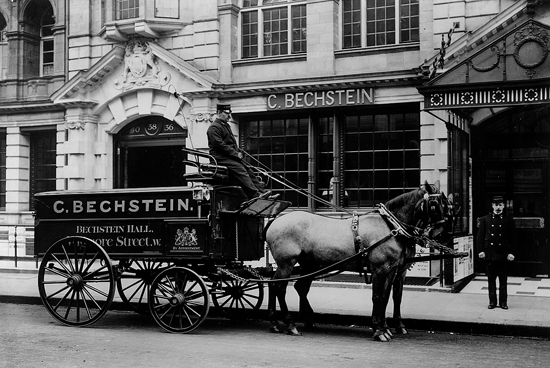
For one night only, audiences at the Wigmore Hall were treated to a glimpse of the hall’s origins, in those pre-First World War days when it was Bechstein Hall and home to the German piano maker C. Bechstein’s London showroom.

bechstein-hall

When Bechstein Hall opened in 1901, Bechstein was Europe’s leading piano maker (it produced 5000 pianos in 1901),  its instruments preferred by most pianists outside America, where Steinway predominated. The Bechstein piano company built similar concert halls in Paris and St Petersburg to showcase its instruments and the leading performers and singers of the day. With its special barrel roof “shoebox” design, beloved of many musicians, the hall still boasts a fine acoustic, while its small size (its capacity is c600 seats) makes it the perfect place to enjoy intimate chamber and piano recitals.

At the beginning of the twentieth century Bechstein Hall on London’s Wigmore Street was promoted as the best of places for intimate music making, and boasted unrivaled comfort and facilities for patrons and artists with its elegant green room up a short flight of stairs behind the stage (so that singers did not arrive on stage breathless). At the time of its opening, concert life and leisure in general in London were enjoying something of a revolution. Theatres and music halls were opening across the west end, a wide public was being introduced to the experience of shopping for pleasure in the new “department stores” (Selfridges is a mere 10 minute walk, at the most, from Wigmore Street), and with cheap and efficient public transport, it was easy for people to enjoy these delights in the centre of the metropolis. A new breed of international concert promoters, agents and impresarios, such as Robert Newman, who with conductor Henry Wood founded the world-famous Proms, were dedicated to organising high-quality recitals, and Bechstein Hall alone scheduled two hundred concerts a year.

During the First World War, it became increasingly difficult for Bechstein Hall to trade viably. Strong anti-German sentiments and the passing of the Trading with the Enemy Amendment Act 1916 led to the hall’s closure in June 1916, and all property including the concert hall and the showrooms was seized and summarily closed. The hall was sold at auction to Debenhams, was rechristened Wigmore Hall and opened under its new name in 1917. Today Wigmore Hall enjoys an international reputation for high-quality music in an elegant and intimate setting.

To give the modern audience a flavour of those halcyon pre-war days of concertising in London, the French pianist Pierre-Laurent Aimard gave a concert on an 1899 Bechstein grand piano, a piano which may well have been sold out of the Bechstein piano showroom next door to the hall on Wigmore Street.  The concert, which included music by composers active at the time when the Bechstein piano company was at the height of its powers, was preceded by a talk with Pierre-Laurent Aimard, Peter Salisbury, a leading piano technician who restored the piano, and composer Julian Anderson, whose work ‘Sensation’, written for Pierre-Laurent, had its London premiere at the concert.

As Pierre-Laurent Aimard explained, the event was the culmination of a long-held dream: to present a concert of the kind of repertoire and composers – and instrument – contemporary with the hall when it first opened. Peter Salisbury talked about the difficulties of preparing a piano for a specific hall, for each space has its own distinct acoustic and the piano must be adjusted and voiced to suit venue, performer and repertoire. When the 1899 Bechstein was brought into Wigmore Hall, Peter noted how closely instrument and venue suited each other, evidence that Bechstein built concert halls to showcase their instruments at their best – and vice versa!

Prior to the First War, piano design and manufacture was still evolving, and each make had its own distinct sound and character. Bechsteins of this period are notable for their special resonance and projection, which result from their manufacturing process. Pierre-Laurent commented on the piano’s uniquely rich palette of colour and tones, combined with great clarity. Every note seems to have “many overtones”, resulting in an orchestral sound which is rich but not cloying.

For composer Julian Anderson, the Bechstein piano has a special place in his life: his own piano is a 1913 Bechstein, passed on to him from his father, and is the instrument on which he composes. He admitted a “great affection for the Bechstein tone”, and that it has a range of colour which “encourages metaphor” and makes it easier to imagine other sounds or instruments when composing.

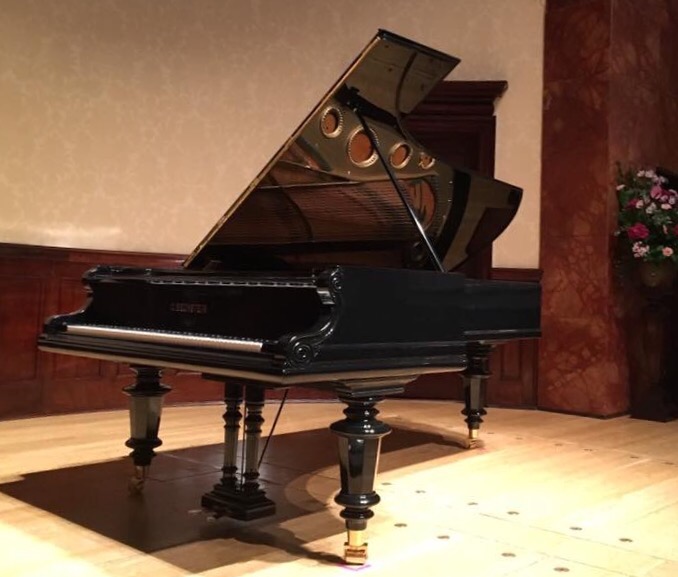
The 1899 Bechstein has been restored by Peter Salisbury and retains the original soundboard and bridge. A new mechanical action was fitted to provide technical accuracy, with new hammers voiced according to Bechstein’s original sound concert. An attractive instrument with a polished black case with scrolled details, the piano has turned legs and a fan-shaped music desk. The instrument is 275 cms (9 foot)long, with 88 notes (not all pianos were at that time – my Bechstein has 85 keys), and it took 3 months to rebuild it fully. For Peter the piano represents “a portal to the past, a lost era of tonal distinction”.

Peter Salisbury’s 1899 Bechstein concert grand on the stage at a Wigmore Hall

After 1910, piano design and manufacture became standardised across makes, and today most concert pianos (most commonly Steinway) have a consistency of sound and touch which enables performers to move fairly effortlessly between a piano in a Tokyo concert hall and one in London or New York. Concert pianos have also grown bigger to project into larger halls, and in the 10 years that I’ve been going t concerts regularly, I’ve noticed the sound of these pianos is, generally, much brighter and often quite strident.

As the owner of a 1913 Bechstein model A, I was very curious to hear this slightly older piano in a concert setting in an acoustic for which it was built. The programme included music by Liszt (the first version of Harmonies poétiques et religieuses), Scriabin and Debussy (both of whom owned Bechstein pianos), Julian Anderson (b.1967)!and Nikoly Obukhov, a colouristic Russian composer whose music bridges the Russian and French compositional traditions of the first decade of the twentieth century. The first half of the concert proceeded without interruption for applause (something with several audience members near me seemed to find quite “difficult”, though I enjoyed the flow of music from one composer to another). From the first notes of the Liszt, I felt I was hearing my own piano in concert – those distinct resonances and layers of colour which drew me to my instrument when I first played it in my tuner’s workshop were made more explicit in Pierre-Laurent’s hands. A surprisingly deep bass resonance, but clear and bell-like, without the chocolatey Sachertorte richness of a Bosendorfer, and a remarkable sustain with unexpected harmonics evident in the sound decay. In the Scriabin pieces, the piano’s multi-faceted sound came to the fore, responding perfectly to Scriabin’s sensual textures with harmonies superimposed on different registers and layered overtones.

The selection of Debussy’s Études was particularly fascinating. Here Pierre-Laurent balanced clarity with tonal sensitivity and the studies burst into to life with delightful shifting colours. The sweet lucid treble was wonderful, so different to the rather strident treble sound one finds in modern instruments, and there were further opportunities to enjoy this sound in the works by Julian Anderson and Nikolay Obukhov. Despite the piano’s resonance and sustain, there was no sense of the sound being too big or overly domineering (again an issue, for me at least, with modern concert grands in medium-sized or small venues). For me, the highlights of the evening, aside from the opportunity to hear this period piano in concert, were the works Debussy and Obukhov – had I not seen the programme, I would have thought the latter was post-Vingt Regards Messiaen, yet this was music written prior to the Russian Revolution, avant-garde and way ahead of its time.

67741286_mandatory_3340468b
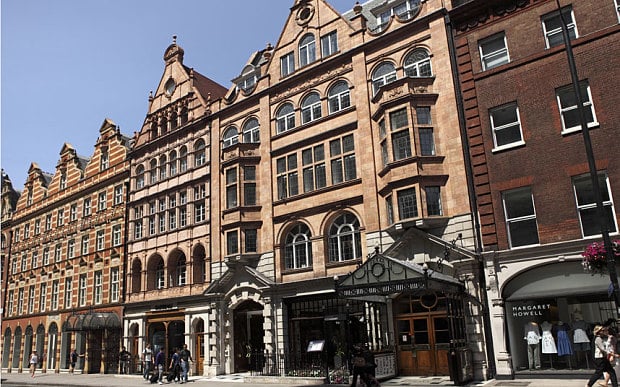
Wigmore Hall today (photo: The Telegraph)