Who or what inspired you to take up the piano and pursue a career in music?

I did not grow up in a musical family and so started playing the piano relatively late, shortly before I turned 10 years old. I was bought a battery-operated keyboard for Christmas – soon outgrown! – and was instantly gripped. I frequently had to be torn away to do my school homework. The real catalyst for my wanting to pursue a career in music was when I attended by first BBC Prom concert. I was so captivated by the atmosphere, the music, the sound of the orchestra and the grandeur of the Royal Albert Hall!

Who or what have been the most important influences on your musical life and career?

My teachers have, without a shadow of doubt, been the greatest influences on my life as a musician. My first principle piano teacher during my formative years studying at the Purcell School and RCM Junior Department (2001-2007) was Emily Jeffrey, and she has had a remarkable and sustained influence on my life and music-making ever since. Ronan O’Hora, my subsequent teacher is a musician of the highest order whose teaching balances high demand on artistic integrity with a philosophical outlook that enables the individual within to find freedom. My current professor, Eliso Virsaladze, is an extraordinary person (not least because she can demonstrate any repertoire sublimely from memory at the drop of a hat, and that she can speak ten languages fluently!). Her artistry and teaching is legendary the world over, and justly so. It is a tremendous privilege to be able to work with her.

What have been the greatest challenges of your career so far?

Maintaining the willpower to keep growing and developing all the time takes huge energy, but I suppose it gives a certain type of energy back. In real terms, I sometimes struggle with the public aspect of life as a performer – the need to be your best always, the business of “networking” and actively telling people about your work etc. It is sometimes at odds with my rather more introverted nature. Despite what people may see on the outside, or when I am on stage, I am, in principle, a private person and sensitive to my moods. Sometimes I really want to perform yet there is no concert until next week, and when there is a concert to perform, I just want to lock myself away practise late into the night by candlelight or read a wonderful book!

Which performance/recordings are you most proud of?

Certain performances stand out as more memorable and for different reasons. In 2007 I performed Rachmaninov’s 2nd Concerto with the RCM Junior Department Symphony Orchestra having won the concerto competition the year before. I would probably dislike many things about that performance were I to listen it now, but I remember feeling at the time that it really represented my work over six years with my first main teacher and was somehow my “graduating” performance. Last year I gave my second recital for the Chopin Society, that time on Chopin’s own Pleyel piano. I just felt a complete sense of abandonment of all physical or psychological inhibitions and felt so engaged with the beauty of the music on the piano Chopin himself had played. It was a magical experience. Also, my latest CD for Willowhayne Records is a source of pride, not least because it features the first recording of Thomas Adès’s Concert Paraphrase on Powder Her Face other that the composer’s own. It’s a monstrously difficult piece (he’s arranged it for two pianos in the hope of having it played more!).

Which particular works do you think you play best?

Some pieces feel as though they come so much more naturally than others. I remember when I first started studying Chopin’s Barcarolle and his Andante Spianato et grande polonaise brillante, Op. 22 they felt as though I had played them before. It usually depends on my affinity with the qualities of individual pieces and sometimes this can change from day to day. Repertoire is rather like people and friends in that sense.

How do you make your repertoire choices from season to season?

Mostly this would be wish lists, but I try to find interesting themes, or tailor programmes to suit the requirements of certain organisations. I think being flexible and open to discovery is really important.

Do you have a favourite concert venue to perform in and why?

I have been fortunate to have played in some really amazing halls, but the Brahms-Saal of the Musikverein in Vienna and the Philharmonie in Cologne were among the most heavenly experiences. Aesthetic beauty and superb acoustic made them particularly effortless joys. For a pianist, the instrument is every bit as important and, when I was on my ECHO Rising Stars tour, Kawai supplied me with a Shigeru Kawai concert grand (which I had chosen in Germany the year before) and a master piano artisan technician for the concerts. With every venue I could walk out on stage with absolute trust that the instrument would not only respond to my every demand but inspire me further still.

Who are your favourite musicians?

There are too many! At least among the living pianists I would include (in no particular order) Martha Argerich, Richard Goode, Eliso Virsaladze, Vladimir Ashkenazy and Radu Lupu. If I were to talk singers, string players, conductors we’d be here forever! However, I could not fail to mention the likes of Arthur Rubinstein, Cortot, Arrau, Richter, Clara Haskil from the past, however…

What is your most memorable concert experience?

Purely for the fun of it: when the pedal lyre fell off altogether during a Tchaikovsky Concerto and another time when the fire alarm went off during my encore after a Chopin Concerto in Germany. When I played in the same hall the following season I just had to play the same encore to finish it!

As a musician, what is your definition of success?

Better for other people to decide!

What do you consider to be the most important ideas and concepts to impart to aspiring musicians?

Also a difficult question to find a suitable response to, because everybody needs different advice to follow their own unique path. The most important thing may be to have the courage to keep searching for the truth in the music, whatever that may be. Keep your integrity as high as you can, but be flexible and open to discover. Never imitate anyone, least of all yourself. Read lots of books and see as many great paintings as you possibly can!

Ashley Fripp’s CD of music by J S Bach, Ades and Chopin is available now on the Willowhayne Records label.


British pianist Ashley Fripp frequently appears as solo recitalist, chamber musician and concerto soloist in many of the world’s most prestigious concert halls, having performed extensively throughout Europe, North America, Africa, Asia and Australia. Recent international highlights include the Carnegie Hall (New York), Musikverein (Vienna), Concertgebouw (Amsterdam), the Philharmonie halls of Cologne, Paris, Luxembourg and Warsaw, the Bozar (Brussels), Festspielhaus Baden-Baden, the Royal Festival, Barbican and Wigmore Halls (London), the Megaron (Athens), Konserthuset (Stockholm) and the Gulbenkian Auditorium (Lisbon).

Read more

The Leeds International Piano Competition has announced the five pianists who have made it through to the Finals of the world-famous Competition this weekend.  Each Finalist plays a concerto with the Hallé conducted by Edward Gardner at Leeds Town Hall, broadcast live by BBC Radio 3 and medici.tv.

They are:

Aljoša Jurinić (Croatia, aged 29).

He will play Mozart Piano Concerto in C minor, K491 (Friday 14 September, 7pm)

Anna Geniushene (Russia, aged 27).

She will play Prokofiev Piano Concerto No.3 in C major, Op.26 (Friday 14 September, 7.50pm)

Mario Häring (Germany, aged 28)

He will play Beethoven Piano Concerto No. 1 in C major, Op. 15 (Friday 14 September, 9pm)

Eric Lu (USA, aged 20)

He will play Beethoven Piano Concerto No.4 in G, Op.58 (Saturday 15 September, 7.50pm)

Xinyuan Wang (China, aged 23)

He will play Schumann Piano Concerto in A minor, Op.54 (Saturday 15 September, 7pm)

Meet all five competitors here

All performances will be live-streamed via MediciTV

The prize winners will be announced at 9pm and presentations made by Lang Lang at 9pm on Saturday 15 September.

This slideshow requires JavaScript.

The Competition began in April, with 68 pianists of the world’s best young pianists, aged between 20 and 29 years old, with international First Rounds in Berlin, Singapore and New York. The five Finalists were chosen from among the 24 who have been participating in Leeds since 6 September.

They are competing not just for generous cash prizes, worth over £90,000, but for a career-changing prize package which has redefined what a competition can offer young artists, and which has helped to attract young international pianists of the very highest calibre promising a thrilling Competition.

The portfolio prize includes artistic management with Askonas Holt, one of the world’s most renowned music management agencies; concerts and engagements with some of the world’s premiere venues and orchestras, including London’s Wigmore Hall and Southbank Centre, the Hallé, Royal Liverpool Philharmonic and Oslo Philharmonic Orchestras; concert and recording engagements with BBC Radio 3, broadcast partner of The Leeds. It also includes a major European tour organised with partners Steinway & Sons; a solo CD with a major label; a programme of recital engagements in Yorkshire and other UK venues; and mentoring from Co-Artistic Director Paul Lewis, Patron Murray Perahia and other members of the performer-led jury, chaired by Paul Lewis, and comprising Sa Chen, Imogen Cooper, Adam Gatehouse, Henning Kraggerud, Thomas Larcher, Gillian Moore, Lars Vogt and Shai Wosner.

www.leedspiano.com

@leedspiano


source: Albion Media

A conversation with Jon Jacob…..

I love the opportunity for interesting interactions and conversations which social media creates, and I have made a number of significant friends in real life through the blogosphere. One is Jon Jacob, a fellow classical music devotee and blogger, and very much a kindred spirit.

We have enjoyed a number of joint projects over the past year, including two podcasts (the most recent with Adam Gatehouse, joint Artistic Director of the Leeds Piano Competition) and our latest – a conversation (by email) ahead of the finals of the Leeds Piano Competition which you can read here on Jon’s blog.

Jon will be attending the Leeds competition finals (sadly, I can’t make it) so do look out for his bulletins via Twitter and follow the competition updates with the hashtag #LeedsPiano2018.

All the performances are being live-streamed by MediciTV – a very welcome innovation as part of the revamped Leeds Competition coverage.


Podcast with Adam Gatehouse

Podcast with composer Thomas Hewitt Jones

I am continually impressed and inspired, and occasionally truly humbled, by the passion and commitment of adult amateur pianists, and in the last month this has been brought home to me powerfully yet again, first at Chetham’s (“Chets”) Summer School for Pianists (read more here) and then on Friday evening at the monthly gathering of the London Piano Meetup Group (LPMG).

Although I work in music, I do not regard myself as a “professional” pianist and I am also quite comfortable now with the title “amateur”. While some may think this means “cack-handed hobbyist” or “Sunday pianist”, I prefer the French definition of the word: “one who loves” because all the amateur pianists I know absolutely adore the piano, myself included.

I co-founded the LPMG in 2013, in part as an opportunity to meet other like-minded people. Playing the piano can be a lonely activity and while many of us enjoy the solitude, the special time with the instrument and its literature, it is also very helpful to meet and talk to other pianists. At the time, I had been playing seriously for about 6 years (having returned to the piano after an absence of 20 years), and had been taking lessons with a concert pianist and teacher in one of London’s leading conservatoires for 5 years. I didn’t know any other pianists, apart from the handful of people I encountered fleetingly through my teacher’s courses. The LPMG filled a big gap in my pianistic life – and I know it has done the same for many others whom I meet through the group. It has also inspired the formation of several other meetups and piano clubs in the UK and beyond: in 2015 our London group had a joint meetup with the Vienna piano meetup group in the city of Mozart, Beethoven and Schubert – a very special experience indeed.

Through the LPMG I have made a number very good friends and connections, while the activities of the group have extended to include workshops and events such as the annual Diploma Day with the very popular and highly skilled teacher Graham Fitch, all of which are designed to support and encourage adult pianists.

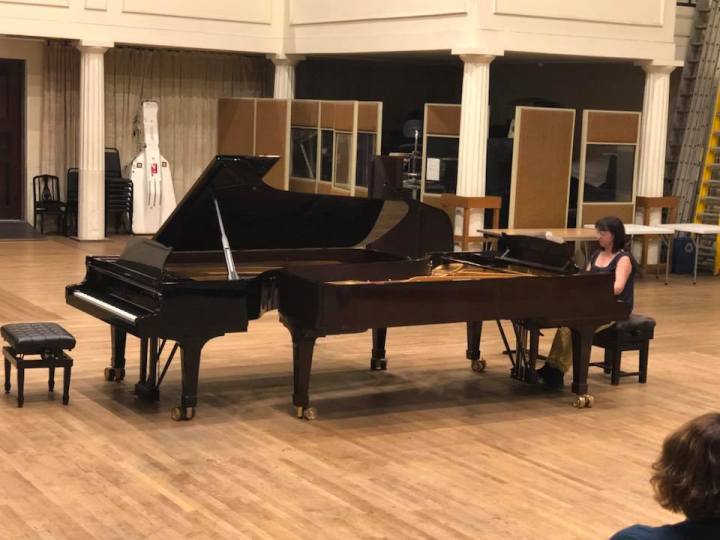
Now run by my piano friends Claire and Rob (whom I met through the group), the LPMG hosts monthly performance events for adult pianists in London venues with good grand pianos. Many amateur pianists aspire to own a really beautiful instrument but cannot afford to do so, or are constrained by space in their home. To have the opportunity to play a really splendid instrument, such as the two expertly-maintained Steinway Ds at Henry Wood Hall, where we met last Friday, is a real treat and a chance to experience the capabilities of a big piano.

41205899_10214792590940719_8666666862802632704_n
Marie playing music by Billy Mayerl at Henry Wood Hall (photo by Iain Gordon who looks after the two Steinways there)

LPMG performance platforms are social events too and always finish in a local pub or wine bar where much “piano chat” takes place – people congratulate one another on their performances, discuss repertoire and the exigencies of fitting practising into one’s working life, courses, concerts we have enjoyed, professional pianists we admire, and much much more…. We come from many different walks of life – the group includes several medics, a mathematician, an accountant, a video games designer – but we all have a common interest and we know that no one is going to roll their eyes or yawn if you start enthusing about Beethoven’s last sonatas or the beauties and intricacies of Chopin’s Fourth Ballade. This sense of a “piano community” with a shared passion is incredibly important.

When it comes to performing, which is primarily what the group is for, we have players of all ages and abilities. Some have had a formal musical training but chose a different career path, others are self-taught. Some have played all their life, others, like me, have returned to the piano after a break. None of that really matters – because we all adore the piano. I have met a number of professional pianists who envy the passion of the amateur – we can choose what we play and when, and we don’t have to make a living from it. It gives us great freedom, and hours and hours of pleasure.

Many LPMG participants are self-effacing and modest: uncertain of their abilities or anxious about playing for others, performances may be prefaced by self-deprecating comments or throwaway asides about what the audience can expect – “It’s work in progress”, “I haven’t been learning this very long”, “We only rehearsed this together yesterday afternoon!”, “It’ll probably all go wrong!”. Everyone at Meetup appreciates the feelings of inadequacy or exposure when playing for others – we all experience this to a greater or lesser degree, and playing to a roomful of other pianists can be both highly stressful and also extremely supportive. I tend towards the latter when I play at Meetups – we all understand how hard it is and appreciate the effort and hours required to bring the music to a certain standard.

After the performances, people are generous with their praise – “I loved your piece!”, “You played so well”, “I really enjoyed your Debussy!” – and this too is an important part of the group’s ethos.

To conclude, I’d like to offer some advice to anyone who feels anxious about performing in front of others:

  • Don’t pre-empt your performance with a negative comment, such as “It will probably all go wrong”. This immediately prompts a negative mindset, making you more vulnerable to nerves. It also makes the audience more anxious!
  • Instead, go to the piano and take a few moments to think yourself into the music. Hear the opening phrase in your head and imagine playing it. Don’t rush to begin. Remind yourself that you have done your practising and you are well-prepared – see below
  • Bring music to performance events which is well-learnt and about which you feel pretty confident. Good preparation through consistent, intelligent practise is more likely to lead to a successful performance, and if you are well prepared you are less likely to be derailed by errors or slips. The Russian pianist Vladimir Horowitz used to say, before a concert, “I know my pieces” meaning he had done the right kind of practising and preparation – it’s a good mantra to follow!
  • Remember these events are non-competitive and no one is judging you.
  • Above all, enjoy yourself!

Performance, like the piano itself, can – and should – be practised. The more times you perform, the “easier” it becomes, so take every opportunity you can to play for others, from a few family and friends at home to events like Meetups. Reaching a state of “acceptance” about performance anxiety can go a long way to relieving and coping with the symptoms. And remember that it’s a normal human response – the pros get it too!

