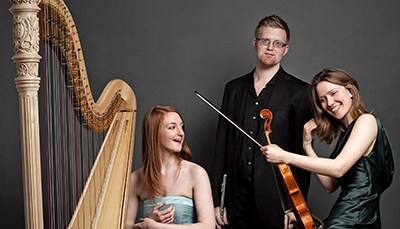
Trio-Anima-2-sized

Trio Anima are Rosalind Ventris (viola), Anneke Hodnett (harp) and Matthew Featherstone (flute)

Who or what inspired you to pursue a career in music?

Rosie: Some of my earliest memories are of my mum, a keen amateur musician, having piano lessons at home and her friends coming round to play chamber music. I was really lucky to grow up in this environment where enjoying music at home with friends just seemed the thing to do and I had really amazingly supportive parents. My father absolutely loved listening to music so both of them were really passionate about classical music, and it was always in the house.

Originally I wanted to play the harp, but I am forever grateful that my parents said they weren’t lugging a harp around after me! Now I get to listen to Anneke playing all the time which is the ideal situation for a one-time wannabe harpist! I started playing the violin when I was seven and was inspired to take up the viola from going to the late John White’s Viola Days in Harlow, Essex, not far from where I grew up. I was a proper little viola nerd! Listening to Lionel Tertis’s recordings had a huge influence on me too – as they still do to-day.

Matthew: One of my dad’s friends was a flautist and after one of his concert I attended when I was 5 years old, I said to my parents that I wanted to play the flute. My parents struggled to find a flute teacher in France who would take me on. I remember going for a lesson with a teacher who insisted I was too young to play the flute and shoud learn the recorder. I was utterly unimpressed and threw a tantrum saying ‘no, I want to play the flute!!’ I was clearly opinionated from a young age, but eventually found a fabulous flute teacher and the rest is history.

Anneke: Growing up in Limerick Ireland, my family would go to the local food market every Saturday. When I was 8, my parents suggested that I take up an instrument. Around that time there was a lady who played folk harp every week in the market. I vividly remember being drawn to the sound week after week, and finally going up to my mum (who was buying potatoes!) to ask whether I could play the harp. She said yes, and almost as soon as I started playing, I knew that I wanted to do it for the rest of my life.

Who or what have been the most important influences on your musical life and career?

We all agree that are are most important influences have been our teachers and mentors, who have inspired and moulded us as musicians. Having been a trio for almost fourteen years it is also fair to say that we have also been shaped by each other! (Matthew and Anneke have been working together since they were students at the Guildhall School of Music & Drama, with Rosie joining in 2012.) With instruments as diverse as this we come from different perspectives and sound worlds, which always keeps things fresh. We trust and challenge each other in equal measure.

What have been the greatest challenges of your career so far?

As you grow in the profession different challenges arise at different points. Now, one of the biggest challenges has been planning our diaries together well in advance to rehearse. We’ve just solved this in part now that Rosie and Anneke live two roads away from each other in East London! As principal flute of BBCNOW, Matthew is of course based in Cardiff. We each individually what might be called ‘portfolio’ careers: Matthew also teaches at the Royal Welsh College of Music & Drama, and is releasing his first EP as a jazz vocalist and composer. Anneke plays for all the main London orchestras and abroad, and teaches at the Junior Guildhall. Rosie has a busy freelance career as a soloist and chamber musician, which she combines with teaching at the Royal Irish Academy of Music in Dublin and as a British Library Edison Fellow and occasional writer.

Which performance/recordings are you most proud of?

We loved playing at Conway Hall a couple of years ago. It was the culmination of a long project contrasting music from the Belle Époque with that written during the First World War. It was a poignant and moving experience for us to do this a hundred years after the Great War. We were delighted by this review from Robert Hugill.

Which particular works do you think you play best?

As a flute, viola and harp trio, we have a natural affinity for French music, which works particularly well for our instrumental combination. Last year, with the centenary of Debussy’s death, we really enjoyed exploring a programme based around his life and influences. We also really relish the challenge of contemporary music and have recently been working on quite a few new modern works. We are very excited to premiere our commission from composer Rory Boyle this year at St John’s Smith Square, London.

How do you make your repertoire choices from season to season?

We love putting together programmes around a particular theme, interest or concept. Usually inspiration starts from one piece of music that has a particular resonance for us or for that particular year or venue. The challenge is sometimes balancing this with specific requests from venues. This instrumental combination offers so many opportunities for innovative and thought-provoking programming. Some of our most popular pieces are actually arrangements of works originally written for other instruments (for instance, adaptations of Baroque trio sonatas can work wonderfully). Having said this, in many of our concerts we will include the Debussy Sonate as it is an undisputed masterpiece and something we love to play.

Do you have a favourite concert venue to perform in and why?

As three very different instruments it’s always interesting turning up in a new hall and finding out how to play in the acoustic. For this intimate chamber group we always love giving concerts at people’s homes and playing in the Hall of Champs Hill was a wonderful combination of performing in lovely hall which is also a homely, intimate space.

Who are your favourite musicians?

Rosie: As a trio we will always be grateful to Dubois who (as far as we know) was the first to write for this combination and of course, Debussy!

Trio Anima performing Dubois Terzettino in 2014

Matthew: I love listening to singers because I think the most expressive instrument is the voice. Cecilia Bartolli is a regular source of inspiration. In another genre, Stevie Wonder is obviously a personal favourite!

Anneke: That’s an impossible question to answer! However, I would say that among the many musicians I admire, I would have to mention Matthew and Rosie! I think that music is very personal, and if you find other musicians you love playing with it can provide so much inspiration and motivation.

What is your most memorable concert experience?

Well, in terms of memorable for all the wrong reasons we once arrived at a venue after several hours of driving and begin rehearsing when the electricity went down! Very sadly the concert had to be cancelled. This was unfortunately followed by deadlock on the M1! In total we were in the car for about eleven hours and didn’t get to play together! It was the worst!

As a musician, what is your definition of success?

Rosie: Connecting to people through music.

Matthew: I think when your enjoyment of music making and the musician lifestyle is balanced with fulfilment in your personal life, and you feel like you’re touching people with what you do.

Anneke: Being able to be in the moment and convey what you want to express through the music.

What do you consider to be the most important ideas and concepts to impart to aspiring musicians?

Start by knowing the WHOLE score (not just your own part) and immerse yourself in the style of that era. Sing, dance, make up a story, use you imagination when working or practising. Prepare well in advance! Don’t be afraid to put yourself out there. For every success you are going to get many many rejections – be strong and have faith in what you’re doing! Meditation and yoga are brilliant!

Working hard. In lots of ways! As you go through music college, the most important thing is to practice as much as you can, and to take inspiration and ideas from everyone who is of-fering them to you. As you go into the profession, you need to take some of your practice time and turn it into “making it happen” time.

What is your idea of perfect happiness?

We are all big fans of food so probably playing a nice concert of some of our favourite repertoire followed by an amazing meal with our spouses, friends and family.


Trio Anima was formed in 2006 at the Guildhall School of Music and Drama. For the past decade, they have been delighting audiences with their distinctive combination of flute, viola and harp. The trio won the Elias Fawcett Award for Outstanding Chamber Ensemble at the 2012 Royal Overseas League Competition & First Prize at the Camac Harps Chamber Ensemble Competition in 2007. They have been Live Music Now Artists, and were awarded a Chamber Music Fellowship at the Guildhall School of Music & Drama in 2011. In 2017 they were selected as Kirckman Concert Society Artists.


Read more

Who or what inspired you to take up piano and pursue a career in music?

Growing up, I was an avid collector of records (even cassettes, as they existed then!). I remember the first time listening to the Rachmaninoff concerti, and falling in love with the monumental scale of the music. I was also extremely fortunate to have an inspirational mentor during my early study – Emily Jeffrey, who made it possible for me to have a career.

Who or what were the most important influences on your musical life and career?

First, my teachers have been hugely important: Emily Jeffrey, as I already mentioned, and then Ronan O’Hora. I feel very lucky that both teachers allowed me to develop my own ideas. Masterclasses and performances with some wonderful masters have also been influential – in particular Richard Goode, Stephen Kovacevich, and Diego Masson. My family have also been incredibly supportive.

What have been the greatest challenges of your career so far?

I think it is the things that affects most musicians – having to learn a great deal of repertoire at short notice, keeping your artistic integrity at the forefront, and finding time to deal with the business side of the career. On a side note, learning statistics for my doctorate (examining musical memorisation) was perhaps the most unusual challenge!

Which performance/recordings are you most proud of?

I hope that all of my performances have some kind of meaning or importance. There are a few that stand out. Performing recitals on consecutive days (with different programmes!) at the Barbican and Royal Festival Hall was an exhilarating – and exhausting – experience. At the end of my postgraduate study I also performed Messiaen’s vast tone poem Des Canyons aux Etoiles with the Guildhall Sinfonia in Milton Court – an absolute privilege!

My debut album is available now, featuring the solo works of Boulez, Dutilleux and Messiaen. It’s an exciting project supported by the City Music Foundation.

Which particular works do you think you perform best?

I have an affinity for French 20th-century repertoire: Boulez Notations, Messiaen Des Canyons aux Etoiles, Dutilleux Sonata. Beethoven Sonatas are also the works I return to the most. Variety is important!

How do you make your repertoire choices from season to season?

There’s so much to choose! I generally try to pick one big work and try to build something interesting around it, often combining with some contemporary repertoire. Next up is Beethoven Op. 110.

Do you have a favourite concert venue to perform in and why?

I’m very fond of Milton Court – as it feels sort of like a second home from my study at Guildhall. The Bridgewater Hall and Wigmore Hall also.

Who are your favourite musicians?

Richard Goode, Pierre-Laurent Aimard, Oliver Knussen, Paul Simon

What is your most memorable concert experience?

Performing Stravinsky’s Les Noces in a huge barn in France with some wonderful colleagues stands out. It was so cold that everyone had to wear thick coats, and there was grain and machinery everywhere. Despite this, it was a great concert!

From a listener’s perspective, Pierre-Laurent Aimard’s performance of Messiaen’s Vingt Regards at Milton Court in 2016 was indescribable.

What do you consider to be the most important ideas and concepts to impart to aspiring musicians?

Be comfortable in your own skin, and keep learning!

What is your most treasured possession?

Friends and family.


Praised as a pianist of “huge intensity” (The Telegraph), Alexander Soares is developing a reputation as an artist of formidable technique and virtuosity, with performances of “diamond clarity and authority” (BBC Radio 3 ‘In Tune’). In 2015, his performance in the BBCSO / BBC Radio 3 ‘Boulez at 90’ celebrations received widespread critical acclaim in the press, described as a “brilliantly unbuttoned account” (The Sunday Times) and “most memorable of all” (The Financial Times). The 2014-15 season began with a BBC Radio 3 broadcast of the rarely heard piano repertoire of John Tavener, and included Alexander’s debuts at the Queen Elizabeth Hall and the Edinburgh Festival Fringe, the latter performance applauded for its “explosive sound world, pulling out a rich array of colour and texture” (The Herald). He was awarded 1st prize and Gold Medal in the prestigious Royal Overseas League Competition, and was subsequently selected as a 2015 Artist by City Music Foundation. 2016-17 highlights include returns to Wigmore Hall, St-Martin-in-the-fields, St. James’s Piccadilly, and Alexander’s debut in the USA.

Contemporary French repertoire forms a major part of Alexander’s programming. Since a U.K. première of Tristan Murail’s work in the BBCSO Total Immersion series, he has performed this repertoire in his debut recitals in the Royal Festival Hall, the Purcell Room, and the Bridgewater Hall. In 2014, he collaborated with Diego Masson performing Messiaen’s Des Canyons aux Étoiles in Milton Court Concert Hall. The following year, he performed Boulez’s Dérive with David Corkhill in LSO St. Luke’s. He worked with the renowned recording producer Andrew Keener to record his debut album of solo works by Boulez, Dutilleux and Messiaen.

A keen chamber musician, Alexander has performed on numerous occasions in the Barbican, working with notable artists such as Boris Brovtsyn and Alexander Baillie. Collaborating with violinist Mihaela Martin, he debuted in Spain at the Palacio de Festivales, Sala Argenta. He has also toured France, in venues including Auditorium St. Germain and Opéra Rouen, performing Stravinsky’s Les Noces on Pleyel’s original double grand pianos, manufactured in the late nineteenth century. Alexander has greatly benefitted from the guidance of pianists including Richard Goode, Stephen Kovacevich, Stephen Hough, and Steven Osborne.

Alexander graduated with first class honours from Clare College, University of Cambridge. He then pursued postgraduate studies with Ronan O’Hora at the Guildhall School of Music & Drama, achieving a Master’s with Distinction. In 2015 he completed a doctorate investigating memorisation strategies for contemporary piano repertoire, under the supervision of Professor Daniel Leech-Wilkinson. He is most grateful for generous support from the Guildhall School Trust, Help Musicians UK, Countess of Munster Trust, Martin Musical Scholarship Foundation, Park Lane Group and Making Music. 

www.alexander-soares.com

I recently heard a performance of Schubert’s penultimate piano sonata, D959, a work with which I spent three years in preparation for a fellowship diploma in piano performance which I took back in 2016. The experience of learning such a large work and to a very high level of competency and artistry was an interesting, rewarding and occasionally frustrating experience during which I learnt a great deal about the practice of practising, the art and craft of performance, and how to take ownership of a piece of music and make it mine – an important consideration for any performer. During the preparation for the diploma recital, I grew to love the music and regard it as “my” sonata, even when I heard other people playing it – pianists who had clearly made it their own and whose sense of ownership was clear in their presentation of the music. Despite not having gone near the music for two years, it is still “my” sonata.

I didn’t pass the diploma, and on reflection I didn’t deserve to pass it because a number of things were not right in the lead up to the recital and on the day – things which I should have taken care of, given I had already taken two other diplomas. Facing up to failure is not a particularly pleasant experience but it is important that one reflects on that failure and to try and learn from it. The most uncomfortable issue was accepting that my ego had got in the way. I do not regard myself as a particularly egocentric person, but one does need a degree of ego to commit to a large project like this and also to push one out onto the stage to actually perform the music (at which point the ego needs to be put away). Unfortunately, my ego got in the way throughout the learning process as well as on the day of the recital: having passed two previous performance diplomas with Distinction, I told myself (and others) that the Fellowship diploma was well within my grasp. In addition, I decided I would take the diploma in my 50th year. It seemed significant, and I felt I needed to prove something – that I was “good enough”, and that it was possible to return to the piano after an absence of some 20 years and play/perform at a high level.

The diploma result was bruising – to my ego, and my confidence and self-esteem as a pianist, which I felt had been hard won, having come back to the piano after such a long time away from it. Although I tried to revisit the sonata and even considered retaking the diploma, it was too caught up with all the unpleasant negative feelings associated with my failure. Despite kind and supportive words from family, friends, teacher and mentors, I was hurt and angry by the result, particularly some of the examiners’ comments, and it took me a long time to process the experience and draw positives from it. I consigned the score of the sonata – or rather scores because I had not only a working score but several other copies – to the back of my bookcase and vowed I would never touch it again….

But things can change, and the passage of time has allowed me to put some distance between the diploma result and my emotions. Hearing the Sonata again reminded me of how much I like it, and during the performance I kept thinking how I would approach this or that phrase or passage. There were moments when I thought “I like this, but I prefer my version” (a sign I still “owned” the music), but I also heard the work afresh: new details were revealed – a little inner melody here, the articulation of a particular passage there – and a few days after the concert, I got out my score of the Schubert sonata and put it on the music desk of my piano. The next day I played the entire sonata from start to finish (including the exposition repeat in the first movement). There were rocky places, of course, but it was encouraging to find that much of the music was still “in the fingers”.

How often do we set aside a piece of music and swear we will never return to it? Fairly frequently, I should think, perhaps more so amongst amateur musicians than professionals who may need to keep certain repertoire going. An unpleasant experience – a bad exam result or unhappy performance – can colour our attitude to certain pieces of music. When I was learning the piano as a child and teenager there were pieces which I simply disliked and never wanted to play again (an important note for teachers to ensure their students, whatever their age, are playing music they enjoy to keep them engaged and motivated).

Returning to a previously-learnt piece of music can be like reacquainting oneself with an old friend – and I certainly feel this with the Schubert sonata. Picking up a piece again after a long absence can be extremely satisfying and often offers new insights into that work, revealing details, layers and subtleties one may not have spotted the first time round. One also recalls all the things one liked about the music and why one selected it in the first place.

Another important aspect is acknowledging that a work can never truly be considered “finished”. Young or inexperienced musicians often think that a learnt piece is finished and are keen to move on to the next one. A satisfying performance of a work to which one has devoted many hours of study can be said to put the work ‘to bed’, but only for the time being. This process of “continuing” and “returning” means that each performance informs the next, and all one’s practising and playing is connected in one continuous stream of music-making.

And what of the Schubert sonata? I have been playing it regularly, and working on it seriously again. It’s satisfying and revealing, and playing it afresh has largely erased the uncomfortable feelings associated with failing the diploma. That I can get around the music, play it well, and convincingly, is extremely gratifying – a reminder of how much good, careful and deep practise I did when I originally learnt the work, work which has not been wasted, nor was thrown away in the moments when I received the diploma result. An important lesson in learning is knowing that everything we do has value, that it is part of an aggregation of gains which cannot be taken away. Those of us who acknowledge this are on a path to self-determination and fulfillment which allows us to move towards a goal which is imperative for any musician – autonomy. It requires an open-minded, ever-curious, spontaneous and mindful approach to the task in hand and a willingness to embrace setbacks and cul-de-sacs along the way.

Will I retake the Diploma? It’s unlikely, though some have encouraged me to re-attempt it. Having given myself plenty of time to reflect and move on, I realise that I do not need to prove anything to anyone but myself, and that competitiveness needs to be tempered by pleasure in learning and music making rather than constantly seeking the outward trappings of success and progress.

hammershoi_interior_with_woman_at_piano_0

Guest post by Rhonda Rizzo

It’s an average practice day and I’m at the piano—just me and the score—and I’m staring into the unforgiving mirror that is making art. I say unforgiving because every musical wart, every lazy line, every single inadequacy is reflected right back to me in the way I play or don’t play each phrase. I once had a trained psychologist as a piano student. After three months of lessons, she told me playing the piano is harder than being in therapy.

Practicing is hard work. Performing is hard work. Creating art is hard work. I know of very few professions where you’re required to search your soul every single time you do your job. And then there are the outside critics—the former teachers who’s voices still sound in our heads, the critics, the Classical “high temple” or “museum” that fills performers with “should” and “have-to” and “only-one-right-way” judgments that further complicate the process of making music. It’s a wonder so many of us bother to go to work every day.

And yet, along with thousands of fellow musicians, I keep returning to the piano and to the music that challenges every part of my intellect, instinct, training, and skill. I do it because it’s oxygen for me. I do it because it’s something that I can never conquer because at this stage of my life, conquering the piano means conquering myself. I do it because the music has so much to say to me and I humbly believe that I may have something of my own to say through the music I’m privileged to play.

Don’t expect applause. It’s what I’ve learned from years of trying to please all of the people all of the time. I’ve never been able to please everyone and I never will. One of the gifts of being a “musician-of-a-certain-age” is that I no longer expect that I can please everyone. Of course, that’s what I think on my more enlightened days. The not-so-fun days are the ones where every negative review, every criticism, every botched performance comes back and settles on the piano bench next to me, howling my failures in my ear like a bunch of harpies. Those are the days I have to remind myself: don’t expect applause.

Not expecting applause is a gift you give yourself. For me, it’s given me the freedom to survive failure. Surviving failure gave me the freedom and strength to simply disregard the judgment of naysayers because I know failure won’t break me. Knowing this gave me permission to trust my musical instincts and my own voice.

Not expecting applause has made me a more confident performer because I’m not thinking “please like me, please like me” every time I step on stage. I play. I do my best to communicate the music. I play some parts well. I smudge some bits here or there. Maybe I have one of those magical nights when the audience is breathing every note of the piece with me. Maybe it’s the “gig from Hell” where anything and everything that can go wrong does go wrong. Either way, when I don’t expect applause, I’m less tossed around emotionally by the highs of a great performance or the lows of a bad.

Don’t expect applause. When I take my own advice, I’m free to disregard the ill-fitting interpretations of others and find my own custom-made sense of the music. I’m open to playing with the music—and maybe even messing it up a bit—as a way to get beyond the stiffness of the notes to the warm, living core of the composition. Most importantly, it allows me to move beyond soul-killing, rigid perfectionism and embrace the wild, vibrant, unpredictable dance of co-creating a work of art.


Rhonda (Ringering) Rizzo is the author of The Waco Variations. She has crafted a career as a performing and recording pianist and a writer. A specialist in music that borrows from both classical and jazz traditions, Rizzo has released four CDs, Made in America, Oregon Impressions: the Piano Music of Dave Deason, 2 to Tango: Music for Piano Duet, and A Spin on It.  As both a soloist and a collaborative artist, her performances include several allclassical.org live international radio broadcasts, Water Music Festival, Central Oregon Symphony, Oregon Chamber Players, Aladdin Theatre, Coaster Theatre, Ernst Bloch Music Festival, Bloedel Reserve, Newport Performing Arts Center, Skamania Performing Arts Series. In addition to her work as half of the Rizzo/Wheeler Duo, with pianist Molly Wheeler (www.rizzowheelerduo.com), Rizzo records and writes about the music of living composers on her blog, www.nodeadguys.com

Her numerous articles have appeared in national and international music magazines, including American Music Teacher, Clavier, Piano & Keyboard, and Flute Talk. Her novel, The Waco Variations, was released in the summer of 2018 and can be found on www.amazon.com.  


(Image: Vilhelm Hammershøi (1864 – 1916) Interior with Woman at Piano)

