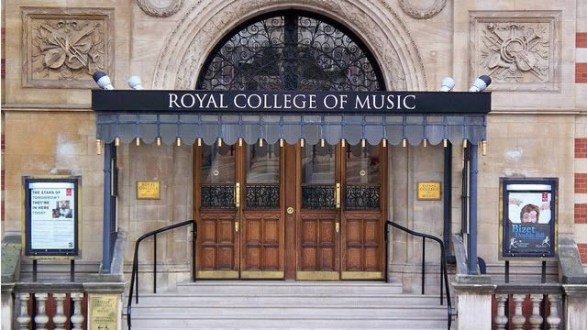
246x0wTido Music, the innovative music learning app, has partnered with prestigious conservatoire the Royal College of Music (RCM), London. Committed to supporting music education, Tido will fund RCM student subscriptions to the app until 31st March 2020. Throughout the course of their subscriptions, students will use Tido Music to assist their studies and will be asked to give feedback on the app, contributing to its future development. The initiative will be extended to the RCM Junior Department next month.

Available as an iPad app or via desktop browser, Tido Music provides almost 10,000 piano and vocal scores from world-leading publishers, including Urtext editions from Bärenreiter and Edition Peters. Students will be able to find and access repertoire instantly and listen to professional audio recordings synced to the notation.

Piano accompaniment recordings are included with the vocal repertoire, enabling singers to practise with the piano part at any time, and innovative pitch-shift and speed-shift tools allow the accompaniments to be adjusted for individual needs. Additional audio tools such as looping will further enhance practice sessions. Tido’s proprietary technology means that the app can even listen to and follow pianists as they play, turning the pages of the score automatically.

Students will also discover rich educational materials such as video masterclasses from concert pianists and scholarly commentaries on the music. The practical and artistic insights offered in the masterclasses may help inform students’ understanding and interpretation of their repertoire.

Stephen Johns, Artistic Director of the Royal College of Music, said: ‘We are delighted to be collaborating with Tido Music, giving our students the chance to be at the cutting edge of music learning technology and benefit from the app’s many innovative features. Working with digital scores is a valuable experience in itself as the music sector becomes increasingly digitally focused. Through the Royal College of Music’s various digital development initiatives we are ensuring that our students are well equipped for 21st century music careers.’
4deb3b6b4296309e7d5868d6da9fb5b3

Brad Cohen, Founder of Tido, commented: ‘Using technology to enhance music education is at the heart of what we believe in at Tido. We’re thrilled to be partnering with such an illustrious institution as we continue to develop our product and further tailor it to the needs of music students. We look forward to working with RCM students directly throughout the course of their free subscription.’


Tido Music is a revolutionary digital subscription service for pianists and singers. Available as an iPad app or via desktop browser, the service provides sheet music, audio recordings, videos, interactive practice tools, written commentaries and images. For students, teachers, and amateur to professional performers, Tido Music offers unparalleled guidance and inspiration.

Tido was founded in 2013 when conductor and editor, Brad Cohen, collaborated with one of the world’s leading music publishers, Edition Peters. Kathryn Knight, former Publishing Director at Faber Music, joined the company as CEO in 2014. In 2015 Tido partnered with Faber Music to create the award-winning ‘Mastering the Piano with Lang Lang app’, and Tido’s flagship app Tido Music was released in late 2016.

Tido works with renowned publishers, artists, exam boards and institutions across the world including Bärenreiter, Edition Peters, Faber Music, Trinity College London and Wellington College International Shanghai.

Tido Music costs £4.99 per month after a 30-day free trial as standard.


Source: Tido Music press release

Guest post by Doug Hanvey

Unless they’ve been living in a cave for the past 30 years, most people have heard about mindfulness. I offer piano lessons in Portland, Oregon, and it’s difficult to go for long in my West Coast city without hearing about a new application or research study related to it. Mindfulness – bringing intentional awareness to one’s experience in the present moment – is said to reduce stress, improve one’s relationships, diminish chronic pain, improve productivity at work, and much more.

Gigantic corporations such as Google, hundreds of hospitals, schools and colleges, and even the military are all touting mindfulness. If mindfulness is good enough for Google, might it be useful in piano pedagogy? I believe the answer is yes.

In fact, I believe there are numerous potential applications of mindfulness in the piano studio that are only now beginning to be considered. Learning to play an instrument as multifaceted as the piano requires so many faculties (cognitive, emotional, kinesthetic) that cultivating a deeper awareness of our present moment experience is sure to help. Piano students (and teachers!) can easily become stressed. One of the primary functions of mindfulness (particularly in healthcare settings) is reducing stress. Piano students need to acquire a high degree of concentration. Mindfulness is most often taught with a focus on developing concentration. Pianists need to be able to feel their emotions deeply in order to express the emotional content of the music. Paying attention to one’s emotional experience is a vital element of mindfulness practice.

But mindfulness of the body, of one’s somatic experience and movements – which coincidentally is how mindfulness is usually first taught to beginners – is perhaps most relevant for most piano students. Mindfulness has immense efficacy in its capacity to enhance our awareness of our physical well-being and, not unrelated, our piano technique. In order to remain healthy by avoiding injuries due to faulty technique or overpracticing, awareness of the body and the impact of our practice habits is bound to be beneficial for most serious students. And since piano technique essentially boils down to how we situate ourselves and move the body to play, enhancing our awareness of the body (posture, position etc.) and how we move is sure to expedite improvements in our technique.

After all, the statistics are alarming. A large percentage of serious pianists, such as college music students or professional musicians, will be compromised physically at some point, most often due to a repetitive stress injury (RSI). Changing practice habits and routines, taking better care of one’s overall health, and even learning injury-prevention techniques such as the Taubman technique – which I have studied intensively – are all bound to be useful for the injured pianist, or the pianist who wishes to avoid injuries. Each of these strategies can be enhanced by practicing mindfulness. How?

One of the most common applications of mindfulness, as I explained above, is to reduce stress, and disorders and ailments aggravated or brought on by stress. Reducing one’s stress is likely to minimize the impact of playing, even with inferior technique – on one’s body.

In addition to stress reduction, mindfulness can help pianists become healthier and better players. Like athletes, musicians require some degree of body awareness simply to learn the instrument. Cultivating body awareness can help players become aware of habits of tension that may lead to injury down the road. Body awareness is also necessary for becoming a better player, i.e. for learning new techniques (ways of moving). Most musicians can be more “body aware” than they are. Mindfulness, in my experience, is one of the best ways to enhance body awareness and secure the benefits that brings.

How can piano teachers bring mindfulness into the studio? Just as piano teachers are expected to “practice what they preach” – i.e. play the piano well before teaching it – it’s also useful for teachers to practice mindfulness before teaching it to others.

Mindfulness is most often taught with an orientation on the body, in particularly towards the natural rhythm and “bare” physical sensations of breathing. “Bare” means awareness of one’s actual felt sensory experience. So a good way for music teachers to begin is by practicing “mindfulness of breathing” or “mindfulness of the body.” There are numerous free audio meditations online, and I offer a set of my own guided audio meditations for piano teachers and students on my blog.

After you’ve practiced mindfulness for awhile, and begin to understand how it works (or if you have already done that) you might be eager to try introducing mindfulness to a student to support their musical health, or when teaching technique. For example, say a student is struggling to learn a new way of moving, and they keep falling back into old habits. You might say:

Would you be willing to try a brief body awareness exercise that may help? OK…close your eyes for a moment, rest your hands on your lap, and tune into the rhythm of your breathing.” (Note: You, the teacher, might want to follow your own instructions by practicing mindfulness with your student as you lead them.)

(pause)

Be aware of the bare sensations of breathing wherever it’s easiest to feel them.

(pause)

Let your breathing do its own thing. Allow the breath to be as it is. You don’t need to change anything.”

(pause)

Now tune into your body. Feel your whole body, sitting here on the bench. Notice any tension or contraction in any part of the body. Let it be as it is.”

(pause)

“Now tune into your right forearm. What sensations do you notice? Be aware of any tension or contraction. If it relaxes or melts away, great. If it doesn’t, just let it be.”

(pause)

Now tune into your right hand. Notice what it feels like to have a hand. Notice the life in your hand. Notice energy flowing, tension, and any other sensations, pleasant or unpleasant.”

(repeat for left forearm and hand)

Now open your eyes and practice the technique we’re working on, with mindful awareness of your body and the movements you’re making.”

This brief exercise can help students to become more naturally aware of their body generally and playing “equipment” specifically (in particular the arms and hands). From this awareness, students may begin to notice that they are habitually moving in certain tense or less-than-efficient ways, which sets the stage for naturally dropping these habits and learning new ones.

Mindfulness offers much more, of course, but a gentle introduction with a specific orientation towards the piano is often the best way to start.


Doug Hanvey taught an undergraduate mindfulness class, The Art of Meditation, at Indiana University Bloomington from 2007-2014. He currently teaches piano in Portland, Oregon.

Guest article by Joanna Wyld

In anticipation of the premiere of our new opera, The Gardeners, on 18 June at Conway Hall, Robert Hugill has written about the genesis of the work

The story of how I came to write the libretto, and the significance of that experience, starts a little further back. When I was studying music at university, I loved writing about it, but I also loved writing it – under the guidance of Robert Saxton – to the extent that I went on to take a Masters in Composition, taught by George Benjamin, Rob Keeley and Jonathan Cole. But I also had to make a living, and composing is a notoriously precarious profession, so I channelled my creative instincts into writing about music. Soon, I felt pretty confident that I’m a better writer than composer, and have loved writing every programme note, every CD liner note, since. Yet alongside that experience there has always been the urge to produce something original for its own sake, so when a friend asked if I might be interested in writing a libretto for Robert Hugill, not only did I jump at the chance, I also felt rather stupid that the idea hadn’t occurred to me before. ‘Librettist’ seemed the perfect fusion of my interests, my loves – but was I up to it?

I met Robert Hugill at his house and he welcomed me with tea in his sunny kitchen. Absurdly, this is the only time we’ve met in person, but there’s a long history of composers and librettists working together remotely and through correspondence, so we’re in good company. Robert’s vision for The Gardeners was clear from the outset. He had read an article about a family of gardeners tending war graves and felt that this subject was ripe for operatic treatment, exploring issues of radicalisation as well as family dynamics. The Dead themselves were to feature, audible only to the Old Gardener – at first. The written style was to be pithy, using short phrases, and adapting lines from poetry by A.E. Housman and Rabindranath Tagore.

Before starting to write, I ordered myself a volume of Tagore’s texts and started to get to know them, as well as re-reading the article. I’d originally envisaged poring over other libretti – I’m a bit suspicious when I encounter writers who don’t also read extensively in order to learn from others – but Robert’s ideas were so clear that the first scene came naturally, and it felt right not to muddy the waters with too many other voices. I wanted Robert’s voice to come through, as well as my own and those of Housman and Tagore. That seemed enough.

However, I did have an idea of what I was aiming to avoid. Ronald Duncan’s libretto to Britten’s chamber opera, The Rape of Lucretia (in which I’d played the flute years before in a production directed by Ryan Wigglesworth), has come in for some criticism for its rather trite sewing up of a complex and sensitive subject. My aim was to dodge where possible the same pitfalls, by allowing tensions to surface and ambiguities to breathe without neatly resolving them. As a result, The Gardeners asks more questions than it answers, but with issues such as radicalisation this seems appropriate; this is a contemporary problem with no easy solution.

ENO+Advert+1000


For the choice of language, my experiences as a composer came into play. I love setting words to music (I still occasionally write songs for my band), and it helped me to remember that process whilst writing this libretto. Words which, when combined, sit well together and possess a musicality, a distinct rhythm, inevitably lend themselves to musical treatment. I also remembered reading letters between Ted Hughes and Sylvia Plath discussing the weight and density of words, and how the energy of two paired words needs to be complimentary rather than overly similar. Hughes wrote to Plath about her poem, Touch-and-Go: ‘… there is a traffic confusion I think in “Fierce flaming game of Quick child” – do you think “Quick flaring game Of child, leaf or cloud” because the “Fierce flaring” are two consecutive likenesses, and have been too often the double tap of the hammer… Well in verse the tendency is to follow an adjective that’s working with an idle timing one, so that adjectives tend to go in pairs. Well in “fierce flaring” an old couple has come up…’ Plath changed “fierce flaring” to “quick flaring” and the difference is palpable. I bore this in mind and tried to avoid ‘traffic confusion’ or ‘the double tap of the hammer’.

As for characterisation, I hoped to give a clear sense of each personality without resorting to types, allowing room for each of our artists to bring their own interpretation to their character. The Angry Young Man’s frustration can be damaging, but we also understand why he resents the invaders of his country, and he grows during the course of the opera. The Old Gardener casts a long shadow over his family, and the Gardener is caught between these two strong figures, trying to keep the peace. The Mother and Grandmother offer insight and wry observations in their attempts to mend relationships; both do their share of peace-making and eye-rolling, but neither is spared the sardonic wit of the other.

I sent each scene to Robert at regular intervals. He would tweak the text as needed, and in turn would send back his composition as it unfolded – and I would enjoy listening as The Gardeners grew. At each stage we discussed the direction of the plot, and although the whole process took some time – we’re both busy people with other commitments – it felt remarkably straightforward. I hope to have the chance to write more libretti in future, but in the meantime, I loved working with Robert Hugill, I’m really proud of The Gardeners, and I look forward to its premiere. See you there.

The Gardeners by Robert Hugill with libretto by Joanna Wyld receives its world premiere at Conway Hall, London, on Tuesday 18 June 2019, conducted by William Vann

Further information and tickets

© Joanna Wyld, April 2019


img_0904Joanna Wyld was born and educated in London before reading Music at New College, Oxford, where she was an Instrumental Scholar. She was listed as one of the Women of Distinction in 25 Years of Women at New College.



Joanna established Notes upon Notes in 2004 and has been writing liner notes, programme notes and other copy for a wide range of artists and record labels ever since. She also worked on Stop The Traffik for Steve Chalke and Cherie Blair, a book used as a resource by the UN.

Joanna won the 2014 OUP spoof Grove Dictionary article competition, as well as both second and third runner-up slots.

She curates playlists for classical streaming service IDAGIO, and recently appeared in a Southbank Centre video introducing a concert at the new Queen Elizabeth Hall. Joanna is Editor at Odradek Records, and has written her first libretto for an opera by Robert Hugill.

Notes upon Notes