Guest post by Eleonor Bindman

Over the course of my work on arranging the Brandenburg Concertos many people would ask me: “Why not for 2 pianos?” Now that the project is completed and the recording has been released, I am still getting emails from fans of the new Brandenburg Duets CDs with the same question. Well, there are many reasons why and the teacher in me strives for thorough explanations, so here are a few paragraphs on the topic.

Of course, the question is perfectly legitimate, since two pianos would be much easier to work with when transcribing this piece, or any orchestral piece for that matter.  No need to decide which string parts to omit completely, no need to transpose up or down an octave, no need to worry about density of texture in the middle register or about dividing a harpsichord cadenza between two players. It would have been easier to have an entire keyboard for each pianist: no bumping elbows, no deciding whose hand goes into an awkwardly high or low position, no issues of balancing register volumes or exact sound and touch matching when sharing the same theme. The sheet music would have been easier to print as well, without having to fit the same measure numbers for each page of Primo and Secondo and to print the hard copies of music back to back.

The overriding reason for this being a piano-4-hands arrangement is elementary: two pianos are much harder to come by than one.  Think of how many times you have seen two pianos in the same room, unless you were in a concert hall or a music school. And now compare that to all the times you have seen one piano in a room, like in your own home, perhaps. You can play this music at home with a friend whenever you are both available, but imagine if you had to have two instruments? And for performances, bringing a second piano in for a concert always requires rental, extra tunings and (unless we’re talking about a major concert venue) moving/ transportation, ditto for a recording –all this means major expenses in a world were musicians barely get paid for anything. Incidentally, recording on 2 pianos is a lot more difficult than on one, as far as synchronicity goes.

My motivation for working on the Brandenburg Duets was to replace the old arrangement by Max Reger which was hastily done and has barely ever been performed. For the same practical reasons as above, his transcription was made for piano-4-hands, as were other transcriptions of Bach’s works, Beethoven’s symphonies, many opera overtures,etc.. There was a huge body of piano duet repertoire generated mostly in the 19th century when pianos were found in most bourgeois homes. Those duet transcriptions served the same function as the radios and records did in the 20th century: they made classical music accessible for the public’s enjoyment outside the concert hall.

All piano teachers know how important 4-hand playing is for one’s development as an ensemble player. Duets for beginners figure prominently in methods books, yet there isn’t much music for that medium written by great composers. Mozart’s Sonatas and Schubert’s works are the only extensive bodies of work that advanced students and adult amateurs can enjoy. I am hoping that Bach’s 6 Brandenburg Concertos – a total of 18 movements of the most wonderful and varied set of orchestral pieces ever transcribed for piano-4-hands – can give piano partners a new source of learning and enjoyment. The single-keyboard format dictates a thinner texture and therefore simpler parts for both pianists, suitable for intermediate/advanced levels.  Some slow movements are very easy to coordinate, some fast ones are quite difficult and there are many in between. Many faster movements sound equally good at a slower tempo and may be used for exercises in finger dexterity and coordination. And playing this in such close proximity, next to one another, has a unique sensation and feeling of partnership in music for pianists who normally don’t find themselves so close to others in chamber music.

Lastly, for me personally, meeting the challenge of adapting the music well to one keyboard and two players was the real purpose of this project.  The process exposed the complex polyphonic architecture of 6 very different pieces and somehow resulted in a version which seems to belong in our times as much as the original belonged in the 1700s. Bach’s music can be heard in a completely new way without losing its essence.

The Brandenburg Duets arranged by Eleonor Bindman and performed by Eleonor Bindman and Jenny Lin are available on the Grand Piano label, and also via streaming services. Further information here

Meet the Artist interview with Eleonor Bindman


Praised for “lively, clear textured and urbane” performances and “impressive clarity of purpose and a full grasp of the music’s spirit” (The New York Times), New York-based pianist, chamber musician, arranger, and teacher, Eleonor Bindman has appeared at Carnegie Hall, The 92 Street Y, Merkin Hall, Alice Tully Hall, and on solo concerto engagements with the National Music Week Orchestra, the Staten Island Symphony, the Hudson Valley Philharmonic, the New York Youth Symphony, and The Radio and Television Symphony Orchestra of Moscow, Russia. Ms. Bindman is a prizewinner of the New Orleans, F. Busoni and Jose Iturbi international piano competitions and a recipient of a National Foundation for the Advancement of the Arts award.

Born in Riga, Latvia, Ms. Bindman began studying the piano at the E. Darzins Special Music School at the age of five. Her first piano teacher, Rita Kroner, hailed from the studio of Heinrich Neuhaus, the venerable Russian piano pedagogue. After her family immigrated to the United States, she attended the High School of Performing Arts while studying piano as a full scholarship student at the Elaine Kaufmann Cultural Center. She received a B.A. in music from NYU and completed her M.A. in piano pedagogy at SUNY, New Paltz under the guidance of Vladimir Feltsman. The Poughkeepsie Journal describers Ms. Bindman as a strong pianist who attacks her work with great vitality and emotion…and mesmerizes her audiences with her flair and technique” (Barbara Hauptman).

More about Eleonor Bindman

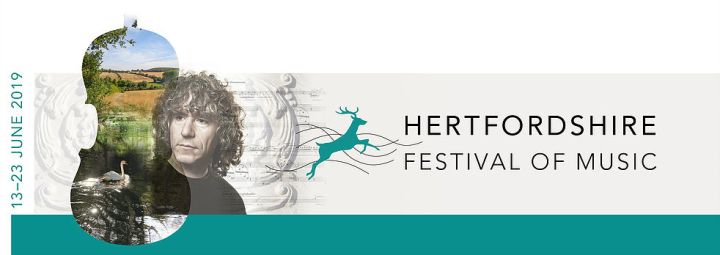
Conductor and festival director Tom Hammond thinks we should all bother with music. In this guest post, he explains why and previews this year’s Hertfordshire Festival of Music.

marchteal

I’m writing this less than two weeks before the opening of the 2019 Hertfordshire Festival of Music (HFoM), with the sweaty brow of the accidental concert promoter desperately hoping to see more tickets flying off the shelves.

We’ve programmed some fabulous music and musicians in this our fourth year: Fauré, Haydn, Schumann, Ravel, Mozart….with Steven Isserlis, Orchestra of the Swan, Anthony Marwood, Clare Hammond, the Carducci Quartet, to name only a few.

It’s not just classical music traditionally presented (although there’s some of that, and no apologies for it!) with two performances from the effervescent ZRI mashing Brahms with klezmer and gypsy styles plus their need live-to-film performance Adventures with Charlie Chaplin, an amazing jazz trio in a magical venue, and even a guided visit to Haydn’s summer holiday home when he was here in 1791. Plus three Featured Living Composers (Peter Fribbins, Alan Mills, James Francis Brown) and three major outreach projects involving more than 200 young people. Basically shed-loads of stuff, and really good stuff!

Since the Festival began – the initial germ of the idea coming to me back in 2015 – we’ve welcomed around 2,500 people to concerts in Hertford and Hertfordshire, given education and performance opportunities to around 500 younger people (schoolchildren as well as conservatoire level students) and raised something like £150,000 in external funds and Box Office revenue. Raising that sort of money for music is incredibly hard work as anyone who’s ever tried will know, taking hours of your life that could be spent doing vastly more enjoyable things….

The money that we’ve raised has gone directly into the music economy via paying our artists – about £75,000 on musician’s fees alone, and we pay at a decent rate –  plus all the other elements of the musical food chain, including commissions, hire of copyright materials, piano tuners, keyboard hire, sound and lighting equipment, etc., etc. Where that money certainly isn’t going is into my back pocket, nor that of my co-Artistic Director. We’ve also got a very hard-working board of trustees, because we’re now properly formalised as a charity, plus our FOH team who also do it for the love of music.

And why on earth would anyone do this?!

I have asked myself that question many times, not least as so many areas of running a Festival are things for which I’ve had absolutely no training, experience or aptitude and I’m already pretty busy with my main work as a conductor and producer. But, when I read my social media newsfeeds, or see classical music mentioned in the national media, it’s too often report after report about cuts in music education and how music is being marginalised. Or how to make it ‘relevant’. Or how it’s seen as for only posh people…. You don’t need me to go on because it’s jaw-clenchingly boring to do so, and moaning is too easy and the time could be better spent doing something about it.

What I and my colleagues at HFoM are trying to do, albeit in a nascent way which needs constant refinement, is simply put amazing music on in appropriate spaces that heighten the audience experience, plus open out opportunities for young people, and try to buck the above trend. As a colleague of mine once said to me, we are attempting to act as incubators of this amazing art form and when the day finally comes and politicians actually read the gazillions of studies that show how music helps people in so many ways and fund it again, someone can buy us all a pint.

Until then, if anyone fancies coming along and helping us continue beyond this year we have plenty of tickets left to sell. With only two exceptions, you can walk to all our performances in less than twenty minutes from train stations, all of which are well-served in and out of London. It will be light well into the evening, hopefully sunny and warm too. Tickets are not expensive, indeed some events are totally free, many offer £5 seats for anyone in full-time education, and they are in nice places with good pubs, restaurants and countryside nearby.

Hertfordshire Festival of Music runs from Thursday 13 to Sunday 23 June 2019. This year’s principal artist is cellist Steven Isserlis who will be giving masterclasses and performances during the festival. Full programme of events

Tom Hammond is co-Artistic Director of Hertfordshire Festival of Music, and a conductor and record producer.

www.hertsmusicfest.org.uk

Meet the Artist interview with Tom Hammond

The concerto is one of the greatest corners of the pianist’s repertoire. A showcase for performer and instrument, it’s an opportunity for the composer to capitalise on the combined forces of soloist and orchestra, often with thrilling and highly expressive results. The concerto format inspires great music and is a spectacle for the audience, and the genre continues to tempt composers today. The romantic image is of the soloist doing battle with the orchestra, but in most instances piano and orchestra are collaborators, creating wondrous musical conversations and exciting contrasts of sound, texture and mood. Instruments may have changed since Mozart’s day, but the genre itself is perennially popular with musicians, composers and music lovers alike. For performers, the biggest challenge in playing these very popular concertos is breathing new life into very well-known and much-loved music.

Careers are made with concertos, and for the professional pianist, playing concertos represents a significant part of one’s working life. Most pianists will aim to have several concertos “in the fingers” from an early point in their career, with some retaining over 50 by the time they are established. Competitions require concerto playing too, and certain works have become staples in the competition and international concert repertoire, a sign of their enduring appeal and ongoing challenges to pianists – and their popularity with audiences.

Here are 6 great piano concertos which are regarded as the “must learns” for soloists, and “must haves” for concert programmes.

Beethoven – Piano Concerto No. 5 in E flat – the ‘Emperor’

A heroic nickname for a heroic concerto. Composed from 1809 to 1811, the work is poised on the cusp of romanticism in its scale, virtuosity and richness of expression while also harking back to its classical antecedents in Beethoven’s skilled handling of the piano concerto form. Two dynamic outer movements bookend a slow movement of infinite beauty and ethereal serenity, which inspired Schumann in the last movement of his Fantasie, Op 17.

Grieg – Piano Concerto in A minor

This is Grieg’s only piano concerto but it has justly joined the rank of “great” and “must learn”. Composed when he was only 25 and inspired by a performance by Clara Schumann of her husband’s concerto, the influence of Schumann is clear from the outset in its sweeping gestures, emotional contrasts and lyricism. But while Schumann’s writing is sophisticated and romantically introspective, this is the work of a young man making his mark with a grand musical statement, weighty and serious. There are high virtuosic elements and adventurous piano writing, inspired by Liszt and Tchaikovsky (big octave passages, for example), but the work has a naturalness too (the finale is a Norwegian folk dance!). Assured and commanding, its anthemic outer movements combine vitality and poignancy while the middle movement is a graceful, soaring Adagio which overflows with heart-warming loveliness.

Mozart – Piano Concerto No. 27 in B flat, K595

Mozart’s final piano concerto inhabits quite a different world from the powerful and bold concertos of the 1780s when Mozart enjoyed a golden time as a concert pianist. Compared to its predecessors, the K595 is pared down, but with a harmonic language that is sophisticated and daring. Full of muted colours and supple textural interweaving of solo instrument and orchestra, its beauty and melancholy looks forward to the romantic lyricism of Beethoven’s fourth Concerto and beyond. With fewer virtuosic frills and extrovert gestures than Mozart’s earlier concertos, the challenges the pianists lie in its restrained character and elegant simplicity of expression.

Rachmaninov – Piano Concerto No. 3 in D minor, Op 30

Composed in 1909, Rachmaninov’s third piano concerto is considered one of the greatest and most challenging in the standard repertoire and is respected, and feared, by many pianists. Monumental and treacherous in scale, gorgeously romantic and highly expressive, the pianist to whom it was dedicated – Josef Hofmann – never performed it in public. Instead, it was premiered by Rachmaninov himself in New York, and its fearsome technical difficulties reflect the composer’s own transcendent prowess at the keyboard. With forty-five minutes of almost continuous playing for the soloist, the renowned English pianist and teacher Cyril Smith likened the sheer physical effort of playing it to shoveling several tonnes of coal! For many pianists, this concerto represents the ultimate “trophy” performance.

Ravel – Piano Concerto in G major

The piano was Ravel’s favourite instrument, and while the Piano Concerto for the Left Hand is profound and significant, his G major concerto was intended to satisfy the box office, the frivolous showpiece could he take on tour. Opening with the famous single “whipcrack”, it contains all the elements fashionable and clichéd at the time of writing – jazz idioms and harmonies, dissonance, neo-classicism and mechanical moments – but it’s brilliantly done and finely-crafted. Written “in the spirit’, Ravel said, ‘of Mozart and Saint-Saëns”, the exuberant, jazz-infused outer movements are offset by a slow movement of serene beauty and transparency.

Tchaikovsky – Piano Concerto No.1

The triumphant opening chords of this concerto followed by the first theme are amongst the most famous bars in all of classical music, heralding a work of sublime romanticism, dramatic expansiveness, invention and emotion, full of memorable themes and glorious textures. Composed in 1874 during a very productive period in the composer’s life, the concerto was premiered in Boston in 1875 by Hans von Bulow (Nikolay Rubenstein, Tchaikovsky’s favoured pianist, rejected the work as badly written and refused to play it). Tchaikovsky later revised the work in 1888 and it is this version which is most commonly performed today. In 1958 it became the first piece of classical music to sell a million records when the pianist Van Cliburn made an impassioned recording of the concerto. After the grandiose opening movement, the middle movement serves as a lyrical slow movement and a scherzo, while the finale is a breathless rondo based on a Ukrainian song. The works succeeds on every level: the virtuosity of the piano part is matched by vivid orchestration while the intricacies of the work are balanced by Tchaikovsky’s beautiful melodies.


This article first appeared on the Interlude HK website

Guest post by 1781 Collective

Classical music is elitist.

Classical music puts up barriers to new audiences.

Classical music is inaccessible and unwelcoming.

A fair chunk of us in classical music performance have heard, acknowledged, and pondered the above statements which are uttered often enough to help us understand why a large majority of the population generally doesn’t want anything to do with us.

Our answer? Make it more elitist, build bigger barriers, and make it even more unwelcoming.

That is, on the surface. Whilst it may seem paradoxical to the extreme, our goal is the do the exact opposite: to release classical music from the perceived elitism that admittedly has a monopoly on a product that we as performers feel too passionately about to let go.


UNDERSTANDING OUR CURRENT SITUATION:

First, we need to understand where the accusation of elitism stems from. As it cannot be the complex arrangement of sine waves and overtones that organise themselves into the actual music, it has to be something outside the actual making of it. We point the finger directly at the institutions and organisations that charge themselves with ‘protecting’ classical music, i.e., the gatekeepers surrounding classical music who have spent the past 100 years building a wall around it (or as Daniel Barenboim termed, those in the ‘Ivory Tower’[1]) to make sure it is as hard as possible for an outsider to walk in.

Nowhere is this more obvious than in existing concert formats. For those of us who have attended more than a few concerts, the existing ritual is a wonderful experience. Arriving early to the Philharmonie, Staatsoper, Southbank Centre, Wigmore Hall (or wherever you prefer to get your kicks); having a crémant before the performance; settling down in your seats and waiting for the lights to dim; knowing exactly when applause is due and frowned upon; relishing in the silent nature that allows one to listen intently; having a pretzel during the interval (sorry U.K., the ‘Interval Ice Cream’ is good, the German ‘Pause Pretzel’ is GREAT) – all of these things we happily agree to upon entry because it is familiar, and a great way to listen to music that more often than not, we are acquainted with or have expectations of.

As an industry, we’re always bleating and bashing our heads against the walls to how to convince the white whale of marketing‘new, young audiences’ – that what we’re doing is a tonne-of-fun and they should come and shut up and realise what they’ve been missing. What we don’t realise is that telling anyone (not just the new and young) to come into an unfamiliar space filled with people all too willing to let them know when they’ve strayed from an unwritten set of rules, whilst sitting still for two hours to listen to something they’ve not necessarily any connection with… well, it hardly comes off as inviting.

So how does building bigger barriers, expectations, exclusivity, and coating it with a fairly thick pretentious layer of paint go against any of this?

RE-DESIGNING THE CONCERT FORMAT:

One of our first attempts at an answer has been to try and completely decontextualise classical music performance by looking at all the existing rituals inherent in the traditional format, and turn them around to observe how it affects audience enjoyment. These rituals can include (and are not limited to):

  • The choosing of concert based on repertoire, performers, instrumentation (generally online or in brochure form);
  • Purchasing tickets or reserving seats (generally online or through a ticket office);
  • Knowing dress codes and what is generally deemed ‘appropriate’ (seemingly obvious perhaps, though there is without doubt an expectation – bondage gear being generally frowned upon);
  • Arrival time at the venue and atmosphere (classical audiences know arriving at least fifteen minutes before is safe, and that there isn’t entry during performance. Non-classical audiences don’t necessarily know this);
  • When to applaud (the most contentious issue – no matter how much proof you give to fanatics, we’ll never go back to applauding between movements);
  • Communication of additional information through programme notes (is anyone else still worried that something as simple as performer speaking to audience is still referred to as a ‘new’ and ‘big’ change?);
  • Sitting silently during performance with as little movement as possible.

Our modifications to these existing rituals include:

  • Not communicating at any point who is performing and what repertoire will be presented – allowing us then to programme according to artistic desires rather than hiding a contemporary work between a Beethoven and a Brahms.
  • Sending formal invitations to selected guests, chosen to represent a wide variety of networks. Note: at least 80% of audience members are not those who currently engage with classical music on any constant level.
  • A strict dress-code policy of all white clothing. Originally this was to change with every performance (for instance, each member would need to wear flowers, or bring a gift), however the success of the white clothing in atmosphere curation has led us to instigate this as a constant across the series.
  • Knowledge of the arrival time (between 20:00-20:25), with no exception allowed.
  • A blanket ban on all applause – taking out the insecurity that non-classical listeners all experience, which can overwhelm their listening attention by creating a sense of anxiety. Note: repertoire selection needs to support thislarge fortissimo perfect cadences tend to leave the audience with the musical equivalent of ‘blue-balls’ if they’re not allowed to express afterwards.
  • Subtle communication of repertoire during the performance, and using a candelabra with five candles to let the audience know how many pieces have been played and how many remain.
  • Selecting different physical situations for each piece, including standing, kneeling, sitting cross-legged, lying down, eye-gazing with a neighbour, and free positions. The audience is informed that every position is wholly optional, with no insistence.

Finally, we want to address the existing performer-audience dynamic, traditionally based on a top-down model. Referred to by Prof. Julia Haferkorn in The Classical Music Industry as the ‘sit-and-stare’ model, audiences attend a performance as passive consumers: having chosen the particular concert they wish to attend, it is then up to the performer to bear the responsibility for the performance (outside of the audience not moving and clapping in the wrong places). We want to realign this relationship to a horizontal dynamic, with both audience and performer responsible for the outcome of the performance – a further justification for the dress code, arrival time, honouring their RSVP commitment, and non-applause. Primarily, we are looking to create a more direct and honest point of contact for the listener to challenge core communication issue that underlies the current barrier between audience and performer.

THE CASE FOR NEW RITUAL DESIGN:

All of this is geared towards delivering a strong element of value for the audience. By respecting certain requests and requirements, we imbue them with a responsibility which gives them more satisfaction at having contributed to that value. For non-classical audiences, simply begging them to attend because we promise the music will be great is not enough: adding additional layers to it welcomes them to see the event as a whole, separate to their existing notions of what a classical music performance is.

Most importantly, whilst designing these additional layers we are conscious of not letting anything get in the way of experience of the actual music – as our goal is to communicate high-quality classical music, nothing can be gimmicky or without justification. Each layer then is designed to highlight or enhance the listening experience, and we’re fully aware of the fine line that separates ‘effective’ and ‘interruptive’, meaning this process includes an element of trial and experiment. The challenge is to create a natural environment where the audience feels comfortable, whilst simultaneously maintaining the necessary elements of silence and reflection to allow them to delve fully into the music.

Our goal through this concert series is to develop a highly-engaged audience community, who we can then utilise as a base for further performance concepts going forward. By and large, this growing community is completely separate to the existing classical audience: as we have no desire to undermine or attack the traditional concert formats in our long-term mission, we aren’t seeking to convert traditional concertgoers to our methods – hence the focus on developing a new audience base. By ‘engaged’, we hope the attention to experience design, and increased audience responsibility and resulting value improvement, means they won’t attend purely for the Instagram-able nature of the events, or just so they can say ‘we went to this weird space to listen to classical music’. Our goal is not to trick people into liking classical music, but to demonstrate its real value.

Following on from this, we want to create a sense of trust in our product from the community, so they introduce the concept to their immediate networks – i.e., marketing. As mentioned above, the initial invitees have been selected because of the diversity of their networks. Each attendee then is encouraged through ‘Invite Cards’ to select friends they believe would appreciate the performance. Inspired by the members’ club model, we hope this method builds a large and motivated core group of attendees.

RESULTS, GOALS, PROJECTIONS:

Which brings us back to the concept of exclusivity, elitism, and unwelcoming barriers. Yes, on the surface, this is extremely exclusive. However this exclusivity is limited to these early stages of audience-community development – allowing us in the future to curate the larger, open-for-all performances that form our mid-term goals, with the knowledge there is a strong audience base to support. Whilst the images above scream ‘elitist’, we believe it is far removed from the perceived existing elitism that stains classical music in the form of traditional format expectations (which can seem like a private party where the initiated understand, and the ‘plebs’ don’t). And, as explained in detail above, the unwelcoming barriers have a two-fold effect: 1) building value and delegating responsibility to audience members; and 2) taking out uncertainty and anxiety from audiences by communicating exactly what is expected, giving them freedom to operate how they prefer within the clearly defined boundaries.

Is the concept perfect? Of course not, it is still very much a work in progress. Does it hold the answers on how to ‘save’ classical music? Again no, we don’t presume any claims of greatness in this realm. However, our audience retention and engagement has been pleasantly high with a vast majority of guests requesting to come to the next events, and reporting that they previously hadn’t experience such a close connection to classical music. Are we claiming our ideas to be unique? Not at all, they’ve been inspired by the constant historical change within the industry. And is it the only way to break out of the traditional model? Not by a long shot, there are many excellent groups doing some really excellent explorations – and one of our goals is to connect with them all.

Finally, to those who have gotten this far and are still not convinced – that’s great! We have no need to be in competition with you. As it is inconceivable that there is anyone who is actively trying to ruin classical music, it stands to reason that we’re all passionate about developing and communicating classical music to as many people as possible. To those who think everything above is trite and unreasonable, well if this is the case, trust the audience to make that decision – if true, then you probably won’t be hearing much more about it. All we can say is that we are looking forward to the future, and you’re more than welcome along for the ride.


The 1781 Collective.

www.1781collective.com
info@1781collective.com

About the 1781 Collective:

Why play along with their system, when we can just create our own?

1781 is an international collective of musicians and interdisciplinary artists. Launched in Autumn 2018, their mission is to explore new listening and performance methods with music, and offer an alternative to the traditional music industry for both audience and creators.


[1] Quote in Alan Rusbridger’s ‘Play it Again’