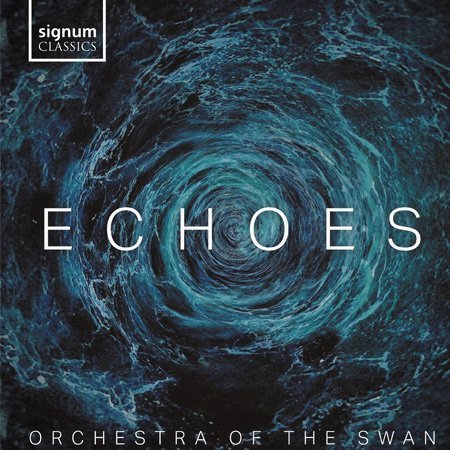
‘Echoes’ is the latest in Orchestra of the Swan’s ‘mixtape’ series, following on from ‘Timelapse’ and ‘Labyrinths’ (which has received over 8 million audio streams since 2021 and was shortlisted for  Gramophone award in the Spatial Audio category).

As with their previous mixtape albums, ‘Echoes’ is an eclectic mix of music encompassing a variety of genres from Baroque to pop. The album features 14 tracks of arrangements of song by Frank Zappa, Adrian Utley (Portishead) and The Velvet Underground together with works by J S Bach, Delius, Max Richter, Philip Glass and Gerald Finzi.

David Le Page, violinist and Artistic Director of OOS, and arranger of many of the tracks, says of the album, “Although you can listen to each track in isolation Echoes is, first and foremost, a complete journey; the way a work ends and another begins is designed to create a frisson, a jolt of recognition or a feeling of surprise and satisfaction. Echoes explores landscape, light, water, dreams, birth and the slowly changing rhythm of the seasons; it also represents a callback to the days of vinyl when the act of listening to recordings was necessarily more involved and required all of your attention…. Despite the ongoing march of music technology and the death of various beloved formats the mixtape has somehow survived and adapted. It is unaccountably more popular than it has ever been.”

Echoes is a captivating and beautifully orchestrated collection of music that seamlessly blends old and new, the familiar and the lesser-known. It opens with a shimmering, luminous and utterly transporting performance of the Bach/Siloti Prelude in B minor, arranged for violin and orchestra by David Le Page. From the silken lines of Bach/Siloti we move into the joyousness of Max Richter’s “recomposed” Spring II from The Four Seasons and thence to the urgent energy of Buffalo Jump by Philip Sheppard. This is followed by the psychedelic, zany Peaches En Regalia by Frank Zappa in an arrangement redolent of the late 60s sound of the original with imaginative scoring for brass and Hammond organ.

After the high jinks of Zappa, a calmer interlude follows with Falla’s Nana, featuring Sally Harrop on clarinet who brings a haunting poignancy to the melody. The Sea of Time and Space by David Le Page is a an uplifting track inspired by the middle movement of Vivaldi’s L’inverno, the Romance from Britten’s Frank Bridge Variations and the second movement of Stravinsky’s Concerto in D for string orchestra, which takes its title from a painting by William Blake. A gentle bossa nova bass and pizzicato notes provide the backdrop over which two violins gracefully, sensuously glide in a silken soundworld. This segues perfectly into The Art of Dancing. V: Trance by Toby Young, a modern homage to the baroque dance suite where each movement hints at a different style of electro dance music. Trance is a nocturne, in part inspired by the stillness of the Adagietto from Mahler’s Fifth Symphony and the hypnotic ambiance of electronic dance music, all beautifully expressed by the muted trumpet solo played by Simon Debruslais.

Venus in Furs, an iconic, unsettling track by the Velvet Underground, is reworked by David Le Page. It retains the angular, ‘shrieking’ viola of the original, but Le Page’s austerely beautiful violin, replacing Lou Reed’s vocals, lends an unexpected tenderness to this track.

Glory Box, by British indie group Portishead, here arranged for voice and orchestra, is the highlight of the album for me. Strings slink and slide with Clara Sanabras’ potent, expressive and bluesy vocals. It’s very close to the original version – it retains that haunting string sample – but is magically reimagined by Le Page.

After the taut fragility of Glory Box, We played some open chords and rejoiced (A Winged Victory for the Sullen) provides another calming interlude: here, a simple chordal piano motif, played by Viv McLean, and shimmering strings and guitar create a beautiful soundscape, understated in its emotion yet replete with expression.

Starbust is a vibrant, colourful contrast, while Aquarelle 1 by Delius, arranged by Eric Fenby, is another demonstration of the warmth and elegance of the Orchestra of the Swan’s string section. A spacious tempo allows the listener to really appreciate Delius’ magical harmonies. Similarly, in Mishima – Closing from String Quartet No 3 by Philip Glass (arr. by David Le Page), the richness of OOTS’ strings piquantly highlights the shifting harmonies and textures of Glass’ music in a movement of shifting emotions and timelessness.

To close, The Salutation from Finzi’s Dies natalis, perhaps the most obviously “classical” piece on the album, and a quintessentially English piece too, its vocal line elegantly sung by Mark Le Brocq who really captures the poignancy of this music, written on the eve of the Second World War.

In ‘Echoes’, Orchestra of the Swan has once again delivered a genre-busting album that contains brilliant, unexpected juxtapositions and imaginative orchestrations. Like their previous mixtape albums, it’s ambitious, ingenious and unorthodox. The result is a stylish, sensitively curated album that is an enchanting, often intriguing and always engaging listening experience.

ECHOES is released on the Signum label and is also available via streaming


This site is free to access and ad-free, and takes many hours to research, write, and maintain. If you find joy and value in what I do, why not
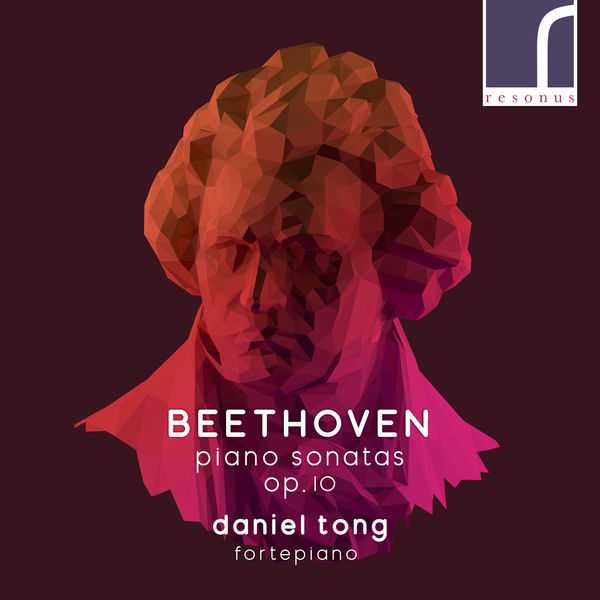
Beethoven
Piano Sonatas, Op. 10 Nos 1-3
Daniel Tong (fortepiano)
Resonus RES10307 

This sparkling new release from Daniel Tong opens with an explosive ‘Mannheim rocket’, the dramatic first sentence of the Piano Sonata in C minor, Op 10, No. 1, which sets the tone for an uplifting and very enjoyable listening experience.

Daniel Tong has been playing Beethoven “since I was nine years old and my teacher gave me a little Bagatelle by the master”, and the piano sonatas as well as the duo sonatas and piano trios are at the heart of Tong’s musical life. The pianist’s affection for this repertoire is evident not only in his close attention to details such as articulation or marks of expression, but also an appreciation of the composer’s wit and comic timing as well as his emotional depth.

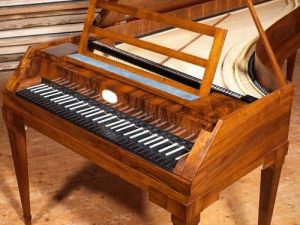
Fortepiano made by Paul McNulty

This new release was made possible via crowdfunding and Tong recorded the sonatas on a copy of an 1815 Walter fortepiano, an instrument with which Beethoven would have been very familiar. The result is a more intimate sound, much more suited to the salon or hauskonzert than the grand concert hall. Yet these pieces are concert works and I am sure Beethoven intended them as such: these sonatas were written for the composer himself to perform, as a young piano virtuoso keen to show off his skill.

Chronologically speaking, these are “youthful” or “early” works, published when Beethoven was not yet 30, yet in their wit and inventiveness, range of expression and appreciation of the capabilities of the instrument they reveal a composer who had already absorbed the finer – and finest – points of sonata form. In these sonatas, we encounter a young composer with the world at his feet.

I have a special affection for the Opus 10 sonatas because I learnt the first one, in C minor, for my Grade 8 exam, taken back in the day (early 1980s) when one was required to perform an entire sonata. I loved the energy of the outer movements and the contrasting warmth and elegance of the slow movement whose melody and structure looks forward to that of the Pathétique sonata (Op 13). Tong neatly captures these contrasts: after the explosive energy and drama of the first movement, the slow movement is a welcome balm. Indeed, it is in the slow movements of each of these three sonatas, that I found the greatest depth of expression: the slow movement of the D major sonata (No. 3) is darkly sombre, spacious and operatic, and freighted with emotion, prefiguring the most profound slow movements of later sonatas.

For the listener more used to hearing these sonatas on a modern piano, Tong coaxes a remarkably rich range of details and colours from the fortepiano. The instrument is far less resonant than a modern piano, and the result is a more incisive, percussive and vibrant sound, with some wonderfully punchy bass details and a gloriously transparent treble.

Is this Beethoven’s piano sonatas as he might have heard them himself? Who knows – we are, sadly, not able to time travel back to late 18th-century Vienna, nor get inside Beethoven’s head to find out – but what this recording confirms is that Beethoven was a master of the sonata form, and Daniel Tong a worthy exponent of this wonderful repertoire.

Alim Beisembayev and Eric Lu, winners of the Leeds International Piano Competition in 2021 and 2018 respectively, have both released new albums. 

Eric Lu impressed at the 2018 competition with his beautiful tone and the phrase “poet of the piano” is regularly attached to his playing. Elegant lyricism is highly appealing, especially in the music of Chopin, which Lu recorded for his previous album.  There is no doubt that Schubert too was a spinner of beautiful, long-spun melodies, but in the case of the music selected by Lu for his latest release, I do not believe that poetry and golden cantabile are enough to convince in this instance.

Lu says in interviews that Schubert is “the composer who moves me most intensely….I love Schubert. It is difficult to describe how meaningful his music is to me.” Yet I felt on listening to this album that Lu had not fully absorbed the “essence” of Schubert’s writing: to play this music pianistically, one must also absorb the songs, chamber music, other piano music et al. The result, for me at least, is a rather contrived sound. Lu aims for expression, overly romanticising the “tragedy” he perceives in Schubert’s writing, in particular in the Allegretto in c and the Sonata in A, D959, and clearly subscribing to the rather hackneyed, oft-quoted view that this work, along with the other two final sonatas, is a portent of the composer’s imminent demise. He portrays this through ponderous tempi (the Andantino of the D959 is positively funereal) and rather suspect use of rubato and agogic accents, which I suppose are intended to emphasise the pathos, poignancy, tragedy et al, in this music, but too often just sound artificial and interrupt the rhythmic flow of the music (most obviously in the Allegretto in c). Throughout the album, I found Lu’s playing rather too ‘safe’, too concerned with beauty of sound rather than highlighting the dramatic shifts of mood and contrasting colours in this music. Personally, I would have liked a little more “bite”, both rhythmically and dynamically, to disturb the beauty.

Contrast this with the new release from Alim Beisembayev, the young Kazakh pianist who at just 23 wowed the 2021 Leeds competition judges and audience with a dashing performance of Rachmaninov’s Variations on a Theme of Paganini in the final, and who displayed remarkable poise, musicianship and maturity in his playing throughout the competition. 

In Liszt’s Transcendental Etudes, an ambitious choice for anyone, Beisembayev positively glitters: superlative, secure technique underpin playing which is daring and fearless from the outset (the Preludio is a stunning opener), with perfectly managed tempi and split-second precision (at no point does one feel that the pianist is in any way out of control), elegant lyricism when required (Paysage – the only piece in this set which I can actually play! – is tender, freighted with poignancy; likewise, the middle section of a fiercely dramatic Mazeppa), tasteful, subtle rubato, vibrant colours and contrasts, and a remarkable control of the momentum and drama within each piece. Feux Follets trips along with gossamer lightness and wit; Vision emerges from the darkness of G minor into heroism, while Harmonies du Soir is delicate yet sweepingly passionate. There is so much to enjoy and marvel at in this album, from tumultuous tumbling descents to sparkling virtuosity, tonal depth and colour, reverie and delicacy. And never once does one feel an ego getting in the way of the music. It’s showy playing, as demanded by the score, without being showy. A absolute treat of an album which reveals the myriad facets of Liszt’s musical personality, played by this young pianist who fully appreciates the variety and range of expression in this music. 

Fauré, Poulenc, Messiaen: Preludes & Nocturnes – Tal Walker, piano

A keen advocate and performer of French piano music, the young Israeli-Belgium pianist Tal Walker explores three masters of French pianism in his debut disc of music by Fauré, Poulenc and Messiaen.

The idea of miniatures (Preludes and Nocturnes) written by French composers at the beginning of the 20th century has always interested me. These are improvisatory-like pieces, rather short and therefore combined in a cycle. These pieces give free rein to the composer’s imagination and reveal a sometimes more secretive side of their personality. – Tal Walker, pianist

The disc takes the listener on a fascinating musical journey, charting these three composers’ exploration of the miniature form and revealing connections within each cycle, while also demonstrating their own distinct musical voices and soundworlds, from the perfumed late romanticism of Fauré to Poulenc’s witty neo-classicism to Messiaen’s mystical harmonies and exotic rhythms.

Fauré composed his set of nine Preludes at the end of his life. Historically overlooked by performers, these miniatures are infused with the richness of late 19th-century romanticism yet look forward to modernism in some of their tonalities and harmonies. Highly imaginative and improvisatory in nature, they hark back to the Preludes of Chopin in their variety, fleeting moods, lyricism and whimsical charm. Tal Walker responds to the mercurial nature of these pieces with fluency and nuance, allowing the listener to enjoy and appreciate the multi-layered textures of these tiny gems.

Poulenc’s Nocturnes were composed between 1929 and 1938, and unlike the nocturnes of John Field or Fryderyk Chopin, these pieces are ‘night-pieces’ more in the manner of Bartok’s The Night’s Music. Some are dream-like, almost childlike in their simplicity. Others are nostalgic, some are humorous and ironic (No. 4 in C minor, for example, is a wry waltz), and many evoke the various personalities of the composer’s friends and intimates, either in the form of a miniature musical portrait or a dedication. There are touches of Stravinsky in the harmonic language in some, while others are richly melodic. The many moods and contrasting voices of these delightful pieces are showcased in Walker’s thoughtful, sensitive playing.

The Eight Preludes of Olivier Messiaen were composed 1928-29. They are clearly influenced by the impressionism of Debussy, with unresolved or ambiguous veiled harmonies, and parallel chords which are used for pianistic colour and timbre rather than definite harmonic progression, but Messiaen’s Preludes are also mystical rather than purely impressionistic, and look forward to his great and profoundly spiritual piano works, Visions de l’Amen (for 2 pianos) and Vingt regards sur l’enfant Jesus. In this suite of early pieces it is already clear that Messiaen was carving a distinct compositional voice of his own with his distinctive modes, birdsongs and a profound sense of mysticism and spirituality.

.

It is perhaps in these pieces that Tal Walker really shines most of all, revealing his skill, musical intelligence and maturity. Whereas in the pieces by Fauré and Poulenc we find a warm lyricism, to the Messiaen Walker brings a slight stridency and brightness of tone (a very ‘French’ style of piano playing) which highlights the many contrasting colours, timbres and textures of this music.

This is an impressive and rewarding debut disc and a fascinating hommage to French pianism by a young pianist who was taught by, amongst others, Madame Françoise Thinat, who herself studied with or was influenced by Yvonne Loriod (Messiaen’s second wife), Marguerite Long (who premiered Fauré’s Preludes), and Yvonne Lefébure. This musical heritage is evident in Walker’s thoughtful, nuanced playing, as if he has fully absorbed the great tradition from the past and melded it with his own personal artistic vision.

Fauré, Poulenc, Messiaen: Preludes & Nocturnes is available on the Collection Cabinet de curiosités record label and also on Spotify

An earlier version of this review appeared on the InterludeHK website