When you see such a fragment, it brings you slightly closer to the struggles of the composer

Yehuda Inbar

4260330917126-cover-zoomWhy did Schubert leave so much music unfinished? Was it the rapidity and volume of his compositional output that works were set aside, and not revisited? Did he feel dissatisifed or struggle with certain pieces? In this impressive debut disc, Israeli pianist Yehuda Inbar seeks to throw light on the conundrum of the unfinished piano sonatas by this most introspective composer by presenting the fragmentary Sonata in F-sharp minor, D571, and the ‘Reliquie’ Sonata in C major, D840 together with Michael Finnissy’s Vervollstandidung von Schuberts D840 (in effect the third and fourth movements of the Reliquie) and Jorg Widmann’s Idyll und Abgrund.

There have been some notable completions of the D571, enabling pianists to perform a “complete” sonata in concert, but Inbar chooses to present this work in its incomplete form, finishing without warning before the recapitulation, a fleeting 7 minutes of extraordinary, intimate poignancy. Inbar’s account is elegantly paced with a warm, richly-hued sound (recorded on a concert Bechstein as opposed to a Steinway). The highlighting of certain details, including interior voices and bass accents, reveals the Mozartian clarity of Schubert’s writing and his fondness for long-spun songlines.

By contrast the C major sonata, probably the most significant of Schubert’s unfinished works, is Beethovenian in its grander orchestral textures and gestures, yet always shot through with the most intimate, introspective writing, its ambiguity made even more explicit through Schubert’s fondness for unusual harmonies and unexpected modulations. The transition between the F-minor sonata and this one works here because the C major Sonata opens with a sense of uncertainty, a spare, haunting motif rather than an emphatic statement. Inbar’s account is robust when required, but he is also acutely sensitive to the mercurial nature of this music.

Michael Finnissy’s piece is a stand-alone work but also completes the D 840 and was written for Inbar, who premiered it in May 2017. Finnissy describes Schubert as someone who has been “heavily marketed by the media, whose personality has been very frequently discussed….We don’t know our last moments and we shouldn’t think we know Schubert’s last moments either…I didn’t want a slow decline into an autumnal coda. I just wanted it to stop, almost with a question mark. Has it finished, has it not finished? What more do we know about Schubert from listening to this?” The work intriguingly interleaves distinctly Schubertian idioms and motifs with instances of unexpectedly crunchy dissonances and dramatic outbursts. Like the D571, it ends ambiguously. If you half-listen you might think this is pure Schubert in a particularly idionsyncratic mood, and, taken with the Widmann which follows, it’s instructive in revealing the essence of Schubert’s writing and the influence and pull of that writing on composers who followed him. Here, the new shines a light on the old, and vice versa.

The extremes of Schubert’s emotional landscape are reflected and distorted in Jorg Widmann’s Idyll und Abgrund, six little Schubert ‘reminiscences’ which combine dreamscapes, brilliance, drama and violence with fragments of Viennese waltzes, raunchy Ländler, and even a child’s music box, complemented by a whistle by the pianist, all handled with immediacy and panache by Inbar.

Highly recommended


Yehuda Inbar: Schubert – Finnissy – Widmann is available on the Oehms Classics label


artworks-000404027133-aju8pu-t500x500James Kreiling, piano (Odradek)

The music of Alexander Scriabin inhabits a distinctive, personal soundworld which is hard to define. It is the music of excess, ecstasy, tumult and passion. It is excessive, overripe, decadent, heavily perfumed, languorous and frenzied, lacking in structure and sometimes downright bizarre. The music of extremes, it is “hyper everything”, and as such it defies description or categorization. Its language is complex, often atonal and frequently almost impenetrable. For some listeners, and artists too, it is this “over-the-top-ness” that is off-putting; for others, myself included, it is this sense of excess and rapture that is so compelling. His personal life and outlook mirrored the excesses of his music: he was dissolute, he could be outrageous, he had high-falutin’ ideas of his own self-worth, and he believed music should be intimately connected to all of human experience. Perhaps this explains the breathless sensuality, the roaring passion and mystic spirituality of his music. All of human life is here, in all its ecstasy, agony, terror and beauty.

In his piano music, he reveals himself as a master of the miniature, and while he wrote 10 piano sonatas – interesting in themselves as they chart his compositional development (nos. 5 to 10 are included on this album) – his shorter works for piano, including some 85 Preludes, distil in microcosm his unique style.

If anything, Scriabin’s late piano music is perhaps his most interesting, revealing his move away from the “pure” Chopin/Schumann/Liszt-influenced romanticism of the nineteenth century as he experimented with unusual harmonies (his “mystic chord”, derived from a dominant 7th) and a kaleidoscopic tonal palette. In addition, fleeting fragments of melody, fleeting filigree figurations, brooding dream sequences, haunting chromaticism, febrile complex rhythms point towards Schoenberg, Messiaen and the avant garde and leave us wondering what Scriabin might have written had he lived longer into the 20th century.

In this generous 2-disc recording James Kreiling makes a persuasive case for Scriabin’s late piano music, suggesting in his detailed readable liner notes that this is the best place for the Scriabin ingénue to start exploring his music. With scrupulous attention to detail and an insightful approach to the music (James’s doctoral research focussed on the late piano sonatas), James captures the composer’s idiosyncrasies with a compelling naturalness and an acute sensitivity to the shifting moods and colours, combining muscularity and delicacy. The free-form nature of this unusual music and the brevity of many of the works draw the listener into a continuous flow of sound – and a lovely sound it is too. The piano is bright-toned yet warm (the recording was made at Henry Wood Hall with Iain Gordon as piano technician, engineered by Michael Ponder), and stylishly-produced album artwork reflects the high quality of the recording.

Recommended


Meet the Artist interview with James Kreiling

51elFUJVORL._SS500 “Give me your hand, my child; I predict that you will become the king of pianists.”

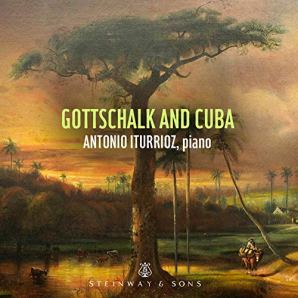
So said Fryderyk Chopin to American pianist and composer Louis Moreau Gottschalk, after hearing him perform at the Salle Pleyel in Paris. Alkan and Liszt also recognised Gottschalk’s impressive talents, and, perhaps in homage to his European virtuoso counterparts, there are distinctly Lisztian idioms in the Symphonie Romantique “La nuit des tropiques”, which opens Cuban-American pianist Antonio Iturrioz’s new recording ‘Gottschalk and Cuba’.

The Symphonie Romantique is especially significant as this is a world premiere recording of the first American symphony, transcribed in its entirety for one piano, as Gottschalk originally intended it and based on Antonio Iturrioz’s extensive research. The second movement, ‘Fiesta Criolla’, is heard in Iturrioz’s own transcription for one piano for the very first time, thus making this a historic recording. In its solo piano form, the work has a Lisztian grandeur with many complex virtuosic passages and rich textures.

Gottschalk was America’s first important pianist-composer. He was also an extraordinary traveler, giving virtuoso performances in Europe, Central and South America and the Caribbean. He fell in love with Cuba and its music, and lived there for extended periods. As a composer, his music combined his Creole heritage with the American, Latin American and Afro-Caribbean influences he absorbed during his travels – all expressed within the boundaries of classical piano writing prevalent in the 19th century.

The Symphonie Romantique provides the starting point for a chronological tour through Cuban classical music, much of it never before recorded. Piano music by Manuel Saumell Robredo, Nicholas Ruiz Espadero, Ignacio Cervantes, Hubert de Blanck, and Ernesto Lecuona features on this album, revealing Gottschalk’s influence and the high regard with which he was held by those who followed him. Many of the works show the influence of nineteenth-century European virtuoso pianist-composers – Chopin, Liszt, Alkan – shot through with the distinctly Afro-Cuban, Cuban and Creole rhythms and folk idioms. There are hints of ragtime and jazz too – a reminder of Gottschalk’s wide-ranging influence on American music of the 20th century. The album closes with Gottschalk’s El Cocoye, Op 80.

Iturrioz’s own Cuban heritage allows him to really get to the heart of this music, and his understanding and insight is clear from the outset. The sensuous, foot-tapping rhythms feel natural and uncontrived, heady harmonic shadings are neatly caught, while the virtuosic passages are executed with aplomb. The overall sound is warm, romantic, lush and exotic.

A generous introduction to the classical piano music of Cuba and an important contribution to the appreciation and understanding of Gottschalk’s work and influence. Includes detailed liner notes by Gottschalk biographer, Dr. S. Frederick Starr.

Released on the Steinway & Sons label and available as a CD or digital download.

Recommended.

Meet the Artist interview with Antonio Iturrioz


An embarrassment of riches amongst recent releases for piano. I regret I don’t have time to write a detailed review of each one, but I hope this brief overview will pique the interest…..

Denes Varjon – De La Nuit (ECM)

Varjon brings vivid imagination and musical poetry to works by Schumann, Ravel and Bartok whose associations with night-time are the unifying thread in this recording which works well as a “recital disc”. Varjon’s sense of spontaneity and range of colours is particularly suited to Schumann’s ever-shifting moods, while the quality of the production brings a special shimmer and resonance to the Ravel.

Steven Osborne – Rachmaninov: Complete Etudes Tableaux (Hyperion)

Osborne’s clarity, scrupulous attention to detail and musical sense, coupled with his wide-ranging sound palette and imagination, bring these miniature “picture studies”  brilliantly to life, often revealing unexpected inner voices and textures. Despite their brevity, many of these works mirror the idioms, architecture and expansiveness of Rachmaninov’s piano concertos: Osborne really appreciates this and treats them with the respect they deserve.

Vikingur Olafsson: Bach (DG)

I very much enjoyed Olafsson’s Philip Glass recording (2017), in particular for his very personal, romantic approach to Glass’s music, richly expressive playing and beautiful cantabile sound. He imbues Bach’s keyboard music with the same qualities, making a strong case for an individual approach to this music and proving that there is no “right way” to play Bach. The wide range of Bach’s character is also revealed, from playful and witty to sombre and grief-laden, while the transcriptions, including Silotti’s ethereal B minor Prelude, pay hommage to Bach’s own penchant for borrowing or augmenting others’ works while also demonstrating how Bach touches and inspires each generation.


Helen Anahita Wilson: Bhooma (Golden Girl Records)

I must admit a personal connection here as Helen is a friend of mine and I have been fortunate to hear selections from her debut disc at several of her concerts over the past year. This album reflects Helen’s ongoing interest in Indian and Persian music and includes her own compositions – intimate miniatures with Sitar-like shimmers of sound, hypnotically pulsing accompaniments, and perfumed chords – alongside works by Peter Feuchtwanger (with whom she studied) and Chick Corea, plus a piece by Stephen Montague, ‘Beguiled’ written especially for her. The piano sound is warm and mellow, perfect for this music.