
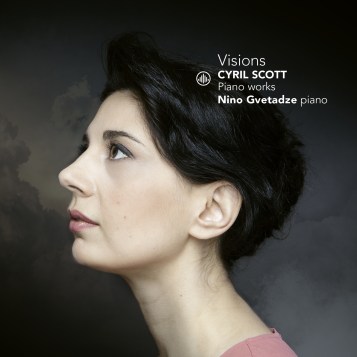
 For many pianists, our first encounter with the music of Cyril Scott is through his exotic, languorous piece Lotus Land. This was also Georgian pianist Nino Gvetadze’s first introduction to Scott’s piano music, through one of her teachers at Tbilisi Conservatory.
Scott’s music is rarely performed today, though Lotus Land remains a perennial favourite at courses and piano clubs (I first discovered it when a friend played it at a weekend piano course and was drawn to its impressionistic, Debussyan idioms). His characterful piano miniatures were popular at their time of writing, at the start of the twentieth century when a piano graced most drawing rooms and there was a keen appetite and fashion for small pieces and songs which could be enjoyed at home. Lotus Land was a novelty for its time; evocative of exotic Eastern places with its perfumed harmonies and black-key glissandi, it is based on one of Scott’s own poems.
Scott stood on the cusp of the modern era: born in the last quarter of the nineteenth century, as a student he heard Clara Schumann play, but his music and attitudes were forward-looking, even revolutionary. In addition to music, he also wrote poetry and copious prose on a variety of subjects from mysticism, religion and the occult to health and well-being. A vegetarian, he advocated alternative medicine and herbal remedies.

Both John Ireland and Eugene Goosens recognised Scott’s position at the forefront of modern British composers, a key figure who pioneered a move away from the stranglehold of nineteenth-century Germanic romanticism and a musical conservatism, and he was admired by Wagner, Debussy, Richard Strauss, Stravinsky and his lifelong friend and enthusiastic supporter Percy Grainger. But despite a prolific output of orchestral and chamber music, two operas, incidental music, and works for chorus, by the time of the Second World War, Scott’s music had declined in popularity, though he continued to compose, undeterred.
In her new recording of Cyril Scott’s piano music, Nino Gvetadze hopes to give the listener a glimpse into his musical imagination, which produced music which Debussy described as “an intoxication for the ear”. This disc is a selection of Scott’s piano music (Leslie De’Ath has recorded Scott’s complete piano music on the Dutton label), including the six Poems, Summerland, Op 54, and the Pierrot Pieces, Op 35. And of course Lotus Land in a dreamy, hauntingly sensuous reading by Gvetadze which for me evokes the drowsy humid heat of the east.
The influence of Debussy and late nineteenth-century orientalism is clear in Scott’s music. The listener could easily mistake pieces like Sphinx, The Garden of soul-sympathy and the two Pierrot Pieces for the work of Debussy, with their colourful, unexpected parallel harmonies and modality. Poppies from Poems has a Satie-esque eccentricity about it, while Summerland is redolent of Schumann’s Kinderscenzen or Faure’s Dolly Suite. Other pieces are more pedestrian and obviously English, all Edwardian drawing rooms, antimacassars and aspidistras with just a whiff of the exotic in their piquant rhythms and harmonies.
Gvetadze brings much colour, nuance, delicacy and grace to these piano miniatures, assisted by a lovely warm piano. Her sound is transparent, lyrical and elegant, and she is adept at highlighting the quirkiness and undisputed charm of the music, but there is a certain ‘sameness’ to Scott’s music in this selection which tires after a while. But Gvetadze is clearly a passionate advocate of this music, and as an overview of Scott’s piano music, this is an enjoyable, handsomely-produced collection. The CD includes interesting liner notes by Desmond Scott, the composer’s son.
Visions – Cyril Scott Piano Works | Nino Gvetadze (Challenge Records)
 R. Schumann – Works for Piano / Joseph Tong
 Dystonia: Franz Schubert – Sonata in A, D959, Robert Schumann – Kreisleriana / Andreas Eggertsberger, piano
 The beautiful packaging and handwritten note from the artist, embellished with pressed flowers, hinted at what was contained inside. For several days I didn’t want to open the package, it was so pretty, but when I did, I found something equally lovely, and intriguing too: an album of music, songs and poetry which reminded me of childhood holidays in Suffolk – by the sea at Aldeburgh or walking through the marshes and reed beds around Snape and Iken – and my parents listening to music by Benjamin Britten on their record player. And it is the music of Benjamin Britten which forms the basis of ‘The Wild Song’ – a musical and literary collaboration between soprano Marci Meth, pianist Anna Tilbrook, actor Simon Russell Beale and composer Mychael Danna.
 Britten was greatly influenced by the natural world, and specifically the coastal landscape of Aldeburgh and the windy, open marshes around the village of Snape where he lived and where he established the Aldeburgh Festival. One only has to listen to the Sea Interludes from ‘Peter Grimes’ to hear how much the sounds of the shoreline and the turbulent North Sea, the wind in the reed beds and birdsong infuse his music. His folksong arrangements are also rooted in the Suffolk landscape which he knew and loved so much, and 31 of them feature on ‘The Wild Song’, sung by Marci Meth with pianist Anna Tilbrook.
 Why did Schubert leave so much music unfinished? Was it the rapidity and volume of his compositional output that works were set aside, and not revisited? Did he feel dissatisifed or struggle with certain pieces? In this impressive debut disc, Israeli pianist Yehuda Inbar seeks to throw light on the conundrum of the unfinished piano sonatas by this most introspective composer by presenting the fragmentary Sonata in F-sharp minor, D571, and the ‘



 The Cross-Eyed Pianist