“Do not find yourself in the music, but find the music in yourself” (Heinrich Neuhaus)
Heinrich Neuhaus’s book The Art of Piano Playing is now available to read online. So, that’s my holiday reading for next week sorted…. Joking apart, this is still regarded as one of the most authoritative and widely-used books on the subject: my teacher regularly quotes from Neuhaus (and Matthay).
Neuhaus was born in the Ukraine in 1888, and though his parents were both piano teachers, he was largely self-taught. The biggest early influence on him came from his cousin, the composer Karol Szymanowski, and his uncle, Felix Blumenfeld. He also studied with Leopold Godowsky in Berlin before the outbreak of the First World War. In 1922 he began teaching at the Moscow Conservatory (where he was also director from 1935 to 1937). His pupils include some of the greatest pianists of the twentieth century: Emil Gilels, Sviatoslav Richter, Nina Svetlanova, Alexei Lubimov and Radu Lupu. His legacy continues today – through his pupils, his grand-pupils, great-grand pupils, and through the many teachers around the world who regard his book as the most authoritative on the subject of piano playing. His own playing was renowned for its poetic magnetism and artistic refinement.
Sviatoslav Richter talks at length about his studies with Neuhaus in the film Richter: the Enigma, directed by Bruno Monsaingeon.
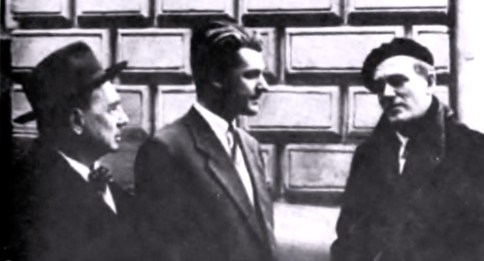
Heinrich Neuhaus with Sviatoslav Richter and Stanislav Richter
In a recent article in The New Statesman, Andrew Mellor whinged about racism, elitism, snobbery and exclusivity amongst classical music audiences. The basis of his argument seemed to be largely founded on the number of adverts for private schools in the BBC Proms programme. Myself, and quite a few other concert-going colleagues, Twitterati, music journalists and classical music fans have felt compelled to refute Mr Mellor’s anxieties by pointing out all the very good things about going to classical music concerts, operas and ballet.
Jessica Duchen has written an excellent article How to Be A Nice Audience, with her top 10 tips on “best practice” for audiences. Like me, she feels if Mr Mellor would stop feeling quite so paranoid about everyone around him at the Wigmore Hall or the Royal Opera House, he might enjoy himself more.
Sure, classical music concerts have their own ‘audience etiquette’, but so do rock concerts, jazz and folk gigs, poetry readings, stand-up comedy, theatre, fringe festivals et al. And if Mr Mellor wants snobbery and elitism, he should try attending the private view at a Mayfair art gallery (I know, I’ve done it!). Classical music has its own etiquette largely to ensure that most of us, including the musicians who have worked hard for weeks and months to present the music to us, have a good time.
One thing Mr Mellor seems to have overlooked, either intentionally or unintentionally, is that without the audience – snobby, elitist, elderly, racist or just there to have a great night out – there would be no concerts at all.
So let’s stop feeling paranoid about who’s sitting beside/behind/in front of us in the stalls, or who might be eyeballing us in the bar during the interval, and simply sit back and enjoy a few hours of quality music.
Here’s another article on this subject by a fellow blogger who tweets as @OperaCreep.
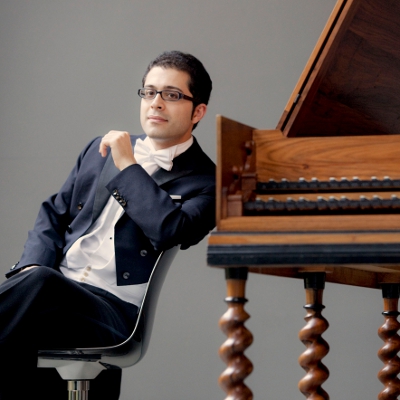
Who or what inspired you to take up the harpsichord, and make it your career?
I think it’s impossible for people involved with the harpsichord to deny the influence of Wanda Landowska (1879-1959). Landowska was the first to make the modern concert stage take it seriously, and, quite frankly, I wonder whether successive generations did plenty to kill the goodwill of the public that she had so painstakingly engendered. Her command, her confidence, her authority, her drama, her understanding of what a plucked string means – she is why I am here. I guess you could say that the decision to take it full on and make a career out of it had a bit to do with latent adolescent rebellion against parents who loved the Romantic repertoire…
Who or what were the greatest influences on your playing?
Probably my playing as a soloist has been most influenced by a lot of the orchestral recordings I grew up with. Otto Klemperer’s readings of the Bruckner and Beethoven symphonies go to the very depths of each piece without resorting to any formulae or cliches. Nikolaus Harnoncourt shows that it is possible to be historically-informed and yet not resign oneself from the messy business of artistic licence and an aesthetic principle.
What have been the greatest challenges of your career?
You would think that my answer would have something to do with the mainstream not taking the harpsichord seriously. I won’t say that hasn’t been a challenge, but so far the biggest challenge has come from fighting the dogmatism, ignorance, sensationalism, inability to embrace change, increasing emphasis on a star system at the expense of actual music, and general intellectual laziness of the so-called world of historical performance.
Which performances are you most proud of?
I’m proud (if that can be the word – delighted, happy?) when someone says to me that I can make the harpsichord sing. That’s me at my best – not fast fingers, not certain effects, but just the idea of the instrument singing and, might I add, speaking.
Do you have a favourite concert venue to perform in?
Where the spirit of the composer descends and in an act of transubstantiation inhabits our ears, our minds, our hearts, and, occasionally, my fingers (if I’m lucky), that’s the best place.
Favourite pieces to perform? Listen to?
I like to perform whatever is in front of me at the moment! To listen to, there’s nothing better for me than one of the Bach Cantatas, or Haydn’s Creation. Lately I have been listening to Elgar’s Chanson de Nuit on repeat; how can anyone write such a beautiful melody? I have to admit that I like salon music very much – Quilter, Sullivan, and all that. I recently heard Cesar Franck’s Piano Quintet – it’s a work of genius!
Who are your favourite musicians?
Sviatoslav Richter. He is like a bear at the piano – always struggling, fighting, taking risks, thinking out loud. Sometimes it works, sometimes it doesn’t, and it is always imparting his special genius. I always try hear and study everything by Nikolaus Harnoncourt.
What do you consider to be the most important ideas and concepts to impart to aspiring musicians?
To aspiring musicians, I can only say: focus only on your music and the quality of your execution and your message, and the rest will come. You will come into contact with a lot of young ‘musicians’ who think they need to dress the part, attend nice parties, and in general fit some sort of silly expectation of what artistry means, and I’m afraid it usually has to do with the bank of Mummy and Daddy. This is all nonsense. These people don’t believe in their musicianship. Even if you are destitute on the street and haven’t two coppers to rub together, you will always have your music, and that is more valuable than anything. I know a lot of voices say otherwise, but, really, trust me on this.
What are you working on at the moment?
I’m working on a very interesting harpsichord transcription of Bach’s A-minor Solo Sonata BWV 1004; it may have been made by one of his sons or, in all probability, by his student and son-in-law Johann Christoph Altnickol. I’ve also just gotten my teeth into another marvellously fiendish concerto by C.P.E. Bach.
What is your most treasured possession?
Right before I left university, my mentor George Houle gave me two very special things as parting gifts. One was a small booklet with a cover reading, ‘the Dolmetsch Concerts,’ which contains the various dates and programmes for a set of concerts performed by Arnold Dolmetsch and his family in the United States in the first decade of the twentieth century. These were amongst the first performances of music on period instruments ever attempted in the United States, and so it’s very precious. Dr. Houle also gave me a turquoise bolo tie, a piece of American Western fashion which I think is now rather passé – this belonged to Landowska’s American student Putnam Aldrich, who later went on to found the early music programme at Stanford. It’s a nice connection to those pioneers who started this whole movement, and for some reason the bolo tie in particular reminds me of my university years in California, which were very happy and eye-opening in every respect.
Several of my students have been learning and enjoying this well-known piece by the Penguin Café Orchestra, and so I thought it might be helpful to have some background.
The Penguin Café Orchestra (PCO) was a collective of musicians, founded by Simon Jeffes in the 1970s. It is hard to categorise their music, but it combines elements of exuberant folk music, and the minimalist music of composers such as Philip Glass and Michael Nyman. The music also contains references to South American and African music, and uses a variety of instruments including strings, pianos, harmoniums, slide guitars, cuatros, kalimbas, experimental sound loops, mathematical notations and more. A number of their works are very familiar as they have been used in film, tv and advertising.
Perpetuum Mobile is one of PCO’s most famous pieces, and comes from their fifth album, ‘Signs of Life’ (1987). The title is Latin for “perpetual motion” (or continuous motion) and in music it refers to two things:
pieces or parts of pieces of music characterised by a continuous steady stream of notes, usually at a rapid speed
whole pieces, or large parts of pieces, which are to be played repeatedly, often an indefinite number of times.
In both cases, there should be no interruption in the ‘motion’ of the music. Examples from classical music include the presto finale of Chopin’s Piano Sonata No. 2 in B flat minor. Marked “sotto voce e legato” (literally “under the breath and smoothly”), the entire movement is a musical stream of consciousness of unremitting parallel octaves, with unvarying tempo and dynamics, and not a single rest or chord until the final bars. The difficulty for the pianist, aside from keeping the triplets absolutely equal and even throughout, is the sotto voce (a fairly common marking in Chopin’s music) which suggests a muted sound. Careful pedalling will, in part, create the desired effect but the sound should never become woolly or muddy: we want to hear every single note. This movement has a strange and mysterious cast: Arthur Rubenstein remarked that the fourth movement is like the “wind howling around the gravestones”, and a pianist colleague of mine described performing it as “horrible – like having your entrails picked over on stage”. Interestingly, Chopin himself said of the movement: “The left hand unisono with the right hand are gossiping after the [Funeral] March” (source: James Huneker in his introduction to the Mikuli edition of the Sonatas). Played well it is inscrutable and brief; played badly and it’s just a muddle.
Here is Ivo Pogorelich, with a good view of his hands at work
Schubert’s Impromptu in E flat is another perpetuum mobile, at least in the outer sections (the middle section of the piece is a rough gypsy waltz), which, like the example by Chopin, is built from almost continuous triplets in swirling, tumbling scalic figures which never quite break free from the secure tether of the bass line. The difficulty in this piece, as in the Chopin, is keeping the triplets even, though with some give-and-take/rubato and dynamic shading to add interest: unlike the Chopin, there is prettiness and charm in this piece, and the dance rhythm of the bass line should be highlighted too. My problem when I was learning this piece (or rather relearning – I first encountered it in my teens) was lifting the fingers too high, which produced a chunky, “notey” sound and interrupted the flow of the music. It also made my arm tense. I taught myself to keep the fingers curled into the keys and to start with a slightly higher hand position: the result was a pleasing “trickling” effect in the long scalic runs, and the piece was far less tiring to play.
Pedalling is another issue in this piece, and I had a long discussion with a colleague about this, who kindly heard my Diploma programme ahead of the exam. In the end, I compromised on 1/8 pedal: like the Chopin Sonata, you don’t want a muddy sound (and I’ve heard plenty of live and recorded performances of this work with some very sloppy pedalling!). The beauty of this music, in my opinion, is the clarity of the writing, and the elegant song lines which are subtly embedded in the triplet figures. Careless or over-pedalling won’t highlight these interior elements to the listener.
A further danger of this piece is getting so caught up in the perpetual motion of it that you forget to breathe! This may sound daft, but I can confirm that in my Diploma recital, I probably played the restatement of the opening section on one breath. And in rehearsal one afternoon, my page turner was so absorbed in the music, he forgot to turn over the pages for me!
Walter Gieseking:
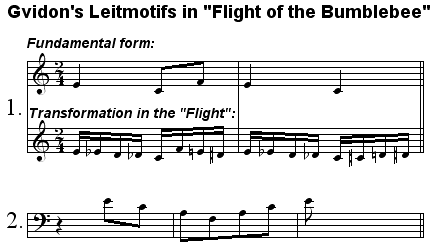
Perhaps the most famous example of a musical perpetuum mobile is Rimsky-Korsakov’s Flight of the Bumble Bee, an orchestral interlude from his opera The Tale of Tsar Saltan. This popular work, often performed as an virtuosic encore, consists of nearly uninterrupted runs of chromatic semiquavers, with leitmotifs (Givdon’s themes) from the opera. It is not so much the pitch or range of notes that present the challenge, but the sheer speed of it and the musician’s ability to move quickly around the notes.
(picture source: Wikipedia)
Other famous perpetuum mobiles from classical music include Debussy’s ‘Mouvement’ for piano (from the first book of Images), and Francis Poulenc’s Trois Mouvements perpétuels.
PCO’s Perpetuum Mobile is built on a simple repetitive melody which is put through several harmonic and textural changes, building in grandeur as it goes. The repetitions of the melody make it a hypnotic piece, but the changes prevent it from being boring. Instead, the accumulation of elements and orchestration make this an energetic and exciting piece to listen to, and to play.
A friend of mine has adapted the music for easy piano (Grade 2-3 level), and although simplified, the music retains key features from the original, including the harmonic and textural changes. After the introduction, the main melody is introduced and repeated in the right hand before the left hand joins in with a progression of stern chords in open 5ths and octaves. Further along in the score, and both hands play the melody unison, reflecting the string articulation in the original. The two-bar melody, which is scored in 7/8 and 4/4, contains an octave leap which might be tricky for smaller hands. However, this also offers a great opportunity to practice ‘rotary motion’: I get students to practice the second, 4/4, part of the melody first, as the smaller stretches make rotary movement easier to grasp.
Before playing a single note on the piano, we practice rotary motion above the keyboard, or even away from the keyboard. Many teachers and tutor books describe rotary as “turning a doorknob” (an old-fashioned round doorknob, obviously) or turning cooker knobs. But my teacher and I decided the movement was more like the windscreen wipers of a car: it’s an “out-in” movement rather than “in-out”. To practice it at the piano, start in a 5-1 position, G-C (either Middle C position or an octave higher, if more comfortable), and place the hand in a “karate chop” position on the G with the fifth finger. Allow the hand to “flop” onto C with the thumb, and repeat. Encourage the student to watch the movement of the wrist: if the wrist isn’t moving, it ain’t rotating! Speed the movement up so that the student understands that it is the rolling (“rotary”) movement of the wrist that makes the sound, rather than the fingers. Keep the wrist and hand flexible and soft throughout: this will also help achieve a good tone.
Everyone I’ve taught this piece to wants to play it fast, but to try and play it up to tempo before you have practised rotary motion and grown comfortable with it will lead to tension in the hand and possibly pain. Keep the tempo sensible and perfect the rotary motion and good legato-playing before cranking it up. Meanwhile, enjoy experimenting with different dynamic levels for dramatic effect. The unison section should be light, nimble and nicely articulated to achieve the effect of the strings from the original.
The Cross-Eyed Pianist is free to access and ad-free, and takes many hours every month to research, write, and maintain.
If you find joy and value in what I do, please consider making a donation to support the continuance of the site








 The Cross-Eyed Pianist