Photoshoot2 008 copy SMALL

Who or what inspired you to pursue a career in music?

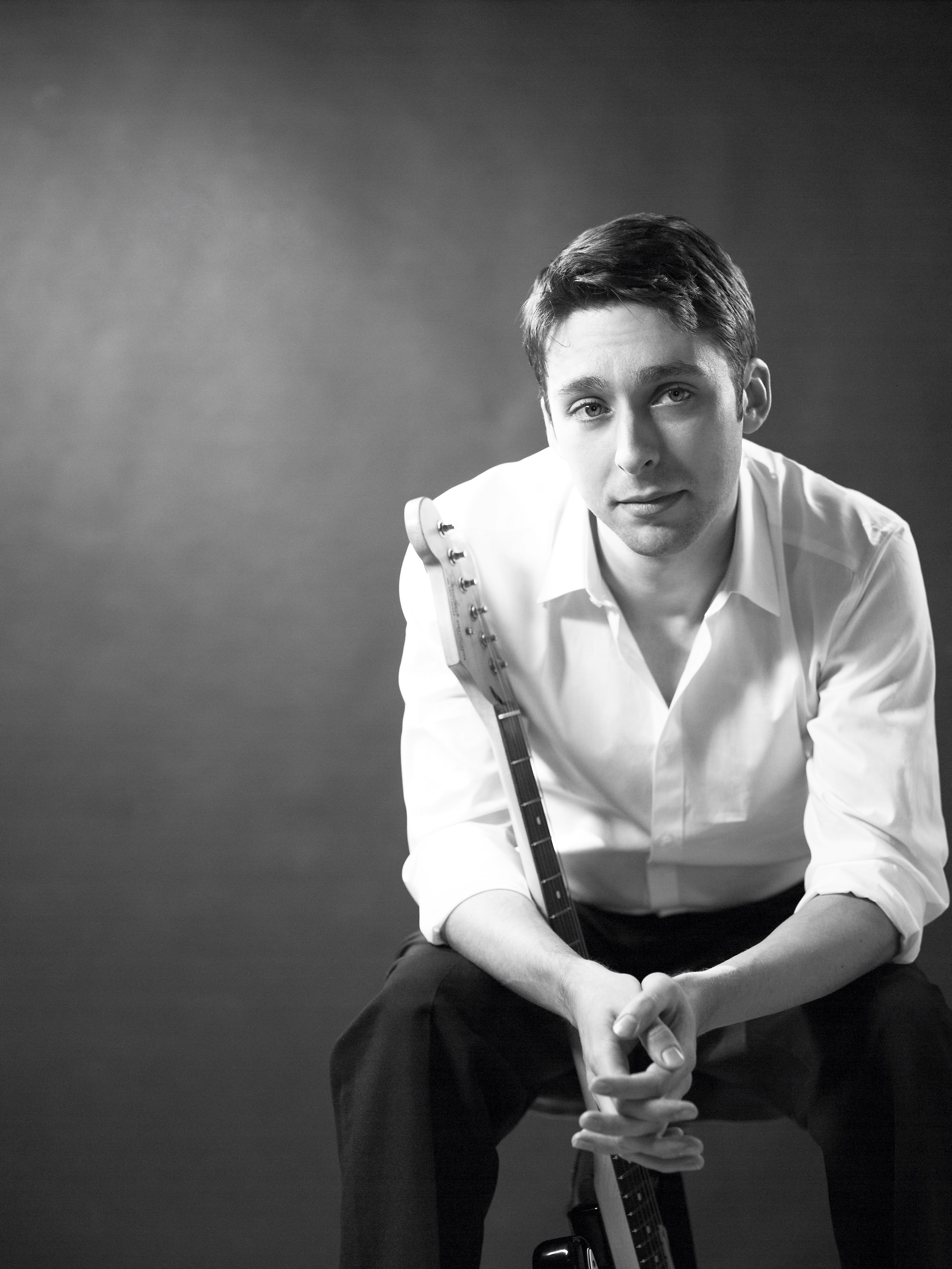
My mum is a huge fan of Rock and Metal. In the late ’80s she started playing Guns n’ Roses in the car, and once my ears had heard that, there was simply no unhearing it: all this swearing, and amazing guitar solos! I just wanted to be Slash from that point onwards, perhaps eclipsing my previous desire to be Indiana Jones. Only recently it occurred to me that there was a second, more important factor involved. My little sister had just the year before decided she wanted to learn classical piano, and had begun taking lessons. Without this, I don’t think it would have occurred to me that learning an instrument was a possibility. So credit (or blame?) is definitely due here.

Who or what were the most important influences on your musical life and career, as both guitarist and composer?

When I went to university I’d already been playing the guitar in bands and writing songs for about 10 years, and I felt pretty confident about my musical abilities. This American dude who lived in my halls very kindly lent me a cassette of Pierre Bensusan’s album ‘Intuite which, as a guitarist, was pretty much like a kick in the face. So I got to work putting a lot of things right about my approach to the instrument. Come to think of it, this is quite possibly why I messed up my Psychology degree…

In terms of composing, I was always more influenced by piano music than guitar, and often tried to emulate that expansiveness as best I could on 6 strings. Rachmaninov’s preludes were like a gateway. Soon after, I bought a fantastic double CD of Debussy’s piano works performed by Pascal Rogé, which I played interminably. But it was a few years later again that I went to see (and this is probably such a cliché) Ravel’s quartet performed by the Tokyo Quartet. I can’t explain how much that instantly changed everything, another massive kick in the face. I realised that for me it wasn’t really about the guitar, but the music I was writing.

What have been the greatest challenges of your career so far?

Probably making that transition from what was becoming a very promising solo guitar career to starting from scratch as a composer. I’d always written music in one form or another since I was about 10 (in fact that’s all I really did), but leaving the guitar and myself as a performer out of the equation was at the same time incredibly liberating, and an enormous learning curve.

I’d also never formally studied music, so when I began to get private composition lessons to try and clear some things up, my head was suddenly filled with all those crippling doubts and questions that you probably get from going to music college (which is essentially what I was getting at in my article for Sound and Music). Overcoming all these questions – or at least to an extent: I think it’s important and healthy, in fact, to question what you do – was probably the next major challenge!

Which performances/recordings/compositions are you most proud of?

Although it’s now some years old, and in a style which is like an old musical version of me, my album ‘Nymph Suite & Other Stories is probably the recording which I’m most proud of. Every few years I come back to it, and I’m always pleased that it’s mine.

Otherwise, it’s generally my latest few pieces that I’m excited about, inevitably. I’m currently working on a piece called ‘…and the stars were like pinpricks in the black fabric of night…‘ for Ed Hughes’ New Music Players (premiered in September 2015). I also have a number of EPs containing some of my music from the past 5 years, which I’ll be releasing over the coming months, so this is quite a focal point for me at the moment.

Which particular works do you think you perform best?

Recently, the musical project which has been getting the most attention and outings is my trio Le Juki

It’s not necessarily very technical guitar work, but I really love the music we write, and we’ve put a lot into our live show, so this is probably where my heart currently lies, performance-wise.

How does your performing influence your composing, and vice versa?

As I was teaching myself to fingerpick, I would let the music I was writing dictate which skills I needed to develop in order to make this happen. So it was always this way round: rather than using the tools I had available to write some music, I would invent new tools to fulfil my musical ideas. Later, when I started composing for other instruments, I actually found that my playing began to influence my writing too much. I had to really abandon the guitar as I couldn’t help but think of music within the bounds of what was possible on the fretboard.

At the same time, some interesting things have come of it. In my guitar music I have a strong tendency to play melodies across the strings. By this I mean that each successive note is played on a different string, providing the greatest possible resonance, akin to the sustain pedal on a piano. When I write for more than one voice, I often find this tendency feeding into my work, with melodies sort of hocketed between the players… kind of a pointillistic approach to single line, perhaps.

What are the particular challenges and pleasures of working on a commissioned piece?

I’ve had the real pleasure of being involved with the organisation Sound and Music for the last three years, and through them I wrote for the London-based choir MusArc – here’s the piece I wrote them –

]. They’re an amateur experimental choir, so the real challenge posed here was trying to guage the overall ability of the singers, and to balance sections when you never knew how many people from each would turn up! At the end of the day though, as well as being an exciting choir, they’re really a fantastic group of people to work with, so this was an amazing experience. Currently I’m working on a new piece for vibraphonist Joby Burgess, so it’s a completely different game: solo, professional musician. There are still challenges, as there are in writing any piece, but in a way it’s much simpler. There are far fewer uncertainties.

Over the past few years I’ve been working with geometer Sama Mara on a project called A Hidden Order [http://musicalforms.com/]

In short, this involved exploring the relationship between music and geometry, through writing a suite of chamber works that directly translate into geometric forms. This collaborative compositional process meant that I would draft a score for a piece, and Sama (who isn’t a composer: he deals with shapes) would send back revisions like “could you change the second note of every bar, as it will improve the symmetry of the image”. So you can imagine this posed enormous compositional challenges! This was really a unique way to work, and not always easy, but I think what we ended up with is something really very special, and quite honestly unlike anything else I’m aware of.

But in general, when we talk about pleasure, I mean, I have to write music, it’s like an innate need, and if there’s not music going on in my life then pretty fast I become unhappy. So writing music, it’s more than a pleasure, it’s all I want to do.

What are the particular challenges and pleasures of working with other musicians, ensembles etc, as both composer and guitarist?

I come from a background of playing in bands, where we would rehearse the same material for 2 years, and gig it every night for another 2. Similarly, playing my own music on the guitar, I would rehearse it until I felt it was ready to perform. That’s just not even nearly the case in the world of new music, and I still find this lack of contact and rehearsal time very frustrating. But that aside, it’s (almost) always an enormous pleasure to witness your music come to life in the hands of others. When you’re in the act of playing it yourself, it’s impossible to hear it with the same ears.

Do you have a favourite concert venue to perform in and why?

I really don’t think it’s about the venue, but the audience. I’ve had the fortune to play some fairly big stages and some prestigious venues over the years, and these can be great fun, but probably my favourite to date was a solo guitar gig I gave to an audience of about 15 people in a small cafe in Folkestone some years back. It was so intimate and relaxed, by the end of the gig everybody knew everybody else. And someone even bought a whole box of my CDs for all their friends who couldn’t make it! So that was pretty cool too…

Favourite pieces to listen to?

I mean, how long have we got?! I listen very, very widely, and not always to things I like, which is a part of exploring what’s out there. But currently my favourites include Martin Suckling’s ‘Candlebird [https://www.youtube.com/watch?v=xKQUiu_v8cA], Poppe’s ‘Welt [https://www.youtube.com/watch?v=9QLGUDzpevI], some of GF Haas’s works [https://www.youtube.com/watch?v=YseRwBugmeU], early Britten [https://www.youtube.com/watch?v=Y-Szv5TEBhg&list=PLXIW-zGxtii0JxJW4UAYcSlgrW-u5H2lf], lots of music by Kit Downes [https://www.youtube.com/watch?v=eWiDlVRQR5k], Nik Baertsch [https://www.youtube.com/watch?v=N4jlBEGLtWw], Kurt Rosenwinkel [https://www.youtube.com/watch?v=ucMGT3jvzZo] (a lot of Jazz, in fact), early Smashing Pumpkins [https://www.youtube.com/watch?v=0SmOcvLBVoI], James Orr Complex [https://www.youtube.com/watch?v=D8NqyfVbcJg], Meshuggah [https://www.youtube.com/watch?v=YmpUNQYwxBg], Kate Bush [https://www.youtube.com/watch?v=JWy8nONlh_Q], J Kriste Master Of Disguise [https://soundcloud.com/louvana/kindness], the Sutartines of Lithuania [https://www.youtube.com/watch?v=Byf4aZ1AdW0], Martin Butler’s ‘Songs & Dances From A Haunted Place [https://www.youtube.com/watch?v=4nb77gx3K38]… Ravel’s chamber works are never too far away… I’m also really enjoying WQXR’s ‘Meet The Composer‘ podcasts [http://www.wqxr.org/#!/programs/meet-composer/], and Bob Gilmore’s ‘Tentative Affinities. [http://www.bobgilmore.co.uk/]

Who are your favourite musicians?

Again, this could potentially be a big list… Le Mystere Des Voix Bulgares (obviously that’s a whole choir, but they knock the socks off just about anyone else), Pierre Bensusan, Pierre-Laurent Aimard, McCoy Tyner, Yamandu Costa, Magic Malik… man, when I read this, I know I’m gonna be like, “why the hell didn’t you mention these guys?!”… In fact, there are a number of players more local to Brighton who have not just been hugely influential to me, but are also some of my all-time favourite musicians, including flautist Philippe Barnes and violinist Ben Sarfas.

What is your most memorable musical experience?

My recollection of my life to date is pretty much a long stream of musically-related experiences, so I’m not sure I can single one out like that…

What do you consider to be the most important ideas and concepts to impart to aspiring musicians?

I teach a lot of guitar. If I had to summarise what the number one goal was when I teach, I would say it is to develop musical independence in my students so that they no longer need me. Basically, doing myself out of a job. The most important skill, I believe, is being able to teach yourself what you need to know, because then really there are so many doors open to you. I also think learning this skill from someone is key, so I’m not advising people to just teach themselves from scratch – you can develop some pretty inhibitive playing habits that way.

I would also say that, alongside having some kind of specialisation, it’s very important to listen as widely, and play as much music of as many different styles, as you can. And that goes beyond music. I always remember this quote of Lichtenberg (I can see this sounds unavoidably nerdy) that goes “He who understands nothing but chemistry does not truly understand chemistry either”.

Finally, a friend once told me this very useful concept. To get by as a musician (or perhaps anything), you need to have any two of the following three things – you don’t necessarily need all three, but one on its own won’t do: a) be good at what you do; b) be a nice person; c) be reliable. You can work out the combinations yourself…

Where would you like to be in 10 years’ time?

I’d like to still feel inspired, still be learning, and hopefully watching my kids get into music too.

What is your idea of perfect happiness?

Probably that point in the compositional process when everything’s like “YESSSS!!!!”, which usually occurs just before everything’s like “NOOOOOOO!!!!!”.

What do you enjoy doing most

I love riding my bike, it makes me feel like a kid in summer holidays again, and is synonymous in my mind with freedom. So riding my bike around town with my daughter Alma on the back singing songs to me is pretty high up there on the list of ‘Best Activities Of All Time’.

What is your present state of mind?

Mildly drunk, and in a dense mist of fatigue.


Finding clothing to perform in which is stylish, flattering, and, above all, comfortable and practical can be tricky and high street stores tend not to cater that well for performers. We need clothes which allow freedom of movement, which do not distract us when we play (there is nothing worse than a tickly label or zip), which look good when we stand to take a bow and when we are seated at the piano. The type of venue and time of day also dictate what to wear: one does not need a full-length evening gown for a lunchtime concert, for example.

It’s much easier for the men. Now that the very formal attire of white tie and tails has largely disappeared, men can choose to wear a dark suit or dark shirt and trousers. Some favour a dark tee-shirt under a dark jacket, others tend towards the Nehru jacket. .

Women, on the other hand, are still expected to turn out in full-length gowns which hark back to the age of Dame Moura Lympany. There are of course exceptions: the Chinese pianist Yuja Wang has made a name for herself almost as much through her daring dresses and vertiginous stiletto heels (how on earth does she pedal in them?) as through her playing. She has been criticised for her risky hemlines, but as she herself says “I can wear long skirts when I’m 40”; she is a young woman who clearly loves fashion and has an enviably svelte figure.

wang_2812135k
Yuja Wang (photo: The Telegraph)

Sadly, I do not have the body and legs of Yuja wang, so I prefer concert clothes which cover my legs, draw attention away from the “lumpy, bumpy” parts of my middle-aged body, and which make me feel graceful and elegant and, importantly, comfortable when I perform. Tight bodices or restrictive sleeves are a no no, as are strapless dresses (and frankly I don’t have the gym-honed arms for such attire). The British women’s fashion chain PhaseEight creates elegant and affordable maxi dresses in a fluid silky jersey fabric which are flattering and comfortable to wear. They also offer more formal full-length gowns, embellished with sequins and beads, for special occasions. I have also worn long skirts by Ghost: their signature “bias cut” dresses and skirts suit most sizes and shapes, and their crepe fabric packs well for travelling – another consideration if you’re a musician who lives out of a suitcase.

KATHLEEN_dress-310x403
‘Kathleen’ dress
Alert to the needs of musicians, a new clothing company called Black Dress Code has launched a collection especially for musicians. Those who play in orchestras or sing in choirs are well aware that a fairly plain black outfit is the dress code for such organisations and Black Dress Code has created stylish and practical clothes with this in mind. In addition to the very elegant full-length black ‘Kathleen’ dress, there are midi dresses, a jumpsuit and palazzo pants (especially useful for cellists and bass players), simple black tops with 3/4 sleeves and silky sashes to enhance skirts and trousers. The designers have clearly thought about what musicians do with their bodies when playing and how clothing “interacts” with gestures and movements. There is a small range of skirts for girls, and a men’s range is in preparation. My only criticism is that the largest size is a UK 16 (because, sadly, some of us do not have the slim proportions of Yuja Wang or Khatia Buniatishvilli). If you’re looking for something to wear for an audition or ensemble work, I would certainly recommend taking a look at Black Dress Code’s collection. When I posted a link to BDC’s site on Facebook, many of my female colleagues and friends reacted very positively and enthusiastically to the collection.

View the Black Dress Collection here

On 20 June 2016 St John’s Smith Square announced its 2016/17 Season. With over 300 concerts and many individual series, workshops and strands, this season further strengthens St John’s Smith Square’s core mission: to be a centre of excellence for chamber orchestras, choral and vocal music and period instrument groups. St John’s Smith Square also plays a vital function in presenting new work (with over 30 world premieres already announced for 16/17) and supporting emerging artists (including an own-promoted Young Artists’ Series).

There is plenty to interest and excite lovers of piano music: the popular and excellent International Piano Series will continue at SJSS, its temporary home while the Southbank Centre undergoes refurbishment. IPS highlights include the outstanding young British pianist Benjamin Grosvenor (4 October 2016), runner-up at the 2010 International Chopin Competition Ingolf Wunder (19 November 2016) and winner of the same competition Yulianna Avdeeva (29 March 2016). Pierre-Laurent Aimard and Tamara Stefanovich perform music for 2 pianos as part of Southbank Centre’s year-long festival Belief and Beyond Belief in partnership with the London Philharmonic Orchestra (24 January 2017). This concert also forms part of Southbank Centre’s International Chamber Music Series.

In addition there will be performances by other pianists, including SJSS Young Artist Christina McMaster, Zubin Kanga, Geoffrey Saba, Rolf Hind, Howard Shelley and Martino Tirimo.

Richard Heason, Director of St John’s Smith Square said: 

“I am thrilled to be able to launch another season packed with exciting and stimulating concerts. It is particularly exciting to see international partnerships, with groups like Les Talens Lyriques and Stradivaria, starting to come to fruition. I am very keen to ensure that St John’s Smith Square presents a dynamic and individual programme and that we devote our energy to ensuring we present top quality artists. Alongside the distinctive baroque programme we offer it is also very rewarding to welcome artists presenting contemporary music and commissions. My sincere thanks go out to all those partners who have collaborated to make this programme possible. St John’s Smith Square receives no public subsidy and so we are reliant on the friendship and support of those who believe in our mission to be one of the UK’s leading concert halls.”

Pianist, composer and teacher Peter Feuchtwanger has died. I never met Peter, though I wanted to, but I felt a connection to him and his wisdom via my teachers who studied with him, and also via pianist friends and colleagues who were taught by him and spoke of his inspirational, sympathetic and experimental approach to piano technique and piano playing.

In addition to his own piano studies with Gerti Rainer (a pupil of Emil von Sauer), Max Egger, Edwin Fischer and Walter Gieseking, Peter Feuchtwanger also studied composition with Hans Heimler (a pupil of Alban Berg, Heinrich Schenker and Felix Weingartner) and Lennox Berkeley, as well as Indian and Arabic music and philosophy. His Studies in an Eastern Idiom (Tariqas) and Variations on an Eastern Folk Tune are inspired by Eastern folk and art music and demonstrate inventive use of the piano’s sonority, texture and pedal effects to suggest Arabic, Indian and other Eastern instruments, styles and motifs.

Largely self-taught, he formed his personal conclusions about technique through experimentation that was free from the dogma or narrow approach of “schools” of piano teaching or formal musical training. As a consequence, he was regarded by some within the profession with suspicion, while those who studied with him and absorbed his wisdom are full of praise for his ability to think outside the box of traditional piano technique and talk of the transformative power of his teaching.

Most people are slaves to technique. But technique is not about playing mechanically and quickly, it is also about tone-balance, colours…. – Peter Feuchtwanger

His piano exercises were developed to relax the hand without making it completely powerless. The specified fingerings encourage the smooth, elliptical, natural choreography of the hands and fingers, and allow the instrument to be played with the greatest relaxation of the body, resulting in tension-free playing and a beautiful sound.

Touching tributes from some of his former pupils

I will never forget the kindness shown me by Peter Feuchtwanger……..without his guidance and generosity of soul I doubt I would be a musician today. He criticised perpetually (with characteristic vibrancy and charm), strove to make me realise my finest self, instinctively understood me, was a considerate listener, was a fountain of naughty jokes, never doubted me and proved to be far more than merely my piano teacher.

You haven’t died, Peter; your legacy lives with the vitality of every string set into vibration by the many pianists who’s lives you touched.
RIP (DG)

….his vast knowledge of styles of playing, along with his unique technical approach, have been incredible for my development, and I’m constantly amazed at his generosity, and commitment to teaching. (DR)

He brought out the absolute best in his pupils by his unquestioning faith in his pupils’ abilities, and his loyal support and generosity of time. The universal truth in his technique will live on in his many hundreds of students. (WMS)

Great teachers never die: their wisdom and enduring legacy is passed down to their students, and continues through successive generations of pianists.

Bel Canto on a percussion instrument – article by Peter Feuchtwanger