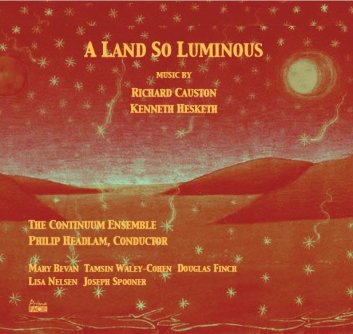
A Land So Luminous – music by Richard Causton and Kenneth Hesketh, performed by The Continuum Ensemble under the direction of conductor Philip Headlam with outstanding soloists including soprano Mary Bevan, violinist Tamsin Waley-Cohen, pianist Douglas Finch, flautist Lisa Nelsen and cellist Joseph Spooner.
The disc features work for large ensemble, duos, trios and music for solo flute, cello and piano. Kenneth Hesketh and Richard Causton are amongst the foremost British composers of their generations, and ‘A Land So Luminous’ showcases their distinct compositional voices and musical craftsmanship, from Hesketh’s piquant, light-filled textures to Causton’s inventiveness and imagination. The music on the disc is diverse and atmospheric, and draws inspiration from an eclectic catalogue of sources, including Heinrich Hoffman’s 19th cautionary tales for children, Der Struwwelpeter (‘Shock-Headed Peter’), the poetry of Marina Tsvetayeva, Fats Waller, shamanic ritual and Mozart’s Clarinet Concerto, K. 622. The title track ‘A Land So Luminous’ takes its name from a piece by writing by 17th century French philosopher-poet Cyrano de Bergerac.
All the works on the disc reveal strong musical gestures and means of expression. Hesketh’s works are expansive, visual and colourful: in Die Geschichte vom Daumenlutscher (‘Don’t Suck Your Thumb’) clarinet and piano dart and weave in a playful yet faintly grotesque dance; while in the second ‘Netsuke’ long sustained sounds emerge overlaid by a wistful clarinet melody gradually build to an unsettling climax. Causton’s ‘Threnody’ is a haunting setting of the English translation of a poem by Marina Tsvetayeva. The piece relies on the musicians being sensitive about their roles, resulting in a work of concentrated poignancy. Mary Bevan’s crystalline yet highly expressive voice is complemented by elegaic clarinets and a delicate piano part. In ‘Sleep’, a work for unaccompanied solo flute inspired by a poem called ‘Mythistorema’ by George Seferis, Causton creates an unsettling aural image of sleep, beset by frequent changes in time signature and tempo. Lisa Nelsen, on flute, displays control and sensitivity in her performance. The night-time theme continues in ‘Night Piece’ for solo piano, based on the clarinet line from the slow movement of Mozart’s Clarinet Concerto and performed by Douglas Finch, who brings a delicate clarity and tenderness to this dreamlike work.
Pianist friends Alison Bestow and Claire Vane have set up a brand new adult piano course. I caught up with them to find out more about their new venture….
Why did you decide to establish a new piano course?
Claire: We wanted to have the opportunity to attend more piano courses, and we were looking for a course in the Easter holidays, but there were very few available. We decided to run our own course, with all our favourite ideas from the other courses that we have enjoyed. We love big, exciting projects, and this is our latest joint enterprise.
How did you go about finding the venue?
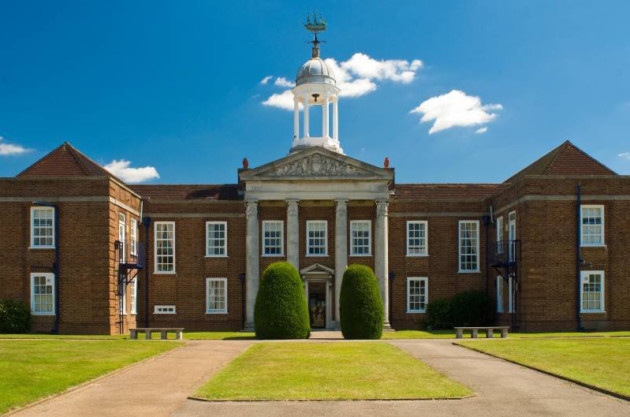
Alison: We approached many venues in Suffolk and Cambridgeshire that we thought would have the facilities that we were looking for, including the right number of pianos, a concert hall and comfortable residential accommodation on site. Initially, we had huge difficulties finding a venue because most schools and Cambridge colleges are booked several years in advance, often to bigger courses. We were really lucky to find the Royal Hospital School, Holbrook, which ticks all the boxes. We have been given full run of their state of the art music block, and the staff there have been very helpful.
Claire: The location is really beautiful, on the side of the river Orwell with spectacular views, so the environment should be inspiring as well.
Who are the tutors and how did you go about finding them?
Claire:Warren Mailley-Smith has been my teacher for the last 3 years and he is very keen on master classes and teaching adults. Penelope Roskell has been a friend of mine since I was a young teenager and we were both Saturday morning exhibitioners at the Royal Northern College of Music. Penelope has subsequently pursued a professional career in music as a concert pianist and later Professor of Piano at Trinity Laban Conservatoire of Music and Dance. Penelope is particularly interested in posture and tension-free playing and is a great exponent of yoga too.
Are there any other tutors at the course?
Alison: I currently have yoga lessons with Izzy Ixer and I was talking to her about the course and she thought it was a great idea and had lots of ideas for using yoga to help with relaxation and performance nerves. Another friend of mine, Claire Weston, was a principal soprano at ENO and she offered to come along to teach about being an accompanist as this is a skill that lots of pianists don’t get chance to practise. They are both highly experienced teachers and I know that their lessons will be great fun.
What are you going to be doing on the course?
Claire: Well, apart from masterclasses and individual lessons in piano, accompanying and yoga, there will be a lot of socialising, eating, drinking, practising and some relaxation. The facilities at The Royal Hospital School in Ipswich are amazing so we’ll have the opportunity to walk in the grounds and even the chance to swim if there is any space between master classes and having fun.
Alison: I am hoping to meet lots of other piano-mad people, make some new friends and play some piano duets. I’m looking forward to playing one of the grand pianos in the beautiful recital hall at the school.
I am very intrigued by the name ‘Pianissimi’ – how did you arrive at that name?
Claire: We wanted a name that conveyed the piano, and as music notation is largely in Italian, we wanted something with an Italian element. We thought that as this was a group event, we’d go for Pianissimi, signifying the plural rather than Pianissimo, and thought it was a bit different and the Italianates amongst the pianists would smile. It also conveys a sense of gentleness and softness, which is the atmosphere we’d like to convey – one of informality and security rather than loud and brash.
Is this a profit making venture?
Alison: We are doing this just for fun, and we have decided that any surplus made will go to Cancer Research so no, this is not a profit-making enterprise.
Who is this course aimed at?
Alison: We want the course to be very inclusive for anyone who loves the piano as much as we do, so we are suggesting that attendees are grade 7 onwards and including diploma level and post-diploma. The levels of experience and performance will be varied, but we want to ensure that everybody feels comfortable and confident playing in a group. The course is also ideal for those with a specific aim, such as preparing for a graded or diploma exam, or getting ready for a particular performance. There will be lots of performance opportunities for those who want them. But there won’t be any pressure on people to perform if they don’t want to.
Where can we find out more?
Claire: All the information about the course is on our website:
Our contact details are also on the site, so I hope people will get in touch if they want to participate and if they have any other questions. If you, like us, are a piano nut, do come and join us at Pianissimi during the Easter holidays in 2017.
Pianissimi
Course dates: 5.30 pm on Thursday, 20th April 2017 to 4 pm on Sunday, 23rd April 2017.
Location: Royal Hospital School, Holbrook, Suffolk IP9 2RX. There are good rail connections from London
Cost: £450 per person to include all tuition, full board and accommodation in the Royal Hospital School, Holbrook, Suffolk.
Benjamin Ellin, the award-winning and critically acclaimed British conductor and composer, has been commissioned to create a classical composition focusing on the concept of peace and this year’s centenary of the Battle of the Somme. The resulting Oratorio One Before Zero is one movement for orchestra, solo baritone, solo mezzo soprano and boys’ choir.
(picture source: 1914.org)
This large-scale musical narrative work is inspired by the moment before battle, before zero, zero hour, the time at which hostilities commence. Benjamin Ellin explains: “It’s the time when all that is known can be turned upside down and where a world of emotions dominates the mind and soul of any soldier”.
The work is in English, French and German and aims to illustrate musically and linguistically how the race to war, the loss of life and the destruction of humanity affected all sides in this devastating war.
Benjamin explains the inspiration behind the new work: “The Imperial War Museum provided a great deal of the research materials that helped inform my understanding of the period and I used the archives of Royds Hall School in Huddersfield which was a military hospital during WW1. I enlisted the talented writer Ben Maier to help me ensure the work flows as a continuous and complete line. The work has a personal connection too. My great relative, Private Samuel Vincent Boot (No. 19463) was killed in WW1. I used his army number to develop a lot of musical material and develop the narrative.”
The performance will take place on 11th November 2016 at the renowned Maison de la Culture in Amiens in Northern France which is located just behind where the front line was established in WW1. A second performance is scheduled on 12th November 2016 in Beauvais, Maladrerie Saint-Lazare.
In this Meet the Artist interview, Benjamin discusses his musical influences, the challenges of his career as a composer, and the creation of ‘One Before Zero’.
Who or what inspired you to take up composing, and pursue a career in music?
I heard a performance of the Nutcracker at the Royal Ballet as a young boy – my mother took each of us (myself and my two older sisters) to see a ballet when we were young by way of a musical intro – and I was hooked. I persuaded her to buy me the tape recording in the shop and listened to it constantly. Whenever I hear a great piece of music, in whatever genre, I just want to write music or do something creative.
Who or what were the most significant influences on your musical life and career as a composer?
There isn’t one single thing. My initial musical impulse often comes from the environment I am in or the world events of our time. I also love the sounds that are around us generally and how they often turn in to little musical ideas all by themselves. For instance, one of the tracks from the TAFAHUM album ‘Osmosis’ is inspired by the sound of the Victoria Line tube at Highbury and Islington; the piece is called Three Fishes Laughing.
What have been the greatest challenges/frustrations of your career so far?
Being pigeonholed really – or people trying to. For me, music is genuinely indivisible and once you try to put people in to boxes you are missing the point. Sadly it seems, at times, this obsession is a by-product of lazy elements of the ‘business’, but I have always believed that the most inspiring characters around do more than one thing and I genuinely just happen to love and feed off different musical arenas.
What are the special challenges/pleasures of working on a commissioned piece?
The shape of a piece is very important. Once the overall structure is set in your mind, even if it changes slightly in the process of being realised, you can really start to write it out. For ‘One Before Zero’ that really was the main issue; deciding on the form and arch because after that a lot of decisions have been made for you. The challenge is knowing what to not use or not do and structure helps that process of illumination a lot. Pleasures? I love harmony and the juxtaposition of chords and the resonances they have; that and treating the audience to the theatrical elements of music so they are – hopefully – truly gripped and engaged.
What are the special challenges/pleasures of working with particular musicians, singers, ensembles and orchestras?
If you have a relationship with a performer or a group then you can try and build the musical material around them in subtle ways; this is a joy. A challenge is to always respect the skill and talent of the musicians. They have to play your music and you hope that they actually want to. I don’t believe music is all about the composer in an egotistical way but always about the collective.
Of which works are you most proud?
I am proud of my Violin Concerto which was premiered last year with the Philharmonia Orchestra, my Trombone Concerto for Joseph Alessi, my tracks on the TAFAHUM album ‘Osmosis’ and the works I have written in conjunction with Violist Rivka Golani and the people of the Siksika nation in Canada – amongst others…
How would you characterise your compositional language?
That is a difficult question – in fact, all these questions are! In short a mix of Stravinsky, Shostakovich, Britten, Vaughan Williams and the jazz world of Miles Davis and Count Basie amongst others. Jazz and blues were major influences growing up in that they were the main style of music that I heard and I still love them. In general, as a composer, I don’t seek to reinvent the wheel but I’ll always express myself as honestly and boldly as I can.
How do you work?
It largely depends on the piece or the commission. Sometimes a solid idea for a gesture within a piece starts the process and other times I have to work relatively slowly. Waiting for inspiration is all well and good, but sometimes it doesn’t always flow and you have to then rely on your technique – however good it is – when a deadline is there! I also like to sow ideas in my mind and let my subconscious chew them over for a bit; they nearly always find a way of becoming a key part of the process.
Please tell us more about your new work ‘One Before Zero’, to be premiered on Remembrance Day.
In short it is a large oratorio for orchestra, solo baritone, solo mezzo and SATB male choir to commemorate the Battle of the Somme.
Not so short, well, subconscious played a major part here too. I first worked in Amiens several seasons ago when I wrote two smaller pieces for a new festival there. As soon as I went on a research trip I was hooked on the area, the cathedral and the history of World War 1. I knew I wanted to write something about it and that was a good start for mental gestation! Then I had the chance to work with the orchestra in Picardie as both a composer (I wrote a new work for them) and also as a conductor in several performances. Therefore I got to know the players a little and I also got to work with their Music Director Arie. By the time the commission came I had soaked a lot up about the people, the area and so I could start from a decent place. The desired use of an all male SATB choir provided another set of options for the work as it was clear to me that the choir should be the soldiers and the baritone soloist is one of them whilst the mezzo represents the home front, picking up the pieces and trying to make sense of everything that was going on through the mirage of propaganda and misinformation through media…how things change!
Then, after lots of reading and textual research I decided on the structure of the piece. The soldier (baritone solo), drained, exhausted and battle-hardened from war stands at the front of the stage. Gazing out at the audience he begins to question who are the people across the stretch of no man’s land in front of him who he will shortly be ordered to attack, to kill, or indeed be killed by. Who are they? Are they anything like him? How did he get to this point where a mere order from a higher rank can result in him, a hitherto ordinary man, attacking with such aggression and ferociousness.
This awakening marks the start of the work. The title itself (ONE BEFORE ZERO) underlines the importance of this moment before battle, before zero, zero hour – the time at which hostilities commence – when all that is known can be turned upside down and where a world of emotions can surely fly through the mind and soul of any soldier.
The text is also a mixture of source letters, propaganda and diary entries from the time and also a number of commissioned texts by Ben Maier – a writer who I work with regularly. The new texts help knit everything together and I wanted to move away from using war poetry as it had already been done several times. The piece is in three languages, English, French and German as the aim of the piece is to underline the human cost on all sides of this conflict.
What is your most memorable concert experience?
Again, there have been many for all sorts of reasons. I think my first concert as a conductor at the Philharmonic in St Petersburg was very special. I studied in St Petersburg and saw a concert there during my studies with the St Petersburg Philharmonic. Amazing. Then, years later when I used to do stage managing I stage managed a concert with the EUYO and Ashkenazy there. A few years after that I made my debut as conductor and with one of my own pieces, WHITE CRUCIFIXION, so it was a powerful feeling of full cycle!
What do you consider to be the most important ideas and concepts to impart to aspiring musicians?
Be really honest with yourself about what you are trying to do, what you love and what you are doing. Lots of people will try and knock you down, directly or just through ignorance. If you genuinely love what you do, no matter what, then just keep going – however hard it gets. Take what you do seriously, but never take yourself seriously so that it becomes destructive – ego is the ugliest trait in people and especially in music.
Where would you like to be in 10 years’ time?
Music Director of a Professional Orchestra, writing a small handful of film scores a year, touring and collaborating with Tafahum, guest conducting with a handful of organisations and carving out commissions that I am interested in.
What is your idea of perfect happiness?
Now, as a father, a good afternoon picnic with my wife and children followed by prating around with them, and possibly some creative work in the garden with my daughter helping.
What is your most treasured possession?
I would say my family, but they are not a possession, so, therefore, I don’t have one.
What do you enjoy doing most?
Lots of things and as much as I can. I learn about other things from doing something seemingly different so I love variety in work and in life.
What is your present state of mind?
A mixture of love, contentment, frustration at the world and hope in the many beautiful things that still manage to exist.
‘One Before Zero’, a new oratorio in one movement commissioned by l’Orchestre de Picardie for the Network ONE® – an Orchestra Network for Europe – to commemorate the centenary of the Battle of the Somme will be premiered in France on Remembrance Day, 11th November 2016. Further information and tickets
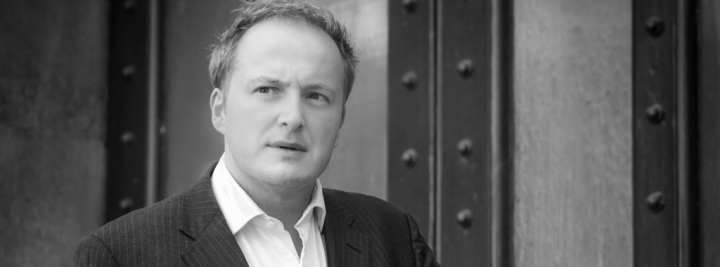
Award-winning and critically acclaimed British conductor and composer Benjamin Ellin is currently Music Director of Thursford Productions, Founder of the Contemporary Fusion ensemble Tafahum, Principal Conductor of the Slaithwaite Philharmonic Orchestra, Music Director of Focus Opera and President of Pembroke Academy of Music, London.
His belief in the positive power of music within society is reflected in the wide-ranging projects of which he is currently a major figurehead. From his own ensemble Tafahum, major projects and collaborations at London’s Southbank Centre, his own commissioned works with the First Nation communities of Alberta, Canada to his commitment to outreach and development work as well as appearing on stage with leading ensembles across the globe, Ellin’s belief in a musical world without boundaries is equalled by a tireless commitment as a guest artist and as a Music Director.
In the autumn of 2014 I set myself the task of learning Schubert’s penultimate piano sonata, No 20 in A, D959. My intention was to learn and finesse the work to be performed in public, confidently and convincingly. I wanted the challenge of immersing myself in a large-scale work over a long period of time: it would test my ability to plan and use practise time intelligently, to set and fulfil goals during the process, and to reflect on learning outcomes. The work was to be included in the programme for a final performance qualification, for which a very high level of musical competency and professionalism was required. In this series of essays, I will explore my approach to learning this work, and what I have gained from the experience. I hope my reflections will offer useful resources to others and serve as a “travelogue” of my journey through this sonata.
So why this sonata and not the final sonata, D960? My reasons were twofold: 1) from the point of view of the professional assessment, I felt most people would select the D960 if choosing a late Schubert Sonata; 2) the Sonata in A has always been one of my favourites for its open-hearted warmth and nostalgia (notwithstanding the extraordinary slow movement).
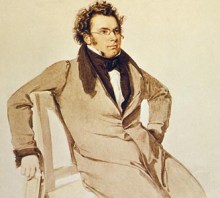
Franz Peter Schubert (1797-1828)The Sonata in A always seems to provoke strong reactions: whenever I mention it online, a whole host of other pianists will comment, citing the slow movement in particular as a significant clue to Schubert’s mental state at the time of the work’s composition. Some commentators suggest that this movement, more than anything else that Schubert wrote, is the clearest indication of the effect of his illness (advanced syphilis) on his mental state and his music. This article offers some frank and disturbing insights into syphilis and its treatment in the early nineteenth century, specifically in relation to Franz Schubert. The side-effects of the illness and its treatment may well have had a detrimental effect on Schubert’s mental state, and it is thought he also suffered from cyclothymia, a form of manic depression (his friends reported periods of dark despair and violent rage). The traditional clichéd, sentimental image of Schubert as the cheery songster or cherubic “little mushroom” is refuted by these accounts. Is the slow movement of the D959 a manifestation of both depression (the opening and closing sections) and mania (the middle storm)?
Another issue which merits consideration in relation to this sonata (and indeed the others which form the final triptych) is the notion of Schubert’s “late style”: whether a sense of his own mortality presaged a change in his compositional style in the works written in the final years of his life. In On Late Style (London: Bloomsbury, 2006, and LRB article here), Edward Said examines the concept of a distinct artistic/literary “late style” and highlights features such as a certain “insouciance” or self-confidence, which may stem from a sense of completion, serenity, acceptance, reconciliation – “fully conscious, full of memory, and also very (even preternaturally) aware of the present” (Edward Said). But rather than express acceptance or a sense of his own mortality, Schubert’s last works seem to communicate an “incompleteness”, that he had much more to say, and suggest “the triumph of artistic achievement over the degradation of death and disease, the permanent presence of death” (Lorraine Byrne Bodley, Schubert’s Late Music, Cambridge: CUP, 2016).
The Sonata in A, D959, certainly expresses these sentiments: it is joyous after the darkness of the C minor Sonata, D958, which precedes it, and its themes are springlike and lilting. In this respect it is related to Beethoven’s ‘Pastoral’ Symphony. If ‘Winterreise’ is heartbreak, a study in unrelieved sorrow, this sonata, and other works from the last year of Schubert’s life, reveal, and revel in all of life – intoxicatingly bittersweet, nostalgic, and life-affirming, never unremittingly melancholy or heavy.
***
A programme note….
Schubert completed his final three piano sonatas in September 1828, just a few months before his death at the age of 31. These were the first works of the kind he had composed following the death of Beethoven, a composer whom Schubert much admired, and his last three piano sonatas pay tribute to Beethoven: indeed the first of the three is even cast in C minor, the key of Beethoven’s Fifth Symphony and the ‘Pathétique’ Sonata. Schubert numbered the three sonatas sequentially, perhaps envisioning them as a cycle. After his death, Schubert’s brother sold the manuscript to the publisher Diabelli, but the sonatas were not actually published until 1839, and they were dedicated to Robert Schumann, a keen advocate of Schubert’s music.
The final year of Schubert’s life was one of extraordinary productivity, marked by increasing public acclaim and declining health (he had been suffering from syphilis, and the debilitating effects of its treatment, since 1822/23). In addition to the three final piano sonatas, the last months of Schubert’s life saw the appearance of the Drei Klavierstücke D946, the Mass in E-flat D950, the String Quintet D956 and the posthumously published ‘Schwanengesang’ songs, amongst many other works, all of which display a high level of artistic maturity.
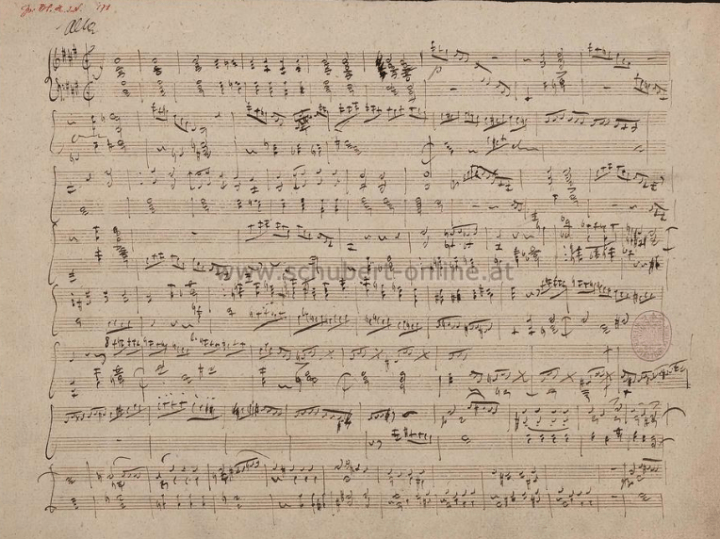
The almost complete survival of the manuscripts of the final three piano sonatas suggests that they were written in two stages: a preliminary sketch, probably made in the Spring of 1828, and a full, final version, most likely notated in September 1828, which contains many remarkable transformations and changes. For example, in the working draft of the Sonata in A, D959, the initial theme is presented in the style of a chorale, without the octave leaps in the bass which give the final version its rhythmic propulsion, and the calm melody of the second subject has far less rhythmic tension and expansiveness. The final version is also particularly notable for its cyclic innovations.
Working draft of first movement of Sonata in A, D959 (source: schubert-online.at)During the 1820s, Schubert had begun to experiment with cyclic devices, whereby motifs or themes established in the opening movement recur elsewhere, often subtly modified, to create an enhanced sense of “belonging” between the various sections and movements. For example, in the Sonata in A, D959, the majestic opening sequence of chords in the first movement re-emerges, much reimagined, towards the end of the slow movement, which then forms the melodic outline of the Scherzo and its Trio; the closing bars of the finale refer back to the opening of the first movement; and the arpeggiated ending of the slow movement anticipates the spread chords of the Scherzo. These simple cyclic motifs, and an innate sense of musical geometry which allows Schubert to draw the whole sonata together at its conclusion, represent his boldly experimental approach to traditional sonata form, further reinforced by a dramatic expansiveness, and the daring underlying harmonies which create contrasting and often startling musical hues and shifts of emotion.
The first movement opens with noble chords which give way to a gentler motif whose falling arpeggio figure could have come straight out of an impromptu. These two motifs form the melodic and rhythmic basis of the first movement and indeed the entire piece. The second subject, a lyrical theme in the dominant key of E major, leads into an intensely chromatic triplet passage culminating in a dramatic section built on descending arpeggios which recall those from the opening. The second subject returns briefly at the close of the exposition, fused with a quiet echo of the urgent triplets from earlier on.
Instead of developing the main thematic material from the exposition, as is traditional in classical sonata form, the development section deals entirely with new material and in the first section the harmony constantly oscillates between C major and B major. Later on, a passage first in C minor and then the tonic minor appears, based on the motif which opens the development.
The recapitulation is traditional: it remains in the tonic and emphasises the tonic minor and the flat submediant (F major) as subdominant tonalities, while the second subject is presented in C major. The coda restates the opening sentence, but in a much more hesitant manner: marked pianissimo, it is interrupted by whole bar rests with fermatas, while the left hand imitates pizzicato strings. The movement closes with gentle ascending arpeggios which mirror those from the opening. It is not until the close of the fourth movement that the opening theme is restated in its full-bodied guise.
The second movement, marked ‘Andantino’, is in F-sharp minor (the relative minor key of A major) and is in ternary (A–B–A) form. It opens with a poignant melody full of sighing gestures portrayed by descending seconds with a simple barcarolle-like accompaniment. The almost hypnotic main melody recalls several of the Heine songs and ‘Der Leiermann’ from Winterreise, while its expressive qualities and character relate to the song ‘Pilgerweise’, also in F-sharp minor. Schubert creates an almost static quality in the opening section through restrained melodic repetitions within a narrow register.
The middle section unfolds like a fantasia, improvisatory in character and growing ever more dramatic with extremely harsh modulations. The music continues to build with increasing savagery via extreme registers and the use of trills to sustain tension, eventually arriving at C-sharp minor and culminating in dramatic fortissimo chords. After this climax, a recitative section follows, repeatedly disrupted by sforzando chords. This leads to a serene phrase, redolent of the G-flat major Impromptu (D899/3), which leads back into the opening melody, now with a more intricate left-hand accompaniment and a haunting triplet figure in the treble.
The dark arpeggiated sonorities at the close of the Andantino are transformed into the brilliant arpeggiated chords which open the Scherzo, and a sense of levity is portrayed through staccato articulation and a lyrical dance-like figure, which is further developed in the second section. The tone here is distinctly bucolic, but the pastoral mood is disturbed by a dramatic descending scale which recalls the stormy middle section of the previous movement. A reference to the main melody of the Andantino is heard in the ensuing passage before the opening theme returns. In the contrasting Trio, Schubert reimagines the initial theme of the first movement with a serene choral quality.
The finale is a Rondo whose scheme is modeled on the finale (also a Rondo) of Beethoven’s Piano Sonata op. 31 no.1. In fact, the only truly imitative element is Schubert’s reworking of the slow movement theme from his Piano Sonata in A minor, D537, composed more than a decade earlier, to which he brings the lilting gentleness of ‘Im Fruhling’ (D882). Scored in sonata-rondo form (A–B–A–Development–A–B–A–Coda), this lyrical movement comprises an almost continuous triplet movement and a songful melody, replete with striking harmonic and emotional shifts. The development section culminates in a long passage in C-sharp minor which refers back to the dramatic middle section of the Andantino. The ensuing passage leads to a false recapitulation in F-sharp major, which then modulates to begin again with the second subject in the home key. In the coda, the main theme returns fragmented, which recalls the hesitancy of the coda in the first movement. The final section of the coda is marked Presto, and here agitated and exuberant arpeggios, redolent of those from the first movement, overlay fragments from the main theme in the bass before arriving at a dramatic false cadence of sforzando chords. Now a fragment of the main theme is heard again, this time marked pianissimo, before the closing statement of sforzando chords, based on the majestic chordal theme of the opening of the Sonata.
The Cross-Eyed Pianist is free to access and ad-free, and takes many hours every month to research, write, and maintain.
If you find joy and value in what I do, please consider making a donation to support the continuance of the site






 The Cross-Eyed Pianist