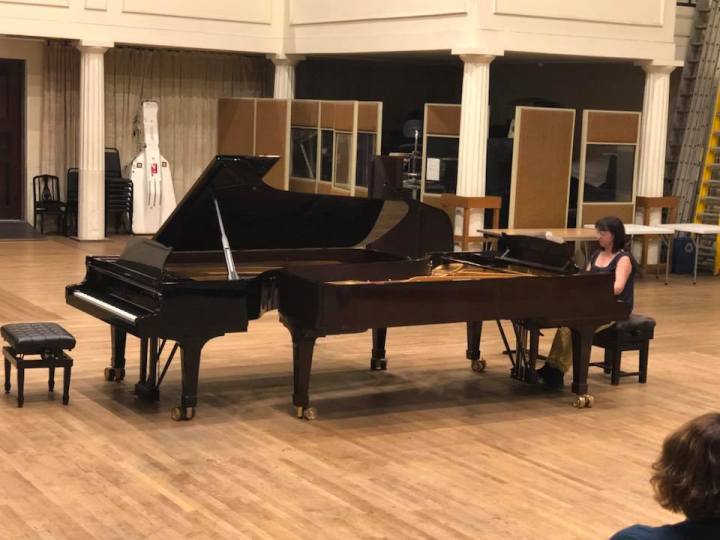
The Leeds International Piano Competition has announced the five pianists who have made it through to the Finals of the world-famous Competition this weekend. Each Finalist plays a concerto with the Hallé conducted by Edward Gardner at Leeds Town Hall, broadcast live by BBC Radio 3 and medici.tv.
They are:
Aljoša Jurinić (Croatia, aged 29).
He will play Mozart Piano Concerto in C minor, K491 (Friday 14 September, 7pm)
Anna Geniushene (Russia, aged 27).
She will play Prokofiev Piano Concerto No.3 in C major, Op.26 (Friday 14 September, 7.50pm)
Mario Häring (Germany, aged 28)
He will play Beethoven Piano Concerto No. 1 in C major, Op. 15 (Friday 14 September, 9pm)
Eric Lu (USA, aged 20)
He will play Beethoven Piano Concerto No.4 in G, Op.58 (Saturday 15 September, 7.50pm)
Xinyuan Wang (China, aged 23)
He will play Schumann Piano Concerto in A minor, Op.54 (Saturday 15 September, 7pm)
All performances will be live-streamed via MediciTV
The prize winners will be announced at 9pm and presentations made by Lang Lang at 9pm on Saturday 15 September.
This slideshow requires JavaScript.
The Competition began in April, with 68 pianists of the world’s best young pianists, aged between 20 and 29 years old, with international First Rounds in Berlin, Singapore and New York. The five Finalists were chosen from among the 24 who have been participating in Leeds since 6 September.
They are competing not just for generous cash prizes, worth over £90,000, but for a career-changing prize package which has redefined what a competition can offer young artists, and which has helped to attract young international pianists of the very highest calibre promising a thrilling Competition.
The portfolio prize includes artistic management with Askonas Holt, one of the world’s most renowned music management agencies; concerts and engagements with some of the world’s premiere venues and orchestras, including London’s Wigmore Hall and Southbank Centre, the Hallé, Royal Liverpool Philharmonic and Oslo Philharmonic Orchestras; concert and recording engagements with BBC Radio 3, broadcast partner of The Leeds. It also includes a major European tour organised with partners Steinway & Sons; a solo CD with a major label; a programme of recital engagements in Yorkshire and other UK venues; and mentoring from Co-Artistic Director Paul Lewis, Patron Murray Perahia and other members of the performer-led jury, chaired by Paul Lewis, and comprising Sa Chen, Imogen Cooper, Adam Gatehouse, Henning Kraggerud, Thomas Larcher, Gillian Moore, Lars Vogt and Shai Wosner.
I love the opportunity for interesting interactions and conversations which social media creates, and I have made a number of significant friends in real life through the blogosphere. One is Jon Jacob, a fellow classical music devotee and blogger, and very much a kindred spirit.
We have enjoyed a number of joint projects over the past year, including two podcasts (the most recent with Adam Gatehouse, joint Artistic Director of the Leeds Piano Competition) and our latest – a conversation (by email) ahead of the finals of the Leeds Piano Competition which you can read here on Jon’s blog.
Jon will be attending the Leeds competition finals (sadly, I can’t make it) so do look out for his bulletins via Twitter and follow the competition updates with the hashtag #LeedsPiano2018.
All the performances are being live-streamed by MediciTV – a very welcome innovation as part of the revamped Leeds Competition coverage.
I am continually impressed and inspired, and occasionally truly humbled, by the passion and commitment of adult amateur pianists, and in the last month this has been brought home to me powerfully yet again, first at Chetham’s (“Chets”) Summer School for Pianists (read more here) and then on Friday evening at the monthly gathering of the London Piano Meetup Group (LPMG).
Although I work in music, I do not regard myself as a “professional” pianist and I am also quite comfortable now with the title “amateur”. While some may think this means “cack-handed hobbyist” or “Sunday pianist”, I prefer the French definition of the word: “one who loves” because all the amateur pianists I know absolutely adore the piano, myself included.
I co-founded the LPMG in 2013, in part as an opportunity to meet other like-minded people. Playing the piano can be a lonely activity and while many of us enjoy the solitude, the special time with the instrument and its literature, it is also very helpful to meet and talk to other pianists. At the time, I had been playing seriously for about 6 years (having returned to the piano after an absence of 20 years), and had been taking lessons with a concert pianist and teacher in one of London’s leading conservatoires for 5 years. I didn’t know any other pianists, apart from the handful of people I encountered fleetingly through my teacher’s courses. The LPMG filled a big gap in my pianistic life – and I know it has done the same for many others whom I meet through the group. It has also inspired the formation of several other meetups and piano clubs in the UK and beyond: in 2015 our London group had a joint meetup with the Vienna piano meetup group in the city of Mozart, Beethoven and Schubert – a very special experience indeed.
Through the LPMG I have made a number very good friends and connections, while the activities of the group have extended to include workshops and events such as the annual Diploma Day with the very popular and highly skilled teacher Graham Fitch, all of which are designed to support and encourage adult pianists.
Now run by my piano friends Claire and Rob (whom I met through the group), the LPMG hosts monthly performance events for adult pianists in London venues with good grand pianos. Many amateur pianists aspire to own a really beautiful instrument but cannot afford to do so, or are constrained by space in their home. To have the opportunity to play a really splendid instrument, such as the two expertly-maintained Steinway Ds at Henry Wood Hall, where we met last Friday, is a real treat and a chance to experience the capabilities of a big piano.
Marie playing music by Billy Mayerl at Henry Wood Hall (photo by Iain Gordon who looks after the two Steinways there)
LPMG performance platforms are social events too and always finish in a local pub or wine bar where much “piano chat” takes place – people congratulate one another on their performances, discuss repertoire and the exigencies of fitting practising into one’s working life, courses, concerts we have enjoyed, professional pianists we admire, and much much more…. We come from many different walks of life – the group includes several medics, a mathematician, an accountant, a video games designer – but we all have a common interest and we know that no one is going to roll their eyes or yawn if you start enthusing about Beethoven’s last sonatas or the beauties and intricacies of Chopin’s Fourth Ballade. This sense of a “piano community” with a shared passion is incredibly important.
When it comes to performing, which is primarily what the group is for, we have players of all ages and abilities. Some have had a formal musical training but chose a different career path, others are self-taught. Some have played all their life, others, like me, have returned to the piano after a break. None of that really matters – because we all adore the piano. I have met a number of professional pianists who envy the passion of the amateur – we can choose what we play and when, and we don’t have to make a living from it. It gives us great freedom, and hours and hours of pleasure.
Many LPMG participants are self-effacing and modest: uncertain of their abilities or anxious about playing for others, performances may be prefaced by self-deprecating comments or throwaway asides about what the audience can expect – “It’s work in progress”, “I haven’t been learning this very long”, “We only rehearsed this together yesterday afternoon!”, “It’ll probably all go wrong!”. Everyone at Meetup appreciates the feelings of inadequacy or exposure when playing for others – we all experience this to a greater or lesser degree, and playing to a roomful of other pianists can be both highly stressful and also extremely supportive. I tend towards the latter when I play at Meetups – we all understand how hard it is and appreciate the effort and hours required to bring the music to a certain standard.
After the performances, people are generous with their praise – “I loved your piece!”, “You played so well”, “I really enjoyed your Debussy!” – and this too is an important part of the group’s ethos.
To conclude, I’d like to offer some advice to anyone who feels anxious about performing in front of others:
Don’t pre-empt your performance with a negative comment, such as “It will probably all go wrong”. This immediately prompts a negative mindset, making you more vulnerable to nerves. It also makes the audience more anxious!
Instead, go to the piano and take a few moments to think yourself into the music. Hear the opening phrase in your head and imagine playing it. Don’t rush to begin. Remind yourself that you have done your practising and you are well-prepared – see below
Bring music to performance events which is well-learnt and about which you feel pretty confident. Good preparation through consistent, intelligent practise is more likely to lead to a successful performance, and if you are well prepared you are less likely to be derailed by errors or slips. The Russian pianist Vladimir Horowitz used to say, before a concert, “I know my pieces” meaning he had done the right kind of practising and preparation – it’s a good mantra to follow!
Remember these events are non-competitive and no one is judging you.
Above all, enjoy yourself!
Performance, like the piano itself, can – and should – be practised. The more times you perform, the “easier” it becomes, so take every opportunity you can to play for others, from a few family and friends at home to events like Meetups. Reaching a state of “acceptance” about performance anxiety can go a long way to relieving and coping with the symptoms. And remember that it’s a normal human response – the pros get it too!
Composer, musician, singer-songwriter, record producer and conductor, Mike Batt has teamed with record label Guild Music to release a special recording of Holst The Planets that he conducted in 1993. Here he shares his thoughts on why The Planets is such a significant work and the challenges of working on it with the Royal Philharmonic Orchestra, together with some insights into his musical and creative life…..
What it is about The Planets that makes it such an attractive piece to conduct?
It’s a seriously wonderful piece of orchestral composition. Maybe that’s obvious but The Planets has such melodic strength, and depth of orchestration and it ranges across the entire spectrum of emotions and dynamics. It’s not just “Programme music” like a piece “about” each particular planet. In Saturn – The Bringer Of Old Age, you feel the emotional weight of old age, in the dark, lumbering opening. Later in that movement you get a bit of feisty madness, maybe even confusion coming in, always in an original and musically striking way. It’s a real adventure for the listener just as it must have been for the composer.
Who or what inspired you to take up conducting and pursue a career in music?
For some reason, as soon as I heard orchestral music. I wanted to be a conductor. I didn’t grow up in a musical family. There was almost no music in the house. The junk mail leaflet from Concert Hall records dropped through the letterbox when I was about 11 and that was it. Once I heard Schubert’s Ninth Symphony, I wanted to conduct it. The fact that my granny sent me an LP called “Music for Frustrated Conductors” with little diagrams of a cartoon bloke diagrammatically conducting the basic rhythms, might have contributed! I read an interview a while ago where Simon Rattle said he had partly been influenced into conducting by that very same album!
Mike Batt conducting (photo: Claire Williams)
Who or what are the most significant influences on your musical life?
My love for music is almost too eclectic for my own good, to the extent that people might be confused by it. But I wouldn’t change the chameleonesque nature of my “theatres of operation” and my passions and influences, which range from from Mozart to Bartok and The Beatles, The Rolling Stones to Frank Zappa and Count Basie.
How exactly do you see your role as a conductor? Inspiring the players/singers? Conveying the vision of the composer?
An orchestra definitely gets a vibe from a conductor and vice versa. The conductor needs the orchestra to feel confident that he or she won’t let them down by screwing up, or make them play a piece in ways that they don’t feel appropriate (eg., tempi that they hate) – although that’s part and parcel of being an orchestral musician. If an orchestra “likes” a conductor and empathises with him, they will play better for him. If they can see it matters to him, they will try to deliver. A bit of an eye contact just before a woodwind or horn entry, for example, works wonders to make the player feel that you know where he or she is coming in and would like to share the moment. If you punch the air at the brass section just as they are breathing to come in fortissimo they actually do play fortissimo!
As a conductor, how do you communicate your ideas about a work to the orchestra?
The best way is by body language. You should be able to walk in and just play, maybe with a little pre-explaining any particular ideas you have, but it should mostly come from your baton, body and face. You are sort of dancing with the band , and you are “leading” the dance. A great orchestra will observe a rubato moment that has never been discussed, just by what they see and feel from the conductor. They should and do follow that baton, far more than non-musicians could ever imagine. Conducting a great orchestra is like driving an F1 car. They respond completely to the slightest gesture.
This was your first time working with the Royal Philharmonic Orchestra. What was the most challenging part of conducting them?
I’ve worked with them many times since – but this recording was 25 years ago. It’s always a thrill to meet a new orchestra and when you know you have top notch players, you know the job will get done, and to the standard you want. Call me an optimist! But “meeting” a new band is rather like a first date. There are a few nerves. It takes only a few seconds for the conductor to size up the orchestra, and crucially for me, vice versa! So the challenges are only psychological. If you have top players the challenges are shared, – you are all after the same thing, a brilliant performance. When I was younger I had an experience where an overseas orchestra decided they didn’t much like me after only a few seconds. You could just tell. You learn by such experiences. You still get the job done but it’s less comfortable.
And what is the most fulfilling aspect of conducting the RPO?
Somehow that day in 1993 when we recorded the Planets it was just a joy to do it. I could see they were enjoying it, and so was I. The room (Watford Town Hall) had wonderful acoustics and I can’t think of a panicky or unpleasant moment. I would cite that whole day of recording as one of the most fulfilling events of my musical life.
Is there one work which you would love to conduct?
Schubert: 9th Symphony (The “Great” C major)
Do you have a favourite concert venue to perform in?
The Royal Albert Hall. It’s intimate and cozy, strangely. Yet it has that special majesty and charisma. You also know the audience are taking in that wonderful atmosphere before you even play a note!
As a musician and composer, what is your definition of success?
It can be so many things, depending on how you look at it. The parameters of commercial success have changed so much that it’s hard to say what is a “hit” and what isn’t. But artistically, if a composition succeeds in moving the audience and conveying the feeling you had when you wrote it, that is success. If you felt tearful writing it, you can bet the audience will feel tearful listening. If you were writing a funny, witty piece and you chuckled or were amused, the audience will chuckle and be amused too. That’s success.
Who are your favourite musicians/composers?
Partly answered above. But guitarists John Paracelli and Chris Spedding are “up there” as musicians. So many classical musicians to choose from. Nicola Benedetti is such a wonderful violinist, so I’ll choose her. The (sadly) late Douggie Cummings (former principal cellist of the LSO) was an astonishingly good “life force” to have in the room while working, a beautiful player. Composers? Prokofiev, Stravinsky, Brahms, Beethoven Schubert, Tchaikovsky. All possibly boring marquee names to choose, but that’s why they got there!
What do you consider to be the most important ideas and concepts to impart to aspiring musicians?
Don’t get into gangs and cliques. Seriously, snobbishness in music is necessary in getting everyone to feel special about their music, but leave the snobbishness (again, sadly) to the audiences. You as a practitioner should feel free to enjoy every genre and do what you like. Oh, and practice until you’re blue in the face. Be passionate. If you aren’t passionate don’t get into it full time. Do it as a hobby. Even then you’ll enjoy it more if you are passionate. Pretty obvious I guess.
What is your idea of perfect happiness?
Knowing that my family could be happy and secure and fulfilled
What is your present state of mind?
Restless, with so much more to do as time marches on and I get older. I wish I could live for a lot more musically capable, healthy years than will probably be the case. Does that mean there will always be a project that I’ve conceived that I will never see come to fruition? Probably. I’m not afraid to die, I’m just afraid of not being alive.
To mark the centenary of the first performance of Holst’s The Planets on 29th September 1918, Guild Music presents the first complete release of a recording that Mike Batt made in 1993 that has lain in the vaults for 25 years. Produced by Robert Matthew-Walker and engineered by Abbey Road’s Simon Rhodes. Further information
Michael Batt LVO is an English singer-songwriter, musician, record producer, director, conductor and former Deputy Chairman of the British Phonographic Industry. He is best known for creating The Wombles pop act, writing the chart-topping “Bright Eyes”, and discovering Katie Melua. He has also conducted many of the world’s great Orchestras, including the London Symphony, Royal Philharmonic, London Philharmonic, Sydney Symphony and Stuttgart Philharmonic in both classical and pop recordings and performances.
The Cross-Eyed Pianist is free to access and ad-free, and takes many hours every month to research, write, and maintain.
If you find joy and value in what I do, please consider making a donation to support the continuance of the site