
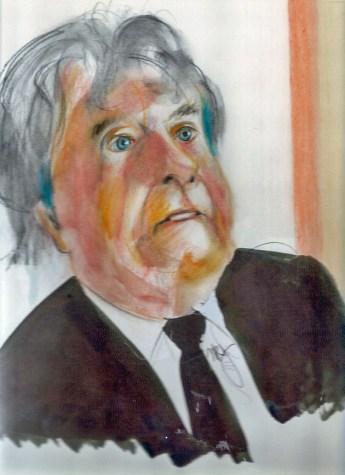
 Guest post by Michael Johnson
The latest edition of the Aix Music Festival brought a stellar array of singers, pianists, instrumentalists and orchestras to Aix-en-Provence, near Marseille this year. Co-founder and violinist Renaud Capuçon tells me the festival has become the realization of a dream he has nurtured since childhood.
A highlight was Austrian pianist Rudolf Buchbinder who played the five Beethoven piano concertos while conducting the Sachsische Staatskapelle of Dresden from the keyboard. He accomplished this in a single day, showing no sign of strain, a remarkable feat for a player of 72 years of age.
On the day before he was to play his back-to-back concertos, Maestro Buchbinder sat down with me in the “Teddy Bar” of the Grand Théâtre de Provence to discuss his age, his stamina, his piano preferences, and his love for Beethoven. He was relaxed and cheerful and spoke freely. He dismissed his marathon feat of keyboard conducting as “nothing special”.
An edited transcript of our conversation follows.
Q. You probably don’t like this term “marathon” to describe your five Beethoven concertos in one day, do you?
A. Actually, a solo recital is much worse than playing the five. Even practicing for four hours is much worse. (Snorts) I once played the two Brahms concertos in one evening!
But you also conduct from the keyboard. That must be stressful, leading this collection of prima donnas….
This is nothing special. Before, everybody did it. Beethoven did it. I conduct with my eyes, with my mouth, a little bit with my hands. I have done it 500 times in my life. It’s a different kind of concentration. The players have to listen.
You have played the five concertos before in one day.
Yes, in 2011 I did it with the Vienna Philharmonic.
You are not intimidated by such a large task?
No. Why should I be ?
Well, because there are a lot of notes!
Oh no. The secret of piano playing is simple. You just have to touch the right notes at the right time. That’s it. (Laughs)
Do you have to prepare yourself for these five ? Do you review the scores prior to the concert?
No, this time I left the scores at home in Vienna. I don’t need them.
Really? You have them all in your head ? How many times have you played these concertos?
Over 200 times for No. 1, and probably a hundred or more for the others. No. 1 was my first big concert. I was 11 years old, in Vienna, dressed in short pants. (Laughs)
In what order you play them?
I play 2, 3, 4 in the first concert, and 1 and 5 in the evening. Because 1 and 5 are the longest. No. 1 has a longest slow movement.
Do you have a favourite among the five?
No. If I had a favorite, I could not play the others. It’s my problem. I have to love all of them. Each concerto is so completely different.
Aren’t they derived from Mozart’s piano concertos in certain passages ? Tovey wrote of “several examples of Mozart” that appear in No. 1. These two geniuses were rivals.
People say the first two concertos are influenced by Mozart but that’s not true. They have nothing to do with Mozart. It’s all about Beethoven. Beethoven didn’t think about Mozart. In fact, he hated Mozart. When he came to Vienna, Mozart was God. Beethoven was always jealous. It took him a long time to be as popular. People also try to make three periods in the Beethoven sonatas. Wrong. He had his ups and downs throughout this life.
Aren’t the Beethoven cadenzas a special feature of these concertos?
Not really. In 1809 or1810 Beethoven wrote all the cadenzas for his concertos. He just sat down and wrote them, one after another. He wrote three cadenzas for his No 1. There actually was one connection with Mozart. Beethoven wrote the cadenza for K466, the D-minor, because Mozart didn’t write this one. He improvised onstage.
Here Buchbinder plays the D-minor concerto with the Beethoven cadenza:
(interview continues after the video)
When you play the concertos, do you use Beethoven’s cadenzas or do you write your own?
Only Beethoven’s. Of his three cadenzas for No. 1, the first one is the best one but was left unfinished so I use some parts of the second and third cadenza to fill it out. They fit perfectly.
Are you the only pianist who plays around with cadenzas like this?
I think so. As far as I now, I am the only pianist to combine the cadenzas into one.
You compose cadenzas for other concertos but you do not use your own for the Beethoven concertos?
No… only Beethoven’s. They are not so bad, you know (Laughs).
I am fascinated that you can carry all these five concertos in your head.
Oh, this is only a part of my repertoire.
A personal question about your stamina. At age 72, can you play all five without worrying about fatigue or anxiety?
I admit that I am very nervous. The older I get, the more nervous I get. As a young man, I used to walk on stage confidently (Mimes confident posture, as if marching on stage.)
You don’t worry about this increasing nervousness?
No. No. Backstage, I don’t think about the concert that is coming. When I come onstage, I have cold fingers. A few seconds later, at the keyboard, I am back to normal.
Do you worry about memory lapses?
No. This should never happen. I am very secure. Well, maybe a little bit in K466.
You have said you want to die on the keyboard. Is this true?
Yes, like Wilhelm Backhaus. After two movements of a Schubert Impromptu he left the stage, then returned to play the same thing over again. It was his favourite. He was very ill and knew this would be his final performance. After his Schubert, he was taken to hospital where he died.
Do you have ten years left, or twenty, like Paul Badura-Skoda, who is still playing in his 90s?
Look. I have to play. But I only play when I am able to concentrate. I have always practiced only two hours a day, and sometimes I don’t touch the piano for one week. I am active. I just signed exclusive contract for Deutsche Grammophon.
Is playing getting more difficult or easier?
The Brahms concertos are much easier for me now than ten years ago. I played the Tchaikovsky First with Valery Gergiev maybe five or six times and also Rachmanninov.
Critics and other experts like to identify Beethoven’s development from Classical composing to a more Romantic style. Where does this begin to show?
This is stupid. The first one is Romantic. Beethoven always went up and down throughout his life. Beethoven was the most romantic composer in music history. He is the only composer who writes espressivo a tempo. Nobody else. He leaves the freedom to the interpreter.
Your views are fascinating because they are so individual. Is this a freedom that you can express now because of your age and experience? Does this empower you to say what you really think, regardless of other opinions?
You know the late Joachim Kaiser? We knew each other very, very well. He forced me … he said to me, “Rudi, you have to record the Beethoven sonatas again.” After 30 years interval I did them again for Sony in Dresden and then again at the Salzburg Festival. Thirty years ago I was not “free” like this.
And when did you feel this freedom arrive?
AYou cannot control it. It comes by itself. Like in the Hammerklavier, you play fast (Sings the opening phrase, loudly and vigorously like B-DUM PATA DUM PATA DUMDUM). You play those first seven or eight bars by the metronome, and then you are free. Beethoven writes everything very clearly. After that introduction he keeps the pedal. That makes a big difference. Many players do not have those freedoms today. They are afraid.
What about phrasing?
Beethoven writes rinf forzando (slurring), for the whole phrase. Only Brahms also used rinf. The alternative is fortepiano, which is short, like a mosquito bite.
But you have the discovered the freedom. Aren’t you afraid of criticism?
I have no problem with criticism if the critic declares what is right and what is wrong. What I don’t like is the critic who says, for no reason, “It was too fast.”
You always choose Steinways for your concerts. Why not a Viennese Bösendorfer?
Of course Vienna was very proud of Bösendorfer. But the tone to me is much too sharp, too harsh. Bösendorfer makes its own sound. I want to make the sound myself.
“Too glassy”, as some pianists say?
The point is that Steinway is the most neutral of all pianos. By this I mean that nothing comes from the piano, the way it is built. You must treat a woman like the Steinway, it’s the same. When you treat them good, they respond good. What you give, it comes back. I want to make the sound. You can play soft, you can pay lyrically, espressivo. The range is much bigger.
You say you have projects coming from Deustche Grammophon. For example?
In October, I will start a cycle of the Beethoven concertos. No. 1 with Andris Nelsons. No. 2 with Maris Janssons with Bavarian Radio. No. 3 with Valery Gergiev and the Vienna Philharmonic. No. 4 with Theileman Andriessen and the Staatskappelle. No. 5 with Riccardo Muti and the Vienna Philharmonic. All to be published by Deutcsche Grammophon. It’s a nice cycle. It will appear in about two years. We also have other plans.
Michael Johnson is a music critic with particular interest in piano. He worked as a reporter and editor in New York, Moscow, Paris and London over his writing career. He is the author of five books and divides his time between Boston and Bordeaux. He is a regular contributor to The Cross-Eyed Pianist
Portrait of Rudolf Buchbinder by Michael Johnson
music.
If you enjoy the content of this site, please consider making a donation towards its upkeep:





 The Cross-Eyed Pianist