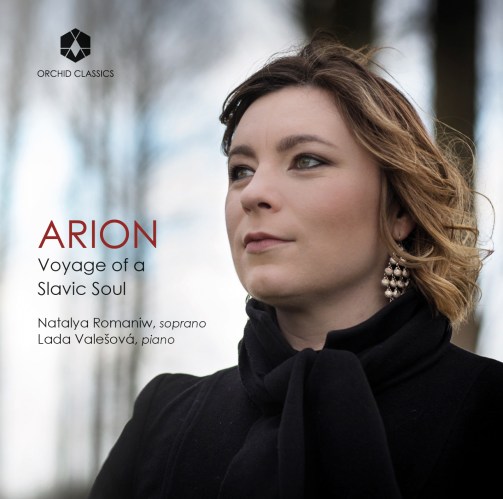
Natalya Romaniw’s star has been shining bright on the operatic stage for the past five years as her creamy soprano voice continues to draw an ever increasing legion of fans. A Daily Telegraph critic suggested in February this year that Romaniw was the next Netrebko of her generation.
At Opera Holland Park last season, I was enraptured by her lead performance in Tchaikovsky’s Iolanta. Her Tosca at Scottish Opera and, more recently, her Madame Butterfly at ENO, earned her the highest of accolades from critics and audiences alike. Her Cho Cho San at the Coliseum was unforgettable.
And now away from the heady world of live opera, Romaniw, together with pianist and long time collaborator, Lada Valešová, are bringing out Arion, an album of Slavic song repertoire.
Who or what inspired you to take up conducting and pursue a career in music?
When I was 14 my violin teacher gave me the chance to conduct a string orchestra I was playing in. I remember vividly the experience standing there with the music flowing around and through me as I tried to communicate with the players. I didn’t have any technique at all and it was probably terrible! But in that moment I had a very strong sense that this was an extraordinary feeling and something I wanted to explore deeply.
Who or what are the most significant influences on your musical life?
I’m not sure I can judge this myself fully. However, without a doubt conductor Sian Edwards who is the most wonderful human being and has taught me a huge amount about the relation between music and conducting technique. Michael Dussek, my piano teacher at the Royal Academy of Music, was also a strong influence in helping me develop my own artistic ethos in service of the music. Working as an assistant to several conductors provided opportunities to see at first hand what works, what doesn’t and what kind of musical leader I would like to be.
What, for you, is the most challenging part of being a conductor? And the most fulfilling aspect?
Mastering a huge range of repertoire in the depth required is a never-ending challenge, particularly as a young conductor starting out. There is almost no amount of preparation that will enable you to feel fully confident with a symphony when standing in front of a great orchestra that has played it hundreds of times before. How to deal with this is an important milestone. The most fulfilling thing is when everything clicks within the orchestra, and the music seems to unfold naturally. When I feel as if I have to do very little on the podium this is wonderfully satisfying.
As a conductor, how do you communicate your ideas about a work to the orchestra?
I try to show everything with my baton, and occasionally where appropriate use a mental image or piece of historical context to frame a particular sound world or effect. It’s important to realise quickly what works best with a certain orchestra: some players prefer to avoid verbal communication, others are drawn in by a bit more context or personal imagery.
How exactly do you see your role? Inspiring the players/singers? Conveying the vision of the composer?
The position of the conductor is often anachronistic – it is only from the time of Beethoven onwards that musicians would have expected someone to direct the performance this way. In Mozart you need to get out of the way; in Mahler it almost seems as if the music was written for a single music interpreter to shape; in much contemporary repertoire you are akin to a sophisticated metronome. So the role varies, but the conductor must always bring his/her personal energy to the ensemble and a love for the letter and spirit of the music.
Is there one work which you would love to conduct?
Elgar Symphony no. 2. I find Elgar’s English character combined with his Austro-Germanic style of composition irresistible.
Do you have a favourite concert venue to perform in?
I’ve only performed there once but the Shanghai Oriental Arts Centre has the most exceptional acoustic: crystal clear yet warm enough to create any sound world you could possibly want.
Who are your favourite musicians/composers?
My all-time No. 1 conductor would be Claudio Abbado, whose flair, intellectual rigour and versatility across all repertoire seem unparalleled to me. If I had to choose one composer it would be Beethoven. At the moment I’m realising what a limited picture we get of him as orchestral musicians if we don’t explore the piano sonatas and chamber music. His symphonies and concerti alone give a misleading sense of his musical personality.
As a musician, what is your definition of success?
Very, very rarely we feel we have done justice to the music. It is gratifying when this feeling is shared by respected colleagues and listeners, and of course sometimes this can lead to career progression which plays a part in ‘success’ too.
What do you consider to be the most important ideas and concepts to impart to aspiring musicians?
An ethos of constant self-sacrificing exploration. And a passion to learn why and in what situation a piece was composed as this can really help recapture its spirit in the present moment.
What is your idea of perfect happiness?
To maintain a fulfilling balance between desire and satisfaction over a lifetime.
Mark Austin’s performances of orchestral and operatic repertoire have been praised for their “eloquent intensity” (Guardian).
Recent highlights include Mark’s debut at Royal Opera House Linbury Theatre, and the final of the Chicago Symphony Orchestra Solti Conducting Competition. He has been shortlisted for the ENO Mackerras Conducting Fellowship 2020-22. In 2019 he was elected an Associate of the Royal Academy of Music and worked in masterclass with Riccardo Muti. He collaborated with soloists including Guy Johnston, Kristine Balanas, Julien van Mellaerts and Siobhan Stagg. As assistant conductor he worked at Garsington Opera and with the Orchestre de Chambre de Paris. 2020 includes work at Folkoperan in Sweden, a return to Garsington and concerts at Oundle International Music Festival and Cambridge Summer Music Festival.
Other projects have included ‘Le nozze di Figaro’ (Dartington International Festival), ‘Goyescas’ (The Grange Festival), ‘Tosca’ (Musique Cordiale International Festival) and a two-concert Brahms residency with Guy Johnston and Faust Chamber Orchestra at Hatfield House. Mark was assistant conductor for the world première production of Mark-Anthony Turnage’s ‘Coraline’ (Royal Opera). He has worked with figures including Vasily Petrenko, Sian Edwards, Marin Alsop, David Parry, David Hill, Steuart Bedford, and the late Sir Colin Davis, and conducted orchestras including Aurora, Britten Sinfonia, Bournemouth Symphony Orchestra, Civic Orchestra of Chicago, Orchestra of St John’s and the Hangzhou Philharmonic, China. Mark was awarded a Bayreuth Festival Young Artist Bursary in 2018 and recorded the world première of Alex Woolf’s ‘NHS Symphony’ for BBC Radio 3, which won a Prix Europa. He studies with Sian Edwards and was awarded an International Opera Awards Bursary in 2017.
An accomplished pianist, Mark has performed at venues including Wigmore Hall, Kings Place, St John’s Smith Square, Holywell Music Room, Opera Bastille (Paris) and the Shanghai Oriental Arts Centre. He is musical assistant to The Bach Choir and regularly conducts the choir in concert and the recording studio, including live on BBC1 for the Andrew Marr Show.
Born in London, Mark had lessons in violin and piano from an early age. He played in the National Youth Orchestra, and studied at Cambridge University and Royal Academy of Music, where he received numerous prizes and was appointed a Junior Fellow. Mark contributed a chapter on Wagner, Beethoven and Faust to the recently published ‘Music in Goethe’s Faust’. You can read more about Mark on http://www.mark-austin.net and follow him on Twitter @mark_aus_tin.
The best recordings expand our ideas of what is possible, on every level, and introduce a sense of camaraderie and kinship with performers and composers that spans generations.
One of the strangest and most unexpected aspects of the lockdown for me has been discovering how fundamentally different playing the piano is when you cannot perform to an audience. For the past twenty years, almost every hour I have spent at the keyboard has been either to prepare for or to give a performance. I know that a piece ‘in practice’ is not remotely the same creature as one in concert, and have experienced the incredible transformation that takes place in an interpretation after the first performance. Yet I have never been in a situation, even when on maternity leave, where I am practising without a performance in mind.
Public concerts will be among the last events to be reinstated when we emerge from this epidemic and we have no idea when that will be. With two small children at home, my practice time is also severely curtailed. Do I use the limited time I have to prepare the new commissions for August? What about the concerto I am scheduled to perform in October? Would I be better learning repertoire for a recording that may never take place? Do I even enjoy playing ‘just for fun’? So far, the most promising avenue for me has been to focus on how, rather than what, I play. I find myself gravitating towards recordings, listening to the same passage repeatedly, and analysing exactly what my idols are doing in an attempt first to mimic, and then to recast in my own style.
In one sense, this is just an extension of an ongoing process. As a teenager, I was very careful never to listen to recordings of repertoire I was learning for fear of copying them. Not only was this fear misplaced, but it also created significant problems for me further down the line. I did not go to a specialist music school or a Saturday school at a conservatoire, so only heard other people play when I attended piano recitals. I was conscientious and my playing was, on the whole, faithful to what the composer had written, but I had no concept of the vast landscapes that lie beyond the score. Without hearing others play the pieces I was working on, I lacked context.
At university, we studied the notion of ‘authenticity’ in performance, and fidelity to the score was a large part of that. We barely mentioned, however, the idea that the score might be insufficient and that there was an expansive arena of expression that could never be notated. I was unaware that a crescendo might have completely different expressive significance in Schumann to Mendelssohn, that the degree of legato a slur implied might affect the emotional narrative, or that I could use my own life experience in truly inhabiting the psychology of this music. For me at that time, the score was merely to be deciphered, memorised and regurgitated. I understood that a performer should ‘express themselves’ but had no idea how you might do this beyond self-indulgently injecting some illicit rubato. I still believed that it was possible to play in a vacuum, while being completely unaware of my predicament.
Fast forward a couple of years, and I went to study privately with Ronan O’Hora, Head of Keyboard at the Guildhall School of Music & Drama. In our second session, he explained that while my playing was (mostly) accurate and technically sound, it “didn’t mean anything”. It took me a long time to fully understand this and for months I felt as though I had lost my bearings. When I came to the GSMD as a Master’s student, I was surrounded for the first time by a significant number of aspiring pianists and heard others perform several times a week. I began to understand what it was to truly communicate through music.
This was now my environment and provided the backdrop to the most intense part of my studies, working with recordings. In one lesson, Ronan and I experimented with a passage of the Barber Sonata Op. 26, a work that I played well and for which I had a natural affinity. We discussed various shortcomings in my performance, and then listened to an excerpt from Horowitz’s recording. Without further discussion, Ronan asked me to play the same passage again and something fundamental happened that was to change my attitude to recordings forever. I caught the spirit of the piece, found colours at the instrument that I had never encountered before, and accessed a freedom that brought the music to life without disregarding the score. The best recordings expand our ideas of what is possible, on every level, and introduce a sense of camaraderie and kinship with performers and composers that spans generations.
I now have no scruples about working with recordings. After all, even if I set out to mimic another’s performance exactly, it would be impossible. When learning Schumann’s Humoreske, I heard Radu Lupu create a pearl-like colour at the keyboard that I would not have thought possible. I spent three hours
listening to the first few seconds on loop in an attempt to capture the astonishing tenderness he creates. Liszt’s Vallée d’Obermann is not a piece that comes naturally to me. It has an unselfconsciousness and almost naive bravado that is alien to my character, yet Volodos’ recording showed me how to look beyond that and find its heart. Many months on, I play these pieces in my own way and my interpretations are all the richer for the different influences I can bring to bear.
It is vital to take the score seriously and to be as faithful to it as possible. Yet the text is just a starting point, the skeleton of a finished interpretation. We need to take all of life’s experiences, all the music we have heard and the wisdom of other performers, in order to truly inhabit a work’s emotional and psychological narrative. Without this, we cannot be faithful to the composer’s intentions because we can neither engage with nor communicate their message. The reason I, and no doubt many other musicians, feel so disorientated at the moment is because playing without communicating is such a bizarre and potentially meaningless act. In isolation, recordings are a way of connecting, across space and time, to feel the true fellowship that music can provide.
Acclaimed as a pianist of “amazing power and panache” (The Telegraph), Clare Hammond is recognised for the virtuosity and authority of her performances and has developed a “reputation for brilliantly imaginative concert programmes” (BBC Music Magazine).
Who or what inspired you to pursue a career in music?
I started my musical journey by having group trombone lessons at school ran by my local music service in Wolverhampton and then soon took up the clarinet, too. Unusually, I did not grow up in a home filled with music, as my parents and wider family have no musical training and there was certainly no music playing in my house at all. Therefore, my formative musical experiences rely mostly on my involvement with my city youth orchestra. My parents have always been extraordinarily supportive of my ideas so at age 14 they bought me a piano and then I began improvising on it and then notating it down. This became something I did rather frequently, although my motivation for doing so was purely just for the enjoyment of it; I didn’t really consider it the act of ‘composing’ as such. A few years later I attended a BBC Proms Inspire workshop in Birmingham and there, due to a chance encounter, I found out that conservatoires existed. I then applied to and attended the Junior Royal Northern College of Music and won the BBC Proms Young Composer’s competition in the following year, which had a large influence on my decision to take composing seriously. Since then, my career has expanded in directions that I could never have imagined or dreamed of. I, therefore, can’t recall the exact moment that I decided to become a composer and pursue a career in music, as I just simply followed the path of what I loved doing. I’m extremely grateful for all the opportunities and experiences that it has afforded me so far.
Which composers have most influenced the development of your music?
When I first started listening to classical music it was mostly Russian composers from the classical canon! Since then, however, the composers that I’m interested in do change frequently and vary widely. I think that the people that have had the most influence on my development would probably be those immediately around me, such as those that I meet, the musicians I write for, and the composers I interact with.
You compose for diverse ensembles, orchestral arrangements, choirs, solo voices, even operatic forms. What drives your experimentation?
I think mostly wanting to develop a musical language that is able to transverse a variety of instrumental ensembles or combinations drives my composition. My method is often the same regardless of what the ensemble is. It’s really important to me, however, to know what the instrumentation is going to be for a long period of time before I begin composing, as I like to imagine a sound-world that utilities that particular instrumental grouping effectively.
How would you characterize your compositional/musical language?
I think my musical language is mostly characterized first and foremost by the use of texture to create atmospheric sound-worlds, which are formed out of linear melodic fragments often inspired by art, poetry or literature to take a listener on a narrative journey… or something along those lines!
How do you work?
I often use extra-musical sources such as contemporary artwork or poetry as my starting point to inspire my music. I will then ruminate over my ideas before taking them to the piano where I improvise musical fragments, and develop the overall structure of the work, before I begin to notate the music down on paper. My compositional process is highly intuitive, almost always in response to my own thoughts and feelings and, therefore, I don’t have a specific writing technique that I can replicate for each piece. I suppose the most fixed aspect of my working process is instead the environment that I choose to compose in, which is often past the midnight hour in that form of silence that you can only achieve whilst everyone else is asleep.
We first heard ‘beneath the silken silence’ at LSO St Lukes as part of the Panufnik Composers Scheme. The work is beautiful and striking, and contains rich tonal harmonies set against more atonal underpinnings. Can you explain how you achieve this unity?
‘Beneath the silken silence’, like a lot of my works, was written in response to a poem, which in this case was Sara Teasdale’s ‘The Faery Forest’. The piece is inspired by both the imagery and phrase structure within the prose and therefore, acts as an unspoken vocalization of the poem. The work seeks to create an atmospheric sound-world to reflect the dream-like movements of nature portrayed in the poem. The harmonic content of the work is also based on this poetic setting, as it is created as a linear line and then loosely reoriented to achieve a tonally centred foundation.
The sophistication of your music seems to belie your age. ‘Fireworks’ is another striking work. How was the piece conceived? Can you tell us something of the process you use in composition?
To compose ‘Fireworks’, a piece for solo soprano voice and orchestra that I wrote in 2018, I began with the text, which is a poem of the same name by the American poet, Amy Lowell. After altering the text by changing and adding a few lines, as I often do, I set it to music as a fragmentary melodic vocal line, which becomes the basis of the work. I then also used this to inform the harmonic and structural shape of the piece. This, as I explained previously, is all a very intuitive process.
Each of your works seems to be associated with or inspired by a specific story, idea, image or illusion. How important is this in your work?
The concept behind each work is extremely important to me. The first step of composing any piece begins with my interaction with an extra-musical source inspiration, and from that I form the idea and the all-important title, which becomes the identity of the work. The story, idea or image that is associated with the work is what enables me to become energized to write and envelop myself in the world of the piece that I’m creating.
What have been the greatest challenges of your career so far? Which compositions are you most proud of?
The greatest challenges are probably trying to avoid being over-critical during the composition process and also creating a good balance between composing and life. The compositions that I’m most proud of are always hopefully the next ones!
As a musician, what is your definition of success?
I think definitions of success are highly subjective and will be different for every musician but, for me, it is being able to continually strive to impart the music of my own particular ‘musical voice’ with genuine clarity. Something I love about the arts is that each person can have their own differing experience from the same piece of music or artwork, whether that’s emotionally or something else, through their own perception of that specific work and the lens of their own influence, and so I’d also like to write pieces that allow space for people to explore themselves through the work whilst simultaneously remaining faithful to my own self-expression.
What do you consider to be the most important ideas and concepts to impart to aspiring musicians?
Be true to yourself, explore the music you are passionate about, and don’t be afraid to experiment!
What’s next for you? Where would you like to be in 10 years’ time? For the future, do you have a dream project or collaboration in mind?
I feel very fortunate to have worked with brilliant organizations, musicians and ensembles and my interactions with them have certainly shaped my work, how I think about music, and its relation to the wider community. I am always coming up with dream ventures and thinking far into the future about musical, and non-musical, passion projects. I think two of my dream pieces that I would really love to write (and ones that I often daydream about in any spare time!) are to write both the music and the libretto for a full- length opera, and a concerto, possibly for viola or something….. I would really love that.
Grace-Evangeline Mason is an award-winning composer based in the UK. She has worked with ensembles and artists including members of the BBC Symphony Orchestra, BBC Philharmonic Orchestra, London Symphony Orchestra, Manchester Camerata, BBC singers, Trio Atem, Royal Northern Sinfonia, London Early Opera, Aurora Orchestra and the Royal Liverpool Philharmonic Orchestra’s new music group, Ensemble 10:10, in venues across the UK and internationally. Her music has been performed at festivals including the New Music North West Festival, the Open Circuit Festival, London Festival of Contemporary Church Music, Cheltenham Music Festival, Southbank SoundState Festival, Norfolk Chamber Music Festival, Connecticut, and the 2017 BBC Proms.
Mason is the recipient of awards including the BBC Proms Inspire Young Composer of the Year (2013), the Rosamond Prize (2016), the Royal Liverpool Philharmonic Orchestra’s Christopher Brooks Prize (2017) and the Royal Philharmonic Society Composition Prize (2018).
The Cross-Eyed Pianist is free to access and ad-free, and takes many hours every month to research, write, and maintain.
If you find joy and value in what I do, please consider making a donation to support the continuance of the site

 Acclaimed as a pianist of “amazing power and panache” (The Telegraph), Clare Hammond is recognised for the virtuosity and authority of her performances and has developed a “reputation for brilliantly imaginative concert programmes” (BBC Music Magazine).



 The Cross-Eyed Pianist