Writing about music is like dancing about architecture

Oft quoted, frequently mis-attributed, this statement nonetheless brilliantly captures the difficulty of writing about something abstract, what Ferruccio Busoni called ‘sonorous airs’ – the music itself.

There’s an over-abundance of writing about music today – academic, analytical, political, sociological, not to mention a wealth of criticism and reviews of concerts and recordings, programme notes,  ‘think pieces’ and celebrity interviews and profiles. But this article is not about these kinds of writing about music; it is about the difficulty of putting the experience of music into words.

Music resists being described in language because it is very hard to convey the abstract aural experience of sound in words. This is one of the things that I – and countless others – love about the experience of music: it defies description because it is deeper than words.

Music expresses that which cannot be put into words and that which cannot remain silent.

Victor Hugo

The problem with writing about classical music is that the artform has existed for too long in a rarefied atmosphere, set apart from other musicks. Tradition and reverence have surrounded classical music with an aura of “specialness”, a distinction which is still continually emphasised by the specialist language and vocabulary used when talking or writing about music. Unfortunately, for many people this kind of specialist technical language is often inaccessible and off-putting; it also contributes to the notion that classical music is “elitist”, for a select, educated few. Until fairly recently, the way music was written about in newspapers, magazines, programme notes and even CD liner notes was either incomprehensible or little use in helping the reader decide whether or not to explore a particular work.

For the general listener, would-be audience member and classical music ingénue, the only way to write about music in a way which brings it to life is to write from the heart. This may sound rather fey or simplistic, but music is about the full gamut of human emotions and experience. We don’t engage with it because it is scholarly, rarefied or elusive; we engage with its because it elicits an emotional response in each of us. It seems incredible to me how politely we often present this extraordinary, heart-stopping artform to its potential audience.

To write convincingly about music, one must engage in lateral thinking to create startling images and metaphors to describe the indescribable in a way which somehow conveys the emotional impact the music has on the writer and brings the experience of hearing it to life for the reader. (Perhaps the greatest compliments I have been paid for my concert reviews is “you made me feel as if I was at the concert with you”.)

But there’s more, for in addition to the emotional experience, one must also try and capture the aural one. What does the music sound like? Musicians have a common language of terms such as legato, staccato, portamento, pizzicato to direct them to the sound effect the composer desires, but to the non-specialist listener/reader translating staccato simply as “detached” (its literal translation) is not sufficient. Staccato can be light, delicate, punchy, percussive, crisp, snappy, spiky…. Similarly legato (literally smoothly or connected) is not confined to one simple description. Then there are the instruments themselves, each with their own distinctive voice: strings which tremble and shimmer, bright metallic brass, the lustrous and mellow clarinet, the rich growl of the lower bass of the piano….

Many of the words used to describe music are drawn from other walks of life – art or nature, for example – to create metaphors for the experience of hearing and playing music. The language of architecture in particular can be useful in describing music’s structures and motifs: arabesques, curlicues, filigree, arching, soaring. Or more physical terms: bouncing, jogging, stamping, limping, dancing, throbbing, breathing, sobbing. Or adjectives drawn from weather: showering, thunderous, misty, dripping, rumbling, splashing.

We often talk about ‘colour’ in music, often in relation to dynamics, from the most delicately nuanced pianissimo to bold fortissimos – and all the subtle shadings in between. Then there is light and dark – ‘chiaroscuro’ – bright, hazy, shimmering, veiled harmonies, plangent tenebrous chords….

Thus the writer must find metaphors and adjectives which amply describe the structure and sounds of the music, the experience of hearing it and the emotions it aroused in a way which captivates the imagination of the reader and avoids clichés. Herein lies the difficulty: an overly liberal sprinkling of adjectives and metaphor can obscure the meaning of the words – and also the music – resulting in florid, purple prose, such as this:

[his] diminuendi could attenuate a note as gently as a thinning fountain that slowly makes slender its spurts

For those of us who write about music, we face the challenge of whether words can really convey music, or if music can be revealed through the medium of language. The secret of any good music writing – whether it’s a puff piece in a concert programme, an in-depth piece of analysis, a programme note or a review of a concert – is that it should make you want to hear the music (or make you glad you didn’t have to hear it!). Either way, the writing should invite and inspire and pique your aural curiosity, not baffle or alienate.


This site is free to access and ad-free, and takes many hours to research, write, and maintain. If you find joy and value in what I do, please consider making a donation to support the continuance of this site

 

Make A Donation


Guest post by Rhonda Rizzo

In the caress of notes, Cassie knew nothing of fire, death, loss, or fear, just love plucked from Bach’s hands, to Eric’s, to her own—spoken in a language too deep for words.

—excerpt, The Waco Variations

Writing about music is like dancing about architecture. And while I can’t speak to dancing or architecture, this cliché sums up the problem of using words to describe what is fundamentally an experience, not a concept. Whether listener or performer, we enter into the world of the notes and receive and respond to the music through the lens of personal experience and understanding. And, because everyone’s experience and taste is different, how does a writer capture in words the sensation of sinking one’s hands into the piano keys, or the eerie magic of “one mind” that occurs when musicians perform together?

Write what you know. It’s another accurate cliché. As a lifelong pianist, I know music. I know the experience of making music, and of listening deeply to others. As a writer, I know my character, Cassie, and how she falls in love to Bach and allows herself to grieve through the music of Rachmaninoff and Liszt. I write the common ground between what I know, what Cassie knows, and the human truths that connect all of this to music.

Show, don’t tell. A writer’s cliché. If I tell the reader that Cassie and her boyfriend Eric, had a good performance of a Bach double concerto, it’s dull boring. Showing makes it tactile. It makes it real. It makes it matter.

In the second movement, Cassie stopped being aware of any reality beyond the music. The competition, the judges, her hair, her dress—none of it existed. The notes defined her universe. And as she and Eric passed the sensuous lines back and forth, she dissolved into them. She was the piano, and the piano was her. She was Eric, Eric was her. And Bach was what held everything together. There were no mental pictures and no stories. Just the music, and Eric, and the piano, which seemed to grow out of her fingertips.

—excerpt, The Waco Variations

Make me care, I used to tell my piano students. Don’t just press the notes. No matter how beautifully you phrase a line, if you don’t have anything interesting to say, you’re just speaking phonetic music. Writing requires the same because readers deserve entry into all aspects of the moment, not just a description. In both art forms, if the notes or the words don’t communicate something beyond themselves, everything comes out flat and lifeless.

Another quote: the visible is the invisible written down. As musicians and writers, we use what’s concrete (notes, words) to point to intangibles: love, joy, loss, hope, and a myriad of other human emotions. It’s an internal landscape we all share, and because of this common ground, music—and writing about music—is about bringing the listener or reader into a new world through our shared emotional doorways. We don’t need to know why a piece of music moves us to tears, or how a paragraph conjures up an entire world. We experience it. We feel Cassie’s struggle with an unfamiliar piano and we know her belief that somehow she can communicate with her deceased parents through the notes of Liszt’s Sposalizio.

Taking a deep breath, she put her hands on the keys, closed her eyes a second, and then played the opening lines. The muted upper register hampered her attempt to get a bell-like tone in her first right-hand arpeggio section. She tried to play through it, thinking of each note as being wrapped in thick velvet. Perhaps the clarity was there, at the center of all that velvet? What the piano took away from the upper register it gave back in the middle; when Cassie started what she always thought of as the prayer-like section—the one where she sensed she needed to breathe the notes rather than just play them—the velvet tone gave the notes a warmth she had never before been able to achieve on any other piano. The sounds matched the one she had been hearing in her mind, and the magic of reality matching the ideal was so strong that she could feel the hair on her arms bristling. Normal life fell away, and for those breathless moments she sensed that the notes were getting through and that somehow, someone was on the other side, hearing all the love and loss she poured into each pitch.

—excerpt, The Waco Variations

Writing about music is, ultimately, writing about humanity because that’s where power of the best music and literature resides. The form—the architecture—only points to the bedrock truths we all share. We love, we grieve, we celebrate, we mourn, and we seek (and sometimes find) meaning in the most unexpected places.


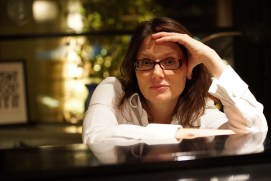
rhonda2bheadshot2bpianoRhonda (Ringering) Rizzo is the author of The Waco Variations. She has crafted a career as a performing and recording pianist and a writer. A specialist in music that borrows from both classical and jazz traditions, Rizzo has released four CDs, Made in America, Oregon Impressions: the Piano Music of Dave Deason, 2 to Tango: Music for Piano Duet, and A Spin on It.  As both a soloist and a collaborative artist, her performances include several allclassical.org live international radio broadcasts, Water Music Festival, Central Oregon Symphony, Oregon Chamber Players, Aladdin Theatre, Coaster Theatre, Ernst Bloch Music Festival, Bloedel Reserve, Newport Performing Arts Center, Skamania Performing Arts Series. In addition to her work as half of the Rizzo/Wheeler Duo, with pianist Molly Wheeler (www.rizzowheelerduo.com), Rizzo records and writes about the music of living composers on her blog, www.nodeadguys.com

Her numerous articles have appeared in national and international music magazines, including American Music Teacher, Clavier, Piano & Keyboard, and Flute Talk. Her novel, The Waco Variations, was released in the summer of 2018 and can be found on www.amazon.com.  

Rhonda Rizzo earned her undergraduate degree from Walla Walla University and her Master’s degree from Boston University.

Guest post by Rhonda Rizzo

In the caress of notes, Cassie knew nothing of fire, death, loss, or fear, just love plucked from Bach’s hands, to Eric’s, to her own—spoken in a language too deep for words.

—excerpt, The Waco Variations

Writing about music is like dancing about architecture. And while I can’t speak to dancing or architecture, this cliché sums up the problem of using words to describe what is fundamentally an experience, not a concept. Whether listener or performer, we enter into the world of the notes and receive and respond to the music through the lens of personal experience and understanding. And, because everyone’s experience and taste is different, how does a writer capture in words the sensation of sinking one’s hands into the piano keys, or the eerie magic of “one mind” that occurs when musicians perform together?

Write what you know. It’s another accurate cliché. As a lifelong pianist, I know music. I know the experience of making music, and of listening deeply to others. As a writer, I know my character, Cassie, and how she falls in love to Bach and allows herself to grieve through the music of Rachmaninoff and Liszt. I write the common ground between what I know, what Cassie knows, and the human truths that connect all of this to music.

Show, don’t tell. A writer’s cliché. If I tell the reader that Cassie and her boyfriend Eric, had a good performance of a Bach double concerto, it’s dull boring. Showing makes it tactile. It makes it real. It makes it matter.

In the second movement, Cassie stopped being aware of any reality beyond the music. The competition, the judges, her hair, her dress—none of it existed. The notes defined her universe. And as she and Eric passed the sensuous lines back and forth, she dissolved into them. She was the piano, and the piano was her. She was Eric, Eric was her. And Bach was what held everything together. There were no mental pictures and no stories. Just the music, and Eric, and the piano, which seemed to grow out of her fingertips.

—excerpt, The Waco Variations

Make me care, I used to tell my piano students. Don’t just press the notes. No matter how beautifully you phrase a line, if you don’t have anything interesting to say, you’re just speaking phonetic music. Writing requires the same because readers deserve entry into all aspects of the moment, not just a description. In both art forms, if the notes or the words don’t communicate something beyond themselves, everything comes out flat and lifeless.

Another quote: the visible is the invisible written down. As musicians and writers, we use what’s concrete (notes, words) to point to intangibles: love, joy, loss, hope, and a myriad of other human emotions. It’s an internal landscape we all share, and because of this common ground, music—and writing about music—is about bringing the listener or reader into a new world through our shared emotional doorways. We don’t need to know why a piece of music moves us to tears, or how a paragraph conjures up an entire world. We experience it. We feel Cassie’s struggle with an unfamiliar piano and we know her belief that somehow she can communicate with her deceased parents through the notes of Liszt’s Sposalizio.

Taking a deep breath, she put her hands on the keys, closed her eyes a second, and then played the opening lines. The muted upper register hampered her attempt to get a bell-like tone in her first right-hand arpeggio section. She tried to play through it, thinking of each note as being wrapped in thick velvet. Perhaps the clarity was there, at the center of all that velvet? What the piano took away from the upper register it gave back in the middle; when Cassie started what she always thought of as the prayer-like section—the one where she sensed she needed to breathe the notes rather than just play them—the velvet tone gave the notes a warmth she had never before been able to achieve on any other piano. The sounds matched the one she had been hearing in her mind, and the magic of reality matching the ideal was so strong that she could feel the hair on her arms bristling. Normal life fell away, and for those breathless moments she sensed that the notes were getting through and that somehow, someone was on the other side, hearing all the love and loss she poured into each pitch.

—excerpt, The Waco Variations

Writing about music is, ultimately, writing about humanity because that’s where power of the best music and literature resides. The form—the architecture—only points to the bedrock truths we all share. We love, we grieve, we celebrate, we mourn, and we seek (and sometimes find) meaning in the most unexpected places.


rhonda2bheadshot2bpianoRhonda (Ringering) Rizzo is the author of The Waco Variations. She has crafted a career as a performing and recording pianist and a writer. A specialist in music that borrows from both classical and jazz traditions, Rizzo has released four CDs, Made in America, Oregon Impressions: the Piano Music of Dave Deason, 2 to Tango: Music for Piano Duet, and A Spin on It.  As both a soloist and a collaborative artist, her performances include several allclassical.org live international radio broadcasts, Water Music Festival, Central Oregon Symphony, Oregon Chamber Players, Aladdin Theatre, Coaster Theatre, Ernst Bloch Music Festival, Bloedel Reserve, Newport Performing Arts Center, Skamania Performing Arts Series. In addition to her work as half of the Rizzo/Wheeler Duo, with pianist Molly Wheeler (www.rizzowheelerduo.com), Rizzo records and writes about the music of living composers on her blog, www.nodeadguys.com

Her numerous articles have appeared in national and international music magazines, including American Music Teacher, Clavier, Piano & Keyboard, and Flute Talk. Her novel, The Waco Variations, was released in the summer of 2018 and can be found on www.amazon.com.  

Rhonda Rizzo earned her undergraduate degree from Walla Walla University and her Master’s degree from Boston University.

Concert going is a social as well as a cultural activity and one of the great pleasures is the after-concert discussion with friends – and occasionally strangers who linger in the auditorium or foyer – keen to share their thoughts on what they’ve just heard. Sometimes a performance can be so profound, moving or thought-provoking that an immediate verbal response may be impossible, as we each privately digest and consider what we have just heard. At other times, the words tumble out eagerly as we rush to share our impressions of the event.

Last week I was back in London for a very special concert at Temple Church, part of a series hosted by Temple Music Foundation featuring pianist Julius Drake and friends. Here was Schubert’s heartrending song cycle Winterreise, a work written the year before he died which has been invested with all kinds of meaning and psychobabble by those who believe this painful narrative is an autobiography of sorts. Austrian mezzo-soprano Angelika Kirschlager was singing this great work for the first time – and for me this was the first time I’d heard a female voice in the role of Schubert’s lonely winter traveller (I’ve now heard the work performed by tenor and baritone voices and also in an excellent English translation). Seated at the back of the church, it took awhile to tune one’s ear into the church’s acoustic, but once settled, it was clear to me that this was a performance of exceptional intensity, drama and emotion. I couldn’t see Kirschlager very easily from my seat, but her projection and commitment to the role was clear, her voice at times rough-edged and richly-hued to bring greater meaning and expression to the text and music.

Repairing afterwards with friends to a cosy pub on the Strand, we discussed what we had just heard over wine and beer (we also discussed the vessel from which my friend Adrian drank – was it a “tankard” or a “glass with a handle”? Such is the way when lively, inquisitive minds meet….!). While I enthused about the intensity and drama of the performance, my companions were rather more guarded, and this provoked a vigorous, but always friendly and considerate discussion. This was not some dry bar-by-bar analysis of the work and its performance, but thoughtful, heartfelt and immediate reactions by people who really care about music and concerts. It proved how meaningful, subjective and, above all, personal our experiences of music are.

It was a real treat to hear such an absorbing gig, then ‘share’ it there and then, as if the evening re-booted into 2 great nights in 1 – Adrian (@adrian_specs)

Never before has a performance led to a spirited, respectful and absorbing conversation. Something that deepened my understanding about a work and a performer – Jon (@thoroughlygood)

As a writer and reviewer, I find such conversations can crystallise or adjust one’s thoughts about a concert, the works performed and the performers, offering valuable reflection or reappraisal ahead of a review or article being written. It’s also a healthy reminder that we do not all like or appreciate the same things – and thank goodness for that, for these differences make the concert-going experience far more rewarding and interesting.


Adrian’s review of the concert at Temple Church will be published on this site shortly.


