
An essay by Jack Kohl
At first I thought the story had everything to do with the piano. As a young undergraduate, the piano had augmented my already considerable sense of self-confidence, yet in striving to make myself inaccessible to all women but the imagined and idealized future one, a strange caution set in when a likely one appeared and herself seemed inaccessible and unobtainable. But in the latter half of her final semester, in the autumn of 1991, the young violinist – tall, porcelain, irresistibly vital and convivial; with a mane of hair as curled and complex as a thousand bundled, undeployed, violin strings; with a beauty of face not so much like any one famous actress but suggestive of many in their heyday, and thus distinctive in a kaleidoscopic patent – suggested we read chamber works together. Many a duet pairing, though well-matched musically, may also start for the same ulterior reasons that inspire many other kinds of superficially strict professional alliances. That possibility made me accept the invitation immediately; under all other circumstances I would have remained content to exult in the piano’s regal, solitary, completeness – a singleness that can even find satisfaction in dividing one’s self into further solitary fractions by practicing hands separately. I contained my romantic hopes at the start, but soon I cultivated them as the young woman and I spent more time together after our readings, even though she would depart for graduate school in England in the New Year.
This romance on Long Island – as elevated and innocent in my memory as a Hays Code Dream, a dream fit for the Motion Picture Production Code established in 1934 – unfolded in the last two months of the year – months, here in the American northeast, that have always stood for a mounting sense of imminence for me, which are marked by the final thinning of the cricket choir into isolated soloists, the passing of the last signs of Halloween, the further darkening and cooling that frames Thanksgiving, and the final but artificial flash of Christmas light that concludes in leafless dark and cold. The growing absence of scent that comes with the mounting cold that burns the inner nose has always encouraged me to perceive, in relief against the surrendering outer vitality of the year, a personal inner life that seems to stand alone, unvanquished, constant, eternally cheerful notwithstanding the increasing and, at last, complete absence of external reinforcement. The apotheosis of these months tests and confirms the Idealist – he who is certain that what comes from within always trumps what comes from without. I have long suspected that the early Church had more than conquest and convenience in mind when it placed Christ’s birthday near to the dates of established Pagan rites in late December. The mutual though perhaps unwitting recognition of the suggestiveness of cold’s victory over scent may have caused all parties to contend for the same dates on the calendar. In the air of December that burns away the scent of all that is without, I become as a self-church, one that finds a sort of solitary Easter within during such dark and thrilling and scentless evenings.
But on a glorious night in December of 1991 in Huntington Village, walking from the movie theater to Swenson’s Ice Cream Parlor on Main Street, I could smell her perfume though my nose burned with cold. My fierce Idealism was thus confronted with the core of a kindlier churchly philosophy – that another may be as conscious as myself – this by the irreligious and outrageous vitality of her young body, laughing and standing against the cold. Her body was even more than this to me. Notwithstanding the scentless and icy air, the young woman seemed the sole and concentrated preserve of all the force and vitality of the past- and distant-future-living parts of the cyclic year. In that hale December bitterness, as the autumn gasped and yielded to new winter, the white and slender columns of her legs seemed a raw memorial of the surrendered spring and summer. No, the monument was more living to me than what it signified. The deadness of the cold air amplified her bodily beauty. To see a young woman’s legs in winter – as I would later see them that month, too, in a short, red velvet Christmas party dress – especially as she may dash from car to indoors, made my eyes relish more than all things the concentrated demonstration of feminine alabaster that thrived notwithstanding the deathly cold. This sight seen in the moment of such transition is indispensable to understanding a young man’s sexual preoccupations that are, at last, completely above the sexual. The shocking sight of her white legs in the leafless blackness was something akin to what one feels in seeing a healthy pumpkin survive into winter. No, for the pumpkin is doomed. But the legs thrive, radiate, bloom even in a hothouse of shattered windows.
If asked, at last, when it was that I encountered the zenith of youth, I would venture that cold night in Huntington in 1991. I hear even now in my mind’s ear my laughter, and the girl’s, as I struggled with the stick-shift of a red Volkswagon Beetle convertible, as I drove along Sabbath Day Path near the village green at the night’s end. I would have to answer Gabriel with something of a riddle, as well: that I had felt most holy when at my most bodily.
The young violinist left for England and graduate school just after the New Year. She said she would write to me, and she did. I ended my reply with an unnecessary valediction – one that contended that I would write no more, for continued correspondence would be as “tacit pledge of fidelity.” I was not seeking other romances, and I still thought the Cosmos of this one, but that phrase seemed best to one who was looking for the noble line by which to realize a Hays Code apotheosis. Yet in the following decades I continued to recall the extraordinarily accomplished and beautiful young woman who, when we sat across from one another at Swensen’s, had also blown at me the wrapper of her straw.
My romances then became less guided by the Hays Code and defined better by the disappointments of the B-players in modern romantic comedies. At the end of each of those stories I thought of the cold night along the Sabbath Day Path and checked the internet to see where the violinist might be. I took no action. One night, however, a year after I had regained my freedom yet again, I searched online once more, and I noted the email address of the law firm for which the violinist now worked. I wrote to her; I had an immediate and gracious reply. We had cordial exchanges, and her warmth extended, as well, to an invitation to dinner with her husband and very young daughter in Connecticut. I declined. I let another year pass, and I wrote again to say hello. She invited me again to visit her family in Connecticut, and to try her new piano. I baulked once more. But this second new correspondence then led, weeks later, to our plan to meet at our alma mater for a chamber music reading session. This was for February 6, 2020 – almost twenty-nine years since I had last seen her.
As I made my drive to our 11 AM appointment at Queens College in Flushing, I endeavored to picture in my mind an unrecognizable, old, woman so that I would not be shocked and so that the day would be passed in pleasant memory no matter whom, in a sense, I would encounter that morning. After an hour’s drive, and after a bit of hunting on the streets for parking, I found a spot not far from the campus on a side street. I phoned the violinist to tell her where I had parked, and she told me to go directly to the school and not to wait in the rain. I went into the nearest building. The violinist called and said that she had found a parking place on the same street as I had. I said I would come out to meet her. I held firm to my image of the imagined old lady. Soon I saw her on the other side of the street – a bit to the west, coming from the side street’s corner to the crosswalk. I was shocked, for I had to dismiss my image of someone made unrecognizable by time. We waved to each other. She crossed the street, and soon we came together for a hug.
“You look exactly the same!” I exclaimed. She smiled and paid a compliment to my navy blue pea coat.
We talked all the way to the music school and then made our way to a little practice room. We read through many pieces, and many were from the same list from decades earlier. The room was warm – no, hot – and we took more than one break in the hallway, during which I gave her two books that I had written, and she gave me a bottle of maple syrup from her property’s trees.
I feared that our day would end with our playing, but she asked if I would like to have lunch. I began to unleash my memories and regrets as we made our way to the side street where we had parked. We found, when we went to her car, that she had been issued a ticket, but I had not. We had a joyful ride to lunch via the Long Island Expressway. On the way I permitted myself to unleash all my memories of the romance from 1991’s end – and the reasoning behind my letter in answer to hers from London in the winter of 1992.
As I write these lines, I look down now upon the lunch receipt that I saved and tipped into my journal. With that receipt pressed flush against the tabletop between us, and my fingers upon its two narrow-most edges, I had pushed those ends together slowly, my hands moving in contrary motion, until two normally separated interior points of the paper met and thus caused a parenthetical bow to form above – that upper portion representing to me the intermediary span of time between two distantly spaced meetings, that upper loop appearing then parenthetical (but somehow remaining latently agent in the tally of chronology), yet the two new touching points on the level plane below also seeming sequentially adjacent. The woman understood my meaning (as she seemed to understand all the things I wished to express). Many may describe this feeling as, “It felt as if no time had passed at all.” But I am certain there is much more to it – as in a musical rondo one still registers the intermediary sections between the A sections, but the A sections, when they return, somehow still feel adjacent, unseparated.
On the printed side of this saved receipt, the text (Panera Bread Café #4657, New Hyde Park, New York, 3:13:30 PM) is fading away (as I have noted happens on many old receipts). But on the blank side of the receipt, written in my own hand below the date, is the word Trapestry. Underneath that lone word I had bracketed a pair of words, one over the other: Tragedy and Tapestry. Trapestry, by process of etymological conflation and stirrings of the heart was our coinage for the fleeting gift of the day, expressed by the fragile demonstration I made with that very receipt.
Before the lunch was over the violinist looked at me in misty earnest and said that the day was a once-in-a-lifetime kind of experience. I agreed. We drove back to my car via a network of streets and not by the Expressway. We sat in her car for a time before I returned to mine. The violinist said she was thinking of how we might proceed – and with very tacit expressions invoked all that had to be considered. I replied that I understood, of course, and that it was to her credit that she made such allusions. For many things had not been said that day, and I abetted the omissions by giving in to the very seductive trap of not asking about them. Before I left for my car she said, “I feel like I’ve been hit by a truck.”
The next day, an almost daily correspondence began, and I remarked: “No single man should leave, by his lack of verbal caution, a stunning married woman feeling as if hit by a truck.” Yet we began a pattern, of meeting almost every two to three weeks for reading chamber music and having lunch. The meetings always observed the demonstrable forms of friendship, yet I always had to govern the unusable impulses that boiled within me as a free man. At one of our lunches, as we recalled our time at the ice cream parlor from three decades earlier, she pursed her lips and then blew the wrapper of her straw at me again. I would remind myself: “She has more to lose; I have more not to gain.”
I would wait with excitement for her as she walked off of the Cross-Sound Ferry and arrived in Port Jefferson for the start of our days together, and I would sometimes notice the papery bodies of horseshoe crabs on the nearby beach, suggesting Normandy casualties to me. But the ease of her arrivals by ferry made it seem as if the loop that hovered over the Trapestry receipt had no figurative part of her crossings across the water from Connecticut.
On cool days she would walk toward me wearing a wrap and sporting lithe boots, yet wearing jeans that covered her still slender legs – looking like a photo of equestrian briskness from a Laura Ashley catalog – and she seemed to carry only printed scores, and her violin case slung across her back like a quiver.
When nearly a year of this pattern had unfolded and the air grew cold once more, I told the violinist as she walked from the ferry with me to my car that the underlying absence of scent from the frigid air had recalled to me the memory of decades earlier of the one scent that had thrived in such a void. As we climbed into my car she smiled and recalled the dramatic name of the perfume she had worn when we were in college. Then she added that her daughter told her that she always smells like sugar cookies.
She revealed to me that she still had the letter I had sent to her in London in early 1992. I was shocked to see it again, and I pretended to laugh with her at my subscription at the letter’s end, written in affectation of the closing of a page from a Samuel Richardson epistolary novel. But my attention was focused, however, on the phrase not far above my signature – and there it was, still, the line about continued correspondence seeming to me a tacit pledge of fidelity.
The violinist said she had looked again at my letter around 2008, and that at one time, as well, she had found a photo of me on the internet, posed with other musicians. “Did they look like a group of singers?” I asked. No, it had been musicians, she replied, and then we both laughed at the easy reflex it is for an instrumentalist to refrain from calling a singer a musician. She expressed embarrassment for her remark. But I assured this accomplished and beautiful woman that she was no snob, that she had raised the standard so high that if one is going to have romantic regrets about lost love, then one should place them on the highest object.
She ventured to me that “there seemed to be no wagons in my house,” after our readings overlapped more than one time with my family: my mother, father, and sister. She said felt she was at times, when back in her own home, as a cat pulling a wagon behind her – that she was in traces that should be occupied by a team of draft horses. I assured her that all families have their covered wagons. I could see that she had the burden of one-in-a-census energy, vitality, and joy, this woman who surprised me with quotations that she revealed were from my own books, and who lobbied for me as a pianist with the rarest kind of attentive agency.
She wondered aloud if I should have gone with her to England. Then she suggested that though we were not together as we may have wanted, that we had each other now after a different fashion. I thanked her for the astonishing way that she sees things. I speculated that perhaps the outcome was optimal, a higher realization than had we pursued a young love in 1991.
I texted her after she left that day: “Thank you so much, all-vital but harness-bound but inimitable and glorious Wagon Cat! The world would not move but for the enfired pulling of the likes of you! There is, however, no like, I should say – no like of or to the singular. Pull on! Pull on!”
We continued to meet, write, and exchange phone calls. I could hear that she was crying on one day when I reached her by phone. Her husband had asked her to end our friendship. I told her that she could tell him for me that ever since I was child and had first seen the movie “Camelot,” I had hated Lancelot’s guts, and thus his wife was safe in this knight’s care. This helped for a time, but even I realized that in professing my contempt for Lancelot I was thus confessing to a sort of self-hatred.
I took a run at this time with a trusted friend along the shoreline of Long Island Sound, and Connecticut looked close and clear in the cold winter light. I had introduced the violinist to my friend sometime before, and now on the privacy of the beach I spoke of my dilemma. My friend is an observant fellow and a self-confessed former “dirty-dog.” We paused at our turn-around point of the run. “She has got it all!” he began, as a man might exclaim after he conjures an ideal woman in the holodeck of Picard’s U. S. S. Enterprise. Then came the wry addition: “Including a husband!”
After the grim humor had passed, he asked: “You do know this has nothing to do with the violin?” The wisdom of a reformed rake always carries a special power of invulnerability to the Puritan who frets over his ostensibly perfect record.
During all this time I continued to practice the piano. I was working on the finale of Bach’s G-Major Toccata. I was rehearsing it hands separately. But it occurred to me – because inner lines pass from one hand to the other in relay when such pieces are performed – that by working this way I was creating the impression that artificial cul-de-sacs blocked the open boulevards that run between the two hands when they work in normal complement – those two hands conducting a relay so subtle, facile, and seamless that any observer on the figurative bleachers would contend that they had witnessed nothing but an unsupported, floating, baton traveling in runnerless lanes.
What cannot be heard by an outside witness but as a single unbroken line, is known to the pianist to be the union of two parts of a divided self giving a singular impression. The practical choreography of a pianist is an expression of intolerance for the sins of omission. I resumed practicing with two hands and thought of the Trapestry receipt – then went to my laptop so as to write a message that would win me the race to the high ground, to the genuine apotheosis, at last, of a Hays Code dream.
But there I found an email from the violinist saying that we should end our alliance. She said, in essence, that our continued correspondence would be as a pledge of tacit fidelity. I realized that she had not been making easy ferry rides, but undertaking a hard portage of her own, as when a kayaker notices that a secret dram of the separated waters is always carried overland in the cockpit. She had been wrestling in her own way with an overarching bow of Trapestry, perhaps reinforced by her own solitary practicing, in which case it had everything to do with the violin.
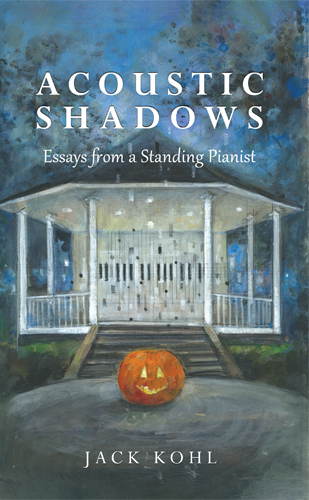
Jack Kohl is a pianist and writer. He is the author of The Pauktaug Trilogy: That Iron String (a novel of pianists vs. music), Loco-Motive (a novel of running), and You Knighted States (a Western). He is also the author of three collections of essays: Bone Over Ivory, From the Windows of Diligence and Acoustic Shadows. His work also appears in The Continental Literary Magazine.
As a pianist he holds performance degrees from the Juilliard Pre-College Division, Queens College/CUNY, and the University of South Carolina.





 The Cross-Eyed Pianist