Guest post

PianoMe: The Smart Way to Share Rehearsal Spaces and Earn Money with Your Music Room

What can you do when rehearsal rooms and instruments stand empty for hours or even days?

The answer is simple: share them through www.piano.me/en and turn unused space into income.

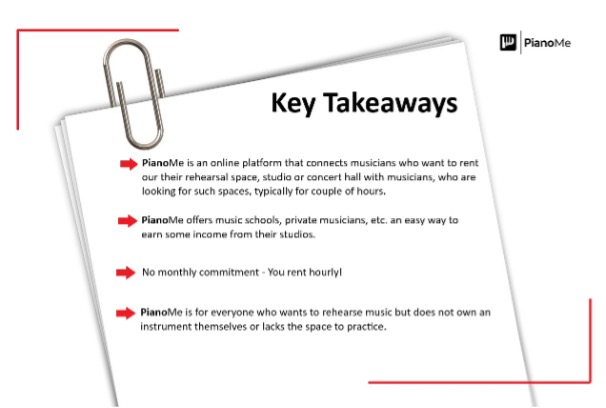
PianoMe is a growing online platform that enables musicians, music schools, studios, churches, and private hosts to rent out rehearsal spaces with instruments by the hour. At the same time, musicians can book affordable practice rooms exactly when they need them—no long-term contracts, no unnecessary costs.

Rehearsal Spaces Sharing Community – Built by Musicians for Musicians

PianoMe was created by musicians who experienced the same problem many artists face: finding a suitable place to practice is often difficult, expensive, and inflexible.

The idea behind the platform is based on the sharing economy: if a room and an instrument are not in use, they can be shared with others.

This creates a classic win-win situation:

  • Hosts generate additional income from otherwise idle rooms
  • Musicians pay only for the time they actually use
  • Cities benefit from a reduction in rehearsal room shortages

Traveling musicians, in particular, appreciate being able to book a nearby practice room within minutes, whether for an audition, an exam, or a recording session.

Monetize Your Empty Rehearsal Room

If you own a rehearsal room or a studio that is not used 24/7, PianoMe offers an easy and secure way to earn money.

Creating a listing takes only a few minutes:

  • Upload photos
  • Set your availability
  • Define your own rental rules and cancellation terms
  • Start receiving bookings

All processes—from request to payment—are fully digital and automated, which means no paperwork and minimal administrative effort.
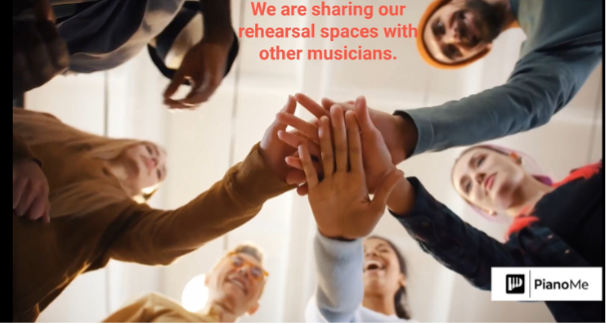
A Lifeline for Music Schools

Music schools are facing increasing financial pressure due to rising costs and reduced public funding. PianoMe helps them:

  • Generate additional revenue from unused rooms during off-peak hours
  • Digitize and automate their rental processes
  • Reach new target groups such as freelance teachers, ensembles, and choirs

For some institutions, hourly room sharing has already become a second financial pillar that helps stabilize operations.

Flexible Solutions for Music Teachers

Freelance music teachers benefit from a highly flexible, on-demand room model:

  • No long-term rental contracts
  • No deposits
  • Hourly bookings based on actual teaching needs
  • Easy cancellations within the respective host’s policy

This supports the growing agency model in music education, where teachers operate independently and require adaptable teaching spaces.
Growing Demand and a Diverse Rehearsal Space Marketplace

The response on social media has been overwhelmingly positive. The general consensus is clear: without PianoMe, many rehearsal rooms would remain unused for hours or even days, generating costs instead of value. With PianoMe, this situation is reversed. As one private host wrote in a Google review, their grand piano used to be played only on weekends, but thanks to the platform, both the instrument and the room are now actively used during the week as well.

As the PianoMe network continues to expand, the range of available spaces is becoming increasingly diverse. Today, the platform offers far more than single piano practice rooms. Musicians can find studios equipped with drum kits, electric guitars, or even full recording setups. Room sizes vary widely—from small attic spaces and basement studios to full concert halls and modern event venues with stage and seating.

Browsing PianoMe feels like discovering the hidden musical infrastructure of a city. Many users are surprised by how many rehearsal rooms and instrument-equipped venues exist behind the scenes—places they would never have found without the platform.

Despite this wide selection, choosing the right room remains simple. User reviews provide real insights into the quality of the space and the instruments. In addition, each listing includes detailed information such as available equipment, room size, hourly price, capacity, concert suitability, rental conditions, and real-time availability.

The platform is used not only by professional musicians but also by hobbyists. And it is no longer limited to pianists—singers, amateur bands, choirs, violinists, composers, and many others are now part of the growing PianoMe community.

Free Music Event Promotion and Digital Tools for Musicians
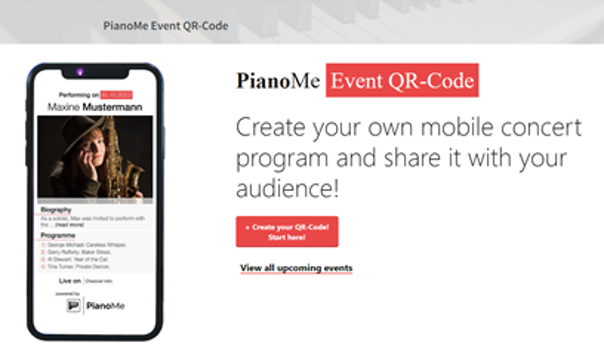
Every musician wants to perform live—and ideally to a full audience. PianoMe makes this easier by allowing users to promote their music events completely free of charge. The platform’s event promotion page, together with its integrated event QR code feature, has recently been expanded with additional functions. Event announcements can now be created on any device within minutes and shared directly across social media channels.

For those who prefer physical promotion, PianoMe also offers a one-click poster generator. Users can design, download, print, and display posters without needing external design tools. Concert programs can be distributed digitally via QR codes, enabling audiences to access them instantly on their smartphones—saving both printing costs and large amounts of paper.

By combining rehearsal spaces with digital promotion and content sharing, PianoMe goes far beyond room booking. It creates a connected ecosystem where musicians support each other, exchange ideas, and present their work.

Read PianoMe’s interview with Frances Wilson (The Cross-Eyed Pianist)
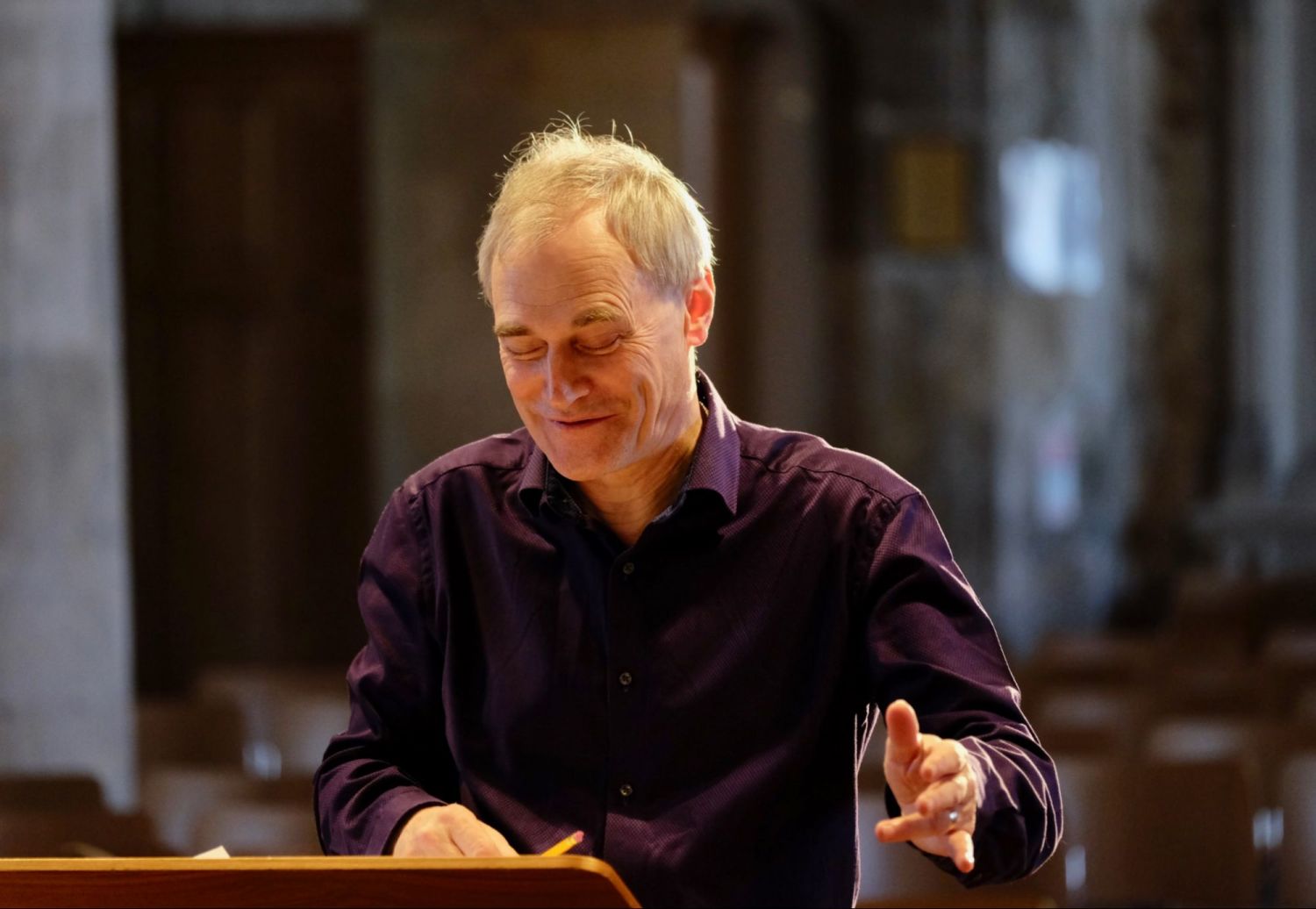
VIVUM MUSIC RELEASES CHORAL SINGLE TO CELEBRATE LINDSAY GRAY AND HIS CHORAL MUSIC LEGACY

‘May the Spirit Sing in Your Heart’ by Thomas Hewitt Jones is a choral single, originally composed for the 70th birthday of Lindsay Gray on 22 July 2023. This release marks the retirement of Lindsay from his role as founder and conductor of Caritas Consort, and celebrates his choral music legacy. The anthem is in the rich key of A-flat major, and sets a new text by Gordon Giles, which celebrates spirituality and the value of music. The piece was commissioned by Lindsay’s daughter Susanna, who sings soprano on the recording, and the music is published by Encore Publications.

Lindsay Gray says, ‘I feel very honoured indeed to have been the recipient of such a fine piece of music written for my 70th birthday by such a highly regarded composer! It has been fabulous to work with Tommy [Hewitt Jones] over the years, and we have greatly enjoyed performing his music in Caritas ever since the choir’s very first ever concert in March 2013, which Tommy so kindly attended. Warmest thanks; this is massively appreciated by me, by Caritas and by the Nepal charity which has also benefited so much!’

Thomas Hewitt Jones says, ‘Lindsay’s wonderful legacy in choral music needs to be celebrated, as does his tireless work raising money for good causes. As well as an esteemed musician. Lindsay has championed countless young musicians over the years (including me, when I started out). I am delighted to call him both a friend and colleague and very pleased we could release this recording to help celebrate the legend that is Lindsay Gray!

MAY THE SPIRIT SING IN YOUR HEART

Music by Thomas Hewitt Jones, words by Canon Gordon Giles

Caritas Consort conducted by Lindsay Gray

Recorded in St German’s Church, Cardiff, by Thomas Hewitt Jones for Vivum Music

Available now on all major streaming platforms


ABOUT LINDSAY GRAY AND CARITAS CONSORT

Lindsay Gray has had a distinguished career as singer, conductor, musical director and educator. He served as Director of the Royal School of Church Music (RSCM) from his appointment in 2007 through to 2012, having previously been a school headmaster for sixteen years, including fourteen at The Cathedral School, Llandaff. After his tenure at the RSCM, he continued to promote choral excellence through initiatives such as the Caritas Consort, embodying his lifelong commitment as an educator, enabler and supporter of sacred music and charities.

In 2013, Lindsay founded the Caritas Consort, a chamber choir that performs concerts to raise funds for charities and other good causes, directing it with a focus on high-quality sacred and classical music. Under his leadership, the ensemble has supported a wide range of causes, with over £80,000 raised from performances and donated to over 70 charitable organisations working in areas such as health, community support and education; in the case of this recording, £500 was raised for a project which supports disadvantaged families in Nepal.

In September 2025 Lindsay hands over the reins of Caritas Consort to focus on his other charitable work, in particular as Director of the Cardiff and District Branch of Samaritans, a leadership rôle in which he oversees 140 volunteers; this release helps celebrate his musical legacy.

www.caritasconsort.org

I am delighted to feature another guest post by writer Dr James Holden

The piano tuner is tuning the piano.

Downstairs, the piano tuner presses down the piano’s keys in order to tune the piano.

He presses down a key. He presses down a key.

Downstairs, the piano tuner is working his way down the keyboard, pressing down each key in turn, turning the tuning pins, tuning it. He works his way right down, pressing now the downmost keys. The downmost keys need tuning and the piano tuner is now tuning them. They need tuning as they are down in pitch. These downmost keys need tuning because they are now down in pitch, and when the piano tuner presses down the keys they beat out of time. They have a metallic clang. When the piano tuner presses down the downmost keys it now sounds like a hammer striking a bell, not a string.

Downstairs, a bell is ringing. Downstairs the piano tuner is ringing a bell, a solemn bell. The hammer strikes. The bell tolls. The hammer strikes. It is a funeral bell tolling. It is a funeral bell, the bell that tolls downstairs, like Berlioz’s bell. It is a bell that calls forth to witness. Downstairs, the downmost notes sound out the Dies Irae. It is now Berlioz’s bell.

He presses down a key. He presses down a key.

Upstairs, I’m listening to the piano tuner. I’m listening to the piano tuner tune the piano. I’m listening to him tune the piano back up to pitch. Upstairs, the piano is uppermost in my mind. I should be writing down my thoughts, but I’m not. Upstairs, I’m listening to the piano tuner tune the piano.

He presses down a key. He presses down a key.

Downstairs, the piano tuner is working his way up the keyboard, turning the tuning pins, tuning it. He works his way right up, pressing now the uppermost keys. The uppermost keys need tuning and the piano tuner is now tuning them. These uppermost keys need tuning because they need to be brought up to pitch, and when the piano tuner presses the keys they beat out of time. They have a metallic clang. When the piano tuner presses the uppermost keys it now sounds like a series of small bells.

Downstairs, bells are ringing out. Downstairs the piano tuner is ringing bells, joyful bells. The clappers clap. The bells ring. The clappers clap. And as the piano tuner rings out these bells, and as he checks his octaves, he plays a casual, coincidental Campanella to rapturous applause. These are bells that call forth to dance, to get up. The uppermost notes sound out the steps. This is now Paganini’s peal.

He presses down a key. He presses down a key.

The piano is now in tune.

Downstairs, the piano tuner has tuned the piano. Downstairs, he has pressed down each key in turn, turned the tuning pins, tuned it. The notes are now where they should always have been. They are neither up nor down but right there, right where they should always have been.

The piano is now in tune.

About the author: 

James Holden is a writer working across the critical-creative divide. He is a specialist in British and European culture from the birth of Chopin in 1810 to the death of Monet in 1926. His published work includes In Search of Vinteuil: Music, Literature and a Self Regained (Sussex Academic Press, 2010). He is currently working on a philosophical reading of romantic pianism. James also writes experimental prose and poetry. He is currently associated with the HOARD art project in Leeds. 

His website is www.culturalwriter.co.uk 

He tweets as @CulturalWriter 


A short film about my piano tuner Rolf Dragstra, made by his son