
On being a musicologist-pianist – guest post by Dr Samantha Ege
As a musicologist-pianist, my repertoire tends to reflect the areas that I am researching. When I started my PhD at the University of York in 2016 with the goal of writing my dissertation on the composer Florence Price (1887-1953), her piano music instantly became a part of my research journey. I found that studying Price’s scores and playing her music helped me write more insightfully about her life. Reciprocally, my writings then helped illuminate new ideas for interpreting her piano works.
In 2017, I went on my first archival research trip to Chicago, Illinois, and Fayetteville, Arkansas. This was a really exciting adventure as I would be visiting Price’s home state and spending time in the Midwestern city that she moved to in the late 1920s. I visited the Rosenthal Archives of the Chicago Symphony Center to see the documents surrounding the premiere of Price’s Symphony No. 1 in E Minor. I managed to attend a concert too. I remember waiting in the foyer and meeting Sheila Anne Jones. Sheila ran the African American Network of the Chicago Symphony Orchestra and told me about her work. I then told her about my research, and we exchanged details.
A year later, Sheila hosted my first major lecture-recital at the Chicago Symphony Center. It was called ‘A Celebration of Women in Music: Composing the Black Chicago Renaissance’. At this time, I was two years into my doctoral studies and had just recorded my first album, ‘Four Women: Music for Solo Piano by Price, Kaprálová, Bilsland and Bonds’. The musicological and performance strands of my work were moving along, but when I brought them together in this lecture-recital format, I felt like I had really found my identity as a musicologist-pianist.

In this lecture-recital, I discussed key themes that would later surface in my published articles and book projects, i.e., themes of community-building and women’s leadership and advocacy. In my performance, where I played Price’s music alongside works by Margaret Bonds, Nora Holt, and Irene Britton Smith, I realised that my programming choices could really assist in conveying historical narratives, as well as striking up new connections and meanings for modern audiences. (See the blog post I wrote on “Connection not Perfection.”)
In the summer of 2019, I prepared for what would be my last archival research trip before the pandemic. I had a one-month fellowship at the Newberry Library in Chicago where my project entailed looking at women’s contributions to concert life in interwar Chicago. This led to me writing an article called “Chicago, ‘the City We Love to Call Home’: Intersectionality, Narrativity, and Locale in the Music of Florence Beatrice Price and Theodora Sturkow Ryder” (which will be published in American Music journal later this year). I also returned to Fayetteville with a mission: I wanted to find Price’s complete Fantasie Nègre compositions for solo piano and record them with the label LORELT.
My biggest challenge was recovering the third fantasie as it was thought to be incomplete. As I looked through the archives, all I could see were the first two pages of the fantasie. As I puzzled over where the rest of the music could be, I found myself drawing upon my entwined experiences of writing about and performing Price’s music. I thought about her approaches to key, form, and melody, and started looking for loose sheets of manuscript paper that might match the other possibilities I had in mind. And that’s when I located the missing parts of the fantasie. I pieced it together and it was truly magical hearing Fantasie Nègre No. 3 come to life, perhaps even for the first time since Price’s death in 1953.
I’m grateful for the opportunities I’ve had over time to shape my voice as a musicologist and pianist. My new album, ‘Fantasie Nègre: The Piano Music of Florence Price’, brings all of these experiences together. Fantasie Nègre combines my passion for scholarship and performance, and demonstrates how both strands can work together to uncover hidden histories.
Samantha Ege’s new album ‘Fantasie Nègre: The Piano Music of Florence Price’ is released on 8 March 2021 on the LORELT label.
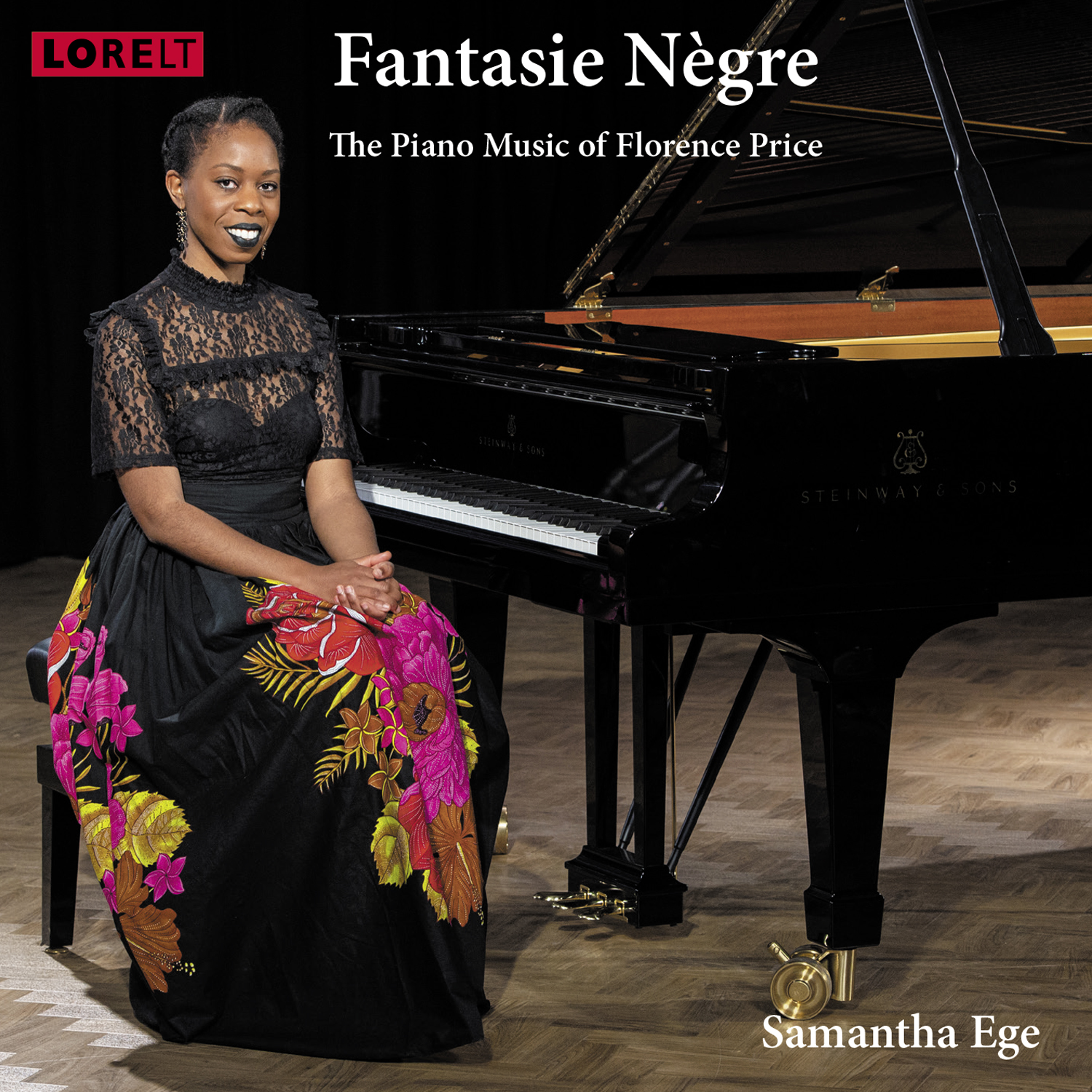
Dr. Samantha Ege is the Lord Crewe Junior Research Fellow in Music at Lincoln College, University of Oxford. She is a leading interpreter and scholar of the African American composer Florence B. Price. She received the Society for American Music’s Eileen Southern Fellowship (2019) and a Newberry Library Short-Term Residential Fellowship (2019) for her work on women’s composers in Chicago. She has written for American Music, Women and Music, and the Kapralova Society Journal. She released Four Women: Music for Solo Piano by Price, Kaprálová, Bilsland and Bonds with Wave Theory Records in 2018. Her latest album is called ‘Fantasie Nègre: The Piano Music of Florence Price’.
 Arthur Sullivan, Haddon Hall
 En Pleine Lumière volume 1 – Sandra Mogensen, piano



 The Cross-Eyed Pianist