noun

Music

noun: fermata; plural noun: fermatas

  • a pause of unspecified length on a note or rest.
  • a sign indicating a prolonged note or rest.

“It’s not the notes you play; it’s the notes you don’t play.” – Miles Davis

John Cage’s 4’33” may be the most infamous example of the use of silence in music (or rather the use of silence to create music), but composers have always recognised the power of silence and musical silence is as meaningful as interruptions and pauses in the language we speak. And because music is also a language, we recognise and understand the significance of those silences in music – a momentary breath, a witty or rhetorical stop-start, a pregnant, portentous pause, false cadences, an interruption to the flow of music which has you guessing before the composer strikes off in another direction. All these devices add meaning, drama, humour and emotion to the music. They also sharpen our attention and keep us listening, for the ear is constantly asking “what comes next?”.

5f4abe3691cbefc5214a04dcca372ff6
Fermata marking in music

A fermata marking above a note is generally understood to mean a longer pause – i.e. longer than the note value. Exactly how long to wait is at the discretion of the performer and there is a fine line to tread between creating dramatic, meaningful silence or suggesting that you might have forgotten what comes next in the music!

There is an even greater fermata at work at present, thanks to the global coronavirus pandemic. It has created an unprecedented, in peacetime at least, rupture to normal daily and cultural life. Concert halls and opera houses are closed, those places which until a few weeks ago resounded with music, and silence – not just the silences between the notes but that special hush of anticipation before the music begins or that magical concentrated, almost inexplicable silence which occurs during a particularly intense performance when it seems as if the audience is listening, and breathing, as one, or that special quiet at the end of a particularly arresting performance before the applause comes.

For those of us who love live music, the closure of the venues and its effect on our cultural life, has come as a huge blow, and not just in the absence of live music but also the social aspect of attending concerts. I had tickets to hear Chick Corea and Yuja Wang at the Barbican in March; both concerts were cancelled, and I do not anticipate returning to the London venues which I love (especially Wigmore Hall) until the autumn now, at the earliest. Summer music and opera festivals are now being postponed or cancelled (sadly, it seems highly likely that the BBC Proms will be cancelled), and one wonders how venues will cope when they are eventually permitted to reopen while audiences must continue to observe social/physical distancing. Auditoriums are not really designed to observe a 1- or 2-metre apart rule, and in older halls such as London’s Wigmore, audiences sit hugger mugger in tightly-packed rows. How will venues square this tricky circle? Will they perhaps sell only every other seat to ensure some distance between people? And how will orchestras, ensembles and choirs, for example, observe appropriate physical distancing on stage?

And there’s another conundrum for the venue managers – managing the social spaces where people meet and congregate before and during a performance, spaces which are often crowded, especially at a sold-out concert or the opening night at the Royal Opera House. It will be a challenge for sure – but I have a feeling that when the venues begin to reopen, music lovers and keen concert-goers like me will flock back to them. And some of us may take a gamble with our health in doing so.

image
Wigmore Hall, London

In the meantime, while coronavirus has forced the closure of the places where musicians and audiences come together to share in the experience of live music-making, it has not silenced the musicians who are determined to play on, their music broadcast via YouTube, Zoom and similar platforms, often with interesting and innovative results, and, it would appear, large audiences. Classic FM reports that a recent “living room” concert by their Artist-in-Residence violinist Maxim Vengerov has been viewed by more than 20,000 people, with 1,500 peak live viewers – more than can fit comfortably into a medium-sized concert hall. Such performances also bring the musicians closer to their audiences and break down the traditional barriers and notions of elitism associated with classical music and the rituals of its performance and presentation. Audiences see musicians at work in their own homes and discover that away from the formality of the concert stage, these people are normal – they live in normal homes, not Lisztian salons, wear normal clothes, have kids and pets. By the same token, musicians can forge stronger connections with audiences by bringing their music to the living rooms of their fans and supporters. If these online viewers translate into paying concert-goers when the venues eventually reopen, this could signal a marvellous resurgence for classical music and perhaps even encourage new audiences, a perennial issue for the artform. So maybe the coronavirus could have a positive impact on the way music is presented and enjoyed – we can but hope….

As a postscript, readers may be amused to learn that an alternative Italian word for fermata is corona…. And fermata is also the Italian word for bus stop.


Who or what inspired you to pursue a career in music?

It might sound weird, but music itself guided me to become a professional musician. As a child and teenager, I lived in my own world and spending time playing and listening to music was my favourite activity. It was much later – around my 15th or 16th birthday – when I realized pursuing a different career would equal spending less time with music and that was no option for me. You could say I was naÏve enough to think you could just choose a life. With time I learned that you have to make your way first.

Who or what have been the most important influences on your musical life and career?

Without doubt the people I love – my parents, my sister and my wife. They supported me from early on and without them I would not have had the luxury of mainly focusing on music. As a musician, I’m convinced it’s impossible to fully seperate the professional from the private parts of life. It’s interwoven and therefore I don’t like to call a vocation a career.

What have been the greatest challenges of your career so far?

I’ve always believed in doing what I love and avoiding the things I don’t like as much as possible. Music has become such a big part of myself; therefore certain elements such as competitions never fit with my perspective on it.

The greatest challenge is, consequently, to stay true to yourself and to keep in touch with your instinct, especially in our noisy, stressful and competitive world. 

Which performances/recordings are you most proud of?

This is impossible to define, because my assessment constantly changes. When I record I have the exact version in mind and I want to believe it is set in stone and made for eternity. However I have learned that even after a few months my concept has evolved and the recording is not up to date any more. The same applies to live recordings or performances. At first it frightened me, but thinking about it now, isn’t change the only true certainty we know?

Which particular works do you think you perform best?

That I can’t decide. All I know is that my interest and passion are generated by the works I play or record. It’s hard to choose favourites, because music is too diverse and too dependent on mood and many other parameters.

I feel a strong affinity for Alexander Scriabin and also Franz Liszt, but that doesn’t mean I don’t equally enjoy Scarlatti, Ravel, Yun or Brahms. 

How do you make your repertoire choices from season to season?

I love compiling recital programmes, creating  a proper ‘menu for the ears’. Proportion, variation, dimension and relations in between the works chosen make such a big difference. Sometimes promoters engage me for certain works desired and some other times they like my suggestions. It’s very much a fluctuating thing.

Do you have a favourite concert venue to perform in and why?

I love the Wigmore Hall, like so many other musicians do. Venues with a rich history usually fascinate me, but there is a few, partly modern concert halls I enjoy very much, such as the Philharmonie Luxembourg, the Maison Symphonique in Montréal or the wonderful Concertgebouw Amsterdam.

A great venue is more than just good acoustics – it’s atmosphere, surroundings, spirit and architecture.

What is your most memorable concert experience?

There are many memorable experiences on stage. Alongside the highlights, such as sharing the stage with close friends or living legends such as Yannick Nézet-Séguin there is a series of exceptional incidents I encountered so far: Medical emergencies on or off stage, pets smuggled into concert halls or drunk promoters involuntarily popping up live on stage…

As a musician, what is your definition of success?

Success is when you achieve separating your self-worth as a person from the satisfaction with your performance. I strongly believe you can only remain independent and free if you don’t allow your personal approach on music to be commercialized.

It’s a lot harder to achieve than it sounds.


Joseph Moog’s ability to combine exquisite technical skill with a mature and intelligent musicality set him apart as a pianist of exceptional diversity. A champion of the well-known masterworks as well as a true advocate of rare and forgotten repertoire paired with his quality to compose and arrange, Joseph was awarded the accolade of Gramophone Young Artist of the Year 2015 and was also nominated for the GRAMMY in 2016.

Read more

(artist photo: Askonas Holt)

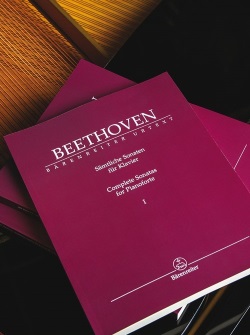
beethovenpianoimage1smallTo Wigmore Hall on Friday evening, at the invitation of music publisher Barenreiter, to celebrate the recent publication of a new three-volume edition of the complete Beethoven Piano Sonatas, edited by renowned Beethoven expert Jonathan del Mar.

Prior to the pre-concert talk, I had lunch with an old pal from university. We hadn’t seen each other for about 30 years, and had only recently reconnected thanks to Facebook. Our lunch conversation was a mixture of catching up and reminiscing about a very happy (and, to be honest, fairly well-behaved) three years at Exeter University in the mid-1980s, a time when there were no tuition fees, when gaining a degree still held a fair amount of cachet, and when it was relatively easy to find a job on graduation. Talking about music, we recalled the songs and bands which had been so meaningful to us at that time – Talking Heads, The Communards, The Smiths, Prefab Sprout, The Beastie Boys….. I almost had to “reset” when I walked through the gilded doors into the plush crimson-and-gold foyer of the Wigmore Hall.

2020 is Beethoven’s year, and however you may rail against it, protest that he’s getting far too much attention, demand more diversity in concerts programmes etc etc, you can’t escape the Old Radical and his music (and maybe there’s an undergraduate thesis to be written on whether Beethoven was the original Beastie Boy!). There’s a good reason for this, in my opinion, and that’s because in addition to this being the 250th anniversary of his birth, his music is absolutely bloody marvellous! He is “great” – and that was amply demonstrated in Jonathan Biss’ performance, the third concert in his odyssey through the complete Beethoven piano sonatas at London’s Wigmore Hall.

The compulsion to play and record this music, combined with, more often than not, a fair degree of reverence, is very much alive and well – and each generation brings a fresh crop of pianists willing to rise to the challenge; Biss’ cycle at the Wigmore comes hot on the heels of those of Igor Levit and Llyr Williams – and all three pianists have released recordings of the complete sonatas (Biss’ final instalment is due soon from Orchid Classics). This music enjoys an elevated stature which goes far beyond the notes on the score, and despite some relaxation in the rituals and etiquette of classical concerts, the 32 piano sonatas are still regularly presented in an atmosphere of awed reverence. This was palpable when I and my concert companion entered the sacred shoebox of the Wigmore auditorium (as my companion commented, hearing Beethoven is like an anticipating a grand meal, with steak as the main component!). Any pianist who takes on the colossal challenge of the piano sonatas enjoys special respect: not only is this music physically and psychologically demanding, but the hand of history, tradition and expectation weighs heavily upon their shoulders.

intense, immersive, impassioned, hugely demanding and hugely enriching

Jonathan Biss, pianist

Friday’s concert was prefaced by a special event hosted by Barenreiter in which Jonathan del Mar talked engagingly about the process of producing another edition of the complete piano sonatas when so many already exist. He outlined the obvious prerequisites for the “ideal” edition:

  • It consults all surviving sources, to ensure “all the right notes” are included
  • It provides a commentary for musicians which is open and transparent
  • It delights the musician’s eye in its clear design and spacious layout, with “as good as possible” page turns.

Del Mar’s research revealed some interesting and entertaining “mishaps” in previous editions; for example, a hole in the paper being mistaken for a staccato marking or essential details being lost in the conservation and cleaning up of manuscripts. His interesting commentary was illuminated by musical demonstrations on the piano.

Jonathan Biss is a “thinking pianist” with an acute intellectual curiosity, as evidenced by his writings on Beethoven, and other composers, and his online course on the Sonatas. It was therefore a surprise to encounter a performer who appeared anything but a stuffy academic. Here was vivid expression, vitality and flamboyance; no standing back from the music as if in modest reverence but rather a deep dive into its every nook and cranny to winkle out and reveal details afresh.

The programme offered an overview of Beethoven’s creative life, with sonatas from all three periods of his compositional output (No. 1 in F , No. 10 in G, No. 18 in E-flat, No. 24 in F-sharp and No. 30 in E), and the first half in particular suggested an exuberant lust for life on the part of the composer, the performer reflecting this with sparkly, febrile runs and dizzying tempi. A tiny memory lapse in the first sonata was handled with bravura (and gave hope to aspirational amateurs, a reminder that this pianist is also human!). The final sonata in the triptych, nicknamed ‘The Hunt’, was a rollicking romp, its barely-reined-in energy given only a brief respite in the elegant Menuetto. In the finale, horses and hounds were fully unleashed and galloped around the keyboard in a vigorous, earthy tarantella. Edge-of-the-seat playing for audience, Biss electrified his performance with the sense that this music could run out of control at any moment (except that it wasn’t going to because this pianist clearly understands the paradox “through discipline comes freedom”) lending a special frisson to the performance. I turned to my companion at the end of the first half and found he was equally open-jawed at what we had just experienced.

There’s something seductive about this process of really going to your limit with this music

– Jonathan Biss

And here’s the thing: live music, done this way, truly is an experience. Not a polite recreation of what’s exactly on the page, a solemn ceremony of reverence, of fidelity and and “authenticity” (whatever the f*ck that actually means!) and honouring the composer’s “intentions”, but a thrillingly personal, witty, eccentric, captivating and unpredictable account of music which this pianist clearly adores. It’s not to everyone’s taste and it’s the kind of playing that will probably irritate the keepers of the sacred flame, but I loved it because it made me feel energised, fully alive.

The second half further confirmed this (and any performer who causes me to spontaneously cry during the Op 109 is clearly “doin’ it right”). A sensitive, but never saccharine Op 78, dedicated to Therese, and then the transcendence that is the Op 109, No false sentiment here – from the lyrical opening movement through the rambunctious middle movement, and finally the gorgeous, seductive theme and variations which open and close with a prayer, this was beautiful, thoughtful and vivid playing.

Companion and I retired to a noisy pub down the road from the Wigmore for post-concert conversation and more wine, neither of us truly able to put into words what we had just experienced. My only comment then was that this is music which can “take anything a performer throws at it”. And therein, for me at least, lies its greatness.

Really, Music is above all other things a language, and since no one used that language more daringly than Beethoven the more of it you speak, the more of it you feel, the more you will find in his Music.
– Jonathan Biss


Jonathan Biss’ Beethoven cycle continues at Wigmore Hall on 20 April (with a talk by Biss on 19 April). Further details.

My concert companion writes: Biss at Wigmore

Meet the Artist interview with Jonathan Biss

AKMI Duo are Valentine Michaud (saxophone) and Akvilé Sileikaité (piano)

Who or what inspired you to take up the saxophone and pursue a career in music?

VM: I chose the saxophone in the first place for a very simple reason: with such a golden instrument, it was love at first sight! I was 7 at the time and I knew 3 or 4 years later that music would be a huge part of my life. I had a fantastic first teacher who really transmitted his strong passion for his art and provided me with incredible opportunities for my first concert tours and groups. He really made me want to be a musician. I received the first instrument of my own at the age of 11 and I am still playing on the very same saxophone today.

AS: As I remember, we always had piano at home and I was quite curious as a child to try it. I received my first lessons from my mother, as she is piano teacher. I guess this is quite a typical beginning for the majority of musicians, but it was also so for me. I do not know how I started to build my musical career;  maybe I had brilliant teachers, and my parents supporting me. Maybe it is my passion for what I am doing, but it is definitely making me thrilled and excited.

Who or what have been the most important influences on your musical life and career?

VM: My first teacher, Slava Kazykin, was a very big influence in the beginning, as he taught me the basics of the saxophone, but also the joy that music making can give. Then I met other teachers who all had an important impact on my artistic vision, such as my two last teachers in Switzerland, Pierre-Stéphane Meugé, who initiated me into the strange world of contemporary music, and Lars Mlekusch, who helped me flourish as an artist with a real identity, and encouraged my interests in trans-disciplinary performances. But also of course the friends that I meet, the ones that I hear perform, and the ones with whom I’ve played, such as my duo partner Akvile Sileikaite, and also the travels have had a strong influence on my musical path.

AS: My family’s support, teachers, people I’m playing with, people I’m meeting, music itself.

What have been the greatest challenges of your career so far?

VM: I think one of the biggest challenges of a musician’s career is the organizational side of it. Nowadays probably even more than fifty years ago, a musician has to be multi-faceted, and has to manage very different things at the same time: communication, planning, traveling, programming, teaching, and of course practicing, without mentioning obviously performing! All this requires a lot of energy and you can never take real ‘holidays’ from it. Also, as a classical saxophone player, I face the challenge of convincing people that this instrument has its place in the classical music world, even if it is not so well-known yet. And as the repertoire for the instrument is very contemporary, I also need to present to as broad an audience as possible pieces that are not especially ‘friendly’ to listen to, and make them love it!

AS: I have to force myself sometimes to not be lazy and just practice. This can be challenging! On a more serious note, the greatest challenge I find is the music itself because it is something that you need to express, literally, getting your feelings, thoughts, expressions, yourself naked in front of the other people, the audience, in a way that they would feel it and believe in it, believe in music, in their own feelings. To do this in every concert is challenging. I also find it the greatest experience because it’s unique every time you go on stage.

Which performance/recordings are you most proud of?

VM: Performances can always be perfected of course… but one performance I remember was our AKMI Duo debut concert in the Lucerne Festival in 2017. It was not perfect, but we really enjoyed our time on stage as the connection between us and the audience was very strong and the atmosphere there was very special.

AS: The ones when I feel the audience is almost not breathing. And the ones which people remember and are excited to share their feelings about afterwards.

Which particular works do you think you play best?

VM: I am definitely more at ease with modern repertoire, virtuosic and highly rhythmical pieces that demand a lot of energy. Romantic pieces are not really my cup of tea…

AS: Denisov and Albright sonatas for saxophone and piano with Valentine.

How do you make your repertoire choices from season to season?

VM: I always try to find a balance between modern pieces, new music, new commissions, and transcriptions, so that our programmes in recital are varied and can demonstrate the incredibly wide range of possibilities of my instrument. I often have ideas when going to concerts to hear colleagues, not necessarily saxophone players. Also, if I have a more trans-disciplinary performance in the season, then the programme is determined by the content of the show.

AS: It varies, from trying to choose the best pieces from the repertoire of the particular instrument I’m playing with, to pieces less-frequently played. Both so that people can enjoy and find something new for them. It is also sometimes very much dependent on a concert organiser’s wishes.

Do you have a favorite concert venue to perform in and why?

VM: I don’t have a particular one, but I do prefer the smaller halls: they have a human dimension that I like, and I find it easier to connect with the audience and really share something stronger. When the audience is really far away or sitting really high in balconies, it is much more difficult for me (at least until at the moment!).

Who are your favourite musicians?

VM: I have a lot! There are many musicians that I admire, not necessarily classical ones. I also love artists who are multi-faceted or really committed to contemporary music, as I think this is very important. And of course the people I play with are among my favourite musicians! But for the big names, it could range from Barbara Hannigan or Patricia Kopatchinskaja to Michael Jackson, Queen or Charlie Parker…

AS: Valentine obviously, then Mirga Gražinyte, Parvo Järvi, Martin Grubinger, Fabian Ziegler, Asmik Grigorian, Hilary Hahn, Kian Soltani and many others. These are the names that come into my head first, there are so many I admire. I still have a secret wish to play with some of them.

What is your most memorable concert experience?

VM: There were many funny or epic experiences through the years… maybe a funny one was in Moscow. Akvile and I were playing a duo recital and programmed a humorous Swiss contemporary piece. We had to speak a text before each movement, and an old woman in the audience started to stand up and complain that we shouldn’t be talking during the concert, and that she didn’t need explanations. I don’t speak Russian, so I didn’t understand what was the matter. Akvile was trying to answer the woman from the stage and they were debating about it while I was just standing on stage wondering what was happening. Then other people in the audience started to take part to this animated discussion. The scene was really absurd. In the end we started playing again but the woman stood up and left with great noise and slamming the door of the hall. So far this is the one and only time I had such a scandalous performance!

AS: My debut at Lucerne Festival. Or if an interesting story, a little scandal Valentine and I had in Moscow when playing contemporary music. We performed a piece by R.Gubler, called “Very Important Things”, a piece that needed us to ‘describe’ the subject we are going to perform, preferably in the language of the country we were playing in. So in the middle of the composition, one lady stood up and said in Russian that we don’t need to explain every subject, people knew what we were doing. Then someone shouted her back that she was disturbing the performance. I tried gently to explain that this was part of the piece and the composers required us to do it. Quite an interesting discussion started then we just continued to play. Then in the middle of our playing, the first lady stood up, said something like “I cannot stand it anymore” and left the hall closing the doors as loudly as possible. I guess she didn’t like the piece so much…

As a musician, what is your definition of success?

VM: I think to succeed is when you make people feel better when you play. Smiles on the faces of my audience are the best rewards, and to see wide open eyes of children as I play is probably one of the best feelings ever.

AS: Working hard, meeting people, not forgetting to invest to “yourself” by reading, attending galleries and concerts, and having hobbies.

What do you consider to be the most important ideas and concepts to impart to aspiring musicians?

VM: As a teacher, I try to give to my students a taste of the joy of playing music can be. Curiosity is also a very important concept to me, to keep an open-minded spirit and to be interested in all kind of arts, not just in your instrument, not just in classical music, and not just in music in general. Of course, working hard and always trying to be better than your yesterday-self is also a very important idea. And sharing is also one of the most important things to me. I don’t think a selfish person can be a truly good musician…

AS: Believe in what you are doing, have goals and enjoy the process of reaching them. And practice.

Where would you like to be in 10 years’ time?

VM: On a stage, surrounded by friends that I like to play with. It doesn’t really matter where!

What is your present state of mind?

VM: At the moment I am extremely enthusiastic and full of energy for what is coming up in the next months! I have many very exciting projects to come and I can’t wait for it!

AS: Trying to enjoy everything I am doing.

What is your idea of perfect happiness?

AS: Family, enjoying the process of learning, playing and being on stage and having time for myself and holidays.

What is your most treasured possession?

AS: People around me, ideas and arts.


AKMI Duo won this year’s Swiss Ambassador’s Award and embark on a UK concert tour from 15 October at Wigmore Hall, 16 October at Carol Nash Hall, Chetham’s School of Music, Manchester and 17 October at Dora Stoutzker Hall, Royal Welsh College of Music & Drama, Cardiff


Valentine Michaud and Akvilé Sileikaité first crossed paths in Zurich in 2015; and with that, the AKMI duo was born.

Read more