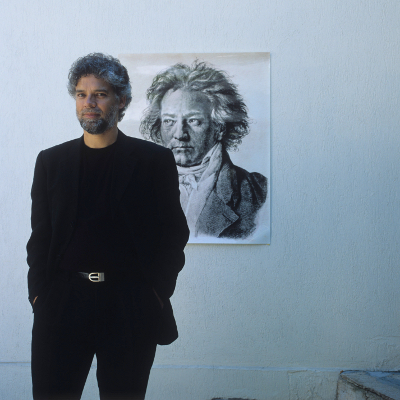
“Brouillards swathed the Wigmore audience in mist, yet the sound was never foggy”
Photo credit: Guy Vivien
Occasionally one comes across an artist who seems so at one with the music, that one can almost hear the composer at the artist’s shoulder saying ”yes, that is what I meant”. Such was the effect of French pianist François-Frédéric Guy’s performance of Beethoven’s final Piano Sonata, the Op.111, at London’s Wigmore hall on Friday night: a performance replete in insight and an emotional intensity which comes from a long association with and admiration for this composer and his music.
Who or what inspired you to take up the piano, and make it your career?
I was fortunate to be playing many instruments as a child and conducting choirs and chamber orchestras. Then suddenly I met a great pianist and person- Felicitas LeWinter- she has been a pupil of Emil von Sauer who had been a pupil of Liszt. She had the most amazing sound and talked about Friedman’s sound. She inspired me- I was 16 – and I was then determined to be a pianist- I had had wonderful teachers in Ireland but she had a very distinctive and important lineage of course! Later on I was touched when she said that I had finally achieved the Arthur Friedman sound!
Who or what were the most important influences on your musical life and career?
I studied with John Barstow at the Royal College and he was very important in my musical development- great passion for music and all music including opera- he opened my eyes. Then Maria Curcio who had studied with Schnabel was central in a very different way. She had a complete command of the piano and a great integrity – there was no showmanship unless it helped the expression of the music.
Other influences are of course- Richter, Giles, Carlos Kleiber and all the wonderful musicians I have worked with and continue to work with such as Svetlanov, Kurt Sanderling, Previn and Maazel – all great conductors.
What have been the greatest challenges of your career so far?
Right now I am recording the complete Brahms and Schubert solo works for Chandos – this is a huge task and very daunting but I am taking it slowly and methodically and I am learning so much.
Which performance/recordings are you most proud of?
I love all my recordings. However, the ones I did with Janowski in Paris hold a special place for me. And of course I love these Chandos recordings.
Which particular works do you think you perform best?
I am not sure – I wouldn’t like to say. It is for others to decide I guess?
How do you make your repertoire choices from season to season?
I play anything that inspires me and that I feel I bring something to. Of course Brahms and Schubert figure a lot at the moment- that is a privilege!
Do you have a favourite concert venue to perform in and why?
I don’t have one. There are great acoustics all around the world, there are great halls in beautiful places, there are places I like because of personal connections, like Ireland.
Favourite pieces to perform? Listen to?
I don’t often listen to music per se as I want to concentrate on my own solutions – but I adore opera and go to performances a lot. When I was 18 and fresh in London I practically lived in Covent Garden and the ENO.
Who are your favourite musicians?
I love my friends who come to my festival every August in Clandeboye, Northern Ireland. They are warm passionate and brilliant people. I love Alison Balsom – she played with my orchestra Camerata Ireland many times. I love Lynn Harrell the cellist and Chio Liang Lin the violinist – we worked together often.
What is your most memorable concert experience?
I think there are many – too many. I can’t choose one in particular.
What do you consider to be the most important ideas and concepts to impart to aspiring musicians?
You must be true to the music and be honest. Performance is not for show, but it must also look good- it is an entertainment (a refined one of course) but people want to see and hear something that will change them, and inspire them.
What are you working on at the moment?
My next Brahms and Schubert CDs – sonatas, Impromptus and intermezzi and the Paganini and Schumann variations of Brahms,
What is your idea of perfect happiness?
Sitting in Provence reading a book by the pool – perfect antidote to the pressurized concert season!!
What is your most treasured possession?
Apart from my family whom I don’t “possess” of course…….my Steinway piano I guess, and my Audi Quattro!!
What do you enjoy doing most?
Driving around Provence in the summer and eating a long lunch
Barry Douglas has established a major international career since winning the Gold Medal at the 1986 Tchaikovsky International Piano Competition, Moscow. As Artistic Director of Camerata Ireland and the Clandeboye Festival, he continues to celebrate his Irish heritage whilst also maintaining a busy international touring schedule.
Who or what inspired you to take up the pianoand make it your career?
I don’t remember not playing the piano. As my parents were also musicians, it was probably a rather obvious thing to do. I never thought of music as a career per se, but it was clear to me rather early (certainly before my teens) that music would consume my life.
Who or what were the most important influences on your musical life and career?
So many people! Obviously my teachers, Sulamita Aronovsky and the late Susan Bradshaw, have both been crucial. I learnt very different things from each of them. In a way they were very contradictory, but I have never felt confused, rather enriched by having multiple views on so many issues. I am hugely grateful to them both. Beyond that, clearly the influences on a musician who is even slightly inquisitive will be very wide-ranging.
Several pianists have been personally very important to me, most obviously perhaps David Tudor – who helped me most generously in my early 20s, as I was preparing a major Cage project – and Maurizio Pollini, whose work was influential on me in many ways from an early age, and who in recent years I’ve come to know personally. He invited me to share a concert with him at Suntory Hall last season, which was a huge pleasure – I played a work of Manzoni in the first half, and he played Beethoven Sonatas in the second.
I have had the honour of working with many living composers over the years and have learnt many things from them. When that honour has been dubious, I have learnt what to avoid rather than what to embrace. But in the case of a composer like Birtwistle, whose “Variations from the Golden Mountain” I am premiering at the Wigmore Hall on Sunday 14th September, the relationship has been only fruitful and enjoyable (for me at least).
Conductors, studying works in other genres (string quartets, orchestral works), visual arts – everything goes into the artistic pot and influences the flavour like herbs in a stew.
What have been the greatest challenges of your career so far?
Challenge in what sense? Every concert, every confrontation with a work of music, is a challenge. And practical life is a challenge. And bad conductors are a challenge.
Yes, that’s it: bad conductors are definitely the greatest challenge.
Which performance/recordings are you most proud of?
A composer was once asked which piece he was most proud of, and said it’s always his most recent. I guess the same is true for me. I’m just seeing a disc of the concertos of Birtwistle through the press, and have also just finished a disc of the complete piano music of Brian Ferneyhough. So I guess they’re the ones I’m most proud of.
How do you make your repertoire choices from season to season?
There are many things I think about for ages but don’t programme for many years, and on the other hand sometimes I decide quite quickly that I want to do a particular work. One of the joys of my situation is collaborating, and bouncing ideas off a trusted promoter can be extremely stimulating.
You are performing a new commission by Sir Harrison Birtwistle at your Wigmore Hall concert on 14th September. What is especially exciting about working on new music such as this?
Working with great composers personally is something that can only happen with contemporary music. All the others are dead. I can’t work with Beethoven or Debussy, but I’m overjoyed to have the opportunity to work with Birtwistle, for example. So much is made clear in our personal meetings and discussions; at the same time one understands the freedom available with more precision.
Do you have a favourite concert venue to perform in and why? What is your most memorable concert experience?
Well there are many remarkable acoustics around the world, and many halls with intelligent and searching programming. But what makes a concert really memorable is the situation – the programme, the audience, my mood, my collaborators (dead or alive). When everything aligns the experience is unforgettable.
What do you consider to be the most important ideas and concepts to impart to aspiring musicians?
The most important starting point for young musicians is the score. Students sometimes seem to view it more as a hint, rather than as the least indirect link to the composers intentions, which is what it is. Understanding notation in the deepest manner is one of the most important things which can be taught.
What are you working on at the moment?
After the Wigmore, I have to prepare a new piano concerto by Simon Steen-Andersen, and will also be working on Brahms 2nd Concerto for a concert in Finland in November. And many other smaller things in between!
Where would you like to be in 10 years’ time?
No idea. I am sure though that I won’t be anywhere I could now guess.
What is your idea of perfect happiness?
I am still trying to work that out.
What is your most treasured possession?
My Steinway (which is beyond obvious).
What do you enjoy doing most?
Watching my children develop.
What is your present state of mind?
Expectant before the birth of a new work at the Wigmore tomorrow!
Nicolas Hodges performs music by Mozart/Busoni, Debussy and Sir Harrison Birtwistle in an 80th birthday tribute concert at London’s Wigmore Hall, Sunday 14th September. Further information here
Born and trained in London, and now based in Germany, where he is a professor at the Stuttgart Conservatory, Hodges approaches the works of Classical, Romantic, 20th century and contemporary composers with the same questing spirit, leading The Guardian to comment that: “Hodges’ recitals always boldly go where few other pianists dare … with an energy that sometimes defies belief.”
This is the year of CPE Bach, the tercentenary of the birth of the fifth son of JS, and this anniversary is being marked with performances, recordings and appreciations of his music worldwide.
This is also the year of Mahan Esfahani, the young Iranian harpsichordist, now resident in the UK, who has been credited with bringing the harpsichord “out of the closet” and making this instrument, the pre-eminent symbol of the Baroque period, accessible and exciting and proving that the harpsichord has an important position in contemporary music making.
I first encountered Mahan Esfahani via Norman Lebrect’s Slipped Disc blog and, my interest piqued, heard Mahan perform Bach’s Goldberg Variations at Cadogan Hall as part of the 2011 Proms. This was a double first – Mahan’s Proms debut and the first solo harpsichord recital in the Proms history. The performance was fresh, thrilling and insightful, revealing many of the gems of Bach’s writing not always highlighted by other performers, either on harpsichord or piano.
Since then, Mahan’s star has been ascending rapidly, evidenced by a busy international concert diary, including participation in this yaer’s Aldeburgh Festival, appearances on BBC Radio 3, and an acclaimed recording of CPE Bach’s Wurttemberg Sonatas for Hyperion. In addition, Mahan is a sharply intellectual musician who is not afraid to challenge the dogmas of the early music movement and who likes to draw his own conclusions about aspects such as interpretation and performance practice from his studies of period sources, and collaborations with modern instrument players to recreate the sonic world of earlier music.
Mahan’s witty and relaxed stage manner combine with his intelligence and musical insight, resulting in recitals with a magnetic appeal which prove that far from an instrument capable of producing “one sound”, the harpsichord is vibrant, colourfully nuanced, expressive and highly textural. From the melancholic arabesques of Couperin to the dramatic bravura and declamatory statements of the young JS Bach’s Toccata in F# minor BWV910 to the graceful soundscape of Takemitsu (an inspired inclusion), this was a concert which fizzed and sparkled.
Those of us more used to hearing piano recitals at the Wigmore need a few moments to “tune in” to the sound of the harpsichord. It speaks more quietly, inevitably, because of its size, but the special acoustic of the Wigmore Hall seems just about ideal for this instrument. Add to this an audience which, by and large, listened most attentively, creating a highly engaging and absorbing concert.
In addition to the works by Couperin, JS Bach and Takemitsu, there were two Sonatas by CPE (“Emmanuel”) Bach, written while his father was still alive. Dedicated to Emmanuel’s employer, the newly-crowned Prussian King Frederick II, these sonatas reveal a composer working within a musical landscape which was poised on the cusp of change and display the remarkable forward-pull of Emmanuel’s creative impulse in the use of texture, dissonance, rapid changes of mood, rhetoric and wit, music which looks forward to Haydn and Beethoven. For the purposes of comparison, Mahan also included in his programme a sonata by Georg Anton Benda, a Bohemian disciple of Emmanuel. More sparely scored, it lacked the immediate “shock value” of Emmanuel’s writing, yet included many distinctive facets – drama and tension, a recitative-like slow movement and a spirited finale – and was performed with great elegance and sensitivity.
On first glance, Rain Dreaming by Toru Takemitsu may seem an odd choice in a programme dedicated to Baroque and early classical music, but the piece worked well, providing an interesting contrast and a pause for reflection. There were echoes of Emmanuel’s unexpected dissonances and Couperin’s poetry within Takemitsu’s writing , yet the work is also highly lyrical in its explorations of tonality.
This was a concert of bravura playing, combined with wit and intelligence to create a thoroughly engaging concert, which challenged pre-conceived notions about the harpsichord and the music of the Baroque and Rococo periods. Mahan’s entertaining and informative introduction (given after the Couperin) and his interesting and quirky programme notes (in which he described Frederick II as an eighteenth-century “hipster”) undoubtedly contributed to a most enjoyable and imaginative evening of music making. Highly recommended.
The Cross-Eyed Pianist is free to access and ad-free, and takes many hours every month to research, write, and maintain.
If you find joy and value in what I do, please consider making a donation to support the continuance of the site