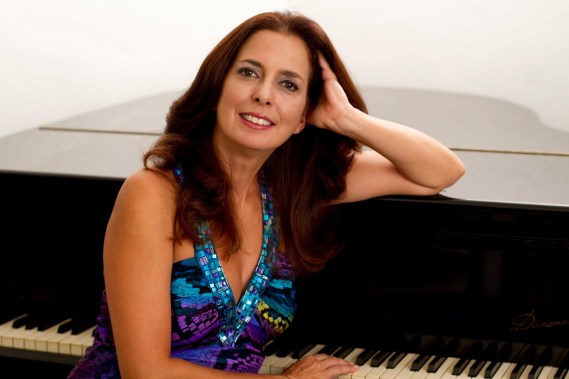
Who or what inspired you to take up the piano and pursue a career in music?

I was a 7 month old baby when I first came into contact with a piano. My mother, at the insistence of my grandmother, placed a 2 octave toy piano in my crib. To my parents’ surprise, I spent hours discovering its sounds, and within a few months I was playing the lullabies my mum sang to me on that little piano. I didn’t have a chance to be inspired! It was always there as a part of my nature.

Who or what have been the most important influences on your musical life and career?

There are, of course, negative and positive influences. They both weigh heavily on the development of a person. My piano studies began with Lyl Tiempo (aged 4 to 8) in Caracas and it was the very best beginning I could have had. She was a wonderful teacher. But most of my childhood and adolescence was marred by a negative influence. I stopped playing for almost 3 years. Then, came the positive influences in my twenties. Discovering the great, historical recordings was pivotal to how I heard and imagined music. It gave me a sense of freedom I had never before been aware of. A sense that the possibilities of music extended far beyond the written score. I also had a wonderful teacher, Hamish Milne, at the Royal Academy of Music, whom I credit for rekindling my love for music. I was in my early twenties, and too young to profit from his wisdom and artistry, but it left a mark on me. I can’t fully answer this question without mentioning Martha Argerich. Martha, upon hearing me play Schumann, Beethoven and improvise, changed my life. From one moment to the next, she took me from barely playing and seriously considering studying psychology (dedicating my life to something useful!) to beginning these last 17, hectic, challenging but rewarding years of my life and career. I owe a lot to her. She has also been a huge inspiration as an artist and human being.

What have been the greatest challenges of your career so far?

Being a single mother to two young daughters and at the same time juggling an intense concert career– without a shadow of a doubt! I am now happily married. My friends and colleagues ask me how I survived, and I really don’t know how I managed to perform well under the constant excruciating worry and pressure. Add to that the heart-breaking situation of my country, Venezuela, and my daily work of the last 8 years as a dissident and human rights advocate, and it has been anything but easy.

Which performance/recordings are you most proud of?

Any performance when I feel I am deeply connected and when I give the most honest and committed performance I can give, is one I am most proud of. It doesn’t matter where it is or how many people are sitting in the hall. I am very proud of my last recording (which is yet to released) of my own concerto – the Latin Concerto!! I had an amazing team to work with in Carlos Miguel Prieto and the YOA Orchestra of the Americas.

Which particular works do you think you play best?

That’s difficult to answer. Most people would describe me as a very big, impassioned and powerful player. I do think that is a very strong element of my musical nature, but at the same time, I am discovering the intimacy and subtleties in the way I play Mozart – which is opposite to how people have heard me perform the romantic repertoire. I am fond of extremes and contrasts, and in Mozart, I am finding a new relationship and sound to an instrument that has been most suited for me in the large and virtuosic pieces. I am a work in progress.

How do you make your repertoire choices from season to season?

Until now, it has always been determined by what I want to play. But now, I am beginning to design programs around a common story, a personal narrative, relationships or connections between pieces. I’m becoming more interested in metaphors that connect people and works.

You’re performing with Carlos Miguel Prieto and the Bournemouth Symphony Orchestra in March – tell us more about this?

I love Carlos Miguel. That’s the most important part of my answer! He is a dear friend, a respected colleague and someone who understands the kind of musical animal I am on the stage, and what my life is like, offstage. I am so looking forward to performing Ravel again with him (also included on our last recording) and to performing for the first time with the BSO. I can imagine it will be a wonderful combination.

Do you have a favourite concert venue to perform in and why?

I love the Wigmore Hall, the Teatro Colon, any hall in Italy, the Palau in Barcelona. There are many. I prefer smaller and more intimate halls. I think I play better when I am in a beautiful space, surrounded by beauty and inspired by the aesthetics of a hall.

Who are your favourite musicians?

Hmmm.. Martha Argerich, Martin Fröst, Alison Balsom, Bill Evans, Horowitz, Annie Fisher, Rachmaninov, Angela Hewitt… There are a few more. All of the people alive in this list are my friends, but I am not biased! They really are wonderful.

What is your most memorable concert experience?

It’s hard to say. I recently performed Tchaikovsky’s Piano Concerto No. 1 with Mirga [Gražinytė-Tyla] and the Berlin Komisch Oper Orchestra in Berlin, and as she lifted her arms to begin the concerto introduction, a couple in the audience interrupted her by singing the national anthem of Venezuela. I sat there heartbroken and stunned, fully aware of what a gesture of pain and courage that moment meant to that couple and I. I will never forget that. Playing at President Obama’s first inauguration was also incredibly meaningful. I felt it was the beginning of a deep and long awaited healing process for the US and its people, and I was very honoured and touched to be a part of it. You had to be there to understand what it felt like. Unfortunately, things have changed significantly since then, and not for the better. But there have been many moments that will forever remain etched in my memory.

As a musician, what is your definition of success?

The older I get, the more I understand that for me, success is inexorably linked to how I contribute to society. I am no longer only a pianist and composer, I am also someone who is trying to rescue people from Venezuela, someone who tries to be a lifeline and a voice to many, and above all, a human being who suffers the pain of those around me. For me, success is not defined by fame and fortune, or playing with a renowned conductor or orchestra, or being on someone’s “favourite” list. It is reaching out to people and knowing I’ve made a difference. We have choices, and they speak volumes of who we are. Success is making the right ethical choice.

What do you consider to be the most important ideas and concepts to impart to aspiring musicians?

Be inspired!! Live!! Love!! Give!! Enjoy! And then, take all those stories and paint them on the score, with the colours of sound. You can’t be a storyteller if you have no stories to tell.

Where would you like to be in 10 years’ time?

In a free and democratic Venezuela. That’s my greatest wish. But sooner, I hope.

What is your idea of perfect happiness?

Helping someone. Knowing that my girls are well. Having a laugh with my husband. Composing. Mozart. Chocolate.

What is your most treasured possession?

My Hamburg Steinway D… and my Maltese [dog], Louie.


Born in Venezuela, Gabriela Montero gave her first public performance at the age of five. At age eight, she made her concerto debut in her hometown of Caracas, which led to a scholarship from the government to study privately in the USA. She continued her studies under Hamish Milne at the Royal Academy of Music in London, graduating with the highest honours. She currently resides in Barcelona, with her husband and two daughters.

Read full biography here


(Artist photo: Shelley_Mosman)

We didn’t have to travel as far as Caracas last night to experience the distinctive, atmospheric sounds, rhythms and textures of Latin American music. Bolivar Hall is attached to Venezuelan Embassy’s cultural complex in London’s Fitzrovia, a short walk from Goodge Street or Warren Street Tube stations.

London-based Venezuelan-born pianist Clara Rodriguez has curated a short series of concerts at Bolivar Hall over the course of the last month, showcasing the talents of established artists as well as up-and-coming young musicians in concerts featuring the best of South American classical music and jazz. In the final concert of the series, she was joined by Efrain Oscher (flute), Cristóbal Soto (mandolin, cuatro, guitar), Gabriel León (double bass) and Wilmerr Sifontes (percussion) to present a musical journey from Argentina to Puerto Rico with a selection of Tangos, Joropos, Merengues, Waltzes, Salsas and Sambas. From the foot-tapping sambas and merengues of Brazil and Venezuela to the passion and pathos of the tango (most notably in Astor Piazzolla’s heartfelt ‘Adios Nonino’, a hommage to his grandfather), the musicians played with commitment and conviction, and a very palpable and infectious sense of pleasure and musical friendship.

As a classically-trained pianist (she was a pupil of the late Phyllis Sellick at the Royal College of Music), Clara brings a deep understanding of musical shape and expression, phrasing, dynamic shading, texture and beauty of sound to her playing, even in the more raucous and rousing pieces. But her Venezuelan heritage shines through in her ability to handle with apparent ease the differing and complex rhythms of the music (although as she admitted at one point during the performance, it isn’t easy music to play, with the emphasis “off the main beat”, and on syncopation and cross-rhythms.

The other musicians were equally skilled: I was particularly struck by flautist Efrain Oscher’s performance. Haunting melodies, sometimes almost whispered, contrasted with bright motifs and some impressive technical/textural effects (triple tonguing). Meanwhile, double bass player Gabriel León showed the richness of the instrument’s voice in some soulful accompaniments and solos. My husband was fascinated by the percussionist, and the myriad sounds and patterns he was able to achieve with simple taps of his fingers or hands. The guitarist, Christobal Soto, brought perhaps the most distinctive Latin flavour to the music: flamenco strumming or the shimmering sounds of the mandolin.

Two encores confirmed just how much both musicians and audience were enjoying the concert. And on the homebound train, our feet were still tapping to the irresistible rhythms of the evening’s music.

Clara Rodriguez

A keen champion Latin American piano music, Clara Rodriguez has recorded the piano works of Teresa Careno, Moises Moleiro, Ernest Lecuona, and Federico Ruiz (a contemporary Venezuelan composer with whom she has enjoyed a close collaboration), as well as an impeccably presented album of the late piano music of Chopin, including the Piano Sonata No. 3 and the Polonaise-Fantasie Op 61. Clara’s recordings are available digitally on via iTunes and Spotify, and from good CD retailers. Further information here


Clara talks about music from Latin America in this short film, featuring clips from the concert

Pianist Clara Rodriguez

London-based Venezuelan pianist, and champion of Venezuelan composers for the piano, Clara Rodriguez returns to the Southbank Centre on 10th December for a concert of music by South-American composers, including Villas-Lobos, Piazzolla and Ruiz, and Debussy. This promises to be a really wonderful evening of music, not just for piano, but for ensemble too, as Clara will be joined by Wilmer Sifontes on percussion, cellist Jordan Gregoris and violinist Ilya Movchan. The concert also features two London premieres of works by Colombian composer Germán Darío Pérez.

I reviewed Clara Rodriguez and friends at Purcell Room last autumn, and Clara also features in my Meet the Artist interview series. Read her interview with me here. And here is Clara in her own words about her forthcoming concert:

All concerts at the Southbank are special events, the magic of one evening only, the energy, imagination and love that goes into putting the programme together is part of our artistic proposal to the world. My concert on Monday December 10th at the Purcell Room is going to be another exciting yet very different experience to the other nine or ten ones I have played there in the past.

The high inspiration, poetry and skill behind all the pieces I am playing makes my heart jump with emotion. Just reading Verlaine’s Clair de lune poem makes me realize even more deeply about the beauty of Debussy’s Suite Bergamasque, which I could play for ever!

Votre âme est un paysage choisi
Que vont charmant masques et bergamasques
Jouant du luth et dansant et quasi
Tristes sous leurs déguisements fantasques.

Tout en chantant sur le mode mineur
L’amour vainqueur et la vie opportune
Ils n’ont pas l’air de croire à leur bonheur
Et leur chanson se mêle au clair de lune,

Au calme clair de lune triste et beau,
Qui fait rêver les oiseaux dans les arbres
Et sangloter d’extase les jets d’eau,
Les grands jets d’eau sveltes parmi les marbres.

Your soul is a chosen landscape
Charmed by masquers and bergamaskers
Playing the lute and dancing and almost
Sad beneath their fanciful disguises.

Even while singing, in a minor key,
Of victorious love and fortunate living
They do not seem to believe in their happiness,
And their song mingles with the moonlight,

The still moonlight, sad and beautiful,
Which sets the birds in the trees dreaming,
And makes the fountains sob with ecstasy,
The tall slender fountains among the marble statues!

I have always been interested by the output of contemporary composers, their loneliness and their bravery in expressing their truths out on paper, apart from appreciating their talent, of course. On this occasion I will première three preludes by the young Venezuelan composer Mirtru Escalona Mijares who lives in Paris and has kindly dedicated the last of the Three Short Preludes to me. It is based on a tanka by the buddhist monk RYOKAN (1758-1831), it is called “…contempler longuement…” in it I have to use special concentration skills to play pianissimo and very slowly as opposed to our usual kind of preoccupation which is to play fast and lots of notes. Mirtru has been working very hard in purifying or cleansing musical phrases and thoughts. It is a challenge! Here is the poem the third Prelude is inspired by:

“Je n’ai rien de spécial à vous offrir juste une fleur de lotus dans un petit vase à contempler longuement “.

I have nothing special to offer to you/Just a lotus flower In a small vase/To be contemplated for a long time

“Hommage à Chopin”, a tour de force written by Villa-Lobos will follow. It is a strange piece, not exactly romantic, I think it has the force of the Amazonian jungle and depicts Chopin’s passionate torments and obsessions. It has a greater number of melodic layers than most piano pieces thus making it quite virtuosic.

It was while studying with Nadia Boulanger in Paris that Piazzolla was urged to develop his love for tango thus creating the “new tango” in which he transformed this old Argentinean dance into music capable of a variety of expression, fusing sharply-contrasted moods: his tangos are by turn fiery, melancholic, passionate, tense, violent, lyric and always driven by an endless supply of rhythmic energy. I am thrilled to be able to play Le Grand Tango, one of his most Classical pieces, and then in the same evening The Four Seasons of Buenos Aires with leading young performers from France, Jordan Gregoris on the cello and from Russia, Ksenia Berenzina on the violin. You’ll see what exquisite pair of musicians they are. We are having the fun of our lives playing this music. It is luxury!

Not forgetting my Caribbean roots, I have added three composers from that part of the world, for two reasons, my dear London public expects it and simply because I have so much joy playing them. So, from Cuba a nostalgic Danzón by José María Vitier, who composed the music for the film “Strawberry and Chocolate”, then two London premières will follow by a composer from Bogotá, Colombia, Germán Darío Pérez, in which my friend percussionist Wilmer Sifontes will play the kind of percussion that should accompany a bambuco and then we’ll play together the very lively Zumba que zumba (joropo) written for me by the Venezuelan composer Federico Ruiz, in which Wilmer will play the Venezuelan maracas. I doubt it if this programme could be more exciting or varied!

Elena Riu

Another enjoyable outing to Sutton House in Hackney for the second concert in Sutton House Music Society’s 2012-13 season, given by Venezuelan pianist Elena Riu, in her new project called ‘Inventions’.

The programme placed the Two- and Three-part Inventions of Bach alongside inventions by contemporary composers, including Ligeti, Lutoslawski, Shchedrin, Gulbaidulina and Finch. Elena described the programme as “an experiment”, though there was nothing experimental about her playing. The Bach Inventions, many of which brought a Proustian rush of memories for me, as I had learnt them as a young piano student, were executed with a restrained elegance, which served to highlight the beauty of Bach’s contrapuntal writing. And by placing Bach alongside contemporary composers, Elena was able to illuminate Bach’s own innovative approach.

Bach intended his Inventions as exercises for piano students: as he stated on the title page, they were designed to enable students of the piano to “learn to play cleanly in two parts” and “to handle three obligate parts correctly and well”. They were also intended to help the piano student develop a good cantabile (singing) style of playing, and to “acquire a strong foretaste of composition”. Bach’s Two- and Three-Part Inventions are models of “inventiveness”. Each one takes an opening motif which is then used to create new themes and develop them in clever and ingenious ways. Although tightly structured, with distinct motives, answers, counter-motives, and expositions, Bach’s Inventions – and those which were inspired by his writing – display an inventive process, whereby the motive is varied, counterpointed and re-textured to create a complete work.

Contemporary composers, inspired by Bach, have used the Invention model as a springboard for new explorations of the form, utilising different styles and musical language. It is the spirit of “inventiveness” in both new and old which connects Bach to his contemporary successors. As Elena Riu mentioned in the programme notes, this juxtaposition of old and new is a “journey of recreation – I have gathered together a selection of pieces which distil new material out of the old”.

Some of the works performed were fleeting, miniatures of only a page or so. Others were a little more substantial, though still of the genre ‘miniature’. Many showed the influence of Bach in motifs, textures and ornamentation. All were played with fine attention to detail, exquisite dynamic shading (whispered pianissimos, and some wonderfully bright and percussive fortes), charm and humour. The programme included the UK premiere of ‘Invención’ by Venezuelan composer Alfredo Rugeles, and world premieres of works by Diana Arismendi and Lola Perrin, whose work ‘Poet Reflecting’ (2012) had a spare and meditative beauty. The concert closed with Rodion Shchedrin’s ‘exuberant and colourful Two-Part Invention’, which left me and my concert companion exclaiming to one another “I’ve got to learn that!”.  (This, for me, is one of the chief pleasures of a concert programme such as this: exposure to new repertoire.)

For an encore, Elena played Granados’ ‘Danza de la Rosa’ from the Escenas Poeticas, a sensuous and atmospheric miniature.
My Meet the Artist interview with Elena Riu

The 2012-13 season at Sutton House continues in February, with a concert by ‘cellist Mayda Narvey and pianist Naomi Edemariam. Full details and tickets here.