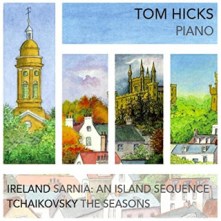
71iqtbpqvfl._ss500_John Ireland      Sarnia: An Island Sequence

John Ireland      The Island Spell

Tchaikovsky      The Seasons Opus 37a

Tom Hicks, piano


At first sight, pairing a twentieth-century British composer with a nineteeth-century Russian romantic seems an unusual combination, but in this debut disc by young British pianist Tom Hicks the music of these two composers sits well together, creating an enjoyable recital disc of music inspired by nature and infused with pastoralism.

The disc opens with ‘Sarnia’, whose first two movements were composed in 1940 while John Ireland was staying on Guernsey, shortly before it was occupied by the Germans. There is a nice connection between music and pianist here as Tom Hicks hails from Guernsey; ‘Sarnia’ is the Roman name for the island. This atmospheric, dramatic and expansive work portrays aspects of the island and Hicks’ sensitive attention to detail and understated bravura brings this music fully to life with colour, spacious expression, pungent sonorities, and a tender poignancy when required.

‘The Island Spell’, inspired by Jersey and the earliest of Ireland’s Channel Islands pieces, is evocative and impressionistic, redolent of Debussy’s perfumed harmonies and filigree traceries (Ireland was described as an “English Impressionist”), its delicate textures rendered with grace and clarity.

Tchaikovsky’s ‘The Seasons’ follow, a suite of 12 miniatures which encapsulate the composer’s distinct style in microcosm. These characterful, contrasting works are the perfect canvas for Hick to paint a full palette of colours and expression, capturing their intimacy and wistfulness, with a keen ear for details and textures.

Overall, an enjoyable and engaging debut recording from this impressive young pianist.

Recommended


Who or what inspired you to take up the piano and pursue a career in music?

I was born into a family of musicians: my mother is a pianist and she was my first teacher. She inspired me to take up the piano and supported me with my further studies.

Who or what were the most important influences on your musical life and career?

Of course my teachers: my mother Liubov Chistiakova, Elena Khoven, Anatoly Ryabov, Mikhail Voskresensky, Boris Petrushansky. I was also very lucky to have wonderful teachers of chamber music and accompaniment: Guzal Karieva, Sergey Voronov, Galina Brykina. And my musical life, thoughts and way of playing changed a lot when I moved to Italy.

What have been the greatest challenges of your career so far?

Life and music are inseparable: that’s the greatest challenge of my career.

Which performance/recordings are you most proud of?

I am never happy with my performance! But I’m really proud of my second CD of French Music which was recorded in Germany thanks to the Shigeru Kawai team. Things are good when you work with professionals.

Which particular works do you think you perform best?

There are some pieces that are always successful: Tchaikovsky’s First Piano Concerto, Petroushka Suite by Stravinsky, Liszt’s Paraphrase “Don Juan”, La Valse by Ravel, several miniatures by Chopin.

How do you make your repertoire choices from season to season?

There is always something or someone who inspires me to make a choice. I like it when a concert program makes sense for me and for the public.

Do you have a favourite concert venue to perform in and why?

It’s the Great Hall of Moscow Conservatory. I have the best memories from there and it’s always a dream to go back there.

Who are your favourite musicians?

A lot of names and not only from Classical, but Jazz, Rock and Popular music as well. I love musicians, people with a great culture, education and respect for the listeners.

What is your most memorable concert experience?

It’s the first time I played with an orchestra at the Great Hall of Moscow Conservatory. I played the 1st Chopin concerto there when I was 12.

I remember when there was an orchestral tutti I felt how the floor was vibrating under my feet and it was so thrilling and so exciting. It was the youth symphony orchestra of Moscow with lots of kids, but they were already professional musicians, like me, so for me it seemed to be very powerful and energising.

What do you consider to be the most important ideas and concepts to impart to aspiring musicians?

Practise with passion, never give up and never regret.

What is your idea of perfect happiness?

Peace and health of my family, well organised life, travels and concerts.

What is your present state of mind?

Fantastic! I became a mother one year ago and it’s an absolutely wonderful feeling.

Galina Chistiakova performs in Manchester Camerata UpClose: The Next Generation at Stoller Hall, Manchester on 4th October 2018. More information

Mozart Sonata for Two Pianos in D major K. 448

Schumann Andante and Variations in B flat major WoO 10

Saint-Saëns Carnival of the Animals

Piano Galla Chistiakova

Piano André Gallo

Manchester Camerata Principal Musicians


Who or what inspired you to take up the piano and pursue a career in music?

I was born into a family of musicians, all quite normal. I do not remember any particular choice but of course many of my ideas and beliefs on how to live with music come from mutual and significant experiences like the traditional band, which is very important in the south of Italy, or watching the day-to-day activities of my brothers (both brass players) of practicing and much music making with other musicians, and so a great deal of chamber music.

Who or what were the most important influences on your musical life and career?

In the first instance my parents. Later on, having understood the meaning of the word “influence”, it was my guide to many choices. My enthusiasm, my curiosity and my views are a combination of continual searching and outside influences from people, books, events or encounters. That is why I think a young person should be more worried about the things that surround them; a choice that needs great care. The objectives are continually changing and will come naturally. I can only name my teacher Maestro Franco Scala as a major influence; also  the composer Marco Di Bari and the singer Alda Caiello, amongst many other artists.

What have been the greatest challenges of your career so far?

I do not see my career as a game or a challenge. That does not mean I do not have goals to dedicate myself to or do not set myself challenges. I have many challenges with myself but not with others. For now, I must say that, having understood what I am not and having had to accept it can be very tiring. Where it will take me to is something still to be seen….

Which performance/recordings are you most proud of?

I cannot really say but to have played the two Ravel Concertos in one evening was certainly something to remember.

Which particular works do you think you perform best?

I have a particular penchant for French music of the last century – e.g. Poulenc, Ravel, Debussy, Messiaen etc.

How do you make your repertoire choices from season to season?

No precise rule; it just happens that a programme is born from an idea or taking a specific line, but on many occasions it is also the exact opposite. Playing a lot of chamber music, it is easy to discover something new and to include those composers in my solo repertoire.

Do you have a favourite concert venue to perform in and why?

Not really. I have played many times in La Fenice Theatre in Venice. I love the city and I feel at home in its theatre.

Who are your favourite musicians?

There are many and a lot are still performing today

What is your most memorable concert experience?

I think my debut at 17 in the Konzerthaus in Berlin. I was very excited.

What do you consider to be the most important ideas and concepts to impart to aspiring musicians?

To feel your own dreams and your own music as an act of generosity. Not to feel yourself as a “son” or “daughter” of the music awaiting gifts and unconditional love, but on the contrary to be yourself the creator of that sincere love and insight of which music is in much need.

André Gallo performs in Manchester Camerata UpClose: The Next Generation at Stoller Hall, Manchester on 4th October 2018. More information

Mozart Sonata for Two Pianos in D major K. 448

Schumann Andante and Variations in B flat major WoO 10

Saint-Saëns Carnival of the Animals

Piano Galla Chistiakova

Piano André Gallo

Manchester Camerata Principal Musicians


Concerto night is a regular feature of the Chetham’s International Summer School and Festival for pianists, and on Sunday 19th August, we were treated to four concertos, performed in the magnificent Stoller Hall by members of the Chets teaching faculty, who also happen to be international concert pianists.

The concerto is one of the greatest corners of the pianist’s repertoire. A showcase for performer and instrument, it’s an opportunity for the composer to capitalise on the combined forces of soloist and orchestra, often with thrilling and highly expressive results. The concerto format inspires great music and is a spectacle for the audience and the genre continues to tempt composers today. The romantic image is of the soloist doing battle with the orchestra, but in most instances piano and orchestra are collaborators, creating wondrous musical conversations and exciting contrasts of sound, texture and mood – very much the case in the four works performed in this concert.

The soloists in these concerts were accompanied by the Stockport Symphony Orchestra, an amateur orchestra of considerable talent and stamina, conducted by Stephen Threlfall, who is a member of staff at Chetham’s School.

Seta Tanyel gave a committed and colourful account of Richard Addinsell’s Warsaw Concerto, a one-movement work of grand romantic gestures and post-Rachmaninov melodies. Written as part of the soundtrack for the 1941 film Dangerous Moonlight, the music has a dramatic narrative, rich in nostalgia and sweeping climaxes. This was followed by Tchaikovsky’s Piano Concerto No. 2 in G Major, played by Leslie Howard, always a popular member of the Chets team (and a regular behind the bar during the piano summer school). Not as popular, nor as satisfying as Tchaikovsky’s first concerto, Leslie Howard nonetheless gave a masterful and enjoyable performance, at times pushing the orchestra to the limit with tempi. The Stockport Symphony Orchestra rose impressively to the challenge and one felt them begin to catch fire in this work.

In the second concerto concert of the evening, Dina Parakhina played Rachmaninov’s Rhapsody on a theme of Paganini with an exquisite sound, rhythmic vitality and musical imagination, matched by the orchestra who clearly enjoyed this piece.

This was followed by a highly imaginative rendering of Grieg’s Piano Concerto by Philip Fowke. The interaction between soloist, conductor and orchestra was clear throughout (and especially evident for those of us seated in the choir stalls with a view down to the pianist and conductor). Philip’s compelling and generous performance was rich in interesting voicings and a rare improvisatory quality, which brought renewed vigour and colour to this much-loved work.


Photographs by Martin Lijinsky


