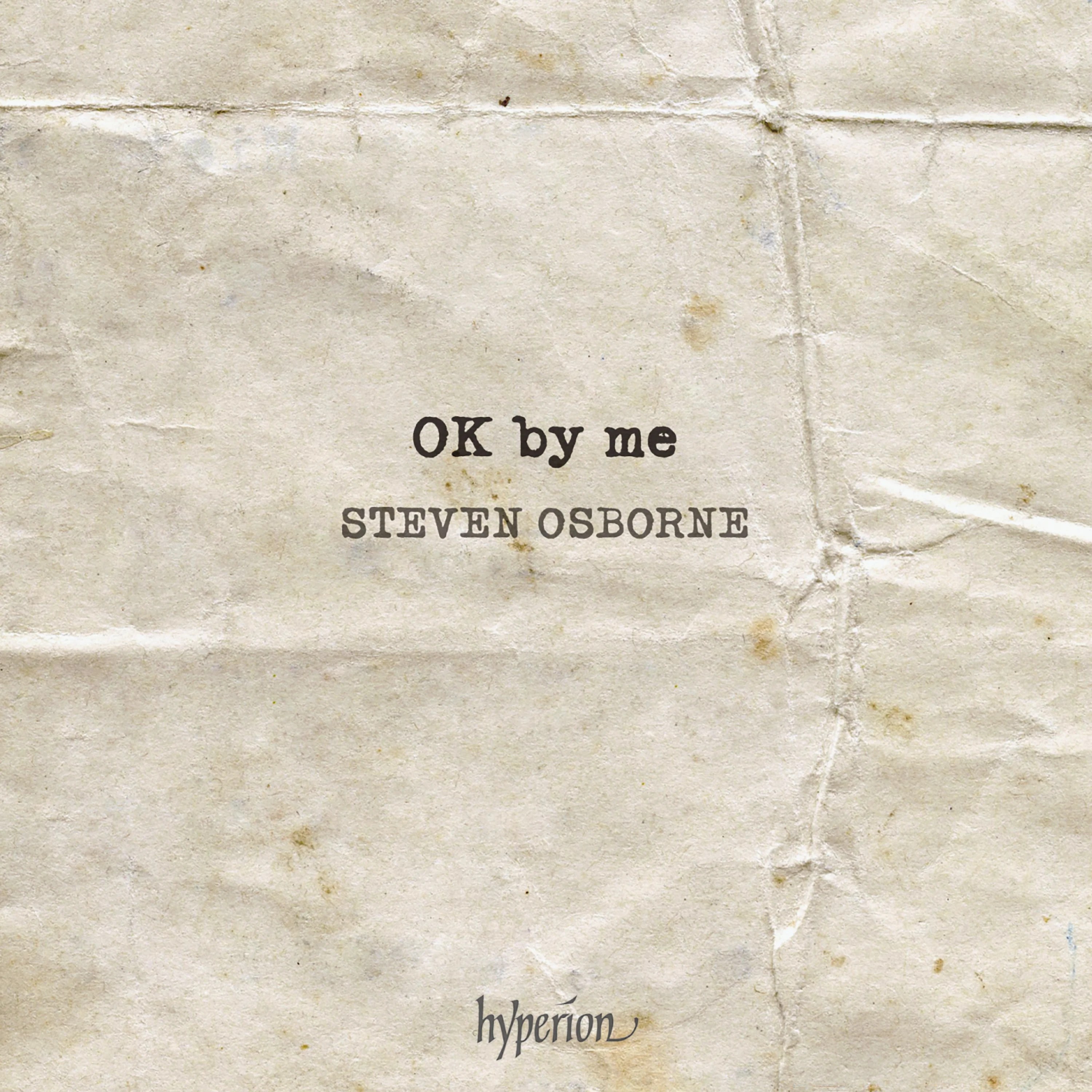
OK by me – A life in Encores
Steven Osborne, piano
Pianist Steven Osborne’s latest release, OK by me – A life in encores, is far more than a collection of attractive miniatures brought together by a distinguished pianist with a large catalogue of acclaimed recordings. Rather, it is a musical autobiography, a highly personal selection of pieces that have accompanied Osborne throughout his life as a pianist, student, colleague, husband, teacher and listener.
Osborne himself describes the album as creating “a line through my musical life”, and his unusually extensive and candid liner notes are integral to understanding the recording. The repertoire is delightfully eclectic: Bach and Grieg sit alongside Rachmaninov, Schumann, Prokofiev and Poulenc, while Keith Jarrett, Meredith Monk and Joni Mitchell rub shoulders with Peter Maxwell Davies and James Clapperton. There are also Osborne’s own arrangements and improvisations, and the album opens with his own OK by me, a simple melody that emerged, apparently fully formed, while improvising.
The real thread running through the album is not repertoire but memory. Liadov’s delicate A Musical Snuffbox recalls his mother’s musical jewellery box and its twirling ballerina; Bach’s Sheep may safely graze evokes childhood evenings spent listening to his parents play piano duets; Grieg’s Butterfly belongs to his earliest repertoire and to childhood performances. Later pieces carry other associations: Poulenc’s Novelettes are bound up with the chance encounter that led to Osborne’s long relationship with Wigmore Hall, while his arrangement of Schumann’s Widmung is associated with his wife, Jeannie, for whom he played it as an encore on their first wedding anniversary.
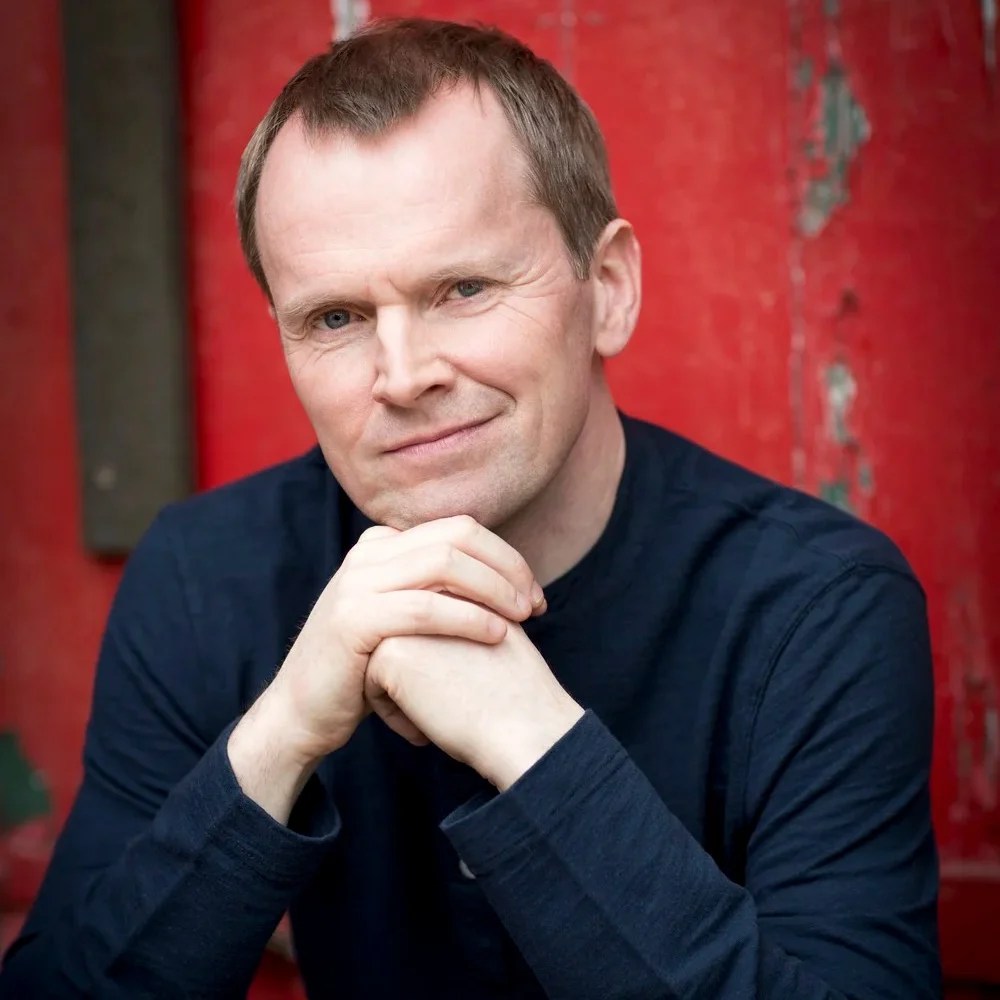
OK by me explores something more interesting than the conventional idea of the encore as a charming musical afterthought. These pieces become repositories of experience and memory. Hearing or playing them can collapse time, reconnecting the adult musician with the child reaching up to the family piano, the student discovering new repertoire and new ways of thinking about music, or the performer encountering colleagues and teachers whose ideas have subtly altered his own.
There is another, deeper narrative here too: the evolution of a musician. Osborne writes revealingly about moving away from a youthful concern with getting things “right” towards something freer and more instinctive – what he describes as a movement “from perfectionism to engagement”. Improvisation played an important part in that change, teaching him to experience music not as something fixed but as something that unfolds in real time, “moment by moment”.
Perhaps most interesting of all is Osborne’s discussion of what it means to communicate through music. For him, interpretation ultimately depends on finding personal meaning in the music and on having the confidence to trust one’s own response to it. As a teacher, he values “honest immaturity far above fake profundity”, encouraging young musicians to discover what a piece actually feels like to them rather than reproducing received ideas about how it ought to go.
That desire for honesty seems to lie at the heart of this deeply personal album. Osborne admits that introspection is his “natural territory” and that he particularly values the communion with an audience which intimate music can create. So this is not really an album about encores at all: it is about the music we carry with us, the people, experiences and memories attached to it, and the way our relationship with certain pieces changes as we ourselves change. Above all, it is about music as connection – between performer and listener, certainly, but also between our present and former selves.
As Osborne observes towards the end of his notes, at its most powerful, music can meet some of our deepest needs: “for safety, for connection, for stories, for transcendence”. OK by me feels like a particularly generous expression of that idea: a pianist opening his musical memory box and inviting us to listen.
And as one would expect from a pianist of Osborne’s pedigree, each piece on this strikingly original album is beautifully presented, with fine attention to detail in dynamics, musical colour, texture, melody, character, and so much more within pieces which last only a few minutes in most cases. There’s great delicacy and tenderness in some of the pieces – for me, Osborne’s arrangements of Joni Mitchell’s A Case of You and Keith Jarrett’s My Song are particular gems. Gershwin’s Three Preludes combine upbeat rhythmic vitality in the first and third with a more introspective, almost brooding atmosphere in the second. There are many delights here to suit all tastes, and as a pianist myself, I find myself wanting to explore more miniatures like these, rather than wrestling with middle-period Beethoven or one of Schubert’s late sonatas! A very personal treasure trove of musical gems, Osborne has, in his own words, “allowed the orders to diverge”, so there is no coherent track order; the pieces simply lead on from one another. Thus, it becomes an album which can be dipped into or listened to as a whole, depending on one’s mood or the time of day.
Listening to OK by me, and reading Steven Osborne’s unusually candid accompanying liner notes, I was struck by how closely many of his reflections chimed with ideas I had been exploring while writing my novel Facing the Music. At its heart, the novel asks what it means to be a musician, and what happens when the identity one has built around music is challenged or disrupted. Osborne writes about performance anxiety, injury, perfectionism, honesty in performance, teachers and colleagues, and the gradual evolution of his own musical identity; but he also writes about something I have long felt very strongly myself – the way music becomes bound up with memory. Certain pieces carry people, places and experiences within them, so that hearing or playing them years later can collapse the distance between past and present. In Facing the Music I explored that idea through fiction; in OK by me, Osborne offers something more intimate and real: the story of a musical life told through the music which has accompanied it.
OK by Me – A Life in Encores is released on the Hyperion label on 13 November 2026
(Artist images: Ben Ealovega)
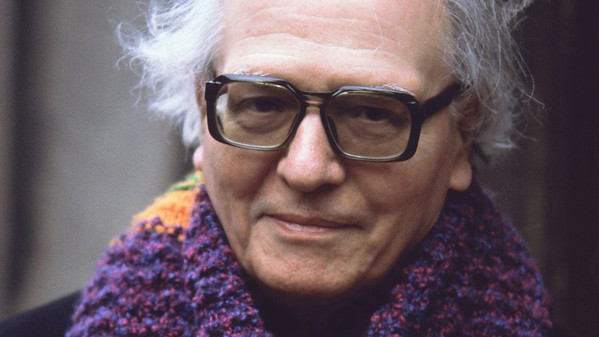 Olivier Messiaen is widely regarded as one of the most important composers of the 20th century, known for his unique approach to harmony, rhythm, and melody. His music is challenging for any performer, requiring not only technical skill, but also a deep understanding of his unique musical language.
The pianists presented here demonstrate a remarkable ability to capture the essence of Messiaen’s music, bringing out its intricate harmonies, colours, textures and rhythms, as well as its emotional depth.
Yvonne Loriod
Messiaen’s student, muse and second wife, Yvonne Loriod was a highly accomplished pianist in her own right. Many of his piano works were written with her in mind. The Vingt regards sur l’Enfant-Jésus (“Twenty Contemplations on the Infant Jesus”) were dedicated to Loriod, and she premiered the work at the Salle Gaveau in Paris in March 1945. Loriod’s playing is known for its clarity and precision, as well as her ability to capture the essence of Messiaen’s unique style. She recorded several albums of Messiaen’s piano music, including the complete set of Preludes and the Catalogue d’Oiseaux.
Pierre-Laurent Aimard
French pianist Pierre-Laurent Aimard is widely recognized as one of the foremost interpreters of Messiaen’s music. Aimard’s connection to Messiaen’s work runs deep, as he was a student of the composer and worked closely with him and his wife Yvonne Loriod. Aimard’s recordings of Messiaen’s piano music are considered some of the most authoritative, and he has performed Messiaen’s works all over the world to critical acclaim.
Angela Hewitt
Canadian pianist Angela Hewitt is perhaps best known for her interpretations of Baroque and Classical music, but she has also made a name for herself in more contemporary repertoire, including Messiaen’s piano music. Her recordings of Messiaen’s music are admired for their technical precision and attention to detail, as well as her ability to bring out the emotional depth of the music.
Steven Osborne
Scottish pianist Steven Osborne has performed Messiaen’s music all over the world, including the Vingt regards and Turangâlila Symphonie. Osborne expertly navigates the intricate harmonies and rhythms in Messiaen’s music with ease, bringing out the complex textures and polyrhythms that are hallmarks of the composer’s style. At the same time, he captures the emotional breadth and spiritual intensity that are crucial features of Messiaen’s music. His performances of the Vingt regards in particular are extraordinarily absorbing, meditative and moving, combining musicality, virtuosity and commitment. (I’ve heard Osborne perform this monumental work twice in London and on both occasions it has been utterly mesmerising and profoundly emotional.)
Tal Walker
For his debut disc, the young Israeli-Belgian pianist Tal Walker included Messiaen’s Eight Preludes. Composed in the 1920s, they are clearly influenced by Debussy with their unresolved or ambiguous, veiled harmonies and parallel chords which are used for pianistic colour and timbre rather than definite harmonic progression. But the Preludes are also mystical rather than purely impressionistic, and look forward to Messiaen’s profoundly spiritual later piano works, Visions de l’Amen (for 2 pianos) and the Vingt regards. Tal Walker displays a rare sensitivity towards this music and his performance is tasteful, restrained yet full of colour, lyricism and musical intelligence.
Other Messiaen pianists to explore: Tamara Stefanovic, Peter Hill, Jean-Yves Thibaudet, Ralph van Raat, Benjamin Frith, Peter Donohoe
This article first appeared on InterludeHK