
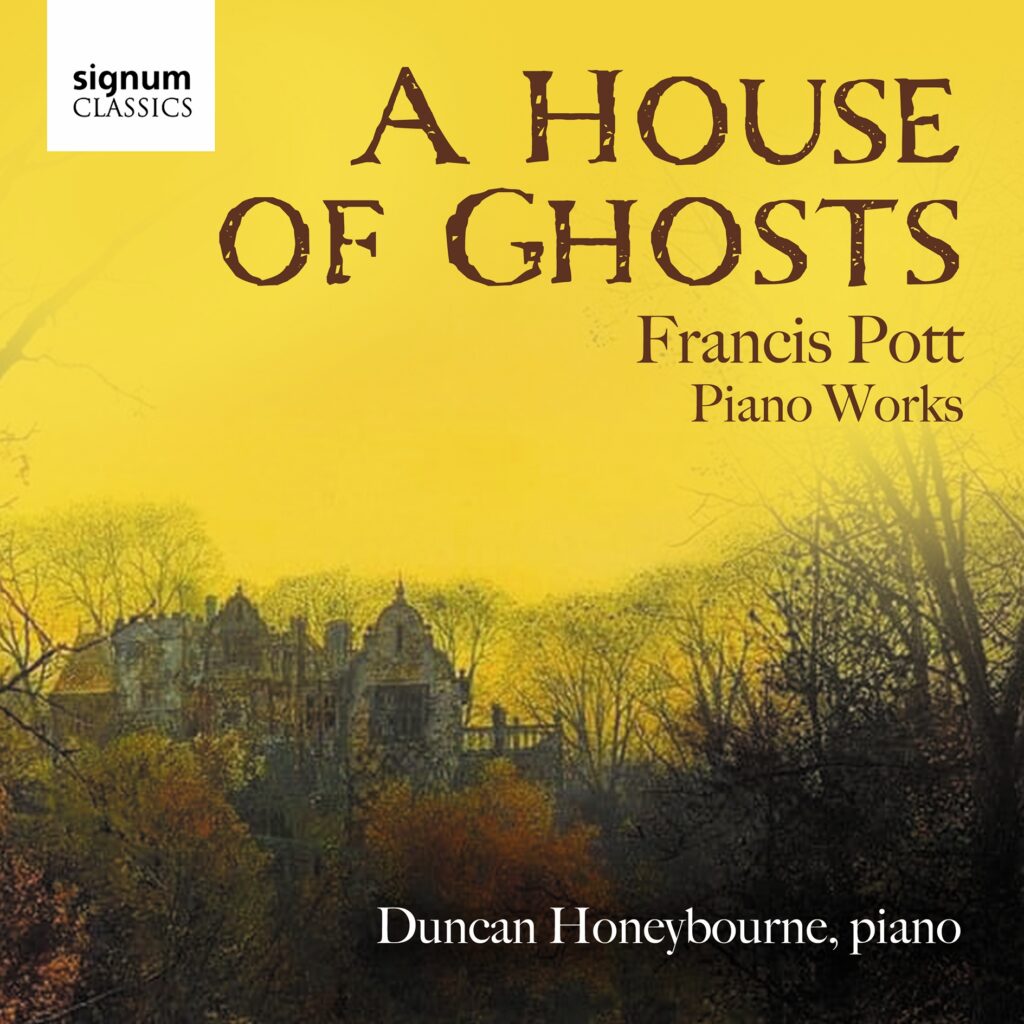
This new release of music by British composer Francis Pott, performed by Duncan Honeybourne, brings together piano works written between 1983 and 1997.
The title of the album, ‘A House of Ghosts’, reflects the character of the pieces: short works and miniatures which offer glimpses of places and voices that remain just out of reach, rather than an overall narrative. Pott’s music is elegant and restrained, reflecting on memory, landscape, and legend, occasional reference to medieval song (Minnelied, Blondel, Walsinghame), Chaucer (Pageant, with its distinctively ‘Medieval’ open fourth and fifth chords), T. S. Eliot (Revenant), and the abandoned community of St Kilda, a remote archipelago in Scotland (Farewell to Hirta). The mood of many of the pieces is wistful or nostalgic, with a timelessness which harks back to earlier times and musical styles: Pott’s influences include William Byrd, Gustav Mahler and Vaughan Williams, and one hears echoes of these composers, and others, in his harmonies, textures and long-spun melodies.
“A House of Ghosts is a sequence of a dozen short pieces concerned with the past, whether imagined, historical or (as in the case of the final piece) autobiographical. These movements are combined here with freestanding longer items, where sea music (Farewell to Hirta and Hunt’s Bay) is mixed with explorations of elusive memory (Le Temps qui n’est plus and Drowned Summer). Gently distinctive in its harmonic and tonal language, this music is the work of a professional pianist-composer with a refined and subtle insight into the physical and textural properties of the instrument.”
Duncan Honeybourne, pianist
I had the pleasure of page-turning for a performance by Duncan Honeybourne of several of the pieces featured on this album. This not only introduced me to Pott’s compelling soundworld but also offered a glimpse of his writing style. ‘A House of Ghosts’ is music written for the intimacy of the home, with the amateur pianist very much in mind. This is music that will appeal to the sophisticated amateur pianist who enjoys contemporary music that is melodic, structured and expressive, yet not overly-challenging. The music is highly pianistic (the composer is a pianist himself), approachable yet thought-provoking, consonant…. They may appear simple, but there is much scope for sensitivity in voicing, dynamics and pedalling to bring these finely-crafted pieces to life.
Duncan Honeybourne brings clarity, gracefulness and emotion to this elegant, atmospheric music, responding with much musical thought and sensitivity to its subtly-shifting colours and moods to create an album that is wholly enjoyable and deeply absorbing.
A House of Ghosts is released on digital streaming and download
Scores of Francis Pott’s music are available from Composers Edition
 ENTRANCED
The Orchestra of the Swan
Signum Classics SIGCD853
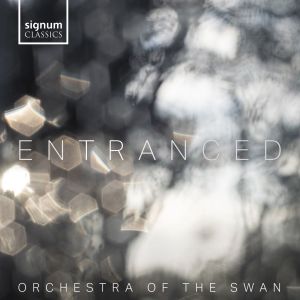
Musical adventurers, Orchestra of the Swan (OOTS), led by the charismatic violinist David Le Page, complete a remarkable musical journey with their latest release, Entranced. It’s an extraordinary odyssey which has seen them topping the US Billboard and iTop charts, and launching millions of streams from new audiences. Their innovative, imaginative approach cleverly combines “traditional” classical music with rock, pop, jazz, techno, ambient and folk to produce eclectic programmes and performances which blur the lines between genres. This enlightened approach to repertoire, combined with the Swan’s concerts in non-standard venues and experiments in digital sound, appeals to listeners with less exposure to classical music.
Over the past few years, OOTS have released a series of “mixtape” albums, which continue the spirit of the mixtapes and compilations on cassette tape of the 1980s (something which those of us of a certain age will remember creating for friends and boyfriends/girlfriends). These inventive, carefully curated and beautifully executed albums present a diverse compilation of arrangements (many of which are by David Le Page) and reinterpretations of works by an eclectic mix of composers.
Entranced is a compilation of these compilations, as it were, incorporating 15 tracks from OOTS’ critically acclaimed trio of mixtape albums, Timelapse, Labyrinths and Echoes, with all tracks now produced in Dolby Atmos – the immersive, surround-sound technology developed by cinema, that places the audience at the heart of the sound.
Artistic Director of OOTS, David Le Page says, “Entranced weaves together the genius of David Bowie, Schubert, Delius, Philip Glass, and Piazzolla. There is a brand new arrangement of Finzi’s extraordinary The Salutation for solo violin and strings, and transcendent beauty, from Brian Eno’s gorgeous An Ending (Ascent), to Peter Maxwell Davies’ Farewell to Stromness.”
Listening in not-quite-darkness, with only the dim light from my bedside clock radio, I hear An Ending (Ascent) by that master of ambient, Brian Eno. Of course I recognise it, but not quite in this arrangement. The sounds wash gently over me and in the dark and still of the night, it’s intimate and meditative, almost a lullaby. Listening again, in daytime, in the surround sound of my kitchen HiFi, the music floats, weightless but for a simple sequence picked out on the harp, now growing in intensity with a soaring violin line over lusher instrumental textures….
This track embodies the spirit of Entranced. The music on this album is serene and introspective, mesmerising and immersive – from the opening track, an arrangement of David’s Bowie’s song Heroes to the gracefulness of Rameau’s Les Boréades, the haunting sensuality of Piazzolla’s Oblivion, and the hypnotic, minimalist loops of Philip Glass, Entranced presents a sequence of beautifully atmospheric musical landscapes, infused with light, which transport the listener to the far reaches of their imagination.
Entranced is released on 20 October by Signum Classics, on disc and via streaming
ENTRANCED
The Orchestra of the Swan
Signum Classics SIGCD853
Musical adventurers, Orchestra of the Swan (OOTS), led by the charismatic violinist David Le Page, complete a remarkable musical journey with their latest release, Entranced. It’s an extraordinary odyssey which has seen them topping the US Billboard and iTop charts, and launching millions of streams from new audiences. Their innovative, imaginative approach cleverly combines “traditional” classical music with rock, pop, jazz, techno, ambient and folk to produce eclectic programmes and performances which blur the lines between genres. This enlightened approach to repertoire, combined with the Swan’s concerts in non-standard venues and experiments in digital sound, appeals to listeners with less exposure to classical music.
Over the past few years, OOTS have released a series of “mixtape” albums, which continue the spirit of the mixtapes and compilations on cassette tape of the 1980s (something which those of us of a certain age will remember creating for friends and boyfriends/girlfriends). These inventive, carefully curated and beautifully executed albums present a diverse compilation of arrangements (many of which are by David Le Page) and reinterpretations of works by an eclectic mix of composers.
Entranced is a compilation of these compilations, as it were, incorporating 15 tracks from OOTS’ critically acclaimed trio of mixtape albums, Timelapse, Labyrinths and Echoes, with all tracks now produced in Dolby Atmos – the immersive, surround-sound technology developed by cinema, that places the audience at the heart of the sound.
Artistic Director of OOTS, David Le Page says, “Entranced weaves together the genius of David Bowie, Schubert, Delius, Philip Glass, and Piazzolla. There is a brand new arrangement of Finzi’s extraordinary The Salutation for solo violin and strings, and transcendent beauty, from Brian Eno’s gorgeous An Ending (Ascent), to Peter Maxwell Davies’ Farewell to Stromness.”
Listening in not-quite-darkness, with only the dim light from my bedside clock radio, I hear An Ending (Ascent) by that master of ambient, Brian Eno. Of course I recognise it, but not quite in this arrangement. The sounds wash gently over me and in the dark and still of the night, it’s intimate and meditative, almost a lullaby. Listening again, in daytime, in the surround sound of my kitchen HiFi, the music floats, weightless but for a simple sequence picked out on the harp, now growing in intensity with a soaring violin line over lusher instrumental textures….
This track embodies the spirit of Entranced. The music on this album is serene and introspective, mesmerising and immersive – from the opening track, an arrangement of David’s Bowie’s song Heroes to the gracefulness of Rameau’s Les Boréades, the haunting sensuality of Piazzolla’s Oblivion, and the hypnotic, minimalist loops of Philip Glass, Entranced presents a sequence of beautifully atmospheric musical landscapes, infused with light, which transport the listener to the far reaches of their imagination.
Entranced is released on 20 October by Signum Classics, on disc and via streaming






 The Cross-Eyed Pianist