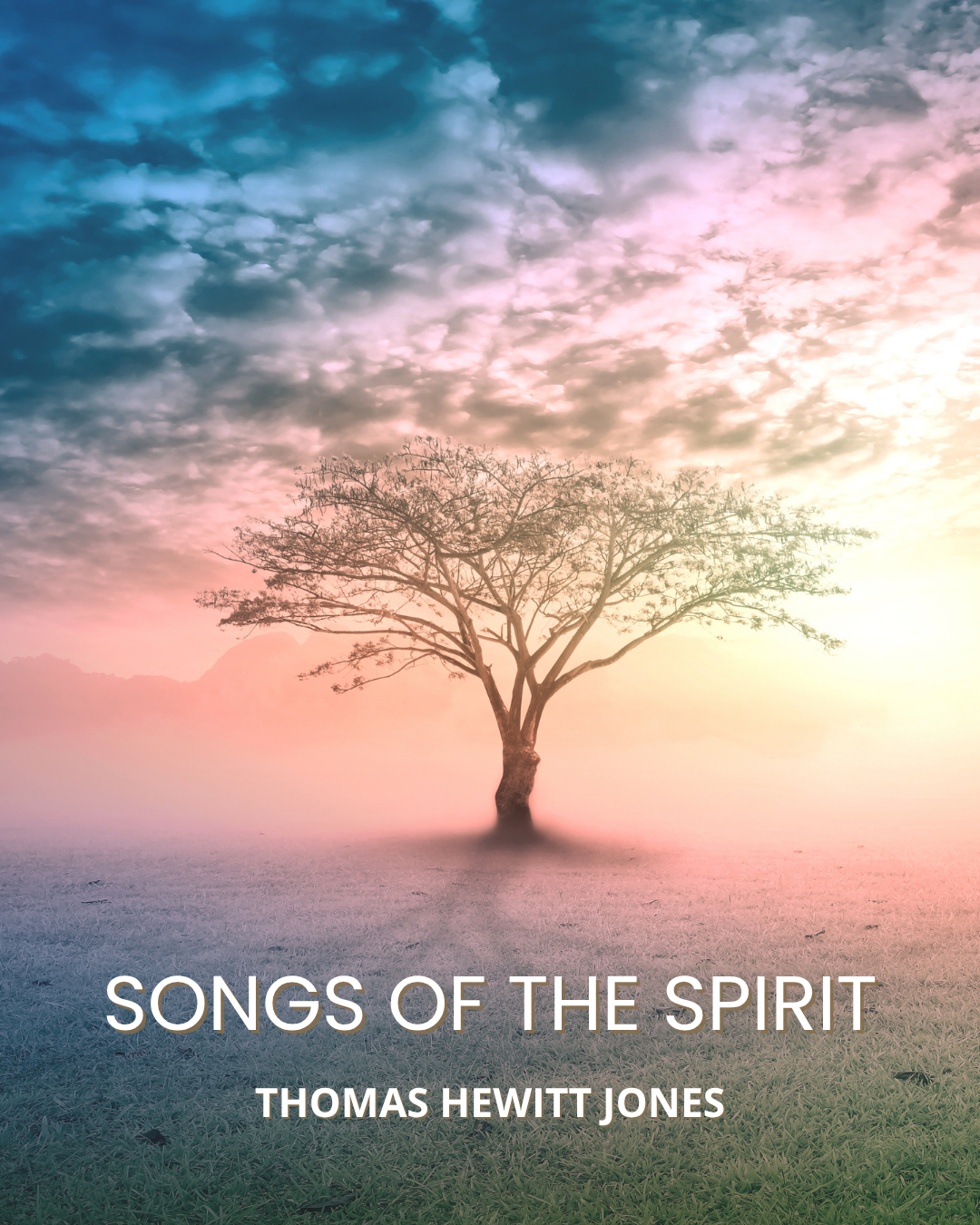
SONGS OF THE SPIRIT Music & words by Thomas Hewitt Jones

The Royal School of Church Music launches a major new choral commission as part of its centenary celebrations in 2027.

Songs of the Spirit is an exciting new suite of songs by award-winning British composer Thomas Hewitt Jones, created to uplift and inspire singers of all ages and backgrounds. With accessible yet impactful music, this 40-minute piece is perfect for community choirs, youth ensembles, chamber choirs, church choirs and can be performed in a wide range of settings. 

At its heart, the work explores a deeply human theme – the longing for safety and belonging in an increasingly complex world. Rooted in Christian values, the piece offers a message of kindness and hope, whilst inviting reflection on profound questions about identity, purpose and the human spirit in 2026 and beyond.

Unforgettable melodies, lyrical clarity, and radiant harmonies will all weave into a musical tapestry expressing the emotional weight and beauty of the themes at play. 

The piece is scored for SATB but is flexible and will include movements suitable for children’s choir alone, and a rousing final hymn-like movement with the option of audience participation. It will be suitable for performance either as a whole, or as standalone movements, with scoring options for piano, organ and strings. 

Listen to an excerpt here:

Following the success of A Season to Sing, the RSCM’s previous co-commissioning project with composer Joanna Forbes L’Estrange and over 50 choirs worldwide, the RSCM now invites choirs to be part of its centenary celebrations. In exchange for a donation of £300, co-commissioning choirs will have the exclusive right to perform Songs of the Spirit during its first year, and also receive the following benefits: 

  • A commemorative, hard-bound signed score 
  • Your choir’s name in the list of commissioners in the printed score 
  • 30% off all scores purchased for your choir within the first year of publication. 
  • Access to full support resources to aid learning 
  • Media promotion of your choir and its performance of the piece 
  • A personalised video message from Thomas Hewitt Jones for your choir 

This is an exciting opportunity to bring a powerful, appealing and uplifting new work to the contemporary choral music repertoire while allowing choirs to share their journey with the RSCM to ensure choral music stays accessible and widespread.

Songs of the Spirit will be available from September 2026

The success of a previous jointly commissioned work, A Season to Sing by Joanna Forbes L’Estrange (premiered in Spring 2025, with over 50 performances world wide to date), demonstrates the value of this model, with co-commissioning choirs praising the excellent resources provided, efficiency, and feeling valued throughout the process.

Ahead of the official launch of A Season To Sing, a reimagining of Vivaldi’s evergreen The Four Seasons for mixed voices and organ, composer Joanna Forbes L’Estrange offers insights into her compositional processes involved in rearranging this popular work for choir and explains why this piece is so appealing to her personally.

The work receives its London premiere on Saturday 22 March at St Bartholomew the Great in the City of London, perfomed by Luminosa Voices and organist Gavin Roberts. Info/book tickets here


Why Vivaldi’s The Four Seasons?

The Four Seasons is the first piece of classical music I remember listening to as a child. I have very vivid memories of dancing around the room to the 3rd movement of Autumn which is in 3/4 – my dad used The Four Seasons as a way of teaching me about 2/4, 3/4, 4/4 and 6/8 time signatures!

When I realised that 2025 will be the 300th anniversary of its publication I thought, “now’s the perfect time to make it possible for choirs to sing it!”

What is the appeal of this music for you?

One of the reasons that this particular work is so famous is because it’s programmatic – in other words, the music describes something specific – and was published with a programmatic title. Everyone, wherever they are in the world, can relate to the changing of the seasons and what makes each season different from the next. A piece called Violin Concerto in E major RV269 Op.8 No.1 has far less appeal to your average music-lover than a piece called Spring! Whereas Beethoven’s Piano Sonata No.14 in C# minor Op.27 No.2 wasn’t given the title ‘Moonlight Sonata’ until long after the composer’s death, The Four Seasons was published with that title. It was a genius move!

Vivaldi is known to have loved a series of paintings of Italian landscapes by his contemporary Marco Ricci, who was living in Venice at the same time, one of which we’ve used as the cover for the vocal score. The paintings inspired Vivaldi to write sonnets describing the seasons; the sonnets inspired the violin concertos and the violin concertos inspired me to write A Season to Sing. Perhaps A Season to Sing will inspire a choreographer to turn it into a ballet. Who knows?! This is the wonderful thing about art and artists – there are endless possibilities and inspiration comes from anywhere and everywhere.

How did you go about arranging the orchestral music for voices? Were there any particular challenges in this process, and what did you enjoy most about it?

The first stage was to study the score and work out which bits were singable. Last April, when I was just beginning to write A Season to Sing, I spent a few days in Venice to get into the zone. While I was there I attended a performance of The Four Seasons in Vivaldi’s church, sitting in the audience with the score on my lap, circling any bits which I knew would be good to sing. I’ve always approached choral composing very much from a singer’s perspective because it matters to me that everything I write feels nice to sing. With many of the movements the solo violin part became the right hand of the organ accompaniment while the choir parts were derived from the accompanying string lines of the Vivaldi. The slower movements (usually middle movements within each season) leant themselves more easily to being sung. Vivaldi’s melody-writing is absolutely sublime – sometimes I had to pinch myself to realise that they’d been written 300 years ago.

I decided early on that I wanted to keep all of the keys the same as in Vivaldi’s original. Sometimes, when you’re arranging instrumental music for voices, it makes sense to transpose into a different key, as was often the case when I was singing Bach in the Swingle Singers. I’m pleased that I chose to keep Vivaldi’s key structure because it helps my piece to retain more of the spirit of the original. Keys have certain colours and Vivaldi’s choice of keys fits perfectly with each season: the bright and joyful E major for Spring, the languid G minor for a hot and stormy summer and so on.

Tell us more about the texts you have chosen for A Season To Sing….

Sourcing the poems, hymn texts and Bible passages for each movement was an integral part of the process. It mattered to me that the words might sound as if they could have inspired the music, even though it was the other way round, of course! This meant matching their rhythms, rhyme schemes, phrase lengths and cadences to Vivaldi’s melodies whilst simultaneously enhancing his musical descriptions of different aspects of the seasons.

Vivaldi’s manuscript helpfully contains the Italian sonnets he wrote as the basis for his music. For the opening movement of Winter, I chose to adapt one of these sonnets, L’inverno, to create a soundscape. This is followed by the only wordless movement of the piece which I arranged in homage to Ward Swingle, the founder of The Swingle Singers, who became a close friend during my tenure as the group’s Musical Director. The remaining texts are from the Old Testament (Genesis, Exodus, Psalms, Song of Solomon and Zechariah), poems by two 19th-century English poets Emily Brontë and Eliza Cook, a hymn by Henry Alford and a Thomas Morley madrigal. It’s an eclectic mix into which I added the words of Ecclesiastes 3:1-8 (beginning ‘To every thing there is a season’) and set them in two movements which serve as bookends to the twelve Vivaldi movements.

In the final movement I’ve worked in a phrase from the Requiem Mass, Dona nobis pacem, (grant us peace) which helps to emphasise the ‘time of peace’ from the Ecclesiastes passage. Our world needs peace now more than ever.

What do you hope choirs/singers will enjoy in singing and performing this music?

My intention is for choirs to have a lot of fun with this piece, especially with the passages which are not so much “sung” as “performed”. For example, in SPRING there’s the birdsong chorus of whistlers and the nasal, bagpipe drone; in SUMMER there’s the call of the cuckoo and a storm created with body percussion; in AUTUMN, what were originally hunting horns are now a trumpet fanfare in praise of harvest; in WINTER the opening movement is half-sung/half-whispered to give the effect of the cold and the singers are required to shiver from time to time to maximise the effect!

As I always do when I’ve finished a new piece, I (together with my brilliant husband) have recorded every vocal line so that I can make sure that they all feel good to sing. Anything that feels awkward gets changed. So choirs can expect to have a lovely time learning and performing this piece. Nothing sits too high or too low and it’s deliberately on the easier side because I want all choirs to be able to sing it, from church choirs and chamber choirs to choral societies and community choruses and everything in between.

And what do you hope audiences will take away from the performances of A Season To Sing? I

imagine most people, even those who would profess to know nothing about classical music, have heard at least some parts of The Four Seasons before so I’m hoping that, as the performance unfolds, the audience will be thinking “ooh, I recognise that tune” from time to time. I’m also confident that by hearing a performance of A Season to Sing people might come to appreciate the genius of Vivaldi’s original concertos in a new way. Not only did he write great music but it is describing different aspects of the seasons – so clever!

Mostly I want audiences to feel joy when they hear this music. Performances should be visually as well as aurally entertaining and, because of the seasonal theme, they can happen at any time of the year. I love the idea that some concerts will be in the height of summer and others in the depths of winter! In 2025 there are performances happening all over the world. I’ll publish the list of dates and places as soon as it’s ready. I hope that everyone will be able to locate a performance happening near them and that all of the choirs who put on a concert will have a lovely, big audience of smiling faces.


A Season to Sing by Joanna Forbes L’Estrange is a choral re-imagining of Vivaldi’s The Four Seasons to mark its 300th anniversary in 2025.

Arranged for mixed voices and organ, A Season to Sing weaves into Vivaldi’s well-loved melodies with texts from poetry and the Bible on the subject of spring, summer, autumn and winter. The 40-minute work also includes a new setting by Forbes L’Estrange of Ecclesiastes 3.2 – To everything there is a season.

“…simply beautiful choral writing by someone who knows, from a singer’s perspective, how to compose music which every choir will want to sing.” – SIR JOHN RUTTER CBE, composer

A Season to Sing is a co-commissioning project with the Royal School of Church Music. The music is published by RSCM Publications and will be available from June 2025.

A Season to Sing events:

A Season to Come and Sing – a full day singing workshop, hosted by Joanna Forbes L’Estrange, followed by an informal concert. 15 March, St Thomas on the Bourne church, Farnham, Surrey. Full details/tickets

A Season to Sing – official launch concert. Saturday 22 March, St Bartholomew the Great, Smithfield, City of London. Full details/tickets

2024 Harold Smart Memorial Composition Competition for Young Composers

The Royal School of Church Music (RSCM) has just launched the 2024 Harold Smart Memorial Composition Competition. This invites individuals 25 and under (as of 1 July 2024) to compose an original anthem – a fresh, innovative work that inspires and uplifts, suitable for performance in a church setting. 

For experienced and new composers alike, this is an excellent opportunity to showcase talent and make a significant contribution to sacred music. The text to be used has been written by Dr Canon Gordon Giles.

The winner will receive a cash prize of £300, as well as £200 of composition tuition (with an agreed tutor), with the possibility of publication by the RSCM.

Closing date for submissions: 31st October 2024

Full information, including submission guidelines and how to enter here

ABOUT THE ROYAL SCHOOL OF CHURCH MUSIC

The RSCM is the Salisbury-based, national, independent charity enabling the flourishing of church music. As the central  ‘home’ of church music, RSCM provides relevant education, training and resources to its membership, the wider church, and beyond. It is committed to encouraging the best of music in worship, and to advocating music as a tool for growth of the church.

The RSCM supports thousands of Affiliated churches across the UK and worldwide through its international partners. In addition, it also supports many schools and Individual members, and its work is sustained by thousands of Friends, Regular Givers and other donors.

The RSCM is an open, life-long learning organisation, offering face-to-face and distance education and training through its programmes, published resources, courses and activities.

Founded by Sir Sydney Nicholson in 1927, the RSCM’s original emphases were English and choral. Now, in a diverse international context, the RSCM’s work is far broader and more diverse, and aims to make all its work ecumenical in purpose, nature and content.

HM The King is the RSCM’S Royal Patron, and its president is The Most Revd and Rt Hon The Lord Archbishop of Canterbury. The organisation celebrates its centenary in 2027.

www.rscm.org.uk

A SEASON TO SING by British composer Joanna Forbes L’Estrange is a brand new 40-minute work for SATB choir/organ or piano, inspired by Vivaldi’s The Four Seasons

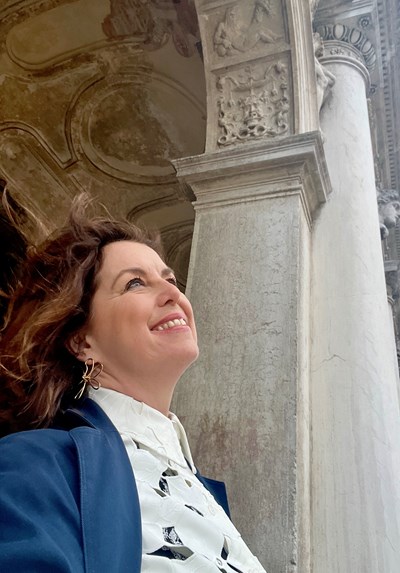
Joanna Forbes L’Estrange

A Season To Sing will be published by the Royal School of Church Music (RSCM) in 2025, marking 300 years since the publication of The Four Seasons. This choral re-imagining of Vivaldi’s enduringly popular set of violin concertos weaves texts from poetry and the Bible on the subject of spring, summer, autumn and winter into Vivaldi’s much-loved melodies. It will also include a new setting by Joanna Forbes L’Estrange of Ecclesiastes 3:2 – To everything there is a season. With its seasonal theme, A Season To Sing can be performed at any time of the year, and is expected to become a firm favourite with choirs throughout the world.

Joanna Forbes L’Estrange recalls, “The Four Seasons is the first piece of music I can remember hearing from my childhood. I used to dance around the sitting room to it! I thought a great way to mark its 300th anniversary would be to make it possible for choirs to perform it. Vivaldi’s tunes are so magnificent they deserve to be sung!” 

To make this commission possible, the RSCM is inviting choirs to contribute £300 ($500) each to participate in this project, for which each choir will: 

  • have the opportunity to perform the piece before its general publication
  • meet Joanna Forbes L’Estrange for a Q&A session via zoom
  • be listed in the vocal score as one of the commissioning choirs
  • receive a limited-edition, hardback copy of the vocal score, signed by the composer

This exciting opportunity is open to all choirs, large and small, professional and amateur, and to individual supporters. Deadline for registering – 31 August 2024.

To find out more, please visit

https://www.rscmshop.com/features/a-season-to-sing


Joanna Forbes L’Estrange (b.1971) is a multifaceted musician who performs, composes, records, directs and produces music in a wide variety of genres. Her career began with seven years as soprano and Musical Director of the five-time Grammy® award-winning vocal group The Swingles, with whom she toured the world and produced six albums. Specialising in contemporary crossover music, Joanna is a regular soloist for Mass in Blue by Will Todd (which she recorded for the Convivium label) and Duke Ellington’s Sacred Concert. With the world’s leading orchestras and contemporary music ensembles she performs works by Steve Reich and Luciano Berio and has sung on over 300 film soundtracks.

One of the Royal School of Church Music’s best-selling composers, Joanna was commissioned to compose an anthem to mark the coronation of King Charles III. The Mountains Shall Bring Peace was sung by over 600 choirs around the world including in the USA, South Africa, Australia, New Zealand and throughout Europe and the UK. Her music has been performed and recorded by Tenebrae, The King’s Singers, The Swingles, The Military Wives Choirs, The National Youth Choir and London Voices. Television credits include Fleabag, which featured her 1940s-style song You Are, and Glee, which featured her Moonlight Sonata arrangement, written for and recorded by The Swingles.

Joanna has written many songs and choral pieces in support of equal opportunities for women: We Will Remember Them (for the Military Wives Choirs of Great Britain), A Woman (Wearing Bloomers) On A Wheel (made into a film by the National Youth Girls’ Choir), Suffragette March (part of a larger work, Freedom! The Power of Song, composed in collaboration with her husband Alexander L’Estrange), A place for us maids (commissioned to mark 40 years of female undergraduates at Trinity College, Cambridge), The Three Wise Women (commissioned to mark the 135th anniversary of St Swithun’s School, Winchester) and Byrd Song (commissioned to mark the 400th anniversary of the death of William Byrd). In 2018 Joanna founded the all-female vocal group AQUILA and, in the same year, made history by organising the first ever all-female recording session at Abbey Road Studios in London, recording her single Twenty-first-century Woman for International Women’s Day.

www.joannaforbeslestrange.com

The Royal School of Church Music

The Royal School of Church Music (RSCM) is the Salisbury-based, national, independent charity enabling the flourishing of church music. As the central ‘home’ of church music, RSCM provides relevant education, training and resources to its membership, the wider church, and beyond. It is committed to encouraging the best of music in worship, and to advocating music as a tool for growth of the church.

The RSCM supports thousands of member churches across the UK and worldwide through its international partners. In addition, it also supports many schools and Individual members, and its work is sustained by thousands of Friends, Regular Givers and other donors.

The RSCM is an open, life-long learning organisation, offering face-to-face and distance education and training through its programmes, published resources, courses and activities.

Founded by Sir Sydney Nicholson in 1927, the RSCM’s original emphases were English and choral. Now, in a diverse international context, the RSCM’s work is far broader and more diverse, and aims to make all its work ecumenical in purpose, nature and content.

His Majesty King Charles is the RSCM’S Royal Patron, and its president is The Most Revd and Rt Hon The Lord Archbishop of Canterbury. The organisation celebrates its centenary in 2027.

www.rscm.org.uk

Registered charity no: 312828