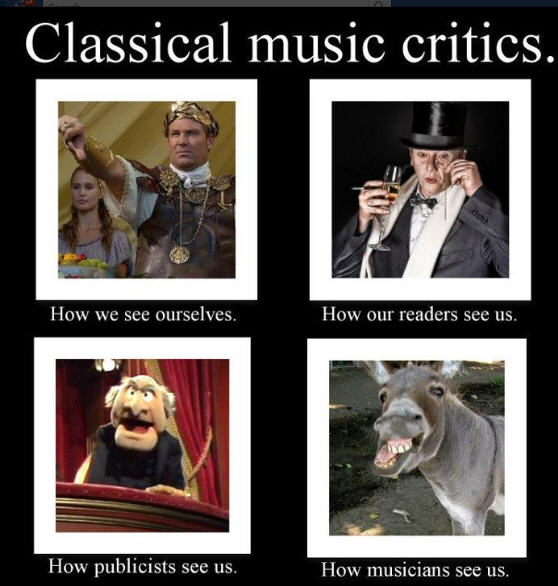
Reviews, and critics, are curious things. As Lisa Hirsch says on her blog ‘Iron Tongue of Midnight’, music reviews and music criticism serve the following purposes:

  • Journalistic: recording what happened and when and by which musicians
  • Opinion: recording a critic’s opinion (we hope a highly informed opinion) of what happened
  • Contextual: placing what happened within some historical and musical context
  • Preservation: enabling people in the far future to get a look at what happened, why, and the impression it made

Good reviews don’t make personal comments on the performer (recall the storm around the very negative comments about the physical appearance of singer Tara Erraught), nor allow the writer’s personal taste to rule the review (i.e. reviewers shouldn’t give a negative review just because they don’t like a particular composer or work: they should be able to put aside such likes or dislikes to offer an objective comment on the performance). Good reviews offer the writer’s considered opinion of the concert: was it effective and did it work? Which parts stood out, which did not? But at the end of the day, a review is one person’s view on someone else’s interpretation.

Some years ago I attended a concert of music by Musorgsky and Liszt by Georgian pianist Khatia Buniatishvili at London’s Wigmore Hall. For many members of the audience, and some critics it was a coruscating display of imaginative and risk-taking pianism, the Liszt pieces in particular performed with the kind of vertiginous virtuosity which Liszt himself may well have approved of. One critic didn’t like the concert, describing the playing as “rash” and “immature” and ended his review with the comment “on the question of whether Buniatishvili can ever be a serious artist, the jury is very much still out” (full review here). A few days later, Khatia Buniatishvili responded to this review with some remarks on her personal interpretation of the pieces (read her response here)

Ms Buniatishvili’s detractor in ‘The Guardian’ had just as much right to give her three stars as ‘The Evening Standard’ critic did in awarding her five stars. And she had every right to reply to her detractor. But I wonder whether such a rebuttal serves any real purpose in the great scheme of things. An international artist like Khatia Buniatishvili will play many concerts in many cities across the world and be heard by many hundreds of people, some of whom are critics and reviewers. A single concert is just a day in the life, and a single negative review is unlikely to make or break an artist.

The violinist Patricia Kopatchinskaja had, for awhile, her own way of dealing with negative reviews. One page of her website was a ‘trashcan’ for negative reviews through which she responded to factual errors and rebuked lapses of taste. She also demanded to know who – herself or the critic – had spent longer studying the score or living with the composer.

Some artists simply don’t bother to read their reviews, and some have agents, managers, mentors and partners who filter the reviews. Performers have to have the courage of their convictions, to get up on stage day in day out and give concerts without worrying unduly what reviewers and critics are going to say. Fundamentally, concerts are about sharing music and entertaining the audience, not playing to please the critics. Without an audience, there would be no concerts (and without concerts, there would be fewer reviewers!).

An informal poll amongst the musical/journalistic community with whom I interact online revealed that most performers felt responding to reviews was a waste of time and that one should hold one’s head high and move on. The only time when a response may be justified is if the review contains inaccuracies or comments which can be construed as slanderous or unduly personal, or where the reviewer has made assumptions about the performer’s lack of form without proper justification or being in possession of all the facts (for example, if the performer is ill, but no announcement is made ahead of the concert). For the purposes of this debate, I am quoting some of the comments by colleagues (musicians and critics/reviewers):

“the dynamic in all this has changed substantially with social media. The critic makes a public statement and the artist can, if he or she so wishes, make a public statement back without having to do anything as cumbersome as, say, write an open letter. These days, artists, both talented and less talented, can succeed by simply getting the public behind them without any help from PRs and record companies.”

This is a good point: social media has had a huge impact on the way artists and performances are received, and has “democractised” reviewing: everyone can be a critic or reviewer these days, with tweets and Facebook/YouTube “likes”

“this whole issue goes round and round and round and round. There are critics. Some are good, some not so good. Some are helpful, some not. Some, sometimes, offend intentionally or otherwise. All get it wrong sometimes, some more than others. But better to be written about than ignored. So there are critics.”

“I have only once responded to a critic. And that is because he was inaccurate and commented on a discography which doesn’t exist. Beyond that, I just play and don’t give a flying duck what anyone thinks – I’ve been at a piano since I was a toddler and have earnt that right. Many/most critics have been to a certain mileage of performances and done a certain amount of reading/research and have an impressive general knowledge of all things musical. They have earnt the right to write. The best any of us can do is go to live concerts and make up our own minds” (a musician)

And a reviewer writes:

When I review, I arrive at the concert wanting to enjoy it and assuming that the performer will give sincerely of their best. Intelligent listening will always find flaws as well as good things, and it’s dishonest to misrepresent the experience; but there are ways of phrasing this – and still keeping it lively and readable (the critic has as much of an obligation to their audience as the performer has to theirs). I’ll only hand down a slating if I detect actual cynicism.”

I return to my earlier comment: a review is just one person’s opinion and is neither right nor wrong. Confident artists know this and are able to move on from a negative review, looking ahead to the next concert. And some artists will always divide critics…..


 

A retrospective of music I’ve reviewed over the year. 2012 has been one of my busiest years as a concert-goer, not least because of my reviewing job for Bachtrack (since April 2011). This has enabled me to get to many more concerts, and I’ve heard a great range of performers (not just pianists) and repertoire. Where relevant, I’m including a link to my review.

January

Peter Jablonski at QEH: a bit hit and miss, this one. I felt Jablonski was far more comfortable in the jazz-oriented repertoire (Copland and Gershwin) and Barber’s Op 26 Piano Sonata. But I’m glad I went, because he was a pianist I was curious to hear. Review

February

Marc-André Hamelin, Wigmore Hall. Hamelin wowed me at the Proms last summer, in a late-night all-Liszt programme, and he did it again with an ambitious, athletic and highly varied programme of music by Haydn, Villa-Lobos, Stockhausen, and more Liszt. Definitely one of the highlights of my concert year. Review

Peter Donohoe, QEH. Peter showed how Debussy should be played in his performance of Estampes, and then went on to demonstrate the invention and intellect of Liszt in an absorbing and at times very personal performance of the first year of the Années de Pèlerinage. His concert closed with a coruscating Bartok Sonata. A fine concert by one of the UK’s most acclaimed pianists (and a thoroughly nice bloke too!) Review

Peter featured in my Meet the Artist interview series – read his interview with me here

March

Truls Mørk (cello) and Khatia Buniatishvili (piano), Wigmore Hall. I love the lunchtime concerts at the Wigmore and quite often nip down there after work for an hour of quality music. Mørk and Buniatishvili came together to perform one of Beethoven’s most miraculous late works and Rachmaninov’s atmospheric and wide-ranging Cello Sonata in G minor, Op. 19. Review

François-Frédéric Guy, QEH. A Frenchman who bears more than a passing resemblance to Beethoven, playing Beethoven. A sensitive opening movement of the ‘Moonlight’ Sonata, and a monumental and philosophical Hammerklavier. Sadly, the evening was marred by much throat-clearing and coughing from the audience, which did not go unremarked by the performer. This is a pianist I would definite hear again. Review

Leif Ove Andsnes, QEH. A pianist whom I much admire for his understated manner and ability to allow the music to speak for itself. An enjoyable mixed programme in which Andsnes moved seamlessly from the mannered classicism of Haydn through to the romance of Chopin, the percussion of Bartok and soundwashes of Debussy. Review

May

Yuja Wang, QEH. I went to hear Wang purely out of curiosity, for much has been written about her playing and her concert attire. It was an interesting concert, but I felt this artist needs to live with some of her repertoire for longer to fully appreciate it and communicate it to the audience. Review

Leon McCawley, Wigmore Hall. Another excellent lunchtime concert by another pianist who is able to put the music first before ego. Chopin, Debussy and Schumann followed by an enjoyable green room chat. Review

Leon McCawley features in my Meet the Artist series – read his interview with me here

Lars Vogt, QEH. Another rather mixed offering. Some charming pieces for children and an ill-judged approach to Chopin’s iconic Funeral March from the B-flat minor Sonata. And Vogt’s gurning was rather off-putting too. (Hear me talking about this concert in my podcast for Bachtrack). Review

July

François-Frédéric Guy & Jean-Efllam Bavouzet, Wigmore Hall. French elan and Russian avant-garde combined in a stunning lunchtime concert. The sparkling two-piano version of Stravinsky’s Rite of Spring certainly roused many elderly Wigmore regulars out of their post-lunch slumber! Review

L’Arpeggiata, Cadogan Hall (Chamber Prom 3). An ensemble I have long admired on disc, it was a real treat to hear l’Arpeggiata live, and they did not disappoint with a lunchtime Prom of toe-tapping Baroque music enhanced by sensuous and energetic dancing. Review

August

Jennifer Pike (violin), Igor Levitt (piano) & Nicolas Alstaedt (cello), Cadogan Hall (Chamber Prom 4). Two duo sonatas and a trio in music by Debussy and Ravel. Exquisitely executed and presented. Review

September

Platinum Consort, King’s Place. I have been following Platinum Consort, a young choral octet, with interest after interviewing their director/founder, Scott Inglis-Kidger, and their composer-in-residence, Richard Bates, for my Meet the Artist series. At their King’s Place debut Platinum gave a faultless and highly absorbing performance of music by Renaissance and Baroque composers, new works by Richard Bates, and James MacMillan’s monumental Miserere. Review

Pierre-Laurent Aimard, Cadogan Hall (Chamber Prom 8). Aimard impressed me in his first Liszt Project concert at QEH last winter – his intellect, his technical facility, his total immersion in the music – and he did not disappoint in a lunchtime recital of Book 2 of Debussy’s Preludes. Review

October

Noriko Ogawa, Wigmore Hall. Another lunchtime at the Wigmore and a pianist I have long wanted to hear live. Noriko opened her concert with Takemitsu’s Rain Tree Sketch II, a piece I am working on myself for my LTCL programme. It was so arresting, so perfectly presented that I could have happily listened to endless repeats of the work. But Debussy’s Études were wonderful too, Noriko bringing a great range of colours and moods to the music. Review

Peter Donohoe, Sutton House. Peter opened Sutton House Music Society’s 2012-13 season with a programme called ‘Opus 1’, which allowed him to present works by Tchaikovsky and Schumann alongside pieces by Prokofiev, Bartok and Berg. Great to hear Peter again, at a delightful and intimate small venue Review

Benjamin Grosvenor, QEH. Grosvenor’s Southbank debut came hot on the heels of a host of awards, and, unsurprisingly, the venue was packed. I admit I have been avoiding Grosvenor, as the tag “prodigy” always worries me, so I heard him with a mixture of curiosity and repulsion. There were some fine moments in the concert, but I never really felt he caught fire and I feel he needs to mature as a performing artist. I hope that such significant early success does not lead to burn out and obscurity as Grosvenor grows up (it would be nice to think his career trajectory is akin to Kissin’s: we shall see…..). Review

November

Elena Riu, Sutton House. Another enjoyable trip to Hackney for ‘Inventions’, a fascinating juxtaposition of Bach’s Two- and Three-Part Inventions with inventions by contemporary composers, including Finch, Ligeti, Gulbaidulina and Lutoslawski. Review

Elena’s Meet the Artist interview

Metier Ensemble, The Forge. My first visit to this great little venue in Camden, which successfully combines an arts venue with a bar and restaurant in a purpose-built imaginatively designed space. Metier are a piano, flute and cello trio, and the programme of their ‘Keys and Coffee’ concert was perfect for a Sunday morning. Review

Meet the Artist: Elspeth Wyllie (pianist with Metier Ensemble)

Other musical highlights during this year include

Left-handed pianist Nicholas McCarthy’s graduation recital at the Royal College of Music, in which McCarthy demonstrated that one hand playing can be as beautiful and subtle, powerful and dramatic as two; it was a great privilege to be invited to Nick’s recital. Review

My students’ concert at Normansfield Theatre, Teddington in May was a wonderful shared celebration of music-making and a tribute to all the hard work my students put in during the year.

Late Schubert piano music in Surrey, performed by an acknowledged Schubert expert, including the Moments Musicaux, Klavierstücke, and both sets of Impromptus. Review

Concert highlights to look forward to in 2013:

Leon McCawley, Wigmore Hall

Mitsuko Uchida, RFH

Quartet for the End of Time, QEH (with the Capuçon brothers)

Piotr Anderszewski, QEH

Steven Osborne/Messiaen – Vingt Regards sur l’enfant Jesus, QEH

Since January 2012, I’ve also been reviewing exhibitions for Bachtrack’s sister site, One Stop Arts. You can find all my art reviews here

As some of my readers already know, I write regular music reviews for international concert and opera listings site, Bachtrack.com. A new sister site, OneStopArts, has just gone live, specialising in listings for theatre, music, exhibitions, comedy and lectures in London. Do visit the site to find out more.

My latest reviews for OneStopArts are here

I thought it would be worthwhile posting other reviews of Marc-André Hamelin’s stunning all-Liszt recital at the Proms on 24th August. The general consensus is that it was a superb evening: it certainly continues to resonate with me as I have discussed it with friends and colleagues, and listened to the concert again, via the BBC iPlayer.

I would also like to thank those people who have contacted me following the concert to comment on my review. Such positive feedback is always very welcome, and I am delighted that people enjoy my writing.

The Guardian

BBC Music Magazine

Classical Source

Hear the concert via the BBC iPlayer here

And here’s Hamelin playing the same Liszt Sonetto (123) that I performed in my students’ concert in July:
