review

Guest review by Michael Johnson

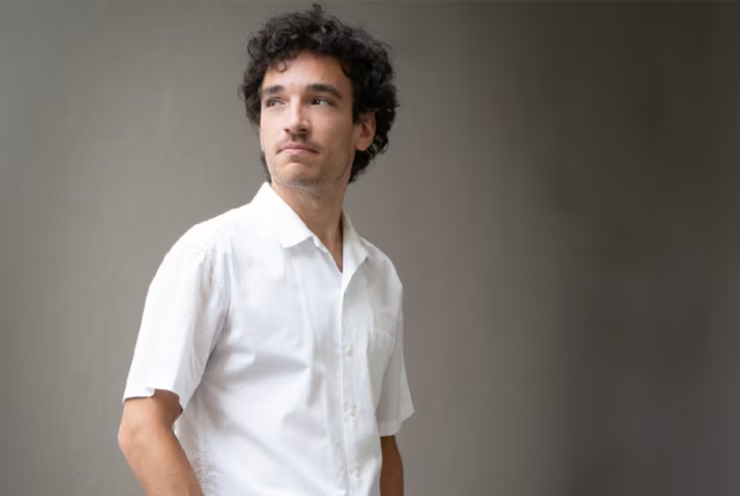
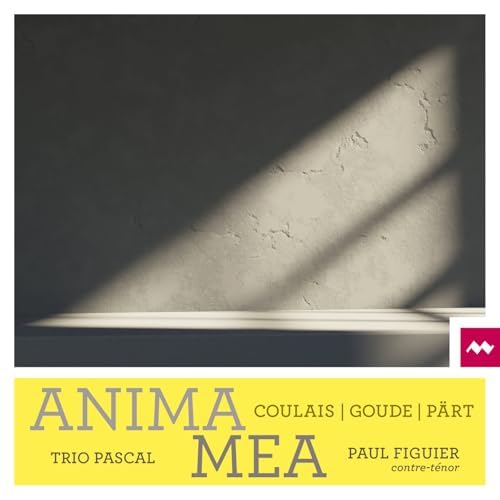
It is a rare occurrence for me to slide a CD into my player and fall immediately under the spell of haunting, hypnotic music I had never heard before. But “Anima Mea” (La Musica LMU 094), performed by the Pascal Trio and the young counter-tenor Paul Figuier, did just that. I replay the full 72 minutes almost every day and have not yet tired of it.

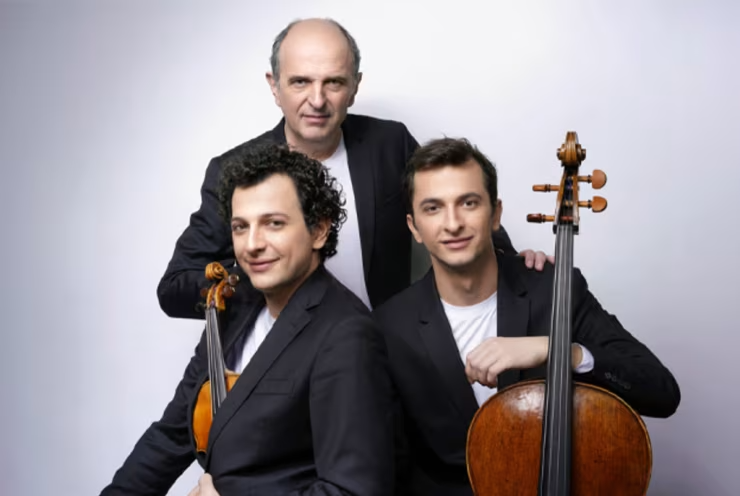
Denis Pascal, pianist in his family trio and a leading promoter of the CD project, tells me this music “creates a space in which one can get a glimpse of another world.”

The recording marks a few important firsts. Composers Bruno Coulais and Jean-Philippe Goude created their contributions expressly for this disc, and thus can claim World First recordings. In addition, the Goude version of Gerard Leane’s Salve Regina is reworked for this recording.

Taken together, the spiritual and sacred themes, beautifully vocalized by Figuier, leave the listener transported into a poetic melancholy mood suddenly shifting to a brisk and lively piece by Arvo Pärt.

The over-all style is a unique form of minimalism. The sustained repetition is evident in the most surprising selection, “My Heart’s in the Highlands” based on the words borrowed from Scottish national poet’s work of the same name and set to the haunting music of Pärt.

Figuier renders the score in English, in a powerful but controlled high-pitched voice – long passages on a single note, backed up by the Pascal brothers and their father. The heartfelt strings and piano interpretation would leave a modern Scot an emotional wreck.

Denis Pascal has been close to Figuier since the beginning of the singer’s career. Now Pascal calls his counter-tenor performance “magnificent”, a voice with “very great expressivity”. Figuier’s growing reputation places him alongside such counter-tenors as Philippe Jarousky, Alex Luna and Andreas Scholl.

The trio comprises a rare family gathering of accomplished musicians. Pianist Denis Pascal and his two sons – violinist Alexandre and cellist Aurélien – form a unique ensemble bonded by years of common musicianship from childhood onward.

The title of the CD, “Anima Mea” (“My Soul” in English), was chosen to evoke spirituality, religious or not, evanescence, invisibility and the meaning of Salve Regina – thee traditional Magnificat in praise of the Virgin Mary, love and devotion.

An exceptionally thoughtful booklet accompanies the CD including biographies of players and composers, analysis by Yutha Tep, and the full texts in Latin, French and English.

As one French critic put it, “For anyone who loves meditative music chiseled in crystal, ‘Anima Mea’ is a stop not to be missed.”
MICHAEL JOHNSON is a music critic and writer with a particular interest in piano. He has worked as a reporter and editor in New York, Moscow, Paris and London over his journalism career. He covered European technology for Business Week for five years, and served nine years as chief editor of International Management magazine and was chief editor of the French technology weekly 01 Informatique. He also spent four years as Moscow correspondent of The Associated Press. He is a regular contributor to International Piano magazine, and is the author of five books. Michael Johnson is based in Bordeaux, France. Besides English and French he is also fluent in Russian. In 2024, he co-published with Frances Wilson ‘Lifting the Lid: Interviews with Concert Pianists’
Guest review by Adrian Ainsworth

What an exhilarating record this is. ‘Future Relics’ is the debut album from guitarist Kevin Daniel Cahill, and I think one of the reasons I love it so much is that it feels like it was made not only by a superb musician, but a great listener. As a result, it’s a great listen.

Reading a description of ‘Future Relics’ might initially make you think it’s more like two mini-albums or EPs gathered into one, as Cahill has assembled two very different ‘groups’ of pieces. One set is a series of classical commissions from composers he asked to write for the album, while theremaining tracks, written by Cahill himself, are rock instrumentals.

There’s certainly an intriguing legacy of ‘split personality’ albums in the rock world, where side one might have had the hits but side two was a playground. You might think of the ‘Abbey Road’ medley, or Berlin-era Bowie’s instrumentals on ‘Low’ and ‘Heroes’ – or even Kate Bush’s piece of audio-theatre, ‘The Ninth Wave’, taking up half of ‘Hounds of Love’. Others among you might come at this entirely differently, perhaps after a listen to fellow classical guitarist Sean Shibe’s recent ‘soft / LOUD’ album, half acoustic/ancient, half electric/modern.

But having identified these two separate sides of himself and his art, Cahill goes one step further and mixes them all up. Dovetailing the different styles of track in this way might seem, to coin a phrase, like a small step. But for the listener, it really is a series of giant leaps, with huge dynamic shifts from speaker-busting riffs and percussion to sparse, delicate picking. (The album is of course available digitally – so you can play any individual tracks you like, in any order you want. But as a measure of how important the sequencing is, I was interested to find that the only physical release of ‘Future Relics’ will be on cassette: the hardest format to ‘shuffle’…)So how and why does it work?

The album perhaps gestures most strongly towards the avant-garde with the commissioned tracks. Featuring Cahill solo, they are often steady and measured, almost at times with an improvisational, ‘working-things-out’ feel. The pieces are not in the least predictable, drawing all kinds of different timbres and harmonics from the guitarist. The combination of careful beauty and occasional savagery make you feel that whatever your accustomed style of player – from Xuefei Yang to Derek Bailey – something will resonate with you here. My personalfavourite of these is Ninfea Crutwell-Reade’s ‘Wallflower’ – slightly more fleet-footed, it starts with what sounds like a chiming lead line, only to use it to create cyclic rhythm, while a ‘true’ lead comes in simultaneously, keening, adding a ‘sheet’ of sound almost to ‘”Heroes”’ effect. Haunting yet joyful – a wonderful work.

Despite their immense heaviness at times, the rock numbers also deploy resources with real care and precision. Cahill provides most of the tracks’ heft, with hooks, riffs or drones as required, and gives generous periods in the spotlight to acrack team of fellow musicians. For example, violinist Abigail Young provides the exotic, hypnotic swirl central to ‘We’ve Taken Aqaba!’. On both this track and the fearsome ‘For Deckard’, Graham Costello plays the drums more or less as a lead instrument, driving the piece forward while constantly shifting patterns and rhythms and increasing the intensity. Cahill again finds melody in the metallic, fashioning distorted chords into tunes.

But it isn’t all strum und drang, with quieter electric pieces punctuating the album. The gorgeous, but propulsive shimmer of ‘They speak in never ending light / Resting place, God’s Acre (For Andra)’ manages to look both ways – towards the cyclic sound of ‘Wallflower’ and the more driven, agitated thrust of ‘For Deckard’. The expansive sound occasionally made me think of the peculiarly Scottish feel of ‘Big Music’ (as coined by the Waterboys’ Mike Scott) in whatever form that may take for you: whether it’s split-second echoes of Local Heroics,  or sudden bursts of barely-controlled Mogwai-style power.

Of course, it’s Cahill himself who is the unifying force across the whole record. He has shaped it – clearly he absorbs and goes on to write and play all the different styles of guitar music he loves. At the start of the album, we hear muffled voices and noise, as if the overall experience is going to represent a kind of ‘KDC FM’, with us moving between the various stations.

There’s also a strong sense that Cahill is channelling all these sources of inspiration into one style: his own. For all the reference points I’ve mentioned, throughout the album, he sounds like no-one other than himself – graceful, yet rhythmically robust on both the self-penned and commissioned material. I think the production is also a key element: ‘Future Relics’ is very concerned with the physicality and action of playing. We can hear the movement of hand and fingers against strings; the breathing; ambient hum and static – whatever’s going on, you feel like you’re in the room. This analogue touch will only be enhanced when played on a not-quite-silent cassette.

By representing his wide variety of musical passions, Cahill has made a bold record which will certainly introduce some listeners to styles of music they might not have been expecting. In doing so, however, he has in fact made an admirably coherent statement, demonstrating how one’s own work can successfully reflect many sides to the same person.

Rewarding; recommended.

Future Relics is released on 27 June. More information

Meet the Artist interview with Kevin Cahill


ireland-england-cover-resizeGuest review by Adrian Ainsworth

A fascinating work to review, this. A deliberate hybrid of artforms: the soundtrack element combines features of electronica, classical composition and sound art, while the video it accompanies is more verbal than visual, a series of facts and figures displayed over an unchanging, neutral background colour.

As Clancy is first and foremost a composer, I paid most attention first time through to the music. It is described as ‘drone-based’, so –repeating and sustained patterns of notes and chords, occasional percussion… here, all created on synthesisers. It’s an intense listen: the rhythmic taps near the start reminded me of Reich’s ‘Drumming’, and the flurries of ‘blips’ which follow increasing the sense of bustle, agitation. Even at its most stretched-out, there are often elements of dissonance or slight distortion that underline this unsettled vibe.

As this composer was new to me, I listened to some of his previous work, in particular the album ‘Small, Far Away’. In many ways, much of that record seems to capture – in bite-size tracks – an approach that Clancy is pushing to almost ‘concept album’ limits on ‘Ireland England’. The music suggests to me a grounding in an ambient, freeform soundworld, invaded by more industrial, hyperactive influences… where a Brian Eno recording might be respectfully – but not too reverently – taken apart by sonic disruptors like Aphex Twin or Shackleton.

I’ve now mentioned the ‘concept’ – and this is where ‘Ireland England’ in fact becomes a multimedia proposition, as you watch the text video while listening. Like art in a gallery, then, the interpretation is provided to us – we’re not left to our own devices. There are two key strands running through the piece. As ideas, they are linked, but as the music plays through, they run more or less in parallel without meeting.

The whole work represents the flight Clancy regularly takes from Dublin to Birmingham. He has divided it into seven sections (“safety announcement / taxi / take-off / cruise / descent / landing / taxi”). This is all explained in the opening stages of the video, which then pursues the second strand, detailing other journeys made by Irish travellers to England, and their reasons for doing so. My impression is that while the stages of his own commute have given Clancy a framework, his composition really takes flight with this second idea – as the intensity levels of the piece seem to increase at points where the migrations are at their most heart-rendingly stressful (fleeing unrest, seeking abortions).

I suspect that if the visuals had pushed into even artier territory – maybe found some way to illustrate the commuter flight alongside the statistics – the piece could have soared higher. But that is to review something the work isn’t, rather than focusing on what it is.

In the face of such emotive subject matter and such a strong folk tradition, it’s fascinating in itself that a composer has sought to express these scenarios through the ‘colder’ medium of electronics. There are ghosts in the machines.

I like to think that ‘Ireland England’ – outside its mission, so to speak – will find a future as an opportunity for electro-classical musicians and groups to experiment with levels of extremity across single, extended performances. The score Clancy has prepared for the work (some instructions and a single sheet’s worth of notation) seems to allow players to re-interpret almost every element, including its length. The composer’s own 35-minute recording is as precision-tooled as it gets, with the sheet music allowing for performance times of up to an hour or so. It would be interesting to hear a ‘cover version’ and see where someone else might take this blueprint.

In the meantime, I’ll be looking out with interest for whatever Clancy decides to do next.

ireland england by Seán Clancy. Released 1 February 2019

Album available to stream/download here


Seán Clancy is a composer and performer who writes music for electronic and acoustic instruments. Through defamiliarisation, repetition, fragmentation, and the use of drones, his music tries to reach out to people and say hello… He lives in Dublin and is a senior lecturer in composition at Royal Birmingham Conservatoire in the UK.

Sean Clancy’s website


Adrian Ainsworth writes for a living, but mostly about things like finance, tax and benefits. For light relief, then, he covers his obsessions – overwhelmingly music, but with sprinklings of photography and art – on the ‘Specs’ blog, which you can find at

Twitter: @adrian_specs

Adrian is a regular guest writer for The Cross-Eyed Pianist

4205e2_758c8115c3f34f1c80528b14268aab01~mv2_d_3562_2490_s_4_2
Wolfgang Rubsam

It is not that often a set of recordings comes along which is genuinely as much a revelation and surprise to the Bach initiate as this one.  Wolfgang Rübsam’s current spate of recordings on his self-released ‘Counterpoint Records’ include the entire Well-Tempered Clavier (across 5 vols.), Art of Fugue and most recently a number of the Cello Suites (!), all of which are available only as downloads but thankfully in FLAC format as well as lossy MP3.  They all feature an unfamiliar sound: the Lautenwerk or lute harpsichord, in this case one of only a few in existence, built by the fine and intrepid instrument maker, Keith Hill.  Readers need look no further than Rübsam’s website for generous helpings of tracks from these CDs together with other recordings of Pachelbel, Buxtehude and Böhm (www.wolfgangrubsam.com/listen ).  For me the recordings speak for themselves, and I have grown to like them even more over time, as well as slowly realising how far they go against the grain of traditional Bach keyboard interpretation. Those who are not instantly convinced may want to read on and reflect.

First let it be said that the Lautenwerk has a charm all of its own.  The timbre outwardly resembles that of the buff stop that is featured on some harpsichords except that it is a lot fuller, mellow and, well, lute-like.  Although notes die away rapidly a warm reverberation is created by a set of strings above that resonate in sympathy, rather like the effect contributed by the undamped final octave or so of strings on the piano.  In fact, the ear does not seem to tire of this closely recorded sound as much as can be the case with the bright tone emitted by some conventional harpsichords, even after listening endlessly to it (on headphones).  There is a gentle ease about it, matched by the ease and delight of the player.  Sometimes the sound-world reminds me of arrangements of Renaissance polyphony for lute duet, and Rübsam manages to make the listener forget that this is actually a keyboard instrument, so nuanced is his touch.

The liberties the instrument itself seems to entice Rübsam towards, lead him beyond where most dare to tread in this very Germanic, learned repertoire. However, for me the results give a breath of fresh air to what can seem sometimes, even on the piano with all its dynamic variety, a rather trudging tradition of playing (I am thinking particularly of the fugues).  In fact, I think this raises a whole heap of questions about how such music may have been brought to life by the player of an instrument where other parameters such as dynamics are so minimal.  It is clear from the modern tendency to perform works like the Art of Fugue on strings and other combinations (not to mention piano) that the listener benefits from such individualisation of lines, yet Rübsam finds a viable and enchanting solution to this problem on the Lautenwerk by displacing one voice rhythmically from another resulting in a remarkably three-dimensional sense of the polyphony (Bradley Lehman has called his Bach ‘geodesic’), an effect that initially takes some getting used to.

This is nothing new for him.  His two complete Bach organ cycles (particularly the later one for Naxos) show a subtle rhetorical approach to rhythm that, although requiring more concentration from the listener, is deeply rewarding in communicating the sense of metre, the stress of dissonances and light and shade of rhythmic groupings, and bears out repeated listens. This sensibility has been transmitted to the work of his students too, including Julia Brown’s brilliant Buxtehude complete organ series for Naxos.  Rübsam himself also did quite a lot of piano recordings for Naxos that also show a distinctly free approach rarely heard in today’s pianistic Bach, saved from accusations of Romanticism by its accomplished ornamentation and deep awareness of style.  The ornamentation on his Lautenwerk recordings is also very impressive and adds to the sense of freshness.  Everything is on the table and there are no textbook solutions for Rübsam, who adds anything he chooses, before, on or after the beat.  Hearing it is really thought-provoking, reminding me of the writings of Frederick Neumann, who has always criticised the dogmatic approach of some early music specialists in the light of contradictory evidence, emphasising the final arbiter of good taste over formula in this epoch, a concept reinforced in many treatises.

There is something luxuriant, deeply sensuous about this playing that I think reveals a kind of ultra-sensitive Bach that perhaps has been unfairly obscured from view by pianists and harpsichordists alike, but is now perhaps coming more into the open (a favourable comparison would be Richard Egarr’s WTC) even if historically one might speculate this to be closer to the performance traditions of the later Bach circle.  Although we know of the importance of the clavichord to Bach, another instrument essentially lost to the modern concert world, it is interesting that the Lautenwerk also had a place close to Bach’s heart (two such instruments are listed in the inventory of his possessions at the time of his death) and these performances should perhaps make us think again about the expressive core of this music, its simultaneous expression of harmonic depth and contrapuntal complexity.  I for one have never enjoyed the canons from The Art of Fugue so much as in the hands of this wise sage of Bach interpretation, who seems to care nothing for contemporary fashion and everything for the music, its world of overlapping voices and subtle comings and goings.  It is fair to say you will find a whole universe here, the existence of which you might not even have suspected.

A 5CD version of WTC I+II by IFO Classics will be released first quarter of 2018.  www.ifo-classics.de/index.php/startseite.html

Also worth reading: Rübsam’s notes on ‘horizontal music’ here : www.wolfgangrubsam.com/biography

Other reviews of Rübsam CDs:

www.bach-cantatas.com/NonVocal/Klavier-Var-Rubsam-Part1.htm

A short video amalgamating various flexible versions of Bach’s C major Prelude from WTC 1 (including Rübsam’s): https://www.youtube.com/watch?v=q0ygnhv2FQ8


About the reviewer:

Dr Charles Tebbs is a freelance piano teacher, pianist, one-time harpsichordist, organist, and accordionist, recording fanatic (both making and listening to) who also composes from time to time (and is a recipient of two minor composition prizes).  Special areas of interest include polyphonic music, jazz improvisation, historical keyboard performance practices from the 18th to early 20th century and early recordings.  He has recorded a CD of Bach’s Goldberg Variations on piano and made numerous contributions to YouTube.  Current plans include recording the entire Well-Tempered Clavier Book One on the piano in a temperament other than equal.

www.charlestebbs.co.uk