The penultimate weekend in March saw me in London for two exceptional concerts in particularly lovely settings. The experience was enhanced by the company of friends and a delicious meal with a wonderful view across Smithfield (former meat market, now the new site for the Museum of London) to St Paul’s cathedral.

A Season to Sing is a reimagining of Vivaldi’s evergreen The Four Seasons for mixed voices by British composer, vocalist and music director Joanna Forbes L’Estrange. A co-commissioning project between the composer, The Royal School of Church Music (RSCM) and over 50 choirs around the world, A Season to Sing was written to mark the 300th anniversary this year of Vivaldi’s The Four Seasons.

The London ‘launch concert’ took place on Saturday 22nd March at historic St Bartholomew-the-Great, a beautiful ancient church in the City of London. Luminosa Music, an exceptional amateur choir (who impressed with their pitch-perfect timing and exquisite, colourful sound) performed the music, the first half comprising choral pieces by Joanna, her husband Alexander L’Estrange, and works by Monteverdi and Thomas Morley, all with a seasonal theme. This set the scene nicely for the second half and A Season to Sing.

The Four Seasons is a perenially popular work, and this is is not the first time it has been ‘reimagined, Max Richter’s Recomposed, being the most famous example. But A Season to Sing is the first time this music has been reimagined for voices. As Joanna says in the concert programme notes, ‘...re-imagining in no way diminishes our respect for the original compositions. On the contrary it offers a new perspective….’ – this latter point being the most striking and magical thing about A Season to Sing.

Think you know The Four Seasons? Think again! Here, the orchestral version is transformed into a colourful extravaganza of sound which makes full use of the human voice (and other parts of the body) to bring Vivaldi’s seasons vividly to life – from whistled birdsong in Spring to “body percussion” to evoke the storm, a bagpipe’s drone and even some Swingle-style wordless ‘scat’ (Joanna was music director of The Swingle Singers for seven years, and the middle movement is dedicated to the group’s founder, Ward Swingle). New details from the original orchestration are revealed by the choir, such as interior lines and textures, and the entire piece feels as fresh as a spring shower. It’s full of affection too, and wit and warmth. It’s a wonderful tribute to this much-loved music.

The Four Seasons is the first piece of classical music I remember listening to as a child. I have very vivid memories of dancing around the room to the 3rd movement of Autumn

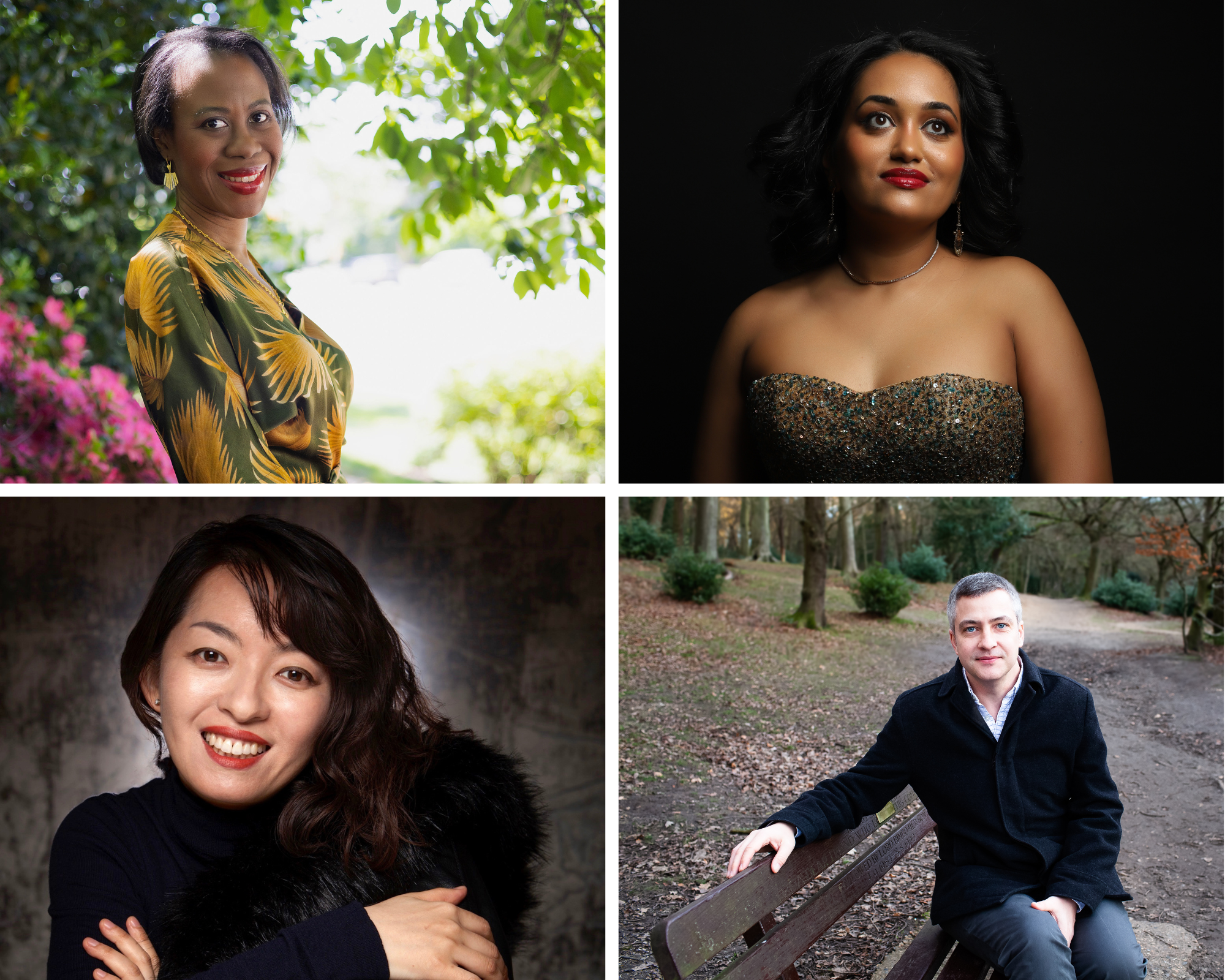
Joanna Forbes L’Estrange, composer

A Season to Sing is being performed around the world by the choirs who took part in the commissioning project (find details of all performances here). The score will be published by the Royal School of Church Music on 1st June (pre-order here).


Sunday afternoon and another concert at a lovely venue, this time the 1901 Arts Club, London’s most stylish and convivial small venue. This was a special concert to celebrate the 340th birthday of J S Bach and to launch American pianist Eleonor Bindman’s new album ABSOLUTE – her own transcriptions for piano of Bach’s Lute Suites BWV 996-998.

A lifelong love of J S Bach has led Eleonor Bindman to produce a number of important transcriptions for solo piano and piano duo of his music for other instruments, including the evergreen Cello Suites and the Brandenberg Concertos. In this latest addition to her catalogue, Eleonor has turned her attention to works originally composed for the lautenwerk or lautenwerck (lute-harpsichord), one of Bach’s favourite instruments, similar to the harpsichord, but with gut (or nylon today) rather than metal strings.

The small size of the music salon at the 1901 Arts Club lends itself to “haus konzert” style performances (such as Bach might have known) and the ambiance at this concert was warm and friendly.

Like Joanna’s reimagining of The Four Seasons, Eleonor sees transcriptions as a vehicle to “revive interest in original compositions”, shine a new light on the original work and “increase their popularity”. And just as in A Season to Sing, new details of dynamics, texture, counterpoint and more are revealed in this transcription for solo piano.

But for me the most satisfying aspect of Eleonor’s concert was her ability to bring so much colour and nuance to the music. Her range of sound was impressive, but never too much nor too little. Perfectly balanced to suit the small size of the venue, she brought both intimacy and grandeur (we can thank Bach for that!) to the music. I don’t think I have ever heard the Steinway at the 1901 played better!

The following day I met Eleonor for a most enjoyable, leisurely lunch, replete with much ‘piano chat’ and conversations about food.

ABSOLUTE is out now on the Orchid Classics label and on all major streaming platforms.

‘The World of Yesterday’ – written & performed by Sir Stephen Hough with the Bournemouth Syphony Orchestra, conducted by Mark Wigglesworth. Wednesday 26th February, Lighthouse, Poole

British pianist Sir Stephen Hough hadn’t intended to write a piano concerto. But during the dark days of the COVID pandemic, he was approached to write a score for a film about a concert pianist writing a piano concerto… With little to do but take Zoom calls, “it seemed like a wonderful way to keep me busy”, and, intrigued by the film’s plot, he began jotting down ideas.

As the world emerged from the pandemic, the film project stalled and Stephen’s concert diary began to fill up again, but he still had the sketches for the film score and, with the support of four orchestras (the Utah, Singapore and Adelaide symphonies, and the Hallé) he wrote his piano concerto ‘The World of Yesterday’. It received its world premiere with the Utah Symphony Orchestra in January 2024 and a recording made with the Hallé and Sir Mark Elder is available on the Hyperion label.

I had the pleasure of hearing Hough perform his concerto with the Bournemouth Symphony Orchestra in a well-conceived programme called Notes of Nostalgia. Given its theme, the concerto sat perfectly between Brahms’ Third Symphony and Elgar’s Enigma Variations – all three works infused with a certain wistfulness interposed with personal reflection, warmth and wit.

Hough’s concerto takes its inspiration, in part, from Austrian author Stefan Zweig’s atmospheric memoir of the same name, which depicts Vienna and Viennese culture in the last golden days of the Habsburg Empire before Europe was torn apart by war. You can almost smell the aroma of Viennese coffee and taste the Sacher-Torte in the quieter passages of the piece.

The music is rich in nostalgia, but without the heart-tugging poignancy of Chopin, for instance: it’s a more reflective yet positive reminiscence of another time. Scored in a single movement but with distinct sections, ‘The World of Yesterday’ has a filmic quality (“something from the 1940s”, my husband commented as we left the concert hall) – you certainly hear nods to Korngold’s film scores, and it shares Korngold’s romantic sweep, but there are also references to Rachmaninov (particularly in the very glittery virtuosic solo sections), Copland, the Warsaw Concerto…but at no point do these references feel like pastiche. And if you’re familiar with Hough’s wonderful transcriptions of Rodgers and Hammerstein, you’ll find similar idioms here (I half-expected Hough to segue into the Carousel Waltz at one point). And yes, there is a waltz too – not so much a Viennese waltz but something more sultry, redolent of Bill Evans and a smoky, late-night jazz club.

Hearing the composer play his own work was like a bridge across time to another world of yesterday, a time when composers wrote piano concertos which they performed themselves: Mozart, Beethoven, Mendelssohn, Chopin, Liszt, Rachmaninov and Prokofiev all performed their own concertos. Showcasing their prowess and personality as both performer and composer, these works becoming their “calling cards” as they toured to give concerts.

The music has an almost “vintage” quality: surprisingly traditional in its direct communication with orchestra and audience, and its idioms, motifs and references to other composers (there’s not a hint of that “squeaky gate” atonality one often associates with contemporary classical music). The piano enjoys Brahmsian interactions with the orchestra and Rachmaninov-esque cadenzas, but Hough’s does break with tradition in a few significant ways. First, the concerto has a narrative title, rather than just an opus number or key, which undoubtedly guides the audience, even without a programme note. Additionally, the cadenza, traditionally heard at the end of a movement, comes very early, after an orchestral ‘prelude’. Here the piano is solo, notes and motifs sparkling in the upper register (later mirrored by the piccolo).

Above all, The World of Yesterday is a richly textured, virtuosic and joyful celebration of past influences, rather than a poignant glance back to a better time. It’s full of warmth and wit, affection and humour: it made me smile, it thoroughly uplifted.

After all, isn’t that what music should do?

The World of Yesterday’ is released on 28 February on the Hyperion label

Guest post by Karine Hetherington


With, ‘Variations’, pianist Joanna Kacperek has chosen to focus on the humble variation. Like many other composers before them and since, Beethoven, Robert and Clara Schumann, Brahms and Chopin, composed many variations. On this album, Kacperek artfully displays the creative possibilities of these variations, which were a way of exploring a theme for these composers, often not their own, and taking it to the next sublime level.

Variations have also been the means by which one composer honoured another. Thus, we hear Robert Schumann’s little-known variations, based on a theme by Beethoven, in this case, Beethoven’s Symphony no.7 and more precisely the Allegretto movement. To hear Beethoven’s solemn theme being repeatedly played and tweaked and then transformed by Schumann, is a thrill and gives the much-loved Beethoven melody a new mesmeric quality.

Clara Schumann’s variations meanwhile, celebrate the rich relationship (musical and emotional) she enjoyed with her husband, Robert. These intimate variations reveal every facet of their emotional life; joy, pain, yearning, eventually unfolding into a marvellous resolution where gratitude seems the overriding emotion.

Impressed by Kacperek’s debut album, Karine Hetherington from ArtMuseLondon went to interview this breakthrough artist.

Had you always planned to have a musical career and become a professional pianist?

Actually, yes! I started my private piano lessons at the age of 6. From the age of 7 onwards, I was educated in state music schools in Poland that are quite strict and take your musical development very seriously. 

Of course all this wouldn’t’have happened without the support of my parents. 

What led you to the idea of doing an album of musical variations? What does it bring to the listener?

I really love the idea of taking something really simple, like a 16-bar theme, and developing it in any way possible; I find it really exciting from both a pianistic and musical point of view. In a way, it feels like pushing the boundaries – how far can we go? How creative and expressive can we be, starting with such simple musical material? 

The album started with my obsession with Clara Schumann’s Variations Op. 20 which she composed on her husband’s theme – I just knew this piece was special. The other thing that influenced this programming was my discovery of Robert Schumann’s Studies on a Theme by Beethoven – a composition that survived (thanks to Clara) and was not published during Robert’s life. It is such a tremendous set that deserves more spotlight! Then, I started adding other sets of variations that complemented the ones by the Schumanns – hence Beethoven Op. 34 (which links to Schumann-Beethoven Studies), and Brahms Op. 18b (the birthday present from Brahms to Clara Schumann). 

Because all of the works I have mentioned had a personal story behind them, I decided to add Dutilleux’s Choral and Variations from his Sonata Op. 1 – the piece dedicated to, and premiered by his wife, concert pianist Genevieve Joy. Then – Cecile Chaminade’s Thème varié Op. 89  – a little gem, so rarely performed and recorded (my recording is only the 4th in the world!) showcasing yet another brilliant pianist-composer; finally Chopin – which is not only a nod towards my Polish roots, but at the same time it links to Dutilleux and Chaminade through their Paris residency. 

Where are you performing next? What musical projects do you have in the pipeline?

2025 looks exciting. I have performances planned in France, Germany, the Netherlands, Poland, Ireland and of course in the UK. January will start with two performances in West London of Beethoven’s 3rd Piano Concerto with an incredible arrangement for a string quintet.

How do you relax?

Playing the piano can be a lonely profession, so to relax, I love being around people.I enjoy the gym and group fitness classes that involve cardio, boxing or dance. Apart from that – quiet evenings with my cat on my lap is also one of my favorite things. 

Joanna Kacperek’s album Variations is available on the Rubicon label and via streaming

joannakacperek.com


This article first appeared on The Cross-Eyed Pianist’s sister site ArtMuseLondon.com

(Artist photo by Paul Marc Mitchell)

Guest post by Dakota Gale, the latest article in his series aimed at adult amateur pianists


Soon after I started piano lessons in 2021, my teacher showed me a clip from a Beethoven Sonata to demonstrate a technique. “Is this piece hard?” I asked? “It’s a Beethoven sonata!” he replied. 

The meaning was clear: they’re ALL hard.

Since then, I’ve listened to the entire series of 32 sonatas, which are a trip through Beethoven’s entire career. They’re simply fantastic.

In his autobiography, masterful pianist Andras Schiff says that he didn’t feel mature enough to learn them until he was well into his professional career. I’ve heard the sonatas called the Bible of music—The New Testament, as compared to Bach’s Well-Tempered Clavier as The Old Testament. 

So it was with some trepidation, plenty of respect, and low expectations that I decided to step into the ring with Opus 14, No. 1 in E major, his 9th sonata. Sure, it’s a Grade 6 Henle, which I’ve played many times… but a) I haven’t played much classical era music b) it’s 13 pages of music c) it’s fast d) IT’S A BEETHOVEN SONATA.

In short, my expectation stepping into the ring: fast and furious blows to the body from this serious dude:

A quick doodle of Beethoven that I did.

Also, Opus 14 wasn’t my favorite sonata, but I liked it…and the others were technically out of reach at the moment. (Some, forever.) I prooobably should have started with Scarlatti or Haydyn, but just couldn’t motivate myself to learn a piece I wasn’t excited about.

Anyway, I just spent a month doing a first pass on all three movements and here’s my experience. May it help your attempts to learn this piece or others.

My approach to learning Beethoven’s Opus 14. No 1

Fear not, dear reader! I’m not so over-confident as to tackle a big task like a Beethoven sonata without a clear approach. I tried that with other pieces and wound up playing insecurely or poorly.

This time around, my approach was:

  1. Starting with the first movement, I did a basic analysis of structure and harmony, finding the main and secondary themes, development, and recapitulation.
  2. I identified the fast sections that I suspected would take the most time and discussed with my teacher to confirm. For me, those were bars 4-6 and 39-45, 50-56 and the fast arpeggios starting on bar 65 in the first movement. The second movement isn’t so bad, but the third movement is fast and the opening and fast runs halfway through the piece needed some solid hands separate practice.
  3. Using the techniques on memorization from The Fundamentals of Piano Practice, I memorized the entire sonata. It was the first time I’d taken such a dedicated approach and it worked wonders. I won’t go too deep with detail here, but I can’t recommend it enough! 

In short:

  1. I’d play through one bar of music with one hand, keeping the sections short enough that I could bring it up to speed quickly. Then I’d close my eyes and play through it in my head without touching the keyboard.
  2. Reinforce a time or two, perhaps singing the melody or harmony, then switch to the other hand. Repeat… move on to the next bar. Learn a few lines per day, reinforcing them the next day and moving on to other sections.
  3. Using this technique, I could play through the seven-page first movement hands together in my head the first week and the remaining six pages the second week. It felt like magic! (That book is so good.)
  1. At the same time, I practiced the fast sections I mentioned every day. Once I decided on fingerings, I kept the speed fast from the start. If I couldn’t play it at full speed with one hand, I decreased the length of the section. (ala Kenny Werner’s great book, Effortless Mastery.)

  2. After three weeks, with hands separate I could play the entire sonata (movement 1-3) at tempo, so I started putting hands together. The usual brain breaking occurred and I had to slow down to 50-75% tempo, but I trusted the process.
  3. Another two weeks and movements 1 & 2 were close to tempo, with some notable spots where building speed will take time (those fast LH arpeggios in bars 65-75 with octaves in the RH feel like careening madly along without brakes!). Movement 3 is fast and playing at tempo will take another round of revision.
  4. My progress had slowed, not to mention my drive, another indication it was time to set the piece aside for a few weeks and let it rest. Onward! (For me, that meant polishing Chopin’s Opus 9. No 1 for a masterclass.)

At this point, I felt elated that I could do ANYthing with this sonata that had seemed like hopping in the ring against Mike Tyson. I’d survived!  Was it to performance standards? Absolutely not! Did I expect that? Nooope.

Also, was I sick of the sonata? Ohhh yeah, it was time for a break and some lighter fare. I gobbled up a Yann Tiersen piece from his wonderful album EUSA and waded into Chopin’s Raindrop Prelude so I could entertain annoy my wife with the booming middle section. 

Overall, I’m both pleased and surprised how well the piece went. Even better, I grew to enjoy the piece’s nuances and wound up liking it much more than when I started learning it. I also picked up new skills, including:

  1. Better memorizing techniques.
  2. Smoother fast LH arpeggios and Alberti bass technique.
  3. Better staccato playing.
  4. Better multiple voice playing via the fugue-y section. 
  5. Better grasp of how new themes vary, develop and morph.

I definitely expected a much longer process. Luckily, I’m an amateur pianist and don’t need to nail down a piece to perform at a set time. I play for myself and for friends/family. 

As with any difficult piece, my primary goal for round 1 was simply to get the piece into my fingers and brain. The artistry and expression happen during later revision. In fact, as annoying as it is, I’ve found it’s often at least a year before I feel confident performing a piece live! Perhaps you’ve experienced this as well? 

Regardless, I survived my first round with a full Beethoven sonata and hope to play many more of his pieces in the future. Opus 26 beckons with its siren song of variations!


When he isn’t playing piano, Dakota Gale enjoys learning languages (especially Italian) and drawing. He also writes about reclaiming creativity as an adult and ditching tired personal paradigms in his newsletter, Traipsing About. He can often be spotted camping and exploring mountain bike trails around the Pacific Northwest.