Another term is over and as my students depart for their summer holidays, I have time to pause and reflect as my piano teaching studio approaches its 10th birthday.

I never intended to be a piano teacher. I worked for ten years in art and academic publishing after leaving university and I continued to freelance in this sector, with occasional stints for a PR company, when I stopped full-time work to have my son. But as my son started to grow up and become more independent, I began to consider a change of direction but it had to be one which could accommodate the school day and looking after my son during the school holidays. One day, during the chat that takes places between mums in the school playground while they wait to collect their children, a friend asked me if I might teach her daughter to play the piano. “But I’m not a piano teacher!” I said. The friend suggested that I try piano lessons with her daughter “as an experiment, to see if you you both like it. Rosie can be your trial student“.

And so in September 2006 I started teaching Rosie, and quickly acquired more students whose parents had heard about me via Rosie’s mum. I have never been taught how to teach and had no clear “method” at the time, only that I was determined to make piano lessons interesting and fun for the children, the absolute antithesis of my own childhood lessons, which had seemed dull and interminable and driven by an exam treadmill. I was pretty sure I could articulate all this in a way that would appeal to children.

My teaching studio grew rapidly and by the end of the first year I had nearly 20 students, most of whom had come to me via my son’s primary school. People would come up to me in the playground and say “you’re the piano teacher, aren’t you?“. And indeed by about 18 months into the job, I felt qualified to call myself “the piano teacher”.
I found the first couple of years quite tough. My son was less than happy about other people’s children coming to the house and taking up my time, but I felt it was important for him, as an only child and a boy, to see his mother working and to understand that working from home is still working.

At that time, when I was a fledgling piano teacher, I took anyone. I didn’t interview prospective students or their parents, because I knew most of them via the primary school anyway. But after a couple of instances where I and the child or parent simply did not get on, I grew more discerning and careful about whom I took on. And after a parent persistently messed me around over dates and times of lessons, cancelling them at short notice and demanding that I reschedule, I introduced a formal contract which put everyone on an equal footing and enabled me to run the studio in a more formal/businesslike way.

And that perhaps was the first most important lesson I learnt about running my own teaching studio – that one needs to formalise arrangements to ensure people treat you with respect. This is not a “hobby job” but a professional role which I take very seriously.

A few years ago, by which time my studio had grown to 25 students and I had two performance diplomas successfully under my belt, I decided to make some significant changes to the way I organised my teaching: I “let go” the students who were simply coasting, not practising and not really taking their piano lessons particularly seriously; I rebranded myself as a serious teacher of classical music (no more Adele songs!) who carefully selects students via an interview and trial lesson; and I put my fees up. Within weeks of making these changes, I had more enquiries than ever and I began to enjoy real job satisfaction too.

Second lesson: as a freelancer, don’t be afraid of making changes to your working life to suit you and which gives you job satisfaction. A happy teacher is more likely to be a successful teacher.

In terms of the actual teaching, I based much of it on my own very positive experiences with my music teacher at secondary school, rather than on my childhood and teenage private piano lessons. My music teacher was endlessly inventive and enthusiastic and it was his enthusiasm that, more than anything else, I tried to incorporate into my own teaching. I felt – rightly – that children and young people, adults too, would be enthused and excited by music if I was enthused by it, and I made sure everyone learnt and played music which they enjoyed, rather than which might be “good for them”. When, in 2008, I started having lessons myself again after a break of nearly 25 years, I was able to distill what I was learning into easily understandable nuggets for my students (something my piano teacher actively encouraged), and I quickly saw the benefit of my own lessons in my students’ playing as well as my own. In addition, I started attending courses and workshops to enhance my professional development, and began to connect with more piano teachers too.

Third lesson: good teachers never stop learning themselves

Now, as my studio approaches its tenth anniversary, my teaching style and approach has settled into one which is relaxed and flexible. There is no “one size fits all” in teaching because all children – and adults too – are individuals and deserve to be treated as such. I know each student’s strengths and weaknesses, what music they particularly enjoy, and how much or little they like to be pushed by teacher. Some want to take exams, others are content to learn music which they simply enjoying playing. I’ve always been a natural communicator and it’s not in my nature to be overly didactic: I want to empower students by giving them the tools, and confidence, which encourages self-discovery and independent learning. I have a couple of very musical and talented students, and supporting them with issues such as perfectionism, performance anxiety and the psychology of performance present their own interesting challenges and force me to think outside the box as their teacher and confront my own issues in these areas. All my students are hardworking and enthusiastic, who are taking lessons because they want to, not because a parent has insisted on it.

In addition to my regular private teaching, I’ve been fortunate to work with a number of adult pianists, both individually and in group workshops and masterclasses which include aspects such as building confidence, coping with performance anxiety and preparing for performance diplomas.

I no longer teach young children or beginners. My students are aged between 11 and nearly 17 and are all early intermediate (Grade 3) to advanced level (Grade 8) players. They are bright and engaged, unafraid to question or challenge me or work things out on their own, which is great because I never want to be the teacher who simply “tells”. For me, teaching is an exchange of ideas, a process of showing, demonstrating, explaining, confirming, questioning….. An inquisitive student is likely to learn more, and more quickly. I encourage my students to find their own individual voice in their music making and to use their developing musical knowledge to help them make judgements about aspects such as interpretation and presentation.I don’t use a set “method” or particular range of tutor books. My teaching is instinctive, responding to each student’s needs and wishes rather than imposing my own opinion and way of doing things on them, and I encourage excellence rather than perfection. My own regular studies with two master teachers, in addition to encounters with other renowned teachers and pianists via courses and masterclasses, has undoubtedly informed my teaching, and will continue to do so.

avatars-000208691703-0he3lq-t500x500Teaching has taught me far more than I ever would have imagined about being a musician as I constantly refocus and re-examine what I do and how I approach my own music making. And I think my students are intrigued by the fact that their teacher continues to study and have lessons herself. Perhaps the most significant thing I have learnt over the past ten years is that learning is a continuous, ever-changing process. It is satisfying, occasionally frustrating, and deeply fulfilling to watch students develop, find their musical voice and tastes and, above all, to gain pleasure and enjoyment from their music making.

For further information about my teaching studio please visit www.franceswilson.co.uk

Further reading
The Performing Teacher

2720374What is your first memory of the piano?
I had a plastic red toy with keys on it that looked like the keys on a piano.  I enjoyed playing on this and so my parents asked me if I would like to learn to play the piano and once I started having lessons and had my own piano I really enjoyed it.

Who or what inspired you to start teaching?

It was almost by chance. When I studied at Birmingham Conservatoire my landlady was also a pianist and piano teacher.  She had a request from a prospective student and luckily she forwarded it to me and I found that I liked teaching very much.

Who were your most memorable/significant teachers?

They were all memorable and significant.  I am so grateful to them for all they taught me and for all the inspiration they gave.  In my native country Sweden Irmeline and Irma Ericsson helped me develop sight-reading skills by giving me three new pieces to learn every week (compare with three new pieces per year in the exam syllabi!).  Christina Lindwall inspired me to go into music professionally with her great musical ideas.  At the beginning of my professional studies at a music college in Sweden Anders Peterson was a wonderful teacher with very careful musical work who organised numerous concerts and study trips in Sweden and abroad for me and my fellow students, giving me a first taste of performing and inspiring me to do more.  Hans Leygraf demonstrated incomparably methodical practice techniques during a Masterclass in Darmstadt.  Gordon Fergus-Thomson provided advice on very detailed score reading.  Peter Feuchtwanger taught me a natural approach to piano playing, which I instantly admired and which has influenced my thinking of the physical aspects of performing.  He has also inspired me greatly musically and helped me always to remember the cantabile qualities of the piano playing.

Who or what are the most important influences on your teaching?

Experiencing arts in its different forms; visiting museums, art galleries, the ballet (I also work with ballet as one of my employments as a pianist at Elmhurst School for Dance) attending concerts and going to the opera are all examples of pursuits which influence both my teaching and performing, as are travelling and meeting interesting people.  It is a privilege to be able to draw on a vast number of experiences and to pass that on to students and audiences.

What do you expect from your students?

To love music.

What are your views on piano exams, festivals and competitions?

They are good sometimes as goals to work towards.  More beneficial still are masterclasses and concerts which is why I organise these regularly for my students.  Last summer I took my students to Sweden where I gave a masterclass and they then performed in a Grieg concert.

What do you consider to be the most important concepts to impart to beginning students, and to advanced students?

This pursuit of beauty that piano studies constitute, which encompasses intensely intellectual, spiritual and emotional aspects.  This applies to both categories of students.

What are your thoughts on the link between performance and teaching?

It is a wonderful advantage to be able to draw on past and present experiences of performing when teaching performance-related issues such as stage presence, stage conduct, memorising and stage fright.  Also all musical aspects of the piano teaching will be enhanced from having a performance background since every piece of music improves enormously during a public performance.  And it is also worth keeping in mind (my students point this out to me regularly) that every piano lesson is a miniature performance with all that it entails.

Tell us why you decided to develop a series of piano exercises and how do you feel these will benefit pianists?

I wanted to pass on my ideas on the physical approach to piano playing.  Following my studies with Peter Feuchtwanger, I teach my students various exercises where the focus is on the ‘how’ rather than the ‘what’.  So the movements, relaxation of certain muscles and tension of others are all important, while the notes in this case are almost incidental. I therefore  encourage the students not to be overly concerned with accuracy but instead to learn a new movement and degree of relaxation that can then be incorporated into the repertoire.  There is a great advantage to having this one aspect in isolation since when performing a piano work there are so many musical elements to consider.  Technique and teaching of movements at the keyboard is often neglected until the teaching becomes quite involved, by which stage bad habits have often set in and are hard to correct.  The DVD may be used to learn the exercises from scratch in which case it is paramount to try copying the movements demonstrated as closely as possible.  In the case of my own students the DVD is used as a reminder of the exercises and to support the information I give in the lessons.  Closely related to these exercises are fingerings which are chosen to encourage a particular movement when working on repertoire.  The traditional ‘five finger position’ is not present; in fact there is rarely a position but always a movement which gives much more suppleness and freedom at the keyboard.

Mikael Pettersson’s DVD of piano exercises is available to order from his website or as a download

Swedish concert pianist Mikael Pettersson obtained a B Mus (Hons) degree at Birmingham Conservatoire in the year 2000.  He has also attended  Masterclasses with Prof. Hans Leygraf and has studied with Prof. Peter Feuchtwanger.

Mikael Pettersson has taught piano for several years, mainly for the higher grades and at Diploma level and has competition prize-winners amongst his students.  He is also Head of Keyboard Studies for Undergraduate and Postgraduate students completing a Music Degree at the University of Wolverhampton.  He regularly organizes Masterclasses and concerts for pianists.

He received a Diploma in the summer 2007 for his attendance at a Masterclass at Universität Mozarteum, Salzburg, Austria where he also performed in concert.  In December 2010 Mikael Pettersson performed in Florida, USA, with mezzo soprano Virginia Alonso, who has appeared in performances together with Placido Domingo.   Recently Mikael Pettersson released his second CD featuring Mendelssohn’s Lieder ohne Worte.  

In 2012 Mikael Pettersson was a semi-finalist in the International Adilia Alieva Piano Competition which took place near Geneva.

www.mikaelpettersson.net


I never thought I’d write an article on “note bashing”. In general it’s not something I advocate – mindless repetitive practise, thoughtlessly hammering away at the same phrase or group of notes. However, during my work on one of Schubert’s late piano sonatas I discovered that note bashing really does have a purpose in practising.

Every piece we learn will have its tricky or hard-to-master sections – that finger-twisting little passage, that scalic run which never feels comfortable under the hand, those hand-filling chords which are just a little bit too hard to reach accurately. For me it was arpeggios, a weakness in my technique which was making it more difficult for me to play the (many) arpeggios in the Schubert sonata precisely and fluently. My teacher worked with me on both good fingering schemes and some useful wrist rotation technique but what I knew I needed to do was to be able to play the passages automatically without the need to think about what was going on in the fingers and hands.

Musicians endlessly talk about training the “muscle memory”. Of course our muscles don’t really have memory, and the correct term for this is in fact “procedural memory”. This is part of our long-term memory that is responsible for knowing how to do things (also known as “motor skills”). Procedural memory retains information on how to perform certain procedures, such as walking, talking and riding a bike – and playing the piano. Procedural memory is created through “procedural learning” – repeating a complex activity over and over again until all of the relevant neural systems work together to automatically produce the activity. This is why as musicians we should be engaging in a hefty amount of repetitive practise, for it is these repetitions which fix the music in head and hands. Forget “practise makes perfect” – the real reasons why we do repetitive practise is because practise makes PERMANENT.

I was away from my own piano at the time when the arpeggios in the Schubert needed the most work, but as luck would have it, I had access to a digital piano which belonged to my husband’s niece. No matter that the keys were covered in a rather unpleasant sticky residue due to repeated use by small children: for three days I worked solely on arpeggios, focusing only on learning the correct sequence of notes and fingering. I did not consider the tone or quality of sound, or any of the more esoteric/artistic aspects of playing these sections; I simply concentrated on repeating the passages over and over and over again…… Back home to my piano and the exercise continued for a further week, by which time my husband, who also works from home, was beginning to develop a deep aversion to those particular sections of the Schubert sonata. “When are you going to practise something else?” he asked me. “When I’ve learnt this bit” I replied.

The “note-bashing” exercise served its purpose: at the end of 10 days the sections were well-learnt and my attitude to them virtually intuitive. I no longer approached them with a feeling of unease, concerned that I was going to fumble the arpeggios, and I have subsequently used this approach to memorise and/or make secure other sections of the Sonata – and indeed other pieces of music. With such security comes confidence and the ability to play without physical tension or anxiety.

Of course my practising wasn’t really note-bashing because all the time I was playing I was taking notice of what I was doing to ensure that notes and fingering were correct, that I was employing the right amount of rotation to move smoothly up and down the arpeggios, that the tempo and pulse were accurate and so forth.

There are stories of pianists doing repetitive exercises or 100 repetitions of the same passage while reading a newspaper or reading aloud from a book. In these cases, one is training the procedural memory while testing one’s ability to divide one’s attention between several different tasks. I do this exercise with students, getting them to repeat a section and once the repetitions begin to feel comfortable and well-known, I might ask them what they are having for dinner or what they are doing at the weekend. Given the amount of multi-tasking that is required in piano playing, this can be a very useful exercise.

If you are simply note-bashing for the sake of it, it is perhaps time to stand back a little from your playing, consider the sound you are making and return to your practising with thought and care.


(photo by James Eppy)


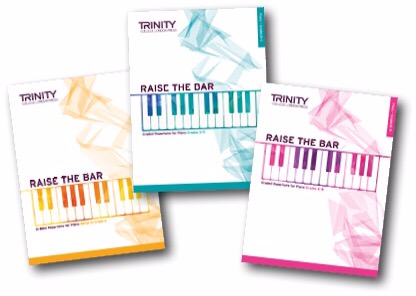
It’s good to see Trinity College London extending its publishing programme to include more books for pianists, including collections of pieces from beginner to advanced level, and a compilation of piano exercises, selected from past exam syllabuses, all of which offer excellent resources for teachers and students alike.

Raise the Bar is a new series of graded pieces from Initial to Grade 8 showcasing favourite repertoire from past Trinity exam syllabuses. Edited by acclaimed teacher, pianist and writer Graham Fitch, each book contains an attractive selection of pieces in a range of styles and periods. Teaching notes for each piece are included, highlighting aspects such as technical challenges, structure, rhythm and expression, and each book contains a summary at the back containing the composer, title, key, time signature, tempo markings and characteristics of each piece. There is a good range of music to suit all tastes and the teaching notes can be used as a springboard for further discussion between teacher and student or a basic starting point for independent study. These books provide useful additional repertoire for students preparing for exams or simply for playing for pleasure and broadening one’s repertoire and knowledge of different style of music.


Piano Dreams is an attractively-designed series of books containing pieces for beginner and early intermediate pianists composed by Anne Terzibaschitsch. The pieces will particularly appeal to younger children with their imaginative titles and fun illustrations. Programmatic text weaves elements of story-telling into the pieces to stimulate the player’s imagination and encourage more expressive and colourful playing. There are notes on each piece highlighting aspects of technique or expression. In addition to the solo pieces, there are two books of piano duets in the same format.

I am a big fan of Trinity’s Piano Exercises which students learn as part of their grade exams. The exercises are designed to develop particular aspects of piano technique and many directly relate to pieces in the exam syllabus, offering the teacher the opportunity to introduce students to the concept of the ‘Etude’ or Study.  This new compilation of selected exercises ranges from Initial to Grade 8 and each has a descriptive title to inspire students to interpret the music imaginatively (thus reinforcing the idea behind Etudes by Chopin and Liszt – that pieces should be both challenging and musical, testing technique and musicality). These exercises provide a useful resource for developing secure technique and can be used alongside repertoire to inform and extend students’ technical and musical capabilities.

More information about Trinity College London music publications here


