What is your first memory of the piano?

Growing up in Malaysia, my first memory of the piano was not a particularly happy one. When I was about 7 my parents decided that I should begin formal music lessons. Unfortunately I had a teacher who was neither sympathetic nor encouraging. I remembered being constantly shouted at and whacked for playing wrong notes (perhaps there was a clash of personality between the two of us…) and I will never forget writing 5 pages of treble and bass clefs (both front and back) as well 6 pages of middle C! (and to think that my students complain when I ask them to write 2 lines!). Needless to say I gave up the piano very quickly. Even though I don’t want to admit this (as I pride myself on being a purist), it was a few years later when I heard a recording of ‘Ballade for Adeline’ played by Richard Clayderman (who was practically the greatest pianist in the world according to all Malaysians at the time) that inspired me to play the piano again. Shortly after my encounter with Monsieur Clayderman, my parents introduced me to the ‘Yellow River’ Piano Concerto, the one piece of music my mother listened to and loved while she was 6 months pregnant with me (perhaps you can say that my musical education started way before I was 7). My family then emigrated to England in 1988. There I met the teachers who started me on the journey to where I am today.

Who or what inspired you to start teaching?

To be honest, I never saw myself as a teacher; all my life I wanted to be on the stage, to be a pianist, a performer. I think this had much to do with the glamour of the concert platform and never having the opportunity to work with brilliant teachers. I am from a culture (and period in time) where it was normal for a teacher to humiliate and belittle a student and it was not until I lived in England that I came in contact with fantastic teachers who changed my opinion about teaching. The real advice to start teaching came from the mother of a good friend, Ricki Lombard (Ricki’s son Benn is a brilliant pianist who studied with Martino Tirimo in London). Ricki heard me ‘play through’ a recording programme and told me afterwards that perhaps I should also look into teaching as (in her humble opinion) I have a ‘knack’ with children. (I had not written progamme notes for the performance but instead introduced each piece before playing) Ricki was convinced that I am able to introduce Classical music to the ‘little ones’ (in her own words) while at the same time make learning fun and enjoyable. With hindsight I must say that the best part about Ricki’s advice was that I listened and looked into it!

Who were your most memorable/significant teachers?

I do not believe that there is such a thing as one teacher for everyone. Every teacher has something to contribute and therefore it is difficult to say who my most significant (or memorable) teacher was. All of them played an important part at a certain point of my musical and pianistic development. My first teacher in England, Richard Frostick (currently the Artistic Director of British Council’s World Voice) set a high standard of technical attainment and instilled in me the discipline of musicianship. When I joined London’s CYM (Centre for Young Musicians), I was extremely fortunate to study with Graham Fitch, who is (sweeping statement perhaps) a genius of a teacher. The attention to detail in Graham’s teaching is really something to behold – especially when it comes to producing endless layers of musical colours within the most complex of musical structures. Graham was also obsessed (I meant this in the most complimentary sense) with the musical line and his for respect for the musical text was a real eye-opener. My teacher at Surrey University, Clive Williamson (a wonderful exponent of the 20th century repertoire) taught me the discipline of rhythm and what it means to play what is written as oppose to what I think is written. I will never forget Clive saying to me ‘Michael, you have the easiest yet hardest job as a musician, all you have to do is to play what Beethoven has written.’ My teacher after Clive, Nils Franke, showed me that music (and playing the piano) is not something that is entirely detached from life itself, whereas Niel Immelman taught me what it is like to work more independently. I consider my Doctorate supervisor – Hendrik Hofmeyr – a musical genius in every sense of the word. I learnt from Hendrik the ability to go for the ‘guts’ of the composition as well as the ability to read the musical score (in the more profound sense of the word). In other words, don’t just play a crescendo when you see a crescendo, what comes before the crescendo? What comes after it? What musical effect that the composer is trying achieve by writing such a marking? I have very fond memories of my times at CYM, especially of the teachers who took the monthly piano studio classes – John Biggs, Catherine Riley, Petra Casen, Peter Croser and Julie Taylor. I also considered it a privilege to have played for eminent musicians and teachers such as Nina Svetlanova, Frank Heneghan, James Gibb, Phillip Fowke, Renna Kellaway, Florian Uhlig, Gordon Fergus Thompson, Francois du Toit and Helena van Heerden. The prominent American Rabbi Harold Kushner noted in one of his books that everyone carries within themselves one or more piece of the jigsaw which will go towards helping others. None of my teachers could have made the impression that they had without the work of their predecessors.

Who or what are the most important influences on your teaching?

All my teachers played an important influence when it comes to my own teaching. I think it is worth mentioning that as well as being great teachers they are also wonderful human beings. This meant that all of them were able to communicate and get their ideas across very successfully. I remember Richard Frostick told me to be ‘an artist’ instead of a pianist, a view echoed by Clive Williamson (when we were working on Tchaikovsky 1): “‘For goodness’ sake, Michael, you have proved that you can play all the notes, now be a musician!” Both Richard and Clive’s statements made little impression at the time until I came across an interview given by the eminent Chinese pianist Fou Ts’ong – “In life, one must first be a man, then an artist, then a musician, and finally a pianist.” Fou Ts’ong was right, of course. Art and music have always been a reflection of life, whereas life has never been about just playing the piano! If one has not had certain life experiences, how are you supposed to translate them into playing and performing, or teaching, for that matter? I recall saying to one very talented and musical student, ‘I am happy that you enjoy practising, but please do yourself a favour and go and have some fun! Go and do something an eight-year-old is supposed to do! Funny though this may sound, I also learn as much from my students as they learn from me. Furthermore, one of my hobbies (since my student days) is comparing interpretations by various artists, finding out which performance ‘works’ for me. I also enjoy interacting with my colleagues, often swapping ideas on the methodology of teaching and how to achieve ‘breakthroughs’ with certain students. I do not take it for granted that I work with so many terrific musicians and I am learning all the time.

Perverse though this may sound, it is occasionally enlightening to come across bad musicians and teachers (some of the posts on YouTube are quite extraordinary, to say the least!). Looking at these can be aesthetically reassuring as they show me what not to do, both as a musician and an educator.

Most memorable/significant teaching experiences?

It is difficult to say which is the most significant or memorable teaching experiences because there are so many of them! I am very fond of the interaction with my students at Western Province Preparatory School and Herschel High School as all of them are so different – and to see their progress is extremely rewarding. I particularly enjoy the sense of honesty and directness when it comes to working with children (they often tell you what they think and you know exactly where you stand with them) – maybe this is because I am still a child at heart! (My sister once remarked that although my real age may be 35, my mental age is 15.) It warms my heart that quite a few of my former students still keep in touch, and it is always wonderful to see what they are doing with their life. What makes me really proud is that many of them still love their music and have kept up their piano playing even though they have not chosen music as a career. I was also in Singapore recently working with students from Kawai Music School Elite, which was an incredible opportunity. It was particularly interesting to see the differences between the East and West in terms of musical mind-set and culture. Also amongst my memories was the very first time I entered students for ABRSM exams and all of them came back with Distinctions and Merits. There was also the occasion when a former student greeted me in a shopping mall; I will never forget his words after I embarrassed myself by not being able to recall his name: ‘Dr Low, I’ve only had four piano lessons with you, but I so enjoyed them and will never forget you.’

What are the most exciting/challenging aspects of teaching adults? 

I have often been asked by adult students if there is a ‘cut-off point’ when it comes to starting piano lessons, and I always tell them that one is never too old (or in the case of Benjamin Button, too young) to learn something new in life – my most elderly student is a seventy-year-old lady who absolutely adores her piano lessons. Perhaps the most challenging aspect about teaching adults is to ask to them to be patient (especially as most of them find it difficult to set aside a daily practising slot). I recall falling in love with the game of golf a few years ago and spending many hours on the driving range (with my golf coach) trying to learn the mechanics of the golf swing. At the same time it was particularly humbling to see junior golfers as young as ten who could swing the club so naturally! Learning to play the piano is exactly the same: if you have never played before, don’t expect everything to come at once; it sometimes takes a while to learn how to utilise the muscles in your hands. I will never forget Graham telling me in one of our first piano lessons that I am in charge of ‘ten circus monkeys and I am the ringmaster.’ Like most things in life, I truly believe that if one persists long enough, then things will happen, but – and this is the important part, especially for those who find it difficult to practise every day – practice does not make perfect, practice makes permanent. If (for whatever reasons) you don’t feel like practising, then rather don’t, as that will set you back in the long run. My colleague Marianne McLean has a good analogy for this: she likened unproductive practising to having a virus that gradually took over your computer.

What do you expect from your students?

One word: Commitment. I do not mind in the slightest what level the student is at or how talented the student is, as long as they approach piano playing with a sense of responsibility, then I am happy. I do not believe in enforcing a strict practising routine on students because I always believe that one practices because one wants to. You don’t play the piano for your parents or your teacher(s), you play for yourself. It took me a long time to grasp this, until one of my teacher told me ‘Michael, if you must play the piano for someone, then do it for Jesus, but even Jesus may have reservations…’) I truly believe that the happiest people in life are those who do things with commitment – whether it is going to church, being a parent, running a business, playing a golf shot, or doing a questionnaire J.

What are your views on exams, festivals and competitions?

In my opinion they can be very good if one approaches them with the right mind-set. Performing is such a fickle and (at times) highly stressful activity that is almost impossible be ‘on the money’ every time one appears on stage – Vladimir Horowitz once noted in an interview that the secret about performance is that you have to be feel great on the actual day itself! If you play in a competition and don’t get to the next round – it doesn’t necessarily mean that you are a bad musician or a bad pianist, it could just be that it is not your day. Similarly, if you enter a competition and win, it doesn’t automatically guarantee a performing career as there is a distinct difference between being able to play your competition programme stunningly and having a repertoire that is able to consolidate your prize-winning engagements. Furthermore, competitions can be full of subjectivity, for every Argerich, Berezovsky and Perahia, there must be at least fifty international prize winners who never consolidated their performing career. Niel Immelman always encourage his students to go listen to the next round of a competition whenever they get eliminated, in Niel’s words, ‘one of the two following things will happen; either the student will learn a lesson or they will disagree with the jury’. I am tempted to add that if the student is lucky enough – sometimes they will end up learning a lesson and disagreeing with the jury! Exams and festivals can be very useful as they give the student something to work towards. However, the candidates also need to approach them with the correct mind-set – a person that scores 128 for his/hers ABRSM exam is not an inferior musician to someone who scores 132. This is because like competition, the marks can be very subjective and different examiners look for different things. There have been occasions when I felt that the exam mark is by no way a reflection of the student’s effort and there have been occasions when I thought the examiners were perhaps a touch generous with their marks. I remember telling a few students a couple of years ago, ‘In my opinion your score of 30/30 is unacceptable, there is no such thing as perfection in my book when it comes to performance’. At the end of the day, if competitions and exams can be approached with a positive attitude, then I am all in favour of them.

What do you consider to be the most important concepts to impart to beginner students, and to advanced students?

For beginners there are a few things: I considered it important to teach any beginner student the importance of rhythm: to make them count out the beat explicitly – sometimes to the extent that I ask them to nod along with their counting (to quote Hans von Bulow, ‘In the beginning there was rhythm’. It is only when I am convinced that they have understood the rhythmic construction of the composition that I am open to discuss the concept of interpretation. I feel that this is particularly important, as there is a difference between playing what is written, as opposed to what you think is written. I have come across quite a number of students with the following mind-set when learning a piece of music, ‘Let me first get the notes and then I will get the rhythm’; to which I response, ‘Surely you never eat your sushi first and then have your soya sauce? Or the other way round for that fact, the two of them goes together!’ Equally important to impart to a beginner (or anyone else for that matter) is the love for music, along with all the discipline that comes with learning an instrument. This (in my humble opinion) has become even more important in an age of social media and instant gratification: why should you practise the piano for 25 years with the prospect of perhaps becoming a good musician, when you can be on Idols and be famous the next day? One doesn’t teach the piano in order to turn every student into the next Lang Lang (the world wouldn’t be big enough for starters) although it is always a privilege to work with talented students. Similarly, one doesn’t learn the piano in order to be the next pianistic superstar. One learns the piano (and other musical instrument) because along with acquiring the mechanics on how to play the piano, one also attains a set of life skills which will make you a better person. These include grit, persistence, integrity and honesty amongst many others. As for teaching more advance students – one merely play the role of a ‘facilitator’, not to impose one’s ideas on the student but instead to present the student with different opinions on interpretation. This could be finding a hidden melodic line within a complex musical composition, highlighting a bass line, or helping them to overcome a particular technical problem.

What are your thoughts on the link between performance and teaching?

For me, I felt that I became a better performer after I started teaching. Up until then my playing was plagued by the lack of internal rhythm (this has much to do with not being taught the importance of rhythm at a young age) and the situation reached its all-time low (no pun intended here) when a very famous professor told me to ‘sort out my rhythm or never play the piano again’. Perhaps you can say that this has something to do with ego and reputation, but when I started teaching I don’t want any of my students to go down the same route where I have been. Even more so, how hypocritical will it be if I am constantly preaching the importance of rhythm but neglect the same thing in my own playing? So I changed my mind-set and approached learning pieces differently, instead of worrying about the technical challenges I concentrate on getting the rhythmic structure before anything else. It was hard work and humbling at the beginning, but as things begin to fall into place, it is almost like curing my playing of cancer – the real eye-opener came when I revisited old repertoire and realised what I had originally conceived rhythmically wasn’t quite what the composer had in mind! The rhythmic discipline in my playing is now more important than ever having recently put together a chamber ensemble to perform and record the last eight Mozart Piano Concerti (amongst other repertoire). Looking back, what was said to me might be harsh but it was exactly the thing I needed to hear.

No disrespect to teachers who only teach, I strongly believe that only those who perform can bring a different dimension to their teaching when preparing the student for a performance and exam. Performance preparation and performance itself can only be taught by those who are constantly involved in performing. All of us are the world’s greatest pianist within the confines of our practising room, but how many of us can rise to occasion when we are asked to play in front of a mike, a video camera, or an audience? And sometimes we have to perform in front of all three!

Who are your favourite pianists/pianist-teachers and why?

The list is endless, but I will try! From Ax to Ashkenazy, Arrau to Argerich, Berman to Barenboim, Gilels to Gulda, Arthur Rubenstein to Sviatoslav Richter, plus everyone else in between! I truly believe that everyone has something to say, it just so happens that some of us have just a bit more to say than others.

As a teenager, Michael studied piano under the guidance of Richard Frostick before enrolling in London’s prestigious Centre for Young Musicians, where he studied composition with the English composer Julian Grant, and piano with the internationally acclaimed pedagogue Graham Fitch. During his studies at Surrey University in England, Michael made his debut playing Tchaikovsky’s First Piano Concerto in the 1999 Guildford International Music Festival, before graduating with Honours under the tutelage of Clive Williamson. In 2000, Michael obtained his Masters in Music (also from Surrey University), specialising in music criticism, studio production and solo performance under Nils Franke. An international scholarship brought Michael to the University of Cape Town, where he resumed his studies with Graham Fitch. During this time, Michael was invited to perform Tchaikovsky’s First Piano Concerto for The Penang Governer’s Birthday Celebration Gala Concert. In 2009, Michael obtained his Doctorate in Music from the University of Cape Town under the supervision of Hendrik Hofmeyr. His thesis set out to explore the Influence of Romanticism on the Evolution of Liszt’s Transcendental Etudes. Michael has also worked with numerous eminent teachers and pianists, including Nina Svetlanova, Niel Immelman, Frank Heneghan, James Gibb, Phillip Fowke, Renna Kellaway, Carolina Oltsmann, Florian Uhlig, Gordon Fergus Thompson, Francois du Toit and Helena van Heerden.

Michael currently holds teaching positions in two of Cape Town’s exclusive education centres: Western Province Preparatory School and Herschel School for Girls. He is very much sought after as a passionate educator of young children.
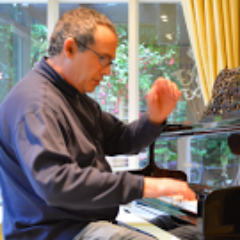
http://michaellow.co.za/

What is your first memory of the piano?

My piano journey began more or less when I was 3 or 4 years old. Movers brought a 1932 5’3” Chickering baby grand to our house. It was a gift from my grandparents.

That piano eventually travelled with me from one coast to another in America, which is where I’m from. It came with me when I arrived in the UK 4 years ago.

Last summer I acquired a new Steingraeber Phoenix 205. It’s an amazing instrument. I looked at a lot of pianos in the UK and America  before I selected it. Some of them were very good but none of them had the special, personal “this is the one – this one is it” kind of feeling I was looking for. When I finally met the 205 at Hurstwood Farm Pianos in Surrey it did seem like the one. It’s definitely reaffirmed that to me since arriving in my house.

There are more than a few fascinating lessons I learned looking for a piano which I’ve written up on my blog. Meanwhile, the Chickering has moved to my neighbour’s house for new and more family adventures.

Who was your first teacher and what do you recall about your early days of learning about the piano?

My first teacher was a very nice woman in our town in New Jersey. But after not all that long I mostly taught myself. I wasn’t systematic or organised in what I learned. It was mostly the Chickering was in the house and I’d play by ear.

From the beginning I had an affinity for jazz. I don’t know why or from where or how because I remember hearing Liberace and Victor Borge but not jazz. I also recall trying to pick out bits of the ‘Rite of Spring’ after hearing a recording of it. But picking out tiny bits of the ‘Rite of Spring’ was about all I could do.

Do you remember what you liked to play?

The Joy of Boogie and Blues’ was the book that had my interest. When I played the pieces in it with the right spin they sounded like boogie and blues. But I hadn’t yet heard real boogie boogie such as Albert Ammons and Pete Johnson used to play. And I didn’t know about New-Orleans-style piano playing even though ‘The Joy of Boogie and Blues’ had pieces in that genre. And of course I didn’t know of the great jazz pianists like Art Tatum, Bud Powell, and Bill Evans.

My parents and neighbours used to say I had a “nice touch” when I played boogie-woogie-type things. That phrase resonated with me. I could feel what it meant in my hands. And I could hear how that feeling translated into sound.

Who or what inspired you to start teaching?

While working towards a PhD in composition at the University of Pittsburgh I taught courses in basic theory and musicianship, jazz history, class piano, and a seminar on Mozart. Teaching was part of what PhdD students did while working towards the degree. So that’s where I began with students and learning about teaching and how to do it – and finding that I really liked it.

Who were your most memorable/significant teachers?

The important teacher who fastened my wheels to the track was Floyd “Floogie” Williams. I met Floyd in the second semester of my first year at university which was mid-1970s. He had recently moved to the area from New York City where he had been a drummer and a percussionist in jazz and studio worlds.

Learning with Floyd was immersion all things musical. I couldn’t possibly have had a better teacher. He had experience in the world I wanted to enter. Essentially he put one on the path towards that world.

Lessons with Floyd always included stories and more stories, all them colourful, about how this or that musician practiced and learned. And there was always an important point that came out of it all. With the piano Floyd boiled it down to one essential: Practice and practice some more.

What he meant was put in time and effort. Serious time and effort – as a method it was brute-force “put-your-back-into-it.” I spent virtually every hour of the day playing Bach, and Chopin, Beethoven, and Oscar Peterson piano transcriptions or picking excerpts out of the Dover editions of scores.

Another big lesson from Floyd was to the importance of being around great pianists – to see and hear firsthand how the did what they did. So Floyd arranged for me to visit to New York City to meet John Lewis, who had who played with Charlie Parker and later formed the Modern Jazz Quartet. A few months later Floyd sent me to New York City again. This time for lessons with Jaki Byard.

Jaki is among the great pianists and teachers in jazz. He played like a one-man jazz repertory orchestra, always with allusions to different pianists and styles, all of which he juxtaposed with wit and great humour.

So for example Jaki’s left hand might play in a stride piano style. But his right hand would play over it in very free bebop style – and perhaps in a different key. But the thing was, no matter what Jaki played he sounded uniquely like Jaki and never like he imitating something. Jaki was postmodern long before postmodernism was a style.

Who or what are the most important influences on your teaching?

At New England Conservatory I continued studying with Jaki and then I switched over to William Thomas McKinley who’s a composer and a jazz pianist. Whereas Jaki’s approach to the piano was based on play, play, and play Tom’s way – because  he was a composer – was write, write, write. So I wrote excerpts and examples – I filled notebook after notebook – of what I wanted to improvise.

I also took lessons outside of NEC from Charlie Banacos who had his own fascinating teaching niche. Charlie was a great jazz pianist but he gave up performing to focus exclusively on teaching. And he was well-known as a teacher – as perhaps “the teacher. All his students first went through his two-year waiting list before lessons began. Many of Charlie’s students went on to play with fabulous jazz musicians. And Miles Davis said he wanted to study with Charlie!

Most of what Charlie taught was simple in concept – for example transcribe a McCoy Tyner solo. But to do that required a lot of focused work with a tape recorder. Once the solo was transcribed, the next step was to play it at speed.

With Charlie simplicity of concept definitely wasn’t the same as ease of execution. Some  of the “simple stuff” Charlie showed me a long time ago is still among what I practice now.

The big picture I synthesised from all of that which is right at the centre of how I teach is “Experiment: cast the net freely and widely.” In other words explore, explore, explore – as Robert Frost said very well:

Two roads diverged in a wood, and I—

I took the one less traveled by,

And that has made all the difference.

I moved to New York City in the early 1980s after New England Conservatory and Boston. New York was exhilarating because it was populated to beyond bursting with fabulously-skilled musicians. If there’s a genre or a style of music anywhere in the world someone in New York is exploring and playing it at some unbelievably high level. Probably along with an entire community of equally-skilled practitioners.

After several years of freelancing there and all sorts of gigs I completed a Masters’ degree in Jazz Piano at the Manhattan School of Music. One of the classes I took there was an introduction to composition. The solo piano piece I wrote for it – along with Tom McKinley’s prescriptions to write, write, write – launched me on to composing.

So I went from the Manhattan School of Music to the University of Pittsburgh for PhD studies in composition and theory. But at the time – mid-1980s – composition there was focused narrowly on serialism through the lens and teaching of Milton Babbitt. Which wasn’t uncommon at that time. But it wasn’t the direction the interested me so I moved on to the Hartt School of Music where there was more plurality of approach and style. That’s where I completed the doctorate.

Beginning in the 1990s I taught composition, music technology, and jazz piano at the University of Maine at Augusta. From there I went to Central Washington University where I directed the music composition and theory programs. During that period I had short and long-term residencies in the United States and Europe – at the Crakow Academy of Music, STEIM in Amsterdam, the Banff Centre in Canada, and the University of California Santa Barbara, among others. And I was always playing jazz.

How do you teach?

Everyone comes to the piano and improvisation with their own interests, strengths, and abilities. So how I teach depends on the interests and experiences my students bring with them. It’s very much based on what they want to learn.

I’d say what I do as a teacher is help students acquire a musical voice. That means on the one hand exploring what, why, and how we do music- and piano-related things. And being creative with whatever comes back from those questions. On the other hand it’s about building as much technique as we can to support creativity. Creativity and technique are the two sides on the same coin.

Most memorable/significant teaching experiences?

I’m keen on teaching improvisation through Skype to students around the world. What’s amazing to me about Skype is it works without getting in the way. So looking into my studio from a distance literally means looking through Skype.

For me, there’s magic and the miraculous in working with students who literally are all around the world. Because with Skype connections to distant places don’t feel distant.

From time to time I’ll think “Well we’re working together in realtime but there’s a 12-hour time difference between us.” Which to me is mind boggling. I’ve had some improvised, interesting two-piano duets with students on Skype.

I’d say what Skype brings out is it’s the creativity and enthusiasm we bring to the learning process that counts. Which is the same for everyone really – without or with Skype. Creativity and enthusiasm are essential.

The biggest challenge with Skype has been managing clock shifts and timezones around the world. So, for example, I’ve since learned some countries – Iran is one and I have a fantastic student there – set their clocks to the half-hour rather than to the hour.

What do you expect from your students?

The first thing I teach is relaxation helps improvisation and playing the piano enormously. Because when we’re relaxed it’s easier to play and make music.

But after that expectations can easily become “it-has-to-be-this-way” or “it-has-to-be-that-way.” If we can reduce “it-has-to-be-this” to as few instances as possible we’re that much closer to relaxation where music and everything can seem easy. So removing expectations is about learning to play and practice in the moment with the skills we have instead the skills we wish we had.

A different example of a removable expectation is the idea that knowledge of theory – scales and chords  – precedes meaningful improvisation. The reality is thinking about theory when improvising is about as helpful as applying theory to playing anything.

Of course later or sooner theory is among the great extra stuff that broadens and deepens how we play. But as a prerequisite to improvisation – and particularly for students who come to improvisation with technique already – it’s not the start point.

What are your views on exams, festivals and competitions?

I’m mostly interested in the quality of experience of the individual – instead of the quantity of quality competition judges have to quantify. The thing is, quality of experience doesn’t depend on prescribed skill levels. A different way to say that is I’m focused on processes of music-making – because experience is process.

On the other hand I competed in the Thelonious Monk International Jazz Piano Competition which is the huge international one of the jazz world. I was a finalist in the the Great American Jazz Piano Competition. My Robots-in-Residence installation which I built in Denmark was a prize-winner in a competition in France. I learned a lot by being in those events and I’m glad I had those experiences.

And many pianists know competitions and such to be exactly what they want to enter into. In that case of course I’m happy to assist and support. But to the question of “are competitions and such things fundamentally part of learning to play an instrument?” my opinion is, no, they’re not.

What do you consider to be the most important concepts to impart to beginning students, and to advanced students?

Being in the moment with the music we’re making. Focusing on right now. To do that we have to relax. Which isn’t a question of “Are we relaxed? Yes or no?” It’s that relaxation is a continuum. Which means we can always bring it to deeper and deeper levels.

Also important is listening to the sound that comes from the piano. Listening to how the piano resonates. How it projects. One way forward with this  play and listen to single, sustained notes – long tones at the piano.

It’s like magic but ears and mind usually then go right to the moment – because they’re listening to the attack, sustain, and decay of each note and then each note after that.

How do you approach the issue of performance anxiety/tension?

We all deal with it in one way or another. I wish I knew how to banish it once and forever. But the reality probably is that’s just part of music making and not really all that unusual.

My approach is to work with it in small increments – instead of looking to conquer or suppress it once and for all. Small increments could mean learning to use specific relaxation techniques of which breathing is one of them.

Breathing meaning focusing on and recognising the importance of breath while we’re at the piano. And of course listening to the sound of the piano. Focusing on sound as it floats out of the piano. The more we focus on breath and sound the more we go to those worlds and then on to relaxation and the moment of “right now.”

Differentiating between “practice” and “performance” mode can be helpful. Practice mode is about working out details and looking to improve “this thing” or “that thing” or both things or all things. It’s intentionally focused to things such as “play these notes” or “perform that passage softly.”

Performance mode on the other hand doesn’t require analytic thinking. It doesn’t require that we try to do something better today than yesterday. It’s sitting down at the piano and being in the moment: Comfortable, and relaxed with the music we make, the sound we hear, the ability we have. Then “letting” everything flow together into a performance. Instead of “making” it flow together into the performance.

Are there any books you’d recommend to pianists or musicians or anyone interested in improvising?

The book for the desert island, assuming the piano’s already been delivered, is The Listening Book: Discovering Your Own Music by W.A. Mathieu. It has listening exercises and philosophy for everyone at every level of ability and experience.

How can we contact you?

My Mark Polishook Studio website is a blog about improvising, jazz, and all things of interest to pianists. My email address is mark@polishookstudio.com.

Dr. Mark Polishook, a pianist, composer, and music technologist, teaches improvisation in his studio in Leicester and on the internet through Skype. Among his compositions is Seed of Sarah, an electronic chamber opera that was made into a film seen across North America, Europe, and Australia. As a jazz pianist Dr. Polishook has performed with many eminent artists. 

To the experimental side of sound art Dr. Polishook has worked with graphics tablets, robots, and open-source software. His Robots-in-Residence installation which he created in Denmark was a prize winner in the 2004 International Bourges Electro-acoustic Music Competition in France. 

Dr. Polishook directed the music composition and theory programs at Central Washington University. He’s been a professor of jazz piano at the University of Maine at Augusta and a Senior Fulbright Lecturer at the Crakow Academy of Music in Poland. Dr. Polishook has been a resident artist in the Aarhus Computer Science Department, at STEIM in Amsterdam and at CREATE at the University of California Santa Barbara. 

He has a DMA in Music Composition from the Hartt School of Music, a masters’ degrees from the University of Pittsburgh and the Manhattan School of Music. His undergraduate degree is from the New England Conservatory of Music.

masterclass

ˈmɑːstəklɑːs

noun

noun: masterclass; plural noun: masterclasses; noun: master-class; plural noun: master-classes

1.

a class, especially in music, given by an expert to highly talented students.

The word “masterclass” can, for some, conjure up a terrifying scenario: the “private lesson in public”, with a formidable “master” teacher and a student quaking at the keyboard, their every error and slip heard and duly noted by teacher and audience. I remember watching music masterclasses on BBC2 in the 1970s (in the good old days when the BBC broadcast such edifying and instructive arts programmes), with eminent musicians and teachers such as Daniel Barenboim and Paul Tortelier. It seemed to my junior piano student self a most nerve-wracking experience and certainly one to which I would not wish to submit.

Fast-forward forty-odd years and I am now a mature “adult returner” pianist, which two performances diplomas to my name and some very positive experiences of participating in masterclasses. For me, the masterclass seems one of the most normal and beneficial ways of learning, providing not just a lesson with a fine teacher but also a forum for critique by others and the exchange of ideas and discussion about aspects such as technique, interpretation, presentation and performance practice. It is this element of interaction with other pianists and active listeners/participants that makes the masterclass scenario quite different from the private lesson.

For students in conservatoire and specialist music schools, the masterclass is an everyday form of learning, and for the teacher it is a way of sharing and passing on information to a group. A skilled teacher will ensure that all the participants in the class feel included, not just when they play, but also when others play, encouraging comments and discussion on what they have heard. A good teacher will also make sure negative comments are delivered in the most constructive way, so that participants feel supported and encouraged.

At many of the courses for adult amateur pianists in the UK and beyond, the masterclass is also a popular form of learning and teaching. Some of these classes are called “workshops” to make them sound more friendly, but in reality they are nearly always a group of c10 pianists, seated around the piano, eagerly absorbing wisdom from the teacher.

Masterclasses are not just for advanced pianists either. The format is applicable to students of all levels, and early students and even children can benefit from observing a teacher working with another student. Seemingly complex aspects of technique can usually be reframed to suit early/intermediate students, and sometimes working on quite simple repertoire within a group can shed a new light on more advanced music. It is also useful training for concert/competition performance and can be a huge help in learning how to manage anxiety.

Watching a masterclass is also a window on to how hard the pianist works and an insight into the practice of practising. Sometimes only fragments of a piece are worked over with the teacher, repeated, recast until a new, different or more exciting interpretation begins to emerge. Observing this process can be extremely exciting and enlightening, and for the masterclass participant, the instant feedback one receives from the teacher and other participants can be highly rewarding, often producing interesting and unexpected breakthroughs.

Returning to old repertoire can be extremely satisfying, and one often discovers new things about the music when returning to it after a break. I also recall all the reasons what I like about the repertoire and why I selected it in the first place.



My teacher has cautioned me about reviving repertoire I learnt as a teenager. This is good advice, for despite a gap of over 30 years, all the impetuous errors of youth seem ingrained in the piece and the fingers, and undoing these problems can be nigh-on impossible. Against my teacher’s advice, however, I revived Schubert’s E-flat Impromptu for my ATCL Diploma in 2011, because I needed a “fast piece” in the programme. I had not touched the piece seriously for over 30 years, yet I was pleasantly surprised at how much of it I could remember (it must be said that this is not a particularly difficult piece to memorise, being constructed from repeating patterns and motifs). But working from the old Editions Peters score I had as a teenager meant that all the errors were still there, as well as my then teacher’s annotations. In order to learn the piece carefully, I ditched the dog-eared score and purchased a new Henle urtext edition. In effect, I started again from scratch with the piece: I learnt new fingering schemes, thought carefully about the structure and atmosphere of the piece, and was delighted to have it described as “an assured and stylistically accurate performance” by the diploma examiner. Having taken the trouble to re-learn the work carefully, it is now very securely lodged in fingers and memory.

People often ask me whether it is “hard” to revive old repertoire. In general, I have to say I have found it relatively easy to return to previously-learnt repertoire, though this isn’t always the case (the ‘Toccata’ from Bach’s 6th Partita will take some careful work if I want to revive it). However, one can take steps to ensure that once learnt a piece can be revived and made ready for performance relatively quickly.

Lately, I have been enjoying revisiting some of Szymanowski’s Opus 50 Mazurkas, the first two of which I played for my ATCL recital. The pieces felt different without the pressure of an exam hanging over me, and I felt I was playing them in a freer way as a result. I am also working on Rachmaninov’s G minor Etude-Tableau (Opus 33, No. 8), for my debut in the South London Concert Series in May (the piece will be paired with Szymanowski’s Mazurka no. 1). It is a mark of how carefully I practised the piece in the first place that within an hour of practising earlier today, I felt it coming back together nicely. Of course there are elements that will need some careful, detailed work (the cadenza, for example), but overall, it is still in pretty good shape. Getting it “concert ready” should not take too long.

Professional pianists will have many pieces “in the fingers” which can be downloaded and made ready for performance in a matter of days. This may include 20 concertos or more, most of Beethoven’s 32 Sonatas, many of Bach’s 48 Preludes and Fugues, plus other pieces which are ‘standard’ repertoire: Mozart and Schubert sonatas, works by Chopin, Schumann, Brahms and Liszt, much of Debussy and Ravel etc., and popular ‘standards’ from the 20th Century repertoire by composers such as Messiaen, Bartok, Stravinsky, Ligeti, Berio, Berg, and Schoenberg. Careful learning and preparation mean that repertoire can be learnt, revived and kept going simultaneously. It is this kind of deep, thoughtful practise that is essential for ensuring repertoire remains in the fingers (and brain) even if one is not practising it every day.

Some thoughts on reviving repertoire successfully:

  • Recall what you liked about the pieces in the first place. What initially attracted you to the pieces? Rekindle your affection for the pieces when you revisit them
  • Don’t play through pieces at full tilt. Take time to play slowly and carefully.
  • Trust your practise skills. Be alert to issues as they arise and don’t allow frustration to creep in.
  • Look for new interpretative and expressive possibilities within the music. Try new interpretative angles and meaningful gestures.
  • Don’t hurry to bring the piece up to full tempo too quickly. Take time to practise slowly and carefully.
  • Schedule performance opportunities: there’s nothing better to motivate practise than a concert date or two in the diary.