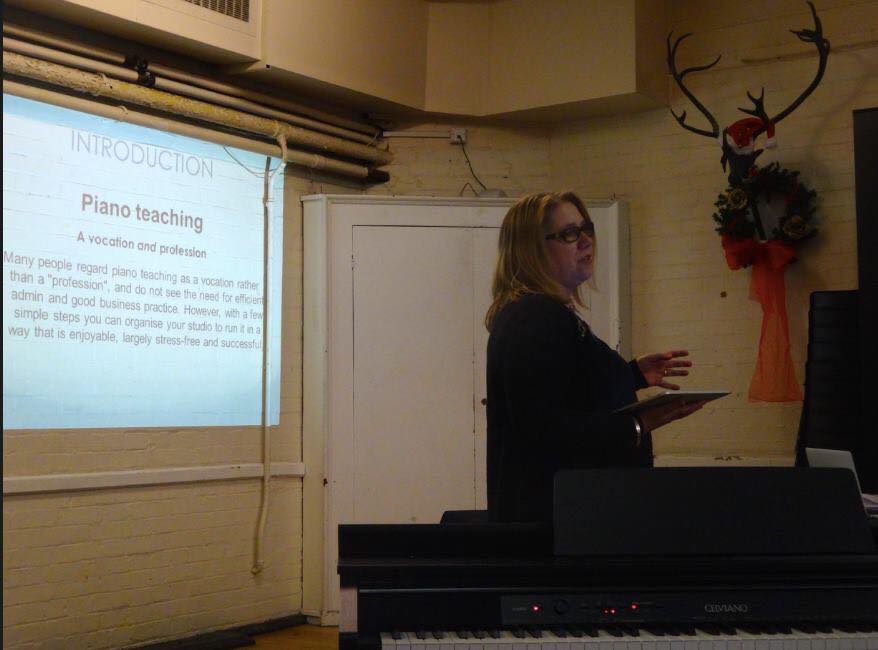
The following text formed the basis for a presentation and discussion which I led at a workshop for piano teachers held on Sunday 23rd November at Cecil Sharp House in north London. The presentation slides can be accessed here (Powerpoint presentation) or here (PDF file).

A vocation and a profession

Many people regard piano teaching as a vocation rather than a “profession”, and many do not understand or see the need for admin and business practice to enter into the craft of piano teaching. However, with a few simple steps you can organise your studio to run it in a way that is enjoyable, largely stress-free and profitable

10612940_1002689153080373_8621179464935562584_n

MARKETING YOUR STUDIO

1. Website

This is the 21st century business card and the first port of call for most people who are looking for a piano teacher.  Your website is your “shop window” and you should present a professional appearance. Pick a website design that is clear, accessible and easy to navigate. Having a website allows you to put up things like your studio policy, fees, term times (if applicable), business hours, your CV and qualifications, and teaching philosophy. Some teachers also like to include exam results and testimonials, sound and video clips and links to other sites. A well-designed website reduces time-wasting questions. You don’t even have to pay a specialist web designer to create a website: attractive and easy to build templates are available free from platforms such as WordPress, Blogger, Wix and Tumblr.

2. Get listed

Take advantage of free listings on sites such as MusicTeachers.co.uk and also local sites such as Mumsnet or a local site for small businesses (I belong to something called Teddnet). Being listed shows you are proactive and “out there”. Local music shops often have teacher listings too.

3. Use social networks

Don’t underestimate the usefulness of social networks such as Facebook and Twitter. Use both platforms to advertise your studio and connect with other teachers and music professionals etc around the world. Include links to your Twitter and Facebook profiles on your website. You can set up a Facebook page which is separate from a personal Facebook profile. Be intelligent about how much information about yourself you share on these networks, but don’t be afraid to use them: they can be a fantastic source of resources, information sharing and interaction between others in the profession.

BEING PROFESSIONAL

Adopt a professional demeanour in everything you do – from the way you dress to teach to how you interact with your students and their parents (your “clients”)

Have a clear studio policy/T&Cs and post this on your website. And stick to it! If you don’t offer catch up lessons, don’t make an exception for one or two students. Your policy must include information on payment, cancellation and make-up policies, punctuality, practising, exams and your expectations of parents and students. Some teachers ask students/their parents to sign a contract to indicate they have understood the T&Cs. Clear policies like these give credibility and confidence by setting expectations from the outset and let everyone know they are being treated fairly. You can also refer to them in the future to clarify things for anyone who may have forgotten or who queries missed lessons, payment of fees etc.

You can obtain a contract template from bodies such as EPTA and ISM.

Fees – always a tricky area as you don’t want to price yourself out of the market nor undersell yourself. Your fees should reflect your experience and qualifications but also take into account the demographic of area you live/work in. Look at what other teachers in your area are charging for guidance. The ISM publishes an annual survey of fees which gives a national average (currently £25 – £36 per hour for private instrumental teaching outside London) and London average (currently between £30-£50). How you choose to bill your students is up to you, but invoicing termly or half-termly reduces admin. Collecting fees can be a major headache so encourage all your clients to pay by direct bank transfer and give a date by which fees must be paid each term. Consider using billing software such as Music Teacher’s Helper (30-day free trial)

Tax and record keeping – be scrupulous about record keeping and keep your tax affairs in order. Use a tax accountant to help you if necessary.

Join a professional body such as EPTA or ISM if you feel this will lend credence to your professional standing. These bodies offer free listings, legal advice, , child protection, and can assist in disputes about fees etc

Get CRB checked – if you work with children you need to be completely transparent. An Enhanced Disclosure Certificate (formerly CRB check) is easy to obtain https://www.gov.uk/disclosure-and-barring-service-criminal-record-checks-referrals-and-complaints#types-of-check. State on your website that you have this certification.

Ongoing professional development – attending seminars, workshops and courses all feed into your teaching experience, allow you to connect with other teachers, and demonstrate that you are a teacher who is enquiring and interested in keeping up to date with new trends in piano pedagogy.

Personal development as a pianist – taking lessons and attending courses, masterclasses and conferences, learning new repertoire, performing, demonstrating to students that study does not end at Grade 8; that it is an ongoing process

Extra-curricular activities – enhance and add value to the teaching experience for your students by organising concerts and encouraging them to enter competitions and festivals, attend concerts and visit museums with musical connections. Student concerts are a wonderful way of celebrating your students’ achievements and allow family and friends a chance to see how your students are progressing. They are also a way of showing that piano lessons and regular practise bring recognisable achievement and progress.

Feel in charge of your own professional destiny and maintain your integrit  – for example, setting fees which you feel reflect your value and experience; being honest about who you want to tell (you don’t have to take on everyone!), setting high expectations of yourself and your students; not resting on the laurels of exam successes.

Related articles

An Image Crisis in Independent Piano Teaching?

Being Professional – the debate

I was delighted to be invited to contribute to a very interesting and stimulating discussion on the subject of professionalism in piano teaching at the The Oxford Piano Group  on 29th October 2014. Other contributors to this important debate were Nigel Scaife (Syllabus Director, ABRSM), Lucinda Mackworth-Young and Sharon Mark-Teggart (Evoco) who each gave presentations which explored the many facets of professionalism, including proper accreditation, good business practice, membership of professional bodies and minimum standards of qualifications for piano teachers. After the presentations, there was a round table discussion about professionalism, which touched on other important aspects, including the setting of fees.

My own presentation was based on my personal views on this subject, discussions with friends and colleagues in the profession, and the results of my recent survey Perceptions of Independent Piano Teachers.  The slides which I used as a starting point for my presentation and discussion are below, and you can read the text on which I based my presentation here: OPG presentation (click to download the PDF file)


This slideshow requires JavaScript.


What is your first memory of the piano?

My parents moved from Hammersmith to Surrey when I was 3 years old, and the house they bought came with an old grand piano that was left behind! I remember being fascinated by the keyboard and what went on behind the lid. I had my first lesson when I was 5, and remember my response to my father asking me if I wanted lessons being “yes, but will I have to practise?” The rest is history.

Who or what inspired you to start teaching?

I studied with Judith Burton for a decade until I went to the Royal Northern College of Music in 2000. She was so dedicated, and her devotion to every one of her students filled me with admiration. She has certainly been my biggest influence with regards to teaching; I always used to think, “if I can spend my time doing what Judith does, I’ll be happy.”

My path hasn’t always been that clear. I struggled with my relationship to music in my later years at music college, and despite achieving an MMus degree, I left feeling convinced that I would convert to law! After speaking to many people about it, the woman who helped me to see the wood for the trees was my piano teacher at the time, Carole Presland, who said, “if you say you love to work with people, what more privileged position can you be in, than to teach students on a one-to-one basis, where you really get the chance to make a difference?”. That was enough to help me back onto my path and I’ve never looked back.

Who were your most memorable/significant teachers?

They are all memorable and significant!

Judith Burton I have already mentioned. We are still good friends, and she was my biggest influence and guide when I was young.

At the RNCM, I studied with Kathryn Stott for 2 years, then Carole Presland for 3 years.

After graduating, two teachers have really helped me in different ways:

Vera Müllerová is a Czech teacher and concert pianist who I met while teaching on a Summer residential course. She showed me some finger exercises that, in one session, solved technical problems I’d been having with trilling in 3rds for years! I now visit her in Plzen once or twice a year to take lessons.

On the same summer course, I met a jazz teacher, who persuaded me to join his student trio for 15 minutes one evening to learn a blues. I had never played by ear and was terrified! In 5 minutes, he had me playing “Sunny Moon for Two”, improvising round it, and taking solos with the band. I was elated, and it felt like the first time I’d really had fun while playing the piano. His name is Paul Cavaciuti, and he is now my husband!

Who or what are the most important influences on your teaching?

This is a difficult question to answer!

My own state of mind is my biggest influence on my teaching. As a professional musician, it is easy for our music-making to become something we MUST do, and this can become tiresome. Also, finding a good balance between teaching and playing is not easy and needs constant adjustment. I put a lot of time and energy into maintaining my own love of music, feeling inspired, and ensuring that what I pass on to my students, predominantly, is a love of music and playing the piano. My husband is wonderful and helps me a lot with this. His expertise is in helping people rediscover their love of music and also helping with stage fright. I’m so lucky to have him available to me 24/7!

Other influences, among my own teachers, are Horowitz, Dr. John Diamond (an educator in the US who has created his own system which involves using the arts therapeutically), and our record collection. We have thousands of LPs, most of which are jazz and classical, and every time I listen to one, I’m immediately drawn to the piano to play, or come up with ideas for my students! I’m sure it has something to do with the analogue sound production. I never feel the same when listening to digital.

Most memorable/significant teaching experiences?

Every teaching experience is significant, and sometimes we have to trust that what we show our students now, may not sink in until much later on in life. My most rewarding experiences are when I take on a student who has been traumatised by the grade exams, or is about to quit, and within weeks they have found a new approach to playing, and realised that they do, in fact, love music after all. It brings me such joy!

What are the most exciting/challenging aspects of teaching adults?

One of the most challenging aspects is that many adults have pre-conceived ideas of things, so often they want a detailed explanation of why I’m asking them to do something, rather than just rolling with it and seeing where it takes them. I don’t see it as a negative – it’s natural that adults want to understand first and experience afterwards – however it’s not always the best way to learn.

The most exciting thing is seeing adults enjoying themselves through music, and doing something meaningful with their time. In today’s society, many parents offer the opportunity to learn music to their children, but secretly long to play or sing for themselves. I feel so excited when a parent comes to me and says, “can I have a lesson?” Being an adult brings with it so many responsibilities of the “must” kind. It’s great therapy to commit to something (especially something creative) for the love of it. If I can assist with that, I am delighted to.

What do you expect from your students?

Application. That’s it.

I’m not concerned with achievement or standards. Nor do I mind if their attitude isn’t positive for a while. We all have our struggles, and if I can find a way to use music to help them through troubled times, then my work is done.

What are your views on exams, festivals and competitions?

Firstly, the term festival is misused. A festival is a celebration of something, and we use the term to describe competitions. Lose the competitive element, (but keep the constructive, positive adjudications) and I think they would be fantastic occasions!

I think exams and competitions are a disaster. I won’t blither on for too long about this (that’s for a future blog!), but developed societies are obsessed with assessment and quantifying ability. This has absolutely no place in the arts, especially in music, and the rise of grade exams and competitions has contributed to:

  • an increase in competitiveness among musicians and parents, (e.g. children in the playground saying “what grade are you on” instead of “fancy a play sometime?”)
  • an increase in performance anxiety and even stage fright.
  • a focus on skill acquisition without a true understanding of music being a language, and to the detriment of having something to say through playing or singing.
  • in the words of Horowitz, “standardisation”. Everything is now the same, instead of people playing as individuals. The idea of playing correctly and incorrectly shouldn’t be at the forefront of a musician’s mind, and it is only with note-reading that it’s an issue at all.
  • a feeling of self-worth being attributed to achievement. Musicians who receive distinctions in exams are often the ones who won’t play in restaurants, at parties or among friends. I think that’s tragic.

I could go on, but I should probably stop there. As a teacher, I want to spend my time convincing people that learning music for the sake of the music, and bringing people together, is enough. Benchmarks are not necessary to become a great musician!

What do you consider to be the most important concepts to impart to beginning students, and to advanced students?

To both beginner and advanced students, to love playing music. Another important concept is to realise is that the music comes from the person, not the instrument. The instrument is there to help release the music (though some instruments are more of a hindrance!)

What are your thoughts on the link between performance and teaching?

I think they are very complimentary; however I think the importance of their connection differs depending on whether the musician has been professionally trained or not.

A musician who has trained to perform professionally, should perform. There are too many teachers who have stopped playing in public, and project bitterness and envy onto their students. This is the most destructive thing a teacher can do, therefore maintaining a balance, in my eyes, is essential. (I’m not suggesting we should all be playing at Wigmore, but some kind of performance is important – like nourishment!)

The advantage of having performed is the advice that can be imparted from the experience of having done so. Performing does feel quite different to playing to the four walls and the dog.

An amateur musician who teaches because they love to teach, but has never really performed, or had the opportunity to perform publicly, is unlikely to pass any such negativity onto their students. Their relationship to music is probably quite different and unaffected by the rigours and strains of the profession. For this reason, it isn’t important that they perform.

How do you approach the issue of performance anxiety/tension?

I’ve been through the mill with performing-techniques. Been there, done that, bought the T-shirt. The one thing that has helped me more than anything, and that I do to this day, is sing along internally while I play. I do lots of singing aloud at home (and ask all my students to do the same), then on stage, whatever state I’m in, singing under my breath grounds me, helps me to concentrate without thinking too much, and regulates my breathing perfectly – consequently releasing tension. The ceiling could fall in or Jack Bauer could walk past, and I’d stay focused. It really is the best thing, and I learnt it from my husband!

Who are your favourite pianists/pianist-teachers and why?

My favourite classical pianist has to be Horowitz. Every time I listen to him or watch him on Youtube, I sit at the piano for ages afterwards. He’s so inspiring.

For years, my idol was Alfred Brendel. He has an incredible mind, and a wicked sense of humour. He’s a real artist – I’ve been to many of his concerts, and he played differently every time. On a bad day he was great, on a good day, he was sublime. (I went to his final retiring concert at the RFH, and shed tears on and off all the way home!)

In the jazz world, I adore Art Hodes. He was playing in the US in the 30s and 40s, and had the most incredible groove. The amazing thing about him is that his music is often in the spaces between the sounds. He isn’t flashy or a show-off, but boy does he make you want to tap your foot!

Lastly, (I suppose this counts as he was a pianist and a teacher), it has to be Beethoven. Whoever composes music and says, “Music is the mediator between the life of the senses and the life of the spirit” knows his purpose as a musician, and to elevate others to something higher, is a wonderful purpose.

Nadine’s biography

Nadine André’s website

For the Love of Playing – Nadine’s blog

Nadine on Facebook

Follow Nadine on Twitter

Nadine’s contemporary trio, Trifarious

And on Facebook and Twitter

Classical Babies

I recently ran a survey, Perceptions of Independent Piano Teachers, as part of some research for a paper I am writing to present at the Oxford Piano Group meeting at the end of this month. Originally intended to offer some insight into whether private and independent piano teachers regard themselves as “professionals”, the survey revealed some interesting and unsettling thoughts on how independent piano teachers perceive themselves generally, and how people outside the profession view them. The majority of respondents were independent/private piano teachers and it was their response to the question When you think of the typical private piano teacher, who teaches at home, what image immediately comes to mind?  which gave me significant pause for thought. See more on this below….

One of my ongoing issues is people not regarding what I do as a “professional” role, despite the fact that I adhere to many of the perceived definitions of the word “professional”: I am paid for my work, I hold professional qualifications, and I belong to several professional bodies. I also run my studio in an efficient and businesslike manner with clear terms and conditions regarding payment of fees etc, I market my studio effectively (website and social media), I participate in regular ongoing professional development, and know how to communicate and interact with my “clients” (my students and their parents). Discussions with friends and colleagues in the profession indicate I am not alone in this, and indeed this is one of the main aspects about which music teachers and musicians in general feel so denigrated: because we enjoy our work and (often) work from home, it is not perceived as “a proper job”, and as such, we are often undervalued, expected to work for low or no pay, and our job is regarded as some kind of eccentric hobby. Nevermind that many of us have undergone a long and specialist training, or have years of experience and an impressive track record of success.

One of the major problems of private piano teaching is that it is unregulated. This means anyone can set up as a piano teacher and recruit a few students. Other professionals – doctors, lawyers, accountants for instance – have their own professional/regulatory bodies, with professional exams, code of ethics, and so forth, which lends proper accreditation and gravitas to their role. Piano teachers can opt to join professional organisations such as the European Piano Teachers’ Association (EPTA) or the Incorporated Society of Musicians (ISM), but membership is not compulsory and these bodies do not “regulate” nor inspect; they offer support, legal advice, continuing professional development, public liability insurance, busaries etc.

I would like to share the results of my survey, in the hope that this may encourage all independent piano teachers to consider how the profession is regarded and to support me in raising the profile of the private piano teacher.

Qualifications
What has the average piano teacher studied to teach in an independent studio?

Piano to grade 8 – 78%

Music theory to grade 8 – 37%

A-level music (or equivalent) – 45%

Music degree – 50%

Teaching diplomas – 46%

Performance diplomas – 43%

Piano pedagogy – 30%

These results interest me because I frequently come across the view that the private piano teacher should have attended music college or taken a degree in music, as a minimum qualification to teach. While I accept that a BMus or MMus (or equivalent international qualification) would be desirable, it is worth pointing out that not all conservatoire or university music courses offer a separate and/or specialist course in piano pedagogy; the main focus tends to be on performance, and music theory and history. Now, you might be the most talented, internationally-renowned pianist, but if you can’t communicate in both words and actions how to do it, you are not going to cut it as a teacher. Many professional musicians teach because they have to; but they are not necessarily the best teachers just because they have undergone a conservatoire training.

As an unregulated profession, there is no minimum standard qualification for independent piano teachers. Personally, I would like to see Grade 8 piano set as a minimum standard together with some other accreditation required and recognised by a body such as the ISM or EPTA.

Here is a teaching colleague of mine on the thorny issue of qualifications:

There is huge range of qualifications on offer, some of which test different things to others. I think in my experience, the usual thing, ‘qualifications do not necessarily a good teacher make’ stands true. All the qualifications I’ve done, I’ve done because they enhance and enrich my teaching rather than that they somehow make me look a better teacher. I’ve never once, in 13 years been asked about them anyway, and I find this quite common. Having worked with quite a few teaching diploma candidates, for example, it is clear which of them are using the qualification as a means to reflect on and evaluate their teaching skills, and those who want the piece of paper (and for the latter, the act of doing the qualification will have had little or no impact upon their actual teaching ability).

What are the main duties and responsibilities of an independent piano teacher?

100% of respondents stated that “teaching piano” is the main duty/responsibility of the independent piano teacher.

Preparing lessons – 87%

Collecting fees – 59%

Scheduling lessons – 73%

Preparing students for exams – 80%

Writing student reports/appraisals – 34%

Marketing the studio – 41%

Administration and recording keeping – 61%

Encouraging students – 91%

Keeping up with one’s professional development – 81%

I was interested to note that “collecting fees” did not receive a higher response, since conversations with colleagues, and my own experience, suggest that this is one of the more time-consuming (and irritating) aspects of the private piano teacher’s role, along with other general admin. Additional comments in response to this question included: dealing with parental expectations, keeping abreast of the current writing/thinking in piano teaching and pedagogy, taking lessons and playing/performing oneself, learning the music that students choose to play, informing students of interesting/relevant concerts and encouraging them to listen to music.

What non-musical skills do you think an independent piano teacher should have in order to teach successfully in a home studio?

Administration and organisational skills – 87%

Computer skills – 53%

Business skills – 57%

Knowledge of learning styles and how to accommodate them – 86%

People skills – 95%

An ability to challenge and motivate students – 96%

Patience – 96%

A sense of humour – 84%

Communication and writing skills – 71%

The responses to these three questions above suggest that independent piano teachers have a clear idea of what the job entails, and what skills are necessary in order to fulfil the role.

In response to the question Do you consider private piano teaching to be a “profession”?  91% agreed with this statement, while 7% did not. 2% responded “Don’t know”. When asked to qualify their responses, the following comments were made:

It’s a hobby, even if a full-time living, and never feels like a ‘real’ job. It’s up to the teacher to be self-motivated and conscientious if he/she wants to do a good job of it, though, but it’s increasingly a peripheral and quaint thing to do in life.

No [it’s not a “profession”], in that there are no recognised entry qualifications, no regulation and no career progression.

It doesn’t command any respect, people think it’s a hobby, not a vocation.

Depends on qualifications

What attributes and/or qualifications do you think define a private piano teacher as a “professional”?

Qualifications (e.g. music degree, education degree, performance or teaching diplomas) – 95%

Experience – 80%

A career as a professional performing musician – 25%

Ongoing professional development – 71%

Self-motivation – 50%

Good business skills – 36%

Additional comments in response to this question:

Success in motivating, teaching and helping students grow – not just musically, but personally, as well

I am constantly baffled as to why some piano teachers are not part of a union or professional body

Understanding of child development and basic psychology (we teach adults too)

A ‘professional’ attitude to practicalities such as studio policy, having insurance. Planning lessons

An ability and willingness to perform up to something resembling professional levels, but not necessarily having a professional performance career.

When you think of the typical private piano teacher, who teaches at home, what image immediately comes to mind?

It is the largely negative responses to this question which have given me most pause for thought. Remember, the majority of respondents are independent piano teachers – these comments are their view of how our profession is perceived by others:

Probably an older, rather eccentric female

Someone who is probably not properly qualified

Old lady next door, cardigan, cats, musical erasers

Someone who is not really up to the job- who isn’t fully trained or a professional musician and has realised they can make a quick buck teaching piano. Someone who is kind and nice to the children and parents but ultimately unaware that they are teaching bad technique often and not aware of the rigours of quality music-making

Not a profession but a religion!

Someone who is keen to develop people in their creativity and understanding of music. They love what they do, and teach it because they themselves love to play and be creative.

A mum who used to play…..has kids and needs a bit of extra money

I divide it into two types: Those that live and breathe the piano, and those for which it is a “nice little hobby”.

Someone who has Grade 8 or Diploma in performance. Teaches pupils for the exam they are working on, leaving ear training and background knowledge until the week before the exam. May be a great performer.

It used to be a woman in her 40s or 50s sitting, slightly seriously, beside a wide-eyed child at an upright piano. Things have moved on now and I know teachers across a wide demographic.

Interestingly, when I asked two professional pianists who also teach (one privately, one in a university music department) how they are perceived by their students and parents of their students, I received the following replies:

I find that my students and parents treat me as ‘highly professional’ due to the calibre of my performing engagements. This is completely unrelated, however, to any ability I might or might not possess as a teacher. The latter comes from studying and working in the field for over thirty years, from discussions with psychologists and other instrumental teachers – and trial and error.

I find that generally (with a few exceptions) teaching within an establishment [a British university] one does get the appropriate respect and indeed, as instrumental teachers, most of the students treat us as being on a par with the other academic staff. The only private teaching that I do (at the moment) is on a consultation basis, so people (generally parents of talented late teenagers or sometimes young professionals themselves) approach me because of what I’ve done or because they’ve actually heard me in concert. I guess that generally means that one has already overcome the hurdle of being respected and the people involved do therefore treat one as ‘professional’. But this is less about qualifications/prizes won….

Do you have any memorable anecdotes about the perception your students, their parents, or someone outside the profession has had about the independent piano teacher or the job of teaching from a private home studio?

Parents of new students think often of piano teaching as a simple, stress free and lucrative job. Parents of older students realize it’s a profession, that requires knowledge, competence and constant learning on the part of the teacher.

Thinking I’m a part-timer. – Believing I deserve less professional respect. For instance: paying me late, assuming I want to babysit their kids, wanting to switch times when a plumber/electrician wouldn’t put up with their crap. This might be a bit controversial, but I think part of the problem lies in the fact that as a profession, there are very little “benchmarks” or “guidelines” to guide absolutely everybody in a uniform fashion, even within unions and professional bodies. For instance, there are some piano teachers who may put up with late payment because they feel they don’t have a choice, or other teachers who allow pupils to switch times and cancel at the very last minute. This makes others believe all piano teachers are the same. I think this freedom and flexibility to operate is a positive, but if you compare to say, the GMC (General Medical Council) or BMA (British Medical Association), they are a lot more stringent and dogmatic about what their members should and should not do as professionals.

“What do you do for a living?” (Parent couldn’t believe this was my job)

Once a mother pulled her son out of lessons because I was getting too skilled and teaching too much and she just wanted him to read notes. I told her I was allowed to grow too

As organizer of a local piano competition and representative of a teaching union, I sat down to check a piano was in tune and the stool was at the right height at the start of the competition day, only for a parent to ask “so you actually play the piano then? Like properly!” Made me smile for hours.

One piano parent asked me and my colleague Claire “So what do you want to be when you are older?” whilst she was sat in my private piano teaching practice which I rent and run as a business.

I am troubled by these largely negative comments and the recurrence of the word “hobby” in relation to piano teaching. The perception, expressed by teachers themselves, that the role is not valued nor regarded as a proper professional job is very evident in these responses. While the stereotypical view of the private piano teacher as a little old lady down the road is fading, there is a still a strong perception that the private piano teacher is doing the job for “pin money”, or because they can’t get a “better” job. I find this view deeply depressing: I take my job very seriously and adopt a professional attitude to every aspect of my work (the fact that I also enjoy it a great deal is an added bonus). How do we change this attitude into a positive perception of piano teachers as highly skilled and professional people? I believe that the impetus must come from within the profession, from piano teachers themselves, and from professional bodies such as EPTA and ISM, who should be actively promoting private piano teaching as a recognised and respected profession.

I would like to thank everyone who took part in my survey and also those pianist and piano teaching friends and colleagues who responded to more specific enquiries from me.

In a later post, I will explore professionalism in private piano teaching in more detail.

Please feel free to leave comments or to contact me directly via the Contact page of this site.