Guest post by Frances Jones

One of the bonuses of teaching is that from time to time you are introduced to new repertoire. Sometimes, you get the opportunity to change your view of a composer that was really only based on a passing experience. 

A pupil of mine has recently been learning a piece by Cecile Chaminade, a composer whose music I had until now associated with a flautist house-mate practising diligently in the run up to a recital. A beautiful work, the Concertino, but the flute can be surprising loud in close quarters. 

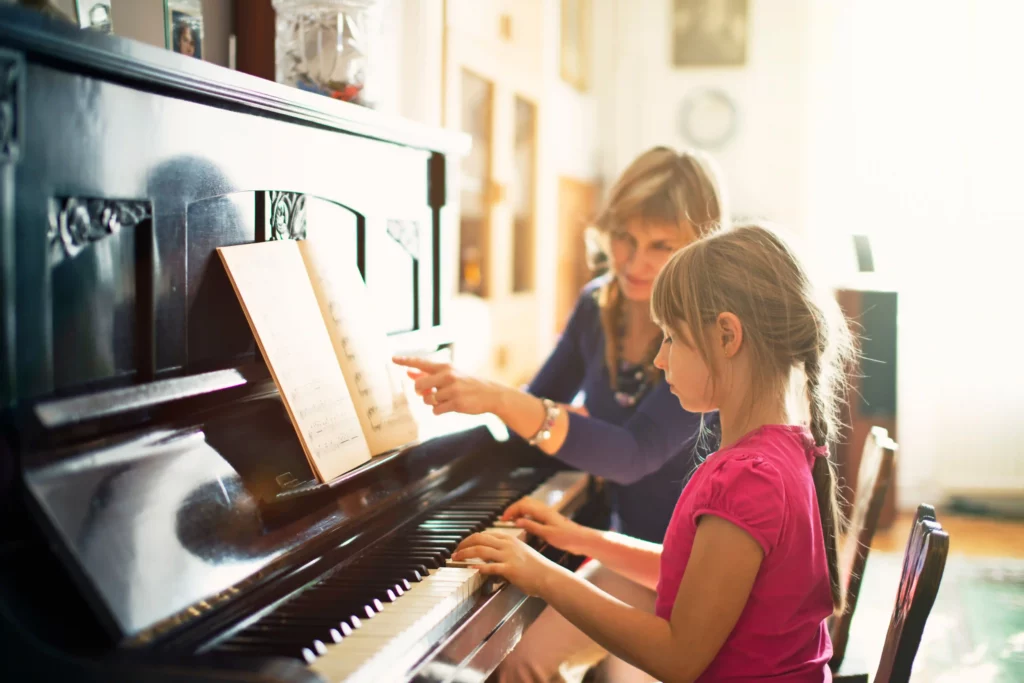
Cecile Chaminade (1857-1944) composed throughout her life, and left a large number of piano works, in addition to orchestral music and songs. The piece that my pupil learnt, and that inspired me to explore Chaminade’s music, was the Idylle, Op. 126, No. 1, from her Album for Children of 1907. It has a melody that becomes a real ear worm; marked bien chanté, it does indeed feel very singable. It’s such a satisfying piece to play; the melody in the right hand is accompanied by a simple enough bass line helped along with discreet pedalling. The middle section requires a little more diligent practice for the aspiring Grade 4 pianist (the piece has recently been on the ABRSM Grade 4 syllabus) and the writing is never dull; the melody wings its way onwards, and for a glorious minute or so you can be flying over the rooftops, your spirits lifted. The opening melody returns to round off the piece and you sense in the pupil the confidence that familiarity brings. Immediately the pupil’s playing is more assured, expressive, even playing around with tempo and the placing of the notes. 

I think it was the singable melody that piqued my curiosity, and made me want to know more about Chaminade’s music. The piece I found first was her Serenade Op. 29, written in 1884. After listening to this you can see why Chaminade’s music has been described as charming. The opening melody is gentle, almost like a lullaby, and is supported by pleasing harmonies in the accompaniment. The second melody has a similar rhythmic pattern and is more searching but still holds a tender quality. They are both such beautiful melodies that the whole piece really works. Both tunes use similar rhythmic patterns and accompaniments, but it’s the subtle melodic development as well as changes in articulation that keeps this piece interesting. The music finally fades away to ppp and a tonic chord, dusk having fallen and the musicians taking their leave. 

The next work of Chaminade’s I listened to, which really threatened to take the attached description of ‘charming’ and hurl it out of the window, was her Arabesque No 1, Op. 6, from 1892. It’s a tempestuous piece, technically much more difficult than the Serenade. Chaminade was a pianist, studying with teachers from the Paris Conservatoire, and later performing her works in Europe and the United States. I can imagine her sitting at the keyboard, absorbed in her music, taking the audience with her on a journey through delicate flourishes and big chords, carried along by a melody that is seeped in the Romanticism of her Russian and German contemporaries. 

Her Caprice-Impromptu, despite being one of her later works, written in 1914, is also decidedly Romantic. Chaminade, like her near contemporary Rachmaninov, remained broadly consistent in her style whilst many composers around her responded to new influences. Indeed, the Caprice-Impromptu has hints of Rachmaninov in its melodic writing. Like the Arabesque, there’s a sense of urgency and although the first section is playful as the title of the piece suggests, the melody that follows in the second section is at once both yearning and lyrical. Chromatic scales in octaves add to the sense of drama and the composer makes full use of the expressive range of the piano; the music ranges from fortissimo to piano and dolce

Chaminade’s music is characterized by its melodic writing and chromaticism; it’s Romantic, yes, accessible, maybe, but no less interesting for that. Chaminade was a prolific composer and her piano works are both imaginative and musically satisfying. I can’t wait to discover more. 


Watching Masterchef The Professionals, a series to which I am rather addicted (mainly because my son is a professional chef), I have noticed a certain expression from chef Marcus Wareing during the preliminary Skills Test section of the competition.

In this round, contestants’ culinary skills and nous are tested with a set of technical challenges, most of which should be second-nature to any well-trained chef – filleting fish, shucking oysters, boning out a joint of meat, making meringue or hollandaise sauce, for example. For some, this is a daunting round where weaknesses are exposed or nerves get the better of the contestant. For others, it proves their mettle and demonstrates that not only have they been properly trained (and keep their skills well-honed), but also that they are able to adapt their skillset and intuitive culinary common sense to an unfamiliar recipe or set of ingredients. When a chef succeeds in this, Marcus Wareing will often say, with an approving nod, “Chef’s head“.

So I’m coining the expression ‘Pianist’s Head’ to apply to those situations when we might encounter music which is unfamiliar or outside our comfort zone, which might at first appear daunting, challenging or even almost impossible, but which, with some consideration, drawing on our musical knowledge, experience and intuition – our Pianist’s Head – is achievable. Having a good Pianist’s Head upon your shoulders will stand you in good stead for successful sight-reading and the ability to learn music more quickly.

No repertoire is ever learnt in isolation – or at least it shouldn’t be – and everything is connected. Musical skills, just like culinary skills, once learnt and practiced, can and should be applied to different situations. No learning should ever be done in a vacuum: a single piece of music is not just that one piece, it is a path to other pieces via accrued technical proficiency, musical knowledge and artistry. Early students and less advanced pianists often see the pieces they are learning in terms of stand alone works which have little or no relevance to other music they are working on, or are going to learn. This is also particularly true of scales, arpeggios and other technical exercises which may be studied in isolation instead of appreciating their relevance not just in understanding keys and key relationships, but also in actual pieces of music. This was something I was not taught when having piano lessons as a child, and it’s the fault of the teacher, not the student, if the usefulness and relevance of such technical work is not highlighted.

Chopin knew this: it is said that he studied Bach’s Well-Tempered Clavier every day, appreciating the music’s relevance to his own musical development, his composing and his teaching. If you can successfully manage Bach’s ornamentation, for example, your Pianist’s Head should allow you to cope with Chopin’s trills and fioriture.

Your Pianist’s Head skills will develop the more time you spend with varied repertoire and your willingness to take an open-minded, lateral thinking approach to learning and playing music to an point where these skills become intuitive and you won’t even know you’re applying them!

To develop and maintain your Pianist’s Head, approach each new/unfamiliar piece of music with the thought, “what do I know already and how can I apply experience from other repertoire to this piece?“. For example, if you’ve encountered a similar passage or technical challenge elsewhere you’ll know how to approach it this time.

Understand and appreciate the composer’s particular stylistic characteristics, idioms, soundworld, and quirks. This can be developed not only through playing other music by the same composer but also by listening and studying scores away from the instrument. And as your Pianist’s Head develops, you’ll find yourself making intuitive decisions about how to approach repertoire based on sound technical knowledge and musical insight.


Support The Cross-Eyed Pianist

This site is free to access and ad-free, and takes many hours to research, write, and maintain. If you find joy and value in what I do, why not


Photo by Juan Pablo Serrano Arenas on Pexels.com
 

Guest post by Anthony Hardwicke


Instrumental Music Teachers as Individual Learning Coaches

In Episode 4 of his A Land Without Music? podcast series, Julian Leeks collected lots of evidence that a musical education can benefit our children. However, he stopped short of claiming that learning a musical instrument can boost a child’s progress right across the school curriculum. I believe we can and should make this claim, and the reason is simple: when children are given piano lessons, they get weekly one-to-one coaching on how to learn

Learning how to learn involves acquiring a key set of skills, such as planning, repetition, memorising, listening, feedback loops, etc. Once encountered, these can be deployed to help master other academic disciplines. Learning to learn has been championed in the past by academics such as Professor Guy Claxton. The main takeaway is that if we focus more on making children better learners, they can use their ‘learning muscles’ to make a success of other areas of their lives. 

In a weekly one-to-one piano lesson with a peripatetic teacher, the child will experience a wide variety of different approaches to learning to play the piano. The teacher might discuss the most efficient strategies for effective practice, explain how to memorise a piece of music, talk about how music theory relates to a Mozart sonata, or they might give the student an impassioned pep-talk about how interesting and exciting Beethoven is. Perhaps they might not even intend this as an outcome, but the piano teacher might find themselves auditing that individual child’s learning skills in a way that a classroom teacher simply hasn’t got time to. I really do see the peripatetic instrumental teachers in a school as a super-motivated, highly experienced team of personal learning coaches.

What nobody talks about is how easily these useful learning approaches can be applied to learning about STEM subjects (and indeed other academic subjects). To memorise eight different chords to let you play 20 pop songs, is a very similar proposition to memorising the formulae of eight different ions so as you can work out the formulae of 20 different ionic compounds in chemistry. 

Teach a child to play the piano and you will almost certainly additionally grant them regular access to an inspirational teacher who will coach them and rehearse the priceless skills they need to learn all other school subjects. In most cases, because the lessons are one-to-one, the teacher will diagnose which skills the child individually needs to develop and move forwards their ability to learn effectively. 

Whether you’re a parent who wants your child to have a competitive advantage, or a politician pondering how best to invest for future society, we must have more music education.


Anthony Hardwicke has been a classroom science teacher for nearly 30 years and is a dedicated amateur pianist. 

Guest post by Ann Martin-Davis, pianist and teacher


‘Dum diddle diddle dum dum dum.’

How can it be that this simple tune that we all know isn’t counted in three? Yes, you heard me, not in three, but in fact in four plus two.

Try it out right now in your head – go on – and then go through all those other Baroque minuets that you have been humming for years and you’ll see that the shape of the melodies and the articulation that follows fall into the same pattern.

Now fast forward 200 years to Ravel; Menuet sur le nom d’Haydn, the Sonatine, Menuet Antique, and you’ll find the same patterns, and why? Because this is how it’s danced.

Learning the dances of the Baroque period doesn’t just sort out your understanding and playing of these composers, but it can inform pretty much everything else dance related that you might be involved with.

I’m with the dancer and historical coach Chris Tudor, and I’m joined by harpsichordist Sophie Yates, and Bach specialist, Helen Leek. We’re here to learn some of the basics and after intros in our ‘comfortable clothing’, we’re warming up with a simple hand held chain called a linear carole.

Caroles, or carols as we now call them, always used to be danced and sung, but at some point we lost the dance element. The origins go way back to the ancient Greeks and to the choros, or circular sung dance. Remember the dancers on Achilles’ shield in Homer’s Iliad? The magic of the shield creates a moment of escape from the pressures of reality and of the battle; I too quickly forget my parking battle off the Euston Road and settle into the conviviality of it all.

Next up is a renaissance dance, the Branle, which Chris tells us is a surreptitious way of introducing some of the steps to a minuet. We take one step to the right, close, then one step to the left and over with the right. Always rotating clockwise as we don’t want any negative energy.

We make swift progress and then I drop the bomb.

‘How about a Courante?’

Chris grimaces a bit and at this point I suddenly have a flashback to a grade exam, where I galloped through a Bach Courante and landed with a grateful ‘ta dah-like’ placement of the final ‘G.’

Sophie steps in and tells me that the Courante was fast in the Renaissance, but by the time J S Bach got busy with it, the metre had moved to 3/2 making it one of the slowest of all of the Baroque dances. She continues, ‘it could be apocryphal, but gossip colomnist in Chief in Versailles, Titon du Tillet said it slowed down because of Louis XIV’s long-toed shoes, meaning an extreme turn-out was necessary.’

So the Courante gets us talking about the ‘cadence’ of a dance which can relate to two ideas. We have cadence, as in the cadence of your voice, the qualities of the dance (a Courante has a noble and stately quality), but there is also the exploration of the cadences in the music and how these are going to relate to the cadences in the dance.

This is blowing my fuses now, so we all agree it’s time for coffee…

‘Dancing with Bach’, hosted by Ann Martin-Davis, with Chris Tudor, Sophie Yates and Helen Leek is a one-day workshop for pianists exploring the dance forms familiar to Bach that he used in his Partitas, Suites, and throughout his other collections of keyboard music.

Saturday 22nd February at St Mary-Le-Savoy Lutheran Church, London WC1H 9LP

Find out more here

Bring your dancing shoes!