In this episode we discuss gesture in piano playing – when it’s useful and when it’s most definitely not!

Find all previous episodes here


This site is free to access and ad-free, and takes many hours to research, write, and maintain. If you find joy and value in what I do, why not

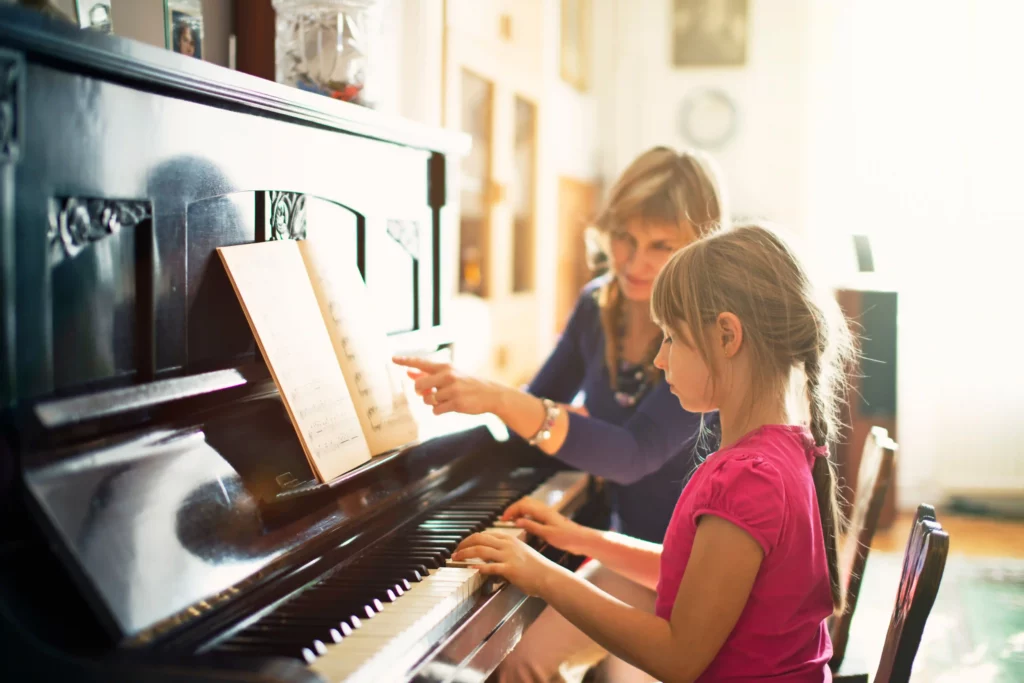
A few months ago, I met the parent of one of my former piano students at an event. I was pleased to hear that the student (we’ll call her Jane) was now studying English Literature at one of the UK’s top universities, but the most gratifying piece of news was that she was still playing the piano and enjoying it. Jane’s mum told me that she liked to download music from the internet and play it for the sheer pleasure of doing so. “You gave her a love of music”, Jane’s mum said, “and that’s the most important thing!”.

I was so touched to hear this, as I think any teacher would be. Because surely our fundamental role, as teachers, is to encourage a love of music?

(This is one of the pieces Jane played for her Grade 5 exam, which she passed with a high merit)

Jane started having lessons with me as quite a young child, and at that age (5 or 6) she was very quiet and lacked confidence. But gradually, as her piano skills developed and blossomed, so too did her confidence, to the extent that she began to play with real poise, beautiful tone production, and above all a sense of real pleasure in the music she was learning.

Piano teachers – indeed all music teachers – have the unique opportunity to shape not only the musicianship and technical ability but also the lifelong relationship that their students have with music.

Here are 5 tips for encouraging a love of music in students:

1. Create a Positive Learning Environment

A nurturing atmosphere allows students to feel safe to explore and express themselves through their playing, and a place where students feel comfortable sharing their thoughts, questions, and concerns. By actively listening and addressing individual needs, teachers can build a strong rapport with their students and create an environment that nurtures a genuine connection with music.

2. Share the Passion

Enthusiasm is contagious A piano teacher who exudes enthusiasm for music can ignite a similar fervour in their students. Enthusiastic teachers inspire curiosity and a desire to explore beyond the confines of the lesson, encouraging students to discover their own musical tastes and interests.

3. Treat your students as individuals

Every student is unique, with distinct musical tastes and preferences – yet too often teachers take a “once size fits all approach” which does not take this into account. Customise your teaching to suit each student by getting to know what kind of repertoire they prefer, their particular strengths and weaknesses, and their approach to learning. In other words, show that you really “know” each and every student personally.

4. Connect music to everyday life

Classical music in particular suffers from an image problem and many young people today regard it as old-fashioned, highbrow or simply not for them. Show students how to relate musical concepts to real-life experiences, emotions, and events, and how music fits into everyday life, such as in film or TV soundtracks. By illustrating the universal nature of music and its ability to communicate feelings, teachers can instil a sense of purpose in their students, fostering a connection between the notes on the page and their own emotions.

Dance of the Knights (theme from The Apprentice TV show)

5. Encourage individual creativity and expression

Beyond technical proficiency, a true love of music involves the ability to express oneself creatively. Piano teachers can inspire this by encouraging students to experiment with interpretation, dynamics, and even composition. Allowing students to infuse their personality into their playing brings a sense of ownership and pride in their music and this sense of empowerment and personal autonomy contributes to a lasting passion for music that extends beyond the confines of the instrument.


This site is free to access and ad-free, and takes many hours to research, write, and maintain. If you find joy and value in what I do, why not

Find all previous episodes here

This site is free to access and ad-free, and takes many hours to research, write, and maintain. If you find joy and value in what I do, why not

The release of a new piano syllabus is always met with excitement and interest from piano teachers, and students too, and the latest release from Trinity College London (TCL) will not disappoint.

I have been a fan of TCL’s piano exam syllabus and approach to music exams for a long time. When I was teaching, my students enjoyed the range of repertoire on offer which seemed to suit all tastes and ages, across the grades, and the emphasis on performance rather than technical exercises. From a teaching point of view, I always valued the exercises included as part of each grade’s syllabus, which assist students in understanding and honing techniques which directly relevant to the pieces they were studying.

The new release of Piano Pieces Plus Exercises from TCL encompasses a wider range of styles and genres at every grade than ever before, offering an engaging, imaginative and highly varied selection to satisfy the tastes of any pianist, be they children, teenagers or adult learners. The grade volumes are immediately appealing: the attractive cover has a striking illustration of a grand piano, while inside there is heavyweight cream paper and clear, unfussy engraving. Each volume, colour-coded according to grade (as per previous syllabuses) and available in print and e-book format, includes comprehensive Performance Notes which offer important context to each piece and aspects to consider in learning, interpretating and performing the music. The major addition for 2023 is the ‘Extended Edition’ for each grade, offering a handsome volume of 21 appealing pieces from Baroque to present-day, plus exercises and scales and arpeggios. These are available in addition to the standard exam repertoire books of 12 pieces. The Extended edition also includes access to broadcast quality downloadable demo tracks (via a download code) so that teachers and students may listen to each piece and the exercises, performed by a cohort of well-respected pianists, including Yulina Chaplina, Greg Drott and John Paul Ekins.

In addition to the books, TCL has produced accompanying resources – Theory of Music Workbooks, Introducing Theory and Specimen Aural Tests from 2017 to support teachers and students. Detailed information about these e-books can be accessed via QR codes at the back of the repertoire books.

And what of the repertoire itself? Teachers really appreciate the importance of finding pieces that will encourage students to practice, and – more importantly – enjoy their practising, and also foster a love of music. Variety is key here, I think, and a good selection of repertoire will enable teachers to find the right music to suit each individual student. If students are engaged by the music they are learning, practicing can be enjoyable and stimulating. It is particularly important to provide teenage students with repertoire which they feel is relevant to them and their interests (e.g. pop or video game music). Some of course will want to play pieces by composers from the “core canon”; while others will make more leftfield choices.

And that’s fine, because ultimately we want students to enjoy their piano playing – and it doesn’t matter if they’re playing Bach or Bieber (Justin!), so long as they find pleasure and stimulation in the music.

If the 2021 piano syllabus widened the repertoire boundaries, the 2023 syllabus has extended them even further to include a highly appealing and imaginative range of well-known/popular pieces from:

  • classical composers ranging from Scarlatti, J. S. Bach, Haydn, Schubert and Chopin to Margaret Murray McLeod, Roxana Panufnik and Ludovico Einaudi
  • jazz and Latin artists such as Duke Ellington, Miles Davis, and Chick Corea
  • pop artists such as Ed Sheeran, Bono, Adele, Coldplay, BTS, and Pharrell Williams
  • films and TV shows such as Harry Potter, Star Wars, La La Land, Doctor Who, and Pokémon, classic Bollywood films such as Woh Kaun Thi? and Dil Apna Aur Preet Parai, and Studio Ghibli films such as Spirited Away and Princess Mononoke
  • video games such as The Legend of Zelda, Final Fantasy, and Super Mario Bros

In addition, as in 2021, TCL has commissioned brand new repertoire for every grade from some of the most exciting international contemporary composers, drawing on diverse musical influences from around the world.

The significant inclusion of music by female composers, including Helene de Montgeroult, Dora Pejačević and Florence Price, and those from historically underrepresented backgrounds ensures as diverse a range of repertoire as possible.

Drawing on the success and appeal of their ground-breaking 2021 syllabus, TCL will no longer be retiring repertoire and these volumes will be available indefinitely, offering a rich and ever-expanding repertoire collection, which will, hopefully encourage students to continue performing the music they love for as long as they like. Trinity’s 2021 Piano books will also remain valid for use in exams indefinitely and can be used alongside the new 2023 books, resulting in the largest selection of repertoire yet with 42 pieces across the 2021 and 2023 publications for candidates to choose from.

Appreciative of the wishes of students, and teachers, TCL offers a flexible syllabus, allowing candidates to take their exams in-person or digitally. They may select three pieces from across the syllabus, allowing them to play the music they want to play and demonstrate their own musical identity. There is also the option to play their own composition. To support students and teachers, TCL offers a range of free online resources, produced with professional musicians and educators, to help students develop their performance skills and musical knowledge.

In conclusion, TCL has produced perhaps the most impressive, comprehensive, wide-ranging and appealing piano syllabus yet and one which I am sure both teachers and students will enjoy exploring and playing.

The new piano syllabus is available from 4 September 2023.

For full details of exam entry requirements, and more, please visit TCL’s website: https://www.trinitycollege.com/qualifications/music/grade-exams/piano


Support The Cross-Eyed Pianist

This site is free to access and ad-free, and takes many hours to research, write, and maintain. If you find joy and value in what I do, why not