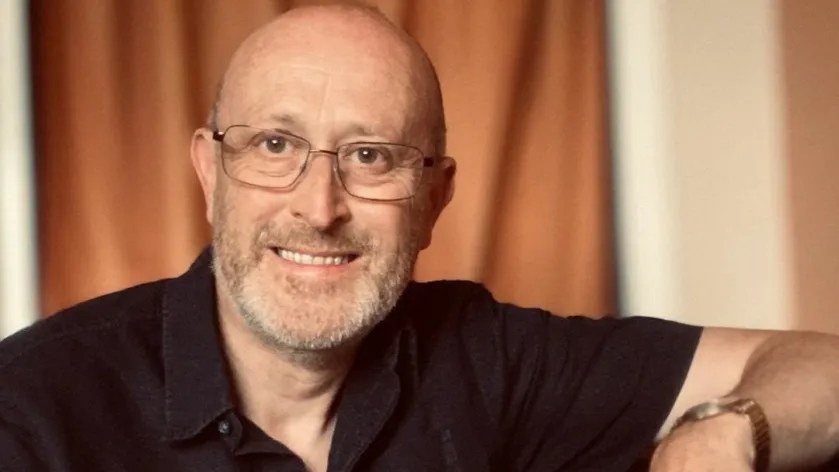
This atmospheric piece for solo piano, whose Afrikaans subtitle ‘Wind oor die Branders’ translates as Wind over the Waves, is by Richard Pantcheff  (b.1959). It comes from ‘Nocturnus’, a suite of six pieces written for different instruments; the final work in the suite is 4th December 1976, written in memory of Benjamin Britten on the fortieth anniversary of the composer’s death. Pantcheff was mentored in composition by Benjamin Britten in the last years of Britten’s life, and his music displays a distinct affinity with Britten’s soundworld, as well as that of earlier English composers including Vaughan Williams, Herbert Howells, Gerald Finzi and Elizabeth Lutyens.

A prolific composer of choral, organ, chamber and instrumental works, Richard Pantcheff was trained in choral music and composition from an early age, initially as a chorister at Ripon Cathedral, and studied music at Christ Church, Oxford, under Simon Preston and Francis Grier. His music has been widely performed and praised for its originality and technical brilliance, combined with intellectual and emotional depth.

I discovered this piece through ‘De Profundis Clamavi’, a recent recording by British pianist, and friend of mine, Duncan Honeybourne. Duncan is a keen advocate of English music and a champion of lesser-known repertoire, and his recording on which ‘Nocturnus V’ appears (together with Pantcheff’s substantial Piano Sonata, of which he is dedicatee) contains no less than eight world premiere recordings.

The piece is minimalist in style. Its title ‘Nocturnus’ obviously suggests a Nocturne or night piece, and although this work makes stylistic reference to Chopin’s Nocturnes in its flowing accompaniment (almost continuous semiquavers to suggest both waves and wind), it is perhaps closer to Britten’s ‘Night Piece’ (which also appears on ‘De Profundis Clamavi’) and ‘Night’ from Holiday Diary in atmosphere, harmonic language and some of its textures. But while the middle section of Britten’s ‘Night Piece’ is unsettled, full of curious nocturnal twitterings and scurrying, Pantcheff exchanges the fluid semiquavers for a rising chordal figure in triplets which climaxes in fortississimo (fff) chords high up in the piano’s register. The effect is hymn-like and joyful. The music then subsides and pauses, before the semiquaver ‘waves’ return, now in the bass, with soft, piquant chords in the treble.

Although not particularly difficult (I would suggest this piece is around Grade 5-6 standard), the challenge for the player comes in retaining evenness in the semiquaver figures and sustaining long notes in the other register. Sparing use of the pedal will avoid muddying the sound in these sections, while the middle section requires greater projection and brightness of sound. It’s a satisfying piece to play as it offers the player plenty of scope for expression and “sound painting” to portray the music’s inspiration. 


‘Nocturnus V’ by Richard Pantcheff, played by Duncan Honeybourne

Buy the score

Guest posts are invited for this series. If you would like to submit an article about repertoire you are working on or enjoy playing, please get in touch


This site is free to access and ad-free, and takes many hours to research, write, and maintain. If you find joy and value in what I do, please consider making a donation to support the continuance of this site

Make A Donation

World Piano Day, an annual worldwide event founded by a group of likeminded people, takes place on the 88th day of the year (29th March this year), because of the number of keys on the instrument being celebrated.

This playlist mostly comprises music I’ve learnt or am learning/revisiting, or that I simply like. I’ve made it collaborative so that others can contribute and between us we can celebrate World Piano Day, the wondrous instrument that is the piano, and its enormous breadth of repertoire

This quote from a Meet the Artist interview with pianist Antoine Préat perfectly expresses my relationship with many composers and their music.

When I returned to playing the piano seriously in my later 30s, after a break of some 20 years, there were pieces which I felt I “should” be playing but which never felt comfortable to me. This feeling grew when I co-founded a piano meetup group where members played all sorts of repertoire. I envied those who seemed so at home with the music of Chopin or Ravel, two composers whose piano music I adore, but which does not necessarily love me back.

Of course, we should never feel obligated to play certain pieces or composers out of a sense of duty; the “tyranny of the shoulds” is often inculcated in our childhood music lessons, reinforced in music college, and – for the professional musician, further emphasised by teachers, peers, agents and critics – or for the amateur, at piano clubs and on courses. Students and those at the beginning of their career probably feel the pressure of this sense of obligation most acutely, and it takes confidence to stand firm against the tide of opinion that says one should be playing certain Beethoven sonatas, etudes by Chopin and Liszt, or the concertos of Rachmaninoff, Tchaikovsky or Grieg in order to be recognised and endorsed by those who may help further one’s professional career and reputation. 

We’re very lucky as pianists; we have a vast repertoire to choose from and this means there is music within it to suit our varied, wide-ranging tastes. It is interesting to note that some of the greatest pianists have chosen to focus on a fairly narrow corner of the repertoire – for example, Alfred Brendel, Andras Schiff or Maria Joao Pires. It really isn’t necessary to have an affinity with or be able to play everything, though of course there are some pianists who seem perfectly at ease with a very broad sweep of repertoire, namely Maurizio Pollini or Marc-André Hamelin. Stephen Hough is quite open about his “uneasiness” about playing the music of J S Bach and I think it is a mark of a pianist’s honesty to admit that certain repertoire or composers do not suit them. 

Our affection for the music we choose to play is, I believe, one of the greatest assets in the learning process. It is what helps to keep us focussed and ensures we will return to the music day in day out to practice and refine it. If you don’t love the music you’re playing, it’s unlikely it will love you back, and the practice of practising will feel arduous and challenging. I recall feeling like this quite a lot of the time when I was having piano lessons as a child, where my first teacher would always select the music I was to learn, without giving me any choice (when I taught piano, I made sure my students played music they liked and enjoyed). It was only when I had passed my grade 5 piano exam, and moved to a new teacher, that I had the foundations of technical facility and the confidence to explore repertoire on my own. It was at this time that my love of Schubert’s piano music developed – and it remains amongst my most favourite music still. 

One of the great pleasures of being an amateur pianist, perhaps the greatest pleasure, is that you are not – or shouldn’t be – under any obligation to play music because someone else said you “should”! Of course sometimes a teacher will suggest repertoire which they feel may help with an aspect of technique or simply that it may appeal to your musical taste and sensibilities – and a good teacher should know and appreciate their students’ tastes. But if it doesn’t appeal, have the confidence to say “it’s not for me”. It’s also worth bearing in mind that our tastes change, and, as our technical facility improves, repertoire we previously loved but might not have been able to play, becomes more accessible.

If the music doesn’t love you back sufficiently for you to play it yourself, simply enjoy hearing others play it – on disc, on the radio, in concerts and via streaming services.

The author Umberto Eco had a library of an astonishing 30,000+ books, most of which he had not, and probably never did read. Nassim Nicholas Talib (author of The Black Swan) calls this an “anti-library” and believes it represents an ongoing intellectual curiosity and thirst for knowledge, for all those unread books contain what one does not know yet. The more one reads, the more one’s knowledge increases; the books one hasn’t read are a research tool, a means to extend one’s knowledge further.

The same can perhaps be said for musical scores. On the bookcase in my piano room are many scores of music which I may never play, but I have acquired those scores out of curiosity, and many of them represent, for me at least, an acknowledgement that my musical knowledge continues to grow. Some scores are also research tools, purchased for their detailed notes and annotations rather than the music itself; others I bought because I simply wanted to possess them. Some I have been sent by composers, hopeful that I may play their music. All of them are the music I haven’t played yet.

Years ago, long before I started writing this blog and interviewing musicians on a regular basis, I went to interview a concert pianist at his home in the leafy suburbs. One wall of his piano room/office was filled with scores, floor to ceiling – dusky blue Henle, brick-red Weiner Urtext and pale green Peters editions and many more. This collection, including some very well-thumbed, much-used editions, represented a lifetime’s work in the profession, but I suspect there were more than a few scores that may never be opened, yet they had their place in this library as the music he hadn’t played yet.

In the world today, knowledge can be accrued incredibly easily and quickly via the internet, and this accrual of knowledge becomes a compulsive need to enable us to rise in the hierarchy of  perceived “intelligence” or “knowledgeability”. I am always rather suspicious of people who tell me they have played all of Beethoven’s piano sonatas, this completist approach suggesting a certain lack of humility, as if to say “that’s it, I have mastered the instrument and its literature!”. I prefer to subscribe to a more humble approach, based on the knowledge that a piece of music is never truly “finished”. People who lack this humility may enjoy a sense of pride at having ‘conquered’ Beethoven, without acknowledging that learning is an ongoing process.

The music we haven’t played yet may well be the most interesting in our repertoire, for it offers new possibilities in broadening our musical knowledge, extending our technical and artistic facilities, and widening our cultural horizons. It is a sign of an ever-expanding understanding of our competence and a necessary spur to mastery.

In fact, all the music we haven’t played yet represents a wondrous opportunity – it is just waiting to be explored!

collections-music-scores