by James Holden

Stephen Hough’s recording of Liszt, ‘Bénédiction de Dieu dans le solitude’, Harmonies poétiques et religieuses, S.173/III on the CD Rhapsodie espagnole; Mephisto Waltz; Bénédiction de Dieu  released on Virgin as 724356112926.

There are moments when the piano ceases to sound like a box full of hammers being thrown against metal. It ceases to be a blacksmith’s instrument, all anvil-struck notes, all blows and impact.

Stephen Hough’s performance of Liszt’s ‘Bénédiction de Dieu dans la solitude’ is one such moment.

I first heard this recording when I was still relatively unversed in the nineteenth-century piano repertoire. I had listened to some Chopin and knew a few of Mendelssohn’s Songs Without Words.I wasn’t familiar with anything by Schumann and knew no Thalberg, Alkan or work by any of the other virtuosos.What little I knew of Liszt I had learnt from reading, and not least from those references to him in Proust.

Like so many other happy cultural discoveries, I first borrowed the CD on which this recording is to be found from the local library (Barnsley). It was there on the racks with the other discs, compilations, popular classics, opera box sets and the like. Stephen Hough, Liszt: Rhapsodie espagnole; Mephisto Waltz; Bénédiction de Dieu.I turned it over, looked at the track listing on the back, weighed it up and then walked it to the desk. I thought, ‘Why not?’

The love I immediately felt for the ‘Bénédiction’ made me a confirmed musical Romantic.There is something in its combination of simple melody and complex accompaniment that, from the very first notes, seems to care for me, the listener, and seeks to protect me. This is not just music to love but music by which one is loved. I’ve only ever had this same feeling with a few other recordings, including Björk’s song ‘Undo’ from her 2001 album Vespertine.

Under Hough’s hands, Liszt’s notes spread outwards; they diffuse themselves. There is nothing struck here, or so it seems, nothing metallic. All is radiated.

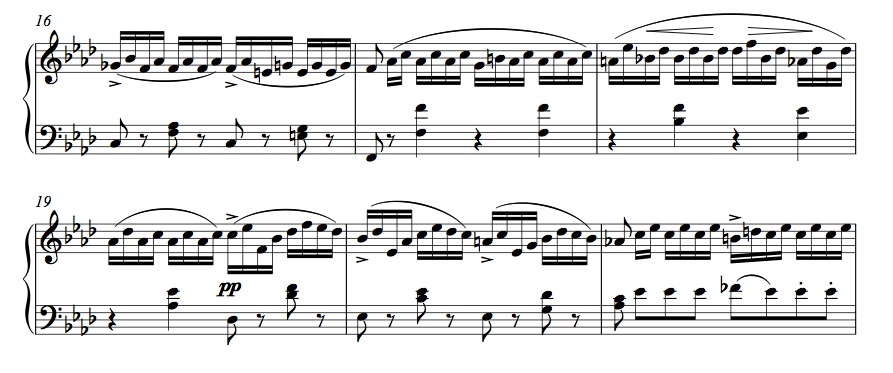
Hough’s gestures respect both the work’s grandeur and the composer’s profound religiosity whilst never straining for emotion or effect. Consider, for example,the moment when the right hand part is extended by a series of arpeggios (the passage marked ‘poco a poco animato il Tempo’ on the score). The upper notes seem to open out of the main melodic material, as though the chord was always already there, in the tune, and has only now risen to an audible volume.What great touch on the keyboard; what pedal control!

No other performance of the ‘Bénédiction’ has affected me in quite the same manner. Leslie Howard’s recording of it for Hyperion is undoubtedly brilliant but its brilliance is that of the bright midday sun reflected off of polished stone surfaces. It’s a little too insistent, too sharp edged, a performance whose volume and clarity causes the overall effect to be lost. The more Howard makes things visible the harder it is to see the work. I own a recording of Claudio Arrau playing this piece that is, by contrast, seemingly formed of those reflective stone surfaces themselves. It gives the impression of blocks of notes being moved into place. The Andante is especially hard, too clearly delineated, too marked in outline.

For all its wavering poetry, Hough’s performance is unwaveringly certain of the work’s coherence. As the piece stretches out to over seventeen minutes this is very welcome – essential, even. To take some examples: we can sense the connection between the partial melody in bars 44-49 and that in the later ‘quasi Preludio’ passage; and at the end of that same Preludio, just before the return of the main melodic material, Hough calls our attention to the communication between the hands, the passing backwards and forwards of the notes. In the Coda we can feel everything combine in one final, calm cadence.

Hough’s recording has affected my own playing. I’m only an enthusiastic amateur at best and doubt that I’ll ever be able to play the ‘Bénédiction’ properly and in full (I can play the comparatively simple Andante and quasi Preludio sections). However, my joy at listening to this recording did lead me to learn Liszt’s ‘Schlummerlied’, another work in F♯ major, one with a similar, albeit much simpler, repeating C♯-D♯ right hand figure. When I worked at this piece it was like working at a ‘Bénédiction’ in miniature, only one within my ability range.

As the piece ends, as the last chord dies away I have felt myself suspended, unwilling to speak or move, to intrude into the space created by Liszt and Hough.

Dr James Holden was born in Ashford and educated at Loughborough University. He graduated with his PhD in 2007. He is the author of, amongst other things, In Search of Vinteuil: Music, Literature and a Self Regained (Sussex Academic Press, 2010). His website is www.culturalwriter.co.uk and he posts on Twitter as @CulturalWriter

© James Holden 2014

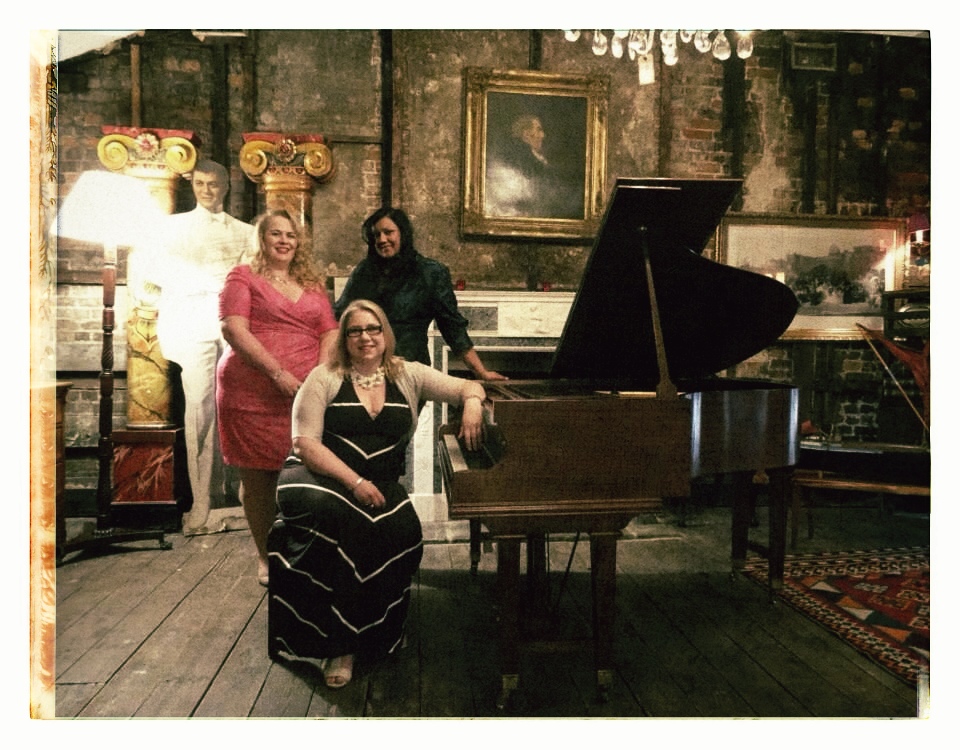
A stag with an impressive set of antlers surveys the room, while a white-tuxedo’d Tony Curtis keeps watch over the proceedings from his niche in a corner near the piano, a John Hopkinson baby grand with a rosewood case. Glittering chandeliers hang from the ceiling, illuminating the exposed brickwork on two walls of the room and highlighting the colours of the stained glass panels in the elegant sash windows. Exotic oriental rugs are draped over vintage British Rail first class seats, and at the back of the room, a glass cabinet is filled with antique pharmacy jars. Welcome to Brunswick House, part of the London Architectural Salvage and Supply Co, a Georgian mansion just five minutes from London’s Vauxhall Station, flanked by the brand new 5-star hotel and luxury apartments of One Nine Elms. Brunswick House is a treasure trove of antiques and salvaged curiosities, and on Thursday night last week, it provided a wonderful and eclectic venue for a fine evening of music making and conviviality.

IMG_2438
Lorraine Banning, Frances Wilson & Lorraine Liyanage (and Tony Curtis) at Brunswick House

“A superb evening – huge fun was had with a mix of musical genres in a delightfully decrepit and stylish Georgian mansion. Best of luck promoting these salon recitals, the way music is meant to be played and heard.”

Rosalind, audience member

The concert was part of the South London Concert Series, and featured a recital by BBC Music Magazine’s “rising star” Emmanuel Vass, together with supporting performances by three talented members of the London Piano Meetup Group, who despite not being “professional” pianists, played with equal poise, musical sensitivity and professionalism. The diverse programme matched the unusual setting, with music by Bach, Chopin, Turina, and Mozart together with Emmanuel’s own transcriptions of pop songs by Queen and The Prodigy. In keeping with the SLCS ethos of recreating the nineteenth-century musical salon, an hour of music was followed by much conversation and socialising in the ante-room next to the Saloon, and continued downstairs in the restaurant adjacent to the house.

View more photographs from the Brunswick House concert


Returning to old repertoire can be extremely satisfying, and one often discovers new things about the music when returning to it after a break. I also recall all the reasons what I like about the repertoire and why I selected it in the first place.

My teacher has cautioned me about reviving repertoire I learnt as a teenager. This is good advice, for despite a gap of over 30 years, all the impetuous errors of youth seem ingrained in the piece and the fingers, and undoing these problems can be nigh-on impossible. Against my teacher’s advice, however, I revived Schubert’s E-flat Impromptu for my ATCL Diploma in 2011, because I needed a “fast piece” in the programme. I had not touched the piece seriously for over 30 years, yet I was pleasantly surprised at how much of it I could remember (it must be said that this is not a particularly difficult piece to memorise, being constructed from repeating patterns and motifs). But working from the old Editions Peters score I had as a teenager meant that all the errors were still there, as well as my then teacher’s annotations. In order to learn the piece carefully, I ditched the dog-eared score and purchased a new Henle urtext edition. In effect, I started again from scratch with the piece: I learnt new fingering schemes, thought carefully about the structure and atmosphere of the piece, and was delighted to have it described as “an assured and stylistically accurate performance” by the diploma examiner. Having taken the trouble to re-learn the work carefully, it is now very securely lodged in fingers and memory.

People often ask me whether it is “hard” to revive old repertoire. In general, I have to say I have found it relatively easy to return to previously-learnt repertoire, though this isn’t always the case (the ‘Toccata’ from Bach’s 6th Partita will take some careful work if I want to revive it). However, one can take steps to ensure that once learnt a piece can be revived and made ready for performance relatively quickly.

Lately, I have been enjoying revisiting some of Szymanowski’s Opus 50 Mazurkas, the first two of which I played for my ATCL recital. The pieces felt different without the pressure of an exam hanging over me, and I felt I was playing them in a freer way as a result. I am also working on Rachmaninov’s G minor Etude-Tableau (Opus 33, No. 8), for my debut in the South London Concert Series in May (the piece will be paired with Szymanowski’s Mazurka no. 1). It is a mark of how carefully I practised the piece in the first place that within an hour of practising earlier today, I felt it coming back together nicely. Of course there are elements that will need some careful, detailed work (the cadenza, for example), but overall, it is still in pretty good shape. Getting it “concert ready” should not take too long.

Professional pianists will have many pieces “in the fingers” which can be downloaded and made ready for performance in a matter of days. This may include 20 concertos or more, most of Beethoven’s 32 Sonatas, many of Bach’s 48 Preludes and Fugues, plus other pieces which are ‘standard’ repertoire: Mozart and Schubert sonatas, works by Chopin, Schumann, Brahms and Liszt, much of Debussy and Ravel etc., and popular ‘standards’ from the 20th Century repertoire by composers such as Messiaen, Bartok, Stravinsky, Ligeti, Berio, Berg, and Schoenberg. Careful learning and preparation mean that repertoire can be learnt, revived and kept going simultaneously. It is this kind of deep, thoughtful practise that is essential for ensuring repertoire remains in the fingers (and brain) even if one is not practising it every day.

Some thoughts on reviving repertoire successfully:

  • Recall what you liked about the pieces in the first place. What initially attracted you to the pieces? Rekindle your affection for the pieces when you revisit them
  • Don’t play through pieces at full tilt. Take time to play slowly and carefully.
  • Trust your practise skills. Be alert to issues as they arise and don’t allow frustration to creep in.
  • Look for new interpretative and expressive possibilities within the music. Try new interpretative angles and meaningful gestures.
  • Don’t hurry to bring the piece up to full tempo too quickly. Take time to practise slowly and carefully.
  • Schedule performance opportunities: there’s nothing better to motivate practise than a concert date or two in the diary.

Ronald Center: Instrumental and Chamber Music 

Volume One:

Music for Solo Piano

Catalogue Number: TOCC0179
EAN: 5060113441799
Release Date: 2 September 2013

Christopher Guild, piano

Sometimes described as “the Scottish Bartok”, composer Ronald Center (1913-73) was born in Aberdeen, the youngest member of a musical family. Despite his active working life as a soloist, accompanist, organist and teacher, his music was somewhat overlooked during his lifetime and after his death, and the centenary of his birth was rather lost amid the furore of last year’s composer anniversaries of Britten, Wagner and Verdi.

Fellow Scotsman and pianist Christopher Guild is a crusader for the neglected Center, and makes a persuasive case for Center’s piano music in his new disc on the Toccata Classics label. There are intimations of the percussive spikiness of Prokofiev, the folk idioms and harmonies of Bartok, the simplicity of Poulenc, the wit and humour of Shostakovich, and the sensuality and stately parallel harmonies of Claude Debussy (in a work entitled ‘Hommage’ which is dedicated to Debussy). Hints of Scottish airs make intriguing appearances in the music, reminding us of the composer’s heritage. There are moments of haunting beauty and wistful lyricism, such as in the ‘Larghetto’, the middle movement of the ‘Sonatine’, the ‘Impromptu’, or the first of the Six Bagatelles. Meanwhile, the Piano Sonata opens with a sprightly Bartokian Allegro molto,

Alert to the musical and emotional cross-currents in the music, Guild offers a sensitive reading of these interesting and varied works that is insightful, colourful, brimming with rhythmic vitality, and meticulously presented on this high-quality recording. An excellent introduction to Ronald Center’s oeuvre.

Toccata Classics

Meet the Artist……Christopher Guild