(photo: K Miura)

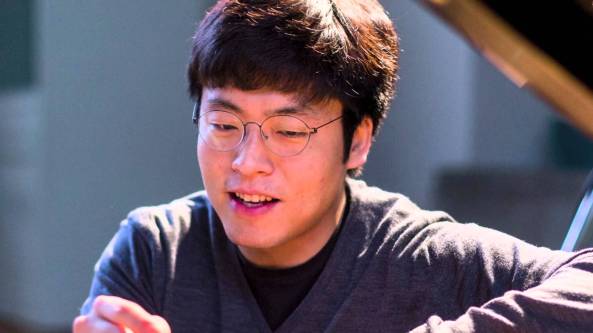
In a concert celebrating 25 years since his Wigmore Hall debut, Polish pianist Piotr Anderszewski presented a programme of music with which he is most at home – works by Bach, Schumann and Szymanowski, with an encore by Janáček. By his own admission, Anderszewski “cannot play just anything” and chooses to perform only those composers he feels a strong urge to play. By the standards of most pianists active today his repertoire might be regarded as “narrow”, but it is this limited focus which results in playing which is both fastidious (without fussiness) and spontaneous, and such spontaneity is clearly the result of a long association with the music coupled with a patient, thoughtful study of it.
Read my full review

The transfer of the International Piano Series to St John’s Smith Square while the Southbank Centre undergoes a facelift is proving successful and popular. An elegant venue with a fine acoustic and a beautiful Steinway piano, coupled with one of the UK’s most gifted pianists active today, made for an evening of music making of the highest calibre, in a diverse programme which opened with Schubert and closed with Rachmaninov.

Steven Osborne
(photo: Benjamin Ealovega)

Schubert’s second set of Impromptus D935 are less frequently performed than the first set, with the exception of the third of the set (a set of variations based on the Rosamunde theme). The first and the last, both in F minor but very contrasting, were presented in this concert. The word “Impromptu” is misleading, suggesting a small-scale extemporaneous salon piece or album leaf. Schubert’s Impromptus, composed in 1827, his post-Winterreise year of fervent creativity, are tightly-structured and highly cohesive works.

There is nothing “small scale” about the opening of the first of the D935, and Steven Osborne‘s account of this was brisk, almost terse, and bold, with a grandeur redolent of Beethoven at his most expansively gestural. But Schubert does not linger in this territory for long and soon the music moved into a far more introverted realm. The middle section, tender duetting fragments over an undulating accompaniment, was poetic, intimate and ethereal. By contrast, the other F minor Impromptu was infused with Hungarian flavours, with offbeat rhythms and twisting scalic figures. Osborne pulled it off with a modest bravado, alert always to Schubert’s miraculous harmonic shifts and fleeting moods.

Read my full review here

‘Tis the season for “top 10” and “best of” the year lists (indeed, such is the popularity of these lists that it would appear that every music critic at The Guardian has issued their own Top 10 Concert/Operas of 2015).

Once again, I have enjoyed a busy year of concerts, reviewing 21 concerts in London for Bachtrack.com, plus various concerts at St John’s Smith Square, the 1901 Arts Club, St Mary’s Perivale and my local music society in Teddington.

“Hits” of 2015 include all five Prokofiev Piano Concertos in a single concert at the Proms, a musical marathon for the orchestra (LSO) and audience alike, with particularly fine performances by Daniil Trifonov and Arcadi Volodos. Other stand out Proms were Sibelius first and second symphonies, Thierry Escaich playing the Albert Hall organ, and Bernard Haitink conducting the Chamber Orchestra of Europe in Mozart’s Piano Concert K488, with Maria Joao Pires as soloist (an exquisitely measured and elegant performance), and Schubert’s ‘Great’ C Major Symphony, D944. My enjoyment of many of the Proms I attended this year was undoubtedly enhanced by my concert companions.

At the Wigmore, Garrick Ohlsson’s Skryabin Focus residency proved enlightening and insightful, with Ohlsson revealing himself as a sensitive and colouful interpreter of this curious, sensuous and often totally over the top music. This was definitely an opportunity to surrender oneself to the composer’s unique soundworld in the hands of a most capable and modest pianist.

Another revealing concert was given by Antonii Baryshevskyi, winner of the Arthur Rubinstein International Piano Master Competition. He presented an engaging programme which made interesting links between Scarlatti and Ligeti, together with music by Chopin, Messiaen and Schumann which revealed Baryshevskyi to be a pianist at home with a wide variety of repertoire and styles.

Maria Joao Pires gave a delightfully intimate and atmospheric joint concert with one of her protegés, Pavel Kolesnikov, in music by Beethoven, Schubert and Schumann (both solo works and music for piano 4 hands).

One of the most eagerly anticipated concerts of 2015 – and not necessarily for all the right reasons – was Ivo Pogorelich’s “this is not a comeback” concert at the Festival Hall in February. It was a curious curate’s egg of an evening, with some very uneven, eccentric and clumsy playing combined with a blistering and masterful rendition of the Brahms Paganini Variations. The critics were universally damning, yet I felt rather sad that Pogorelich had been submitted to such vitriol. Whatever one may think about the quality of his playing, together with some very strange interaction with the page turner, it was undoubtedly an “interesting” concert, and somewhat refreshing to hear such personal piano playing as opposed to the “louder faster” school of pianism one encounters rather too often these days…..

Talking of which, against my better judgement I decided to hear Lang Lang at the Royal Albert Hall, and for me the first time I’d heard the Chinese poster boy pianist since 2002. There were flashes of insight and sensitivity, particularly in the slow movement of the Bach Italian Concerto, but the Chopin Scherzi were a vehicle for his trademark flashy, overblown virtuosity, the subtlety of Chopin’s writing lost in a whirlwind of noise and velocity. ‘The Seasons’ by Tchaikovsky was simply the wrong repertoire for the size of venue, but here there were also moments of beauty and hints of a more mature approach.

Which leads me to my “miss” of 2015, the much-lauded young Polish Canadian pianist Jan Lisiecki who played much by Mozart, Mendelssohn, Liszt and Chopin’s Opus 25 Etudes at the Wigmore Hall in October. I had read much about Lisiecki, very fulsome and often gushing praise and I was curious to hear him live. Sadly, most of his concert was a display of youthful arrogance and immaturity which manifested itself in some very ugly and unsubtle playing. Jan is only 20 and he has plenty of time to develop as an artist – and I sincerely hope he does.

In addition, I’ve also enjoyed fine performances this year by Jeremy Denk, Murray Perahia, Stephen Hough (including the premiere of his new Piano Sonata), Marc-André Hamelin, Yevgeny Sudbin, François-Frédéric Guy, Peter Donohoe, Steven Osborne and Warren Mailley-Smith. 2016 seems set to begin on a high with concerts at the Wigmore by Pavel Kolesnikov, Steven Osborne, Piotr Anderszewski, Denis Kozukhin, and the continuation of Warren Mailley-Smith’s survey of Chopin’s complete piano music at St John’s Smith Square, a lovely venue for piano music. Further ahead in 2016, I am very much looking forward to Andras Schiff’s ‘Last Sonatas’ programmes at the Wigmore, exploring the final three sonatas of Haydn, Mozart, Beethoven and Schubert, and Daniil Trifonov in June. There is much to enjoy in 2016 and I think my concert diary is likely to be as busy as it has been this year.

Link to all my Bachtrack reviews and articles

Wigmore Hall

International Piano Series

St John’s Smith Square

Special offer – readers of this blog can enjoy discounted tickets. Use code CEP10 when booking online or by telephone

Book tickets

On 4th September 2015, British pianist Warren Mailley-Smith embarked on year-long survey of the complete piano music of Fryderyk Chopin through a series of 11 concerts at St John’s Smith Square, London.

Chopin’s life and music was a phenomenon. Unlike most composers, his music has never been out of fashion and this series is a rare opportunity to explore the reasons for his enduring popularity. The concerts focus on various aspects of Chopin’s output, including the Waltzes, the Preludes, the heroic Polonaise, the Ballades and the Scherzi.

Here Warren to explains what makes the piano music of Chopin so special and describes how he planned and prepared for this pianistic marathon.

What do you love about Chopin?  

Chopin is one of those composers whose music is equally rewarding to play, as it is to listen to. That may sound like an obvious thing to say, but it isn’t necessarily always the case. Some composers can create the most heavenly music to listen to, for example Beethoven or Rachmaninov, but it doesn’t necessarily ‘fall under the fingers’ or ‘lie in the hand’ in the same way that Chopin does.

Why is Chopin’s music so amazing to play?

His music is written in a way that allows the hand to follow a very natural movement over the keys, but is so much more than that. There is something very sensual and beautiful about the whole experience of PLAYing Chopin which is present in almost every one of his pieces. They are so driven by this ever-­present, persistent  cantabile line, which really gives you, as a performer, a feeling of singing through the piano.

Chopin also has the most amazing way of building up the most deeply felt and exhilarating climaxes in his music so that it can becomes the most overwhelming feeling when you are actually  performing  it.

Tell us more about your feelings on Chopin’s music  

For me there has always been something very exciting and gratifying about the way Chopin uses harmony to surprise and enthrall – for example, in the 2nd subject of the Barcarolle, or the transitional passage in the G-flat-major Impromptu. And in equal measure the way that he uses it to say something profound – as in the opening bar of the Polonaise Fantasy -­ and magical, for example, in the middle section of the Scherzo No. 3. But above  all, it’s the way that Chopin uses his harmonic progressions to build up to the most overwhelming climaxes,  for example in the last full statement of the theme in the 4th Ballade.

What is it like to play some of Chopin’s hardest music?

The short answer is exhilarating. Chopin rarely writes difficult music ‘for the sake  of  it’ – and there’s always an underlying musical idea, phrase or shape that  is involved. So, even when your fingers are flying around at 60 notes a second, your brain is able to focus on the bigger picture which makes it easier to make the passage sound convincing. But of course the complex passages (of which there are many!) require hours of slow, careful, repetitive practice in order to train the fingers, almost (but not quite) into ‘auto pilot’ which allows you to take your focus away from each individual note and concentrate more on the bigger shapes in the music – and of  course certain key turning points!

Concept of the programmes  

When you have an almost infinite number of possible combinations of pieces to build 11 programmes, it becomes necessary to have a structure behind it.  So I decided each programme had to:

  1. feature an important work, or group of works that stands out from his output as being exceptional or ground­‐breaking in some way.
  2. contrast well-known Chopin with lesser-known Chopin
  3. contrast early Chopin with late Chopin
  4. follow a chronological thread, through the Mazurkas.
  5. offer a sufficient contrast of moods, emotions and colour for the audience
  6. be well timed, with good key relationships

It’s actually been a lot of fun designing them over the past 3 years – and, as you can imagine, there has been a lot of tweaking, and juggling over that time.

Journey of the series  

Each individual programme is designed to stand alone as a compelling presentation of the composer’s genius. However, the series as a whole is designed to take you on a bold journey from his Op 1 in the first concert through to one of his last masterpieces, the breath-­taking Sonata No. 3.  By experiencing EVERYTHING, we can gain a fuller understanding of both the music and the man.

What is so special about Chopin  

As a man, Chopin was highly refined and reserved in manner, moving as he did in the upper echelons of society. But his music belies a highly-charged emotional and sensual depth – to the extent that, I believe he was using his music to express what he felt unable to say in words -­ or indeed actions.  It is surely the underlying emotional depth in every note he wrote that accounts for the enduring popularity of his music. 200 years on and his music is arguably more popular today than it has ever been, bearing in mind that his music has never really been out of fashion!

What does this series mean to you?

This is a truly amazing opportunity for a performer to go on such a journey with an audience.  Although it will be an uplifting experience for me to pass my hands through Chopin’s entire works, I believe it will also be a great experience to offer audiences an opportunity to get to know the music of this great genius of the piano a little better and hopefully discover some  new favourites whilst reacquainting themselves with old ones!  This is something I have wanted to do for nearly 10 years and so for me it is the realization of a great ambition.

Why take on the whole piano works of Chopin?  

When you learn a piece of music by a composer, you obviously learn a little about their style, their feelings and the composer themselves. When you learn a second piece -­ you often discover something further, something contradictory or complimentary. The more works you learn, the more you learn about how to interpret any given piece by that composer and you start to build a very comprehensive picture of both the music and the man. I’ve obviously been playing Chopin for many years – and  after a while you start to fill in the gap your repertoire and before you know it, it’s not quite such a mammoth task as it might first appear.

This also happens at a very relevant time in my life. I will be the same age when I start the series as Chopin was when he died. It is quite a humbling feeling to have absorbed so many masterpieces, written by the same person in so few years

Why do this in London? 

As a Londoner, I began my performing career here in London nearly 20 years ago, at the same venue. I was just thrilled to have the opportunity to give these concerts at St John’s as it is a wonderful feeling to return to the same stage, with so many experiences of performing now behind me. I can honestly say that I am now a very different artist as a result of the many concerts I’ve given since m  student days and the many thousands of hours of practice that I’ve undertaken since then!

Have you got any plans to take the series to Poland? 

I certainly have plans to take these pieces with me everywhere I go from now on!

How long does it take to learn the whole cycle?  

I’ve spent 4 years planning these concerts. But that certainly hasn’t been 4 years of uninterrupted practice. Other concerts and demands have often taken priority for large chunks of time.  But I could not have prepared it any sooner, as the many big, complex works simply take a long time to ‘settle  in’ and you can’t force that number of notes into your fingers all in one go!

Are you doing it all from memory?

That is most certainly my intention. Simply because I believe one can perform to one’s best without the music there, because it removes a constraint between me and the audience.  Most of all I want the audience to feel that the focus of my attention  isn’t on the pages in front of me, but that my whole attention is focused on communicating what is in my fingers, to them. That is the goal!

How many hours a day do you practice?  

It really varies so much from day to day. But it doesn’t seem to matter how many hours practicing  I  do – 2  or 12 – I  always end up wanting to do a bit more.

Why do so many pianists love playing Chopin?  

I am sure that every pianist has had a slightly different reason for playing Chopin.  But the bottom line is that people love listening to his music and to watch a pianist performing his music live takes that experience to a new, more personal and heightened level. But for pianists themselves, I think that Chopin consistently takes the performer on a satisfying journey  – whether it’s a short hop, or an epic voyage, you nearly always feel better for having played it when you reach the last bar!

What will make these Chopin recitals different from the many others before them?

Any one combination of pieces paints a slightly different picture.  I think the 11 pictures, or programmes which I’ve painted, will portray striking contrasts of the man and his music. A number of pre-concert events are also designed to paint a truly comprehensive picture of his music and influences.  There will be talks, dancing, chamber music and workshops to complement the concerts.

How do you prepare for such a marathon as this?        

A lot of careful planning, advice, preparatory performances, honest self-assessment and a good deal of ruthless goal setting! It’s quite a lot of repertoire to learn over a sustained period of time, which makes it essential that one’s love for the music you are practicing is unquestioned. Therefore, it never really feels like work, but more like an extended indulgence in your favourite chocolates.

Browse the complete series of concert