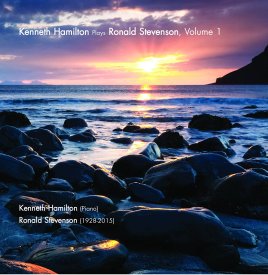
81u7rrpufwl-_sl1500_The Scottish composer Ronald Stevenson died in March 2015. He was one of the most important composers of our time, a composer-pianist in the grand tradition of Beethoven, Chopin, Liszt and Rachmaninov, probably best remembered for his monumental Passcaglia on DSCH, his tribute to Shostakovich composed in 1962. Stevenson has been compared to Liszt and Busoni: he transcribed many works for piano, and he was also a generous supporter of other musicians and students. His musical language is also redolent of these composers, as well Chopin and Alkan, but always with its own distinctive voice and an awareness of his adopted Scottish heritage.
This new disc by pianist and academic Kenneth Hamilton, which marks the beginning of Hamilton’s survey of Stevenson’s vast keyboard output, avoids the really large-scale works, though the Peter Grimes Fantasy is pretty substantial – Stevenson’s own Lisztian operatic paraphrase, in which themes from Britten’s opera are woven into music of expansive, inventive virtuosity and vivid imagination.

The disc works well as a “recital programme” offering an excellent introduction to Stevenson’s varied oeuvre. Alongside the more meaty works such as Beltane Bonfire and Symphonic Elegy for Liszt, there are shorter works, including transcriptions of Scottish folk songs and Three Elizabethan Pieces after John Bull, which are reminiscent of Percy Grainger in the combining of rich harmonies and textures with period music.

Hamilton studied with Stevenson and his understanding of the composer’s personal idioms is evident in his masterful handling of this music: robust and sweepingly romantic in the more bravura works, charming and witty in the shorter pieces with moments of luminous delicacy, as, for example, in Stevenson’s transcription of Rachmaninov’s Lilacs, which is all filigree textures, echoed in the opening of the transcription of Ivor Novello’s We’ll Gather Lilacs.

Recorded on a Hamburg Steinway at the School of Music, Cardiff University, Hamilton achieves a warm resonant sound which is particularly suited to the more expansive, textural works, though occasionally a little too dominant. Overall a most enjoyable disc with comprehensive liner notes by Kenneth Hamilton, which draw on his studies and conversations with Stevenson.

PRIMA FACIE PFCD050 1CD

primafacie.ascrecords.com

picWho or what inspired you to take up the piano and pursue a career in music?

I started piano aged 6 and didn’t show much interest in the first few months but a family trip to London when I was just 7 included a night at the Proms, with Malcolm Sargent conducting the Berlioz Symphonie Fantastique which just blew me away. When I got back home they couldn’t get me off the piano ! As far as a career was concerned I really had no idea what was entailed … I just drifted into it…one thing led to another. 

Who or what have been the most important influences on your career as a musician?

My teachers to start with: Marjorie Clementi, who sorted out my technique when I went to her aged 13 and who taught me to listen to myself for the first time. Gordon Green, who taught me how to practise in so many imaginative ways, and whose infectious love and enthusiasm for music overall was very inspiring. He really was a great human being. When I was a student Alfred Brendel’s early recordings were a great inspiration, and also the playing of so many pianists… Richter, Rubinstein , Kempff and Curzon to name a few of the most important.

What have been the greatest challenges of your career so far?

Recording all the major Schubert works for Radio3 in the 1980’s and more recently recording all the Beethoven Sonatas for Deux-Elles. Playing at the Proms was a great experience , but very challenging!

Which performances/recordings are you most proud of?

My performance of Rachmaninov’s Second Concerto at the Proms in 1989, and my recordings of the Beethoven Sonatas

Which particular works/composers do you think you play best?

Beethoven and Schubert for sure. Mozart’s Concertos, Brahms, Dohnanyi, and Debussy.

How do you make your repertoire choices from season to season?

I’ve started to play themed programmes in the last few seasons….The piano and nature for example this year including Beethoven’s Pastoral Sonata and shorter works by Liszt, Schumann, Dohnanyi Ireland and Debussy all inspired by nature. Next year The piano and Art …works by Liszt, Debussy and Granados culminating in Mussorgsky’s Pictures. Also a lot of all Beethoven programmes when recording the sonatas. Now all Schubert programmes in preparation for recording his works.

Do you have a favourite concert venue to perform in and why?

S0 many! – but Manchester’s Bridgewater Hall for concertos…. The clarity and immediacy make it so exciting. For solo it’s difficult to beat Kings Place. For chamber the warmth of sound in the Wigmore is very special

Favourite pieces to perform? Listen to?

Too many to list….but for listening I’m still as obsessed by Wagner now as I was when I discovered his music as a teenager. Haydn Quartets are an endless treasure trove…..

Who are your favourite musicians?

Again, where to start ? Just recently I heard two stunning performances from very contrasting pianists whose work I love and admire…….Richard Goode and Martha Argerich

What is your most memorable concert experience?

Taking part in the final concert of Kathy Stott’s Piano 2000 festival at the Bridgewater Hall in Manchester…all the Rachmaninov Concertos in one evening. I played No.2

What do you consider to be the most important ideas and concepts to impart to aspiring musicians?

Fidelity to the score and the communication of the music without personal interference. Meaning is more important than style, yet a sound knowledge of style is also necessary. An interest in all the works of the major composers, not just the piano music.

What do you enjoy doing most?

Apart from playing Schubert and Beethoven, walking on the hills of Scotland and the Lake District, cooking, watching films, and listening to Wagner


With an extraordinary career spanning over 4 decades, Martin Roscoe is unarguably one of the UK’s best loved pianists. Renowned for his versatility at the keyboard, Martin is equally at home in concerto, recital and chamber performances. In an ever more distinguished career, his enduring popularity and the respect in which he is universally held are built on a deeply thoughtful musicianship allied to an easy rapport with audiences and fellow musicians alike.


Read more about Martin Roscoe here

SOMM JUNE RELEASE: SOMMCD 259 

Release date: 29 April 2016

PROKOFIEV PIANO SONATAS VOL. 3, The “War Sonatas”, Nos, 6, 7 & 8

Peter Donohoe – piano

“Donohoe’s authoritative playing shines through in every work — he has lived with these pieces for a long time… In his hands every sonata makes a memorable impression, and the Fifth receives one of the finest performances I have encountered on disc. A wonderful anthology. Next instalment, please!”   Classical Ear (of Vol. I).

The recording is exemplary, fully projecting Donohoe’s massive dynamic range. The finale of the Second Sonata epitomises all that is Prokofiev, and, in Donohoe, all that is great Prokofiev playing… The helter-skelter character of No. 3 is perfectly conveyed through Donohoe’s impressive technique. There are performances of both No. 2 and No. 3 by Gilels in existence, and Donohoe loses little in that exalted company. It is No. 4 that is the highlight, though, a performance of magisterial intensity. No. 5 receives a performance of the utmost integrity. Magnificent” . International Piano (of Vol. I).

This intelligently planned programme is played by musicians fully attuned to Prokofiev’s expressive lyricism and humour… Raphael Wallfisch and Peter Donohoe give the music’s opening narrative a compelling sense of direction, making the gentle, inward quality of the exposition’s end all the more captivating.” *****  BBC Music Magazine (of Vol. II).

peterdonohoe

This is the third and final volume in Peter Donohoe’s highly-praised recordings of the complete Piano Sonatas of Sergei Prokofiev and SOMM are proud to have been able to capture his mature interpretative thoughts on the composer’s War Trilogy. Prokofiev was a magnificent pianist and, like so many of his predecessors and contemporaries, he would often reserve his most personal and intimate thoughts to the music he wrote for his own instrument. Sonatas Nos. 6, 7 and 8, written consecutively during World War II, reflecting on and reacting to the horrors of what was referred to in Soviet Russia during their titanic struggle against Hitler as the ‘Great Patriotic War’, drew from Prokofiev some of his greatest music, expressed through his own instrument, the piano, producing in the central sonata of the trilogy, No. 7, his most famous and brilliant piano music, with the exciting finale marked Precipitato (impetuous, headlong) depicting the ferocity and grit of the Russian attacks on the Nazi army. The beautiful Sixth Sonata is more personal and inward-looking, contemplative and moving, and the Eighth looks forward to a post-war world in which all conflict on Russian soil will have ceased.

Peter Donohoe has always been closely attuned to Russian music and particularly that of Prokofiev and his recordings of the War Trilogy go back more than 30 years. He first recorded the 7th Sonata in 1982 for HMV then again in 1991 together with the two other “War Sonatas”, 6 and 8 for EMI. He believes that Prokofiev’s Sonatas form one of the greatest piano solo cycles in the repertoire. ‘Prokofiev was creating these major works throughout his career — all of them are major and some are still underrated and I am delighted to have had the chance of recording, on SOMM, the complete cycle at last.’

Tracklisting:

Piano Sonata No. 6 in A, Op. 82 (1940)

[1[ 1. Allegro moderato

[2] 2. Allegretto

[3] 3. Tempo di valzer , lentissimo

[4] 4. Vivace

Piano Sonata No. 7 in B flat, Op. 83 (1942)

[5] 1. Allegro inquieto — Poco meno — Andantino

[6] 2. Andante caloroso – Poco più animato – Più largamente – Un poco agitato

[7] 3. Precipitato

Piano Sonata No. 8 in B flat, Op. 84 (1944)

[8]  1. Andante dolce – Allegro moderato – Andante dolce come prima – Allegro

[9]  2. Andante sognando

[10]3. Vivace – Allegro ben marcato – Andantino – Vivace come prima


Peter Donohoe  – biography

Peter Donohoe was born in Manchester in 1953. He studied at Chetham’s School of Music, gratuated in music at Leeds University and went on to study at the Royal Northern College of Music with Derek Wyndham and then in Paris with Olivier Messiaen and Yvonne Loriod. He is acclaimed as one of the foremost pianists of our time, for his musicianship, stylistic versatility and commanding technique.

Recent and forthcoming engagements include appearances with the Dresden Philharmonic, the BBC Concert Orchestra, RTE National Orchestra and CBSO (under Sir Simon Rattle), a UK tour with the Russian State Philharmonic Orchestra as well as concerts in South America, Europe, Hong Kong, South Korea, Russia and the USA. Other engagements include performances of all three MacMillan piano concertos with the BBC Scottish Symphony Orchestra, a series of concerts for the Ravel and Rachmaninov Festival at Bridgewater Hall alongside Noriko Ogawa, and performances with The Orchestra of the Swan. Donohoe is also in high demand as an adjudicator at piano competitions around the world, including the International Tchaikovsky Piano Competition, Moscow, the Queen Elisabeth Competition, Belgium, and the Hong Kong International Piano Competition. Recent recordings include two discs of Prokofiev pianos sonatas for SOMM, the first of which Gramophone described as “devastatingly effective”, declaring Donohoe to be ” in his element”.  Other recordings include Cyril Scott’s Piano Concerto with the BBC Concert Orchestra under Martin Yates for Dutton and Malcolm Arnold’s Fantasy on a Theme of John Field with the Royal Scottish National Orchestra and Martin Yates, also for Dutton.

Donohoe has worked with many of the world’s greatest conductors including Christoph Eschenbach, Neeme Järvi, Lorin Maazel, Kurt Masur, Andrew Davis and Yevgeny Svetlanov. More recently he has appeared as soloist with the next generation of excellent conductors such as Gustavo Dudamel, Robin Ticciati and Daniel Harding.

Peter Donohoe is an honorary doctor of music at seven UK universities and was awarded a CBE for services to classical music in the 2010 New Year’s Honours List.

[Source: press release]

Meet the Artist……Peter Donohoe


Olivier Messiaen’s monumental work Vingt Regards sur l’enfant Jésus (Twenty Contemplations on the Infant Jesus) surely ranks amongst the “greats” of the piano repertoire, standing shoulder-to-shoulder with Bach’s Well-Tempered Clavier and Beethoven’s 32 Piano Sonatas in terms of its scale, variety and pianistic challenges. It is one of the most ground-breaking works in 20th-century piano music, a work which has accrued iconic status and deep respect. It combines richly-hued romanticism and the spare modernism that influenced Messiaen’s pupil, Pierre Boulez, and reveals many of Messiaen’s preoccupations and interests – birdsong, eastern rhythms and instruments, cosmology, religious iconography and his own deeply-held Catholic faith.

French pianist Pierre-Laurent Aimard enjoys the special distinction of having known Messiaen personally, and he studied with Yvonne Loriod (who premiered the work in March 1945 and who became the composer’s second wife in 1961). Aimard has a long-standing and highly-respected relationship with Messiaen’s piano music and it remains a core part of his repertoire. He is also a champion of modern and contemporary piano repertoire, and as a result he brings to this music a special understanding of Messiaen’s unique approach to pitch, rhythm, sonority and attack.

Read my full review here