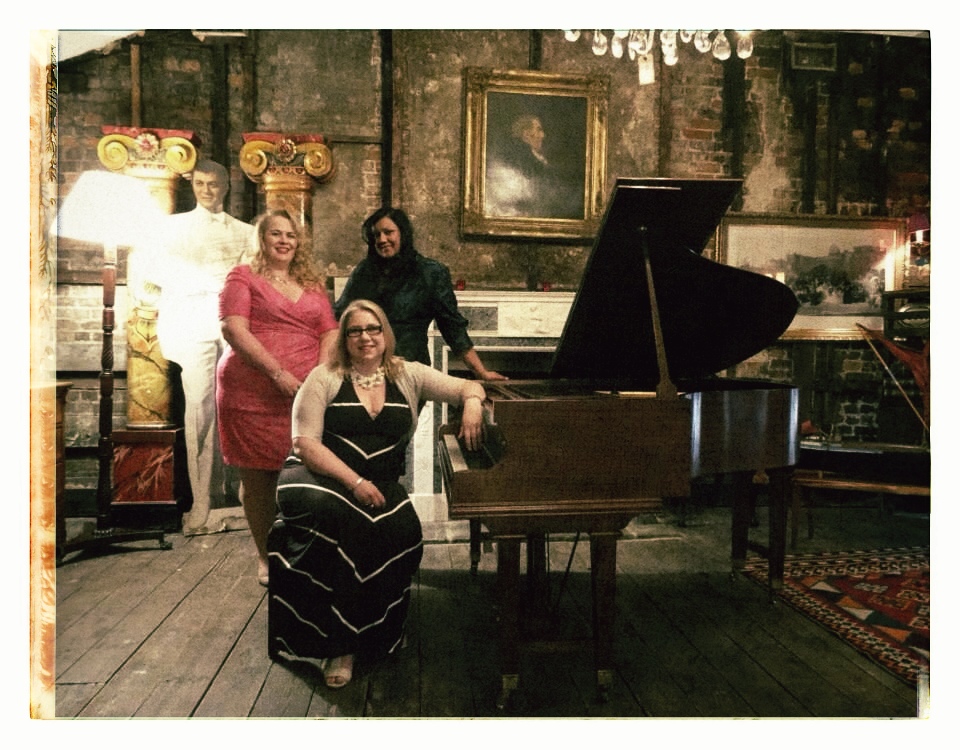
A stag with an impressive set of antlers surveys the room, while a white-tuxedo’d Tony Curtis keeps watch over the proceedings from his niche in a corner near the piano, a John Hopkinson baby grand with a rosewood case. Glittering chandeliers hang from the ceiling, illuminating the exposed brickwork on two walls of the room and highlighting the colours of the stained glass panels in the elegant sash windows. Exotic oriental rugs are draped over vintage British Rail first class seats, and at the back of the room, a glass cabinet is filled with antique pharmacy jars. Welcome to Brunswick House, part of the London Architectural Salvage and Supply Co, a Georgian mansion just five minutes from London’s Vauxhall Station, flanked by the brand new 5-star hotel and luxury apartments of One Nine Elms. Brunswick House is a treasure trove of antiques and salvaged curiosities, and on Thursday night last week, it provided a wonderful and eclectic venue for a fine evening of music making and conviviality.
Lorraine Banning, Frances Wilson & Lorraine Liyanage (and Tony Curtis) at Brunswick House
“A superb evening – huge fun was had with a mix of musical genres in a delightfully decrepit and stylish Georgian mansion. Best of luck promoting these salon recitals, the way music is meant to be played and heard.”
Rosalind, audience member
The concert was part of the South London Concert Series, and featured a recital by BBC Music Magazine’s “rising star” Emmanuel Vass, together with supporting performances by three talented members of the London Piano Meetup Group, who despite not being “professional” pianists, played with equal poise, musical sensitivity and professionalism. The diverse programme matched the unusual setting, with music by Bach, Chopin, Turina, and Mozart together with Emmanuel’s own transcriptions of pop songs by Queen and The Prodigy. In keeping with the SLCS ethos of recreating the nineteenth-century musical salon, an hour of music was followed by much conversation and socialising in the ante-room next to the Saloon, and continued downstairs in the restaurant adjacent to the house.
Concert grand piano on the stage at London’s Wigmore Hall (picture source The Guardian)
This post was prompted by this question from a friend: “How has reviewing piano concerts influenced your own playing?”.
In the 18 months I’ve been reviewing for Bachtrack, I’ve been to many excellent solo piano and chamber recitals, given by top international artists, and lesser-known, or up-and-coming artists too, at venues large and small. Reviewing has been a way of indulging my passion for piano music, while also being allowed to write about it, and, I hope, share my passion with others. When I select concerts to review, I tend to make choices largely based on repertoire rather than performer, though this year I have made one or two deliberate choices to hear certain performers, out of curiosity, namely Yuja Wang and Benjamin Grosvenor. I also wanted to hear again Marc-André Hamelin and Pierre-Laurent Aimard, and for the first time, Noriko Ogawa.
I often urge my students to go to concerts for “inspiration” (sadly, few of them take up my suggestion). There is something very special about live music, and seeing and hearing a professional musician at work can be illuminating and inspiring – and sometimes just jaw-droppingly extraordinary (in the case of Hamelin). You don’t experience that same excitement from hearing music, however expertly played, on disc, as you do in the concert hall. You can listen to a disc any number of times, but in the concert hall, it’s an entirely unique experience – for performer and audience. I’ve heard a couple of pianists in the same repertoire at different concerts, and after a pause of several years, and have been surprised, and excited, at the changes in the music. Not significant changes of interpretation, but small adjustments – a little more rubato here, some subtle shading or tenuto there – which shine a new light on the works or highlight different aspects. As a performer, it is these flashes of illumination and insight that make performing such an interesting and exciting experience, aside from the cultural gift of sharing music with others.
I couldn’t really claim that any particular concert or performer has directly informed my playing, but occasionally I’ve considered some of my repertoire in a new way after hearing it in concert. One is unlikely to pick up any nuggets of technique in the concert hall: you’re often too far away from the stage to see details, but listening attentively is helpful, particularly for pedalling. It’s amazing how many pro pianists don’t seem to know how to pedal properly, or who use the pedal as some kind of on-off switch to hide mistakes or inconsistencies of technique. I’ve been doing a lot of work on refining my pedal technique this year, specifically with regard to Mozart’s Rondo in A minor K511 (which requires very minimal pedal), so I have a heightened sensitivity about sloppy or inconsistent pedalling! Peter Donohoe, in his early spring concert at Queen Elizabeth Hall, gave a fantastic demonstration of how to pedal Debussy effectively in his performance of Estampes (read my review here). It was an enlightening and expert performance.
Similarly, hearing Noriko Ogawa play Toru Takemitsu’s evocative Rain Tree Sketch II, a piece dedicated to Olivier Messiaen, and full of Messiaenic echoes in its colourful tonalities and ‘flashes’, was very illuminating. I had just started looking at the piece when I went to hear Noriko in a lunchtime concert at the Wigmore featuring this piece and Debussy’s Études. To hear the work performed live by one of the composer’s compatriots, who clearly has a profound understanding of his work, was special enough, but the beauty and refinement of Noriko’s playing made this a truly spectacular five minutes of music for me. I went home to practise the piece with an excitement and enthusiasm, which has remained every time I open the score or indeed think about the work.
A really vibrant or emotionally powerful performance of a piece I am working on will often send me home to study the score in detail away from the piano, or may encourage me to try something new or different. I’ve stopped trying to copy what the pros do – the frustrated concert pianist within has long since been put to bed, and I now concentrate on trying to bring my own interpretation to the music – but a well-executed performance of some of my repertoire may force me to raise my game, always a good thing, especially when one has been working on the same repertoire for a long time.
I think the best aspect of reviewing is the exposure to a such great variety of music, and this is probably the most significant influence on my own playing. My reporter’s notebook, and the black Moleskine notebook I keep by the piano for practising notes, are full of lists of repertoire I’ve heard in concert and mean to learn one day. Here’s a small sample, in no particular order, with a note of where I heard the work:
Liszt – Bénediction de Dieu dans la solitude (Proms 2011, Marc-André Hamelin)
Liszt – Legende: St. François de Paule marchant sur les flots (Proms 2011 – Marc-André Hamelin)
Debussy – Les soirs illumine de l’ardeur du charbon (Proms 2012 – Pierre-Laurent Aimard)
Copland – Muted & Sensuous from Four Piano Blues (Peter Jablonski, QEH 2012)
Bach, trans. Liszt – Prelude & Fugue in a minor BWV 543 (Khatia Buniatishvili, Wigmore 2011)
Bartok – Dirges, no. 4 Andante Assai (Aimard, QEH 2011)
Messiaen – any of the Catalogue d’Oiseaux (Aimard, QEH 2011)
At his spring concert at QEH, Leif Ove Andsnes played one of Rachmaninov’s opus 33 Études-Tableaux for an encore (C major) and in an instant I was hooked (those slavic open fifths!). Sadly, I had some difficulties with tension in my left arm when I attempted to play this one, so I switched to the g minor. I am also learning the E flat Etude-Tableau from the same opus. Together, these pieces form the close of my LTCL programme. Thank you, Leif!
The Cross-Eyed Pianist is free to access and ad-free, and takes many hours every month to research, write, and maintain.
If you find joy and value in what I do, please consider making a donation to support the continuance of the site






 The Cross-Eyed Pianist