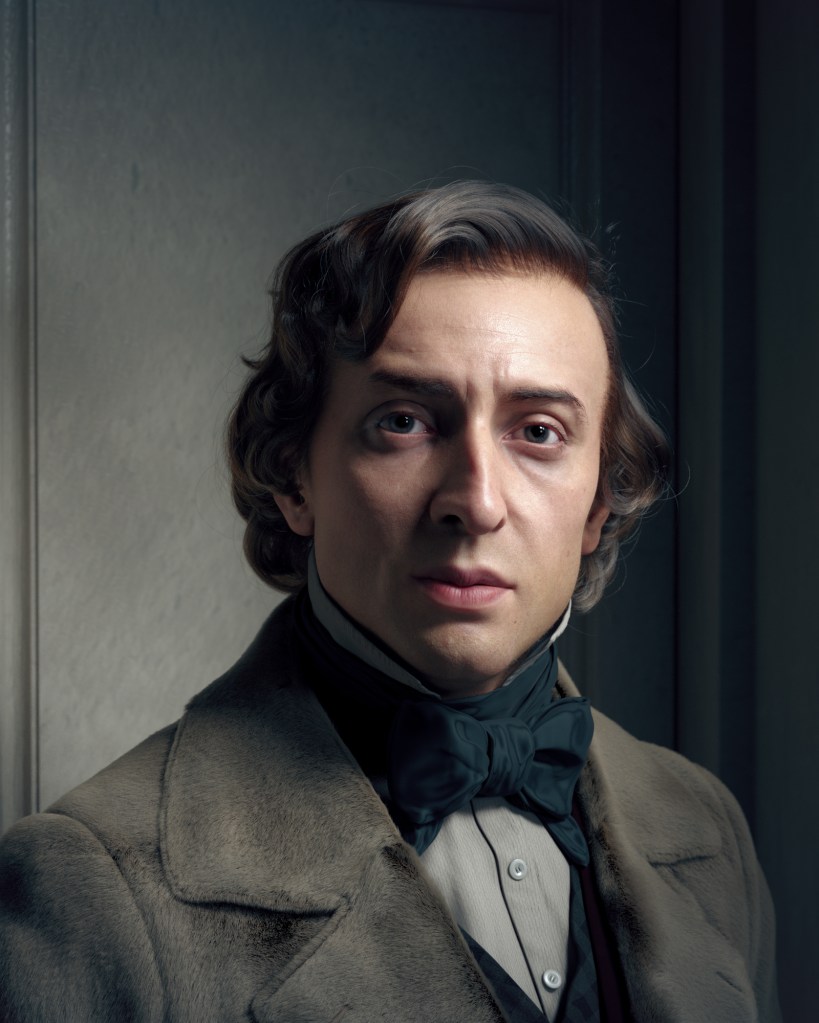
When the first notes of Chopin sound through the concert hall there is a happy sign of recognition. All over the world men and women know his music. They love it. They are moved by it. When I play Chopin I know I speak directly to the hearts of people.

Arthur Rubinstein


Virtuosic, imaginative, and emotionally profound, Chopin’s music offers pianists a wealth of expressivity, requiring a combination of superior technique, which always serves the music (rather than as an end in itself), refined touch, a beautiful cantabile (singing) tone, highly nuanced dynamic shading, supple phrasing and rubato, and an appreciation of the interior architecture of this multi-layered music. Chopin is also symbolic of Poland, the country of his birth, whose musical idioms are evident in almost all his music, most obviously, the Mazurkas and Polonaises.

When asked, the great Chopin player Arthur Rubinstein could not explain why Chopin’s music spoke to him, but like the music of J.S. Bach (which Chopin greatly admired and studied), it expresses universal humanity which, combined with a certain vulnerability, speaks to so many of us, and on many different levels.

An unrivalled authority and one of the greatest interpreters of the music of Chopin, Rubinstein brought great dignity and refinement to the music, avoided unnecessary mannerisms and sentimentality, and revealed the structural logic of Chopin’s writing. His playing is memorable for its elegant vocal phrasing, beauty of tone, and natural yet sophisticated shaping.

Arthur Rubinstein Plays Chopin’s Polonaise in A Flat Major, Op.53

“A master of the keyboard” (Harold C Schonberg), Dinu Lipatti was the pupil of an older Chopin master, Alfred Cortot.

Lipatti’s immaculate performances of the waltzes, in particular, are spontaneous, light and nimble, lyrical and suitably dancing, with subtle rubato and great charm.

“It’s very inner music and very deep,” Maria João Pires has said of Chopin. For her, he is “the deep poet of music”. That depth is really evident in Pires’ playing of the Nocturnes: intimate, refined and passionate, her interpretations eschew drawing room night-time sentimentality and capture all the drama and emotional intensity of these much-loved pieces.

Described by one critic as “the greatest Chopin player to have emerged from Italy since the Second World War”, Maurizio Pollini’s association with Chopin goes right back to the beginning of his professional career when he won the Chopin Competition in Warsaw when he was just 18. His unsentimental, cultivated interpretations are notable for their clarity of expression, perfectly judged poetry, and close attention to the bel canto melodic lines which make Chopin’s music so immediately appealing.

Alfred Cortot is one of the most celebrated Chopin interpreters, combining flawless technique with a deep appreciation of the structure, voicing, and textures of Chopin’s music. His recordings are acclaimed to this day, and his detailed, annotated editions of Chopin’s music remain highly prized among pianists and teachers.

Hailed by her mentor Arthur Rubinstein as “a born Chopin interpreter”, Polish-Canadian pianist Janina Fialkowska captures the soul of Chopin, in particular in her performances of the Mazurkas, works which reveal Chopin’s patriotism and innermost sentiments towards his homeland. Fialkowska is sensitive to both the humble, peasant origins of the Mazurka and Chopin’s elevation of the genre into concert pieces. She really captures the poetry, poignancy, and whimsical emotions of these Polish folk dances, and her rubato is perfectly judged, especially important in these pieces where suppleness of pace lends greater emphasis to the emotional depth of the music.

An earlier version of this article appeared on the InterludeHK website


Support The Cross-Eyed Pianist

This site is free to access and ad-free, and takes many hours to research, write, and maintain. If you find joy and value in what I do, why not


This article first appeared on the InterludeHK site, part of a series exploring musicians’ connections with particular composers


Why is it that some pianists have become so closely associated with specific composers? Is it due to personal preference, that they feel a particular affinity with certain composers, or simply like their music? Or is the association one which is conferred upon them by critics, commentators and audiences? Media focus undoubtedly plays a part in this: the pianist becomes an acknowledged specialist or authority in the music of a specific composer, or composers, and their other performances/recordings may be overlooked as a consequence. Take Alfred Brendel, for example – a pianist most closely associated with the Viennese masters Haydn, Mozart, Beethoven and Schubert – yet he also made some very fine recordings of Liszt’s piano music.

This series of articles will explore pianists who have a special relationship with specific composers.


Beethoven’s 32 Piano Sonatas – scaling the pianistic Everest

Beethoven’s 32 Piano Sonatas are often referred to as the ‘New Testament’ of the pianist’s repertoire, and for many pianists they offer a remarkable, quasi-religious journey – physical, metaphorical and spiritual – through Beethoven’s creative life. This is truly “great” music, that which is endlessly fascinating and challenging, intriguing and enriching, and such is the popularity of this repertoire that you can guarantee that somewhere in the world right now there is a concert featuring these remarkable sonatas.

There is something about the personality of Beethoven that is so overwhelming, and I think that the sonatas are the pieces that go the deepest, that show him at his most exploratory, his most inventive, and at his most spiritual.” – Jonathan Biss

Artur Schnabel

The first pianist to record the complete Beethoven piano sonatas in the 1930s, just a few years after electrical recording was invented, Schnabel set the standard by which all subsequent recordings was set, and his playing is acclaimed for its intelligence and insight, emotional depth and spiritual understanding of this music. So fine were his recordings that one critic described him as ‘the man who invented Beethoven’.

Daniel Barenboim

I’ve known these works for many years….but whenever I go back to this music I find something new.”

Beethoven’s piano sonatas have followed Daniel Barenboim throughout his career, and such is his affection for this music he has recorded the complete piano sonatas five times, most recently during lockdown when, during this period of enforced isolation, he decided to approach the sonatas anew. His first recording was made in 1950s when he was a young man. It is perhaps an indication of the reverence with which this music is held, and its distinctive challenges, that Barenboim has made so many recordings of the sonatas. For him, this is music which has an infinite appeal, to be taken up by other pianists who follow him.

Annie Fischer

It is interesting to note that few women pianists have recorded the complete Beethoven piano sonatas, Annie Fischer being an exception. The music of Beethoven was central to Fischer’s career and her recordings are still much admired, nearly 30 years after her death. Her style is unaffected and self-effacing, letting the music, and composer, speak, and her playing displays great nobility, elegance and humanity. Her recording of the complete piano sonatas is regarded as her greatest legacy.

Igor Levit

Beethoven’s music kind of creates this link between the player, the music, the audience. This triangle is enormously intense.” – Igor Levit in an interview with Jon Wertheim

Igor Levit released his first recording of Beethoven piano sonatas when he was just 26, an album which received huge acclaim for its intense expressivity and Levit’s mature approach balanced with a youthful ardour. He released his recording of the complete Beethoven sonatas in 2019.

In his performances of Beethoven, Levit produces a clear, lively and well-balanced sound, but he’s not afraid to roughen the edges of the music to create a more visceral impact. His concerts can be intense, almost uncompromising, but his Beethoven playing is some of the most exhilarating and adventurous to be enjoyed today.

Jonathan Biss

For American pianist Jonathan Biss, Beethoven has been a close companion throughout most of his life, and during the past 10 years he has fully immersed himself in Beethoven: he has recorded the complete piano sonatas, performed complete cycles around the world, and also teaches an in-depth online course about the sonatas which has attracted over 150,000 students globally.

“As individual works, each is endlessly compelling on its own merits; as a cycle, it moves from transcendence to transcendence, the basic concerns always the same, but the language impossibly varied”

Biss is a “thinking pianist”, with an acute intellectual curiosity and an ability to articulate the exigencies of learning, maintaining and performing this music. His Beethoven playing has long-spun melodic lines, well-balanced harmonies, taut, driving rhythms, rumbling tremolandos, dramatic fermatas, carefully-considered voicing, subito dynamic swerves, and colourful orchestration. It is not to everyone’s taste, but his performances can be vivid, edge-of-the-seat experiences which reveal how Beethoven took the genre to the furthest reaches of what was possible, compositionally and emotionally.


This site is free to access and ad-free, and takes many hours to research, write, and maintain. If you find joy and value in what I do, why not

I’ve been writing a series of essays for InterludeHK on pianists and their composers. Some are obvious choices – Gould, Schiff and Hewitt for Bach, for example. The selections are neither comprehensive nor definitive, and are by their very nature subjective – because they are selected by me. These articles are simply intended to offer readers some listening suggestions or a pointer to explore pianists and/or recordings with which they may not be familiar.

I tend not to read comments on my published essays these days, but I was amused – though not surprised – by some of the responses to my Pianists and their Composers articles. It is inevitable that such compilations will omit your favourite pianist for Bach, Beethoven, Schubert et al, and your choices will not necessarily align with mine.

“Wot, no XX, XX or XXX?” declared a ruffled reader on Twitter in response to my article on the music of Chopin. “How could you omit so-and-so?” demanded another on reading the article on Beethoven’s piano sonatas.

These responses demonstrate several important truths. First, that fans of classical music in general, and specific composers and artists in particular, care very deeply and are very attached to their favourite artists; secondly, that taste is a very personal, “me” thing.

Our musical taste is shaped from an early age, influenced initially by our parents’ listening habits, later by teachers, peers, friends, study, growing maturity, curiosity…. Our taste evolves and changes due to our experience of music, life experience, and a whole host of other factors – from mixtapes/playlists shared between friends at college to our first proper rock or classical concert or grand opera. Today the availability of a seemingly infinite amount of music of all genres means one’s taste and musical curiosity knows no bounds, if one allows it to graze freerange, uninhibited and with an open mind. Your taste won’t align with mine – and that’s fine. How dull life would be if we all liked the same thing!

But a word of caution: the quickest way to alienate me, or indeed anyone else who enjoys listening to music, is to tell them that their taste is “wrong”, or “bad”. Most of us don’t like music because we are told we should like it; nor do we stop liking it because we told shouldn’t like it!

Shameless begging bit:

This site is free to access and ad-free, and takes many hours to research, write, and maintain. If you find joy and value in what I do, please consider making a donation to support the continuance of this site