Guest post by Christina Cooper

From the moment that I started playing, my heightened adrenaline had perceived ‘allegro con fuoco’ to mean ‘presto,’ almost without my permission. Almost immediately, the running thread of demi-semiquavers which underpin the melody throughout the entire piece threatened to unravel like a stitch that had been picked open. The panic inside my head was immense. I was picturing the whole thing falling apart and me running offstage in floods of tears, feeling like a complete failure. All this was happening whilst my fingers continued to hammer out those demi-semis like a runaway train. My subconscious was holding me hostage, and I had no conscious control of what I was doing. I just had to surrender to my unconscious mind whilst in a constant state of total panic, fearing the worst at any point. 

On of the reasons peformance anxiety hits so hard is because it threatens our identity. Are you more likely to say to somebody: ‘I play piano,’ or ‘I am a pianist?’ Certainly professionals will likely say the latter, and perhaps many amateurs too. Being a musician is something which becomes so bound up in your identity, especially if you choose to make a career out of it. We are all programmed to give ourselves an identity which often sums up our greatest purpose in life, whether as a lawyer, cleaner, tennis payer, housewife, banker, artist, musician, or other profession. So when we perform, we are not just playing our instrument, but being our instrument. When we perform we put our whole identity out there to be scrutinised. If we perform well, we might receive praise and money; if we do badly we may be criticised and may not be booked again. This can leave you feeling worthless, as though you have been rejected as a person, not just for your playing. Add to this, the social pressures of playing in orchestras and ensembles; whether you bought the teas for your section, whether you drank with your section, whether you asked too many questions in rehearsals, whether you showed too much personality, and the recipe for performance anxiety based on identity becomes magnified. Paradoxically, if you are an orchestral player, you have to lose your sense of identity in order to fit in, but in lots of ways it is your identity which you feel is being judged above everything else.

If you look hard, as I did, you might find some resources around which aim to help musicians to overcome their anxiety, and while these may work well for some, for others they merely take the edge off the nerves. For years none of these worked for me at all, until I stumbled across something called Cognitive Hypnotherapy. Within 6 months my performance anxiety was gone. I realised that this method is truly life-changing, and I decided to train in it. I now have my own therapy business in Performance Coaching for musicians, to help them to overcome their performance anxiety.

At the heart of Cognitive Hypnotherapy is the understanding that we are all different, and we each have our own model of the world which is completely unique to us. Another key element recognises that the functioning of our brain is far simpler than we think. What this means is that the reason for our performance anxiety could be linked back to one ‘small’ event which most likely happened early on in our childhood, such as having to stand up and sing in front of the class, and feeling humiliated when we couldn’t do it well. The key here is that as a child, it will have been a significant emotional event, as our thinking at this age is nominal: we only know whether something is good or bad. Our subconscious mind then documents this event, and looks for consequent events which may be similar, and tries to prevent us from making the same mistake again. So the more we perform, the more likely we are to have bad performances because the subconscious desperately tries to get us out of the situation by pumping adrenaline through our body. The more often we experience this the more our brain will then compute that ‘when I perform I will play badly’ and over time this leads to ‘I am a bad performer/pianist/violinist/musician, or ‘I cannot play without nerves,’ and consequently the anxiety often gets worse over time.

As a Cognitive Hypnotherapist I find that often at the core of a musician’s performance anxiety is a sense of low self-esteem. This is not surprising, due to the rigours of training from an early age, and always being told you can do better, being up against constant competition, being a perfectionist and always comparing yourself to others. Often it can develop from a demanding parent or teacher, making you believe that what you do is never good enough. Of course this then often becomes linked to your identity and not being good enough as a person.

In therapy, I connect with your model of the world and use this to speak directly to your subconscious in a special language it understands. This communication is incredibly powerful, and because the brain is plastic, it will respond by literally rewiring itself. In combination with specific techniques which incorporate neuroscience, CBT, traditional hypnotherapy, NLP, positive psychology and many other therapeutic/scientific fields, we work to reprogram your brain’s faulty wiring, create new positive pathways and reframe the negative to positive. The astounding thing about this is potentially how quickly this can happen. Sometimes in as little as 3 sessions, and certainly by 6, it is possible to make huge changes in relation to your performance anxiety, within the space of about 3-6 months. We aim to either overcome it completely, or reach a level which is manageable, and this entirely depends on the outcome you want. So to all my fellow musicians out there, I think I might know what you are going through, and if you need my help, please get in touch. You are far greater than your anxiety.


Christina Cooper is a cognitive hypnotherapist, and runs her own performance coaching practice based in Clerkenwell, Central London. Her therapy practice, Cognitive Harmony, specialises in helping musicians with performance anxiety. Alongside this she teaches piano and double bass privately in South-East London. She began her career as a professional orchestral double bass player, having studied at the Royal Academy of Music, and the Juilliard School in New York. During her freelance career she performed with many orchestras, including the London Philharmonic Orchestra, Philharmonia, Royal Liverpool Philharmonic, English Chamber Orchestra, Opera North, English Touring Opera, English National Ballet and St.Petersburg Ballet. She recently hung up her bow to develop another burning passion in her life, the piano, and her second calling in life, to become a therapist. As a pianist, she has recently gained her LTCL in piano performance from Trinity College of Music, and performs regularly as a solo pianist in venues across London, including Southwark Cathedral, St.Paul’s Covent Garden, Citylit, and the 1901 Arts Club Waterloo.


‘Composed’ received its London premiere on 2 May 2017. The director is looking for futher London and UK screening opportunities – if you are interesting in hosting a screening, please get in touch via the contact page of this site

Performance Anxiety – for many musicians and performers it’s the fear which cannot, must not, speak its name, and together with injury and illness, it’s a major taboo. We don’t discuss anxiety because we’re not supposed to feel it. As highly trained individuals, musicians are supposed to sweep onto any stage, large or small, and perform with confidence, poise, and musical imagination, never betraying the slightest hint of nerves. As with injury, anxiety is often kept hidden and not discussed because sufferers fear (that word again) that admitting to it is a sign of weakness, technical or artistic, which may lead to loss of work and status, and the disapproval of colleagues, teachers, more senior musicians, critics and even audiences.

One of the crucial steps in coping with Performance Anxiety (and sufferers should not necessarily seek a “cure”) is accepting that it is something that happens to most performers, that it is normal, and that the physical symptoms are common to us all, driven by the body’s “flight or fight” response. ‘Composed’, an insightful new film by percussionist and film-maker John Beder, goes a long way in supporting this view, while opening up the discussion about performance anxiety in a sympathetic way.

Originally intended as a study of musicians’ use of beta blockers to subdue the symptoms of anxiety and how such drugs are perceived within the classical music community, ‘Composed’ takes a broad view, exploring the passion and motivation which drives people to become professional musicians, the root causes and symptoms of performance anxiety, the difference between practising and performing, music education, deep learning and proper preparation for auditions and performance, the fight or flight response, perfectionism and how hard musicians are on themselves. With contributions from musicians (soloists and orchestral players) and experts in the field of peak performance and performance anxiety, including Dr Noa Kageyama (creator of The Bulleproof Musician), Mike Cunningham (mind training coach), Gerald Klickstein (author of The Musician’s Way) and Professor Aaron Williamon (Professor of Performance Science at the Royal College of Music), the film offers a sensitive and honest account of the exigencies of the profession.

symptoms
(source: ‘Composed’ website)

Rather than present dry advice and one-size-fits-all coping strategies, the first-hand accounts of musicians, teachers and practitioners offer insightful personal anecdotes and solutions. The film also touches on the competitive nature of the conservatoire system, the ruthlessness of the professional career and how musicians, who tend to forge friendships and communities with others in the profession, find themselves competing with friends and respected colleagues at auditions for orchestral positions or concert bookings which can set up feelings of “inner turmoil of wanting to encourage your friends while secretly hoping the panel will favor your performance”(John Beder, film-maker). Such feelings can lead to self-doubt and anxiety.

The responsibility of teachers, mentors and institutions in supporting musicians is also explored. Until fairly recently, support for students suffering from performance anxiety was virtually non-existent in the conservatoire and music college system, except from a few enlightened tutors. Today, students have more resources at their disposal, including mindfulness and mind training, biofeedback, Alexander Technique, yoga and relaxation techniques, counsellors and hardware such as the Royal College of Music’s innovative performance simulator which allows students to perform before a virtual audience or audition panel.

There is also practical information about the physiological effects of beta blockers and commentaries by users, including a painfully honest account by a British cellist who also resorted to alcohol while still at music college to help her deal with debilitating performance anxiety.

It took John Beder two years to produce ‘Composed’. Originally, 61 musicians gave interviews for the documentary, though not all of them made the final cut, and Beder’s approaches to musicians were generally met with gratitude – “I wish we talked about this more” was a common response, proof that this is a subject musicians want to discuss in a more open forum. To hear musicians talk openly about their personal struggles, emotional limitations and coping mechanisms reminds us that we are very much not alone with our anxieties. The film is an empathetic and humane examination of the musician’s life and work, providing a greater understanding of the pressures, and pleasures, of the musical life, and is a potent reminder that musicians should “know themselves”, to appreciate their strengths and abilities, rather than continually comparing themselves to others. As such it makes an important and timely contribution to the study and understanding of performance anxiety.

“The film explores what without exception all of us, performers, have experienced and known well – first, love for our craft and stage, and then performance anxiety at the other end of this beautiful and exciting spectrum. Congratulations to the director John Beder and his team for completing this project and for inviting all of us to a meaningful and necessary conversation.”

Christoph Eschenbach, conductor

John Beder is currently looking for UK venues for future screenings of ‘Composed’. If you would like to host a screening or suggest a venue please contact John via this site or via the Composed website

‘Composed’ trailer

cf3a43f548ef0b0425f8af95032b8849Whenever we have a thought or physical sensation thousands of neurons are triggered and get together to form a neural network in the brain. “Experience-dependent neuroplasticity” is the scientific term for this activity of continual creation and grouping of neuron connections which take place as a result of our personal life experiences. With repetitive thinking, the brain learns to trigger the same neurons each time, and neuroscientists and psychologists have found that the brain can be “trained” to build positive neural traits from positive mental states. The trouble is, the brain tends towards the negative: it is very bad at learning from good experiences and very good at learning from bad ones. This negativity bias was very important in keeping our ancestors alive during times of great hardship and danger, but in our 21st-century brains it can be a block that prevents positive experiences from becoming inner strengths which are built into our neural structure.


As musicians most of us are very familiar with “the inner critic”, that destructive voice within that can sabotage a practise session or performance and damage our self-esteem with negative self-talk. The ability to self-evaluate one’s playing and performance and give oneself critical feedback is of course very important: it enables us to practise effectively and mindfully, it encourages humility in our work and tempers the ego. Equally, we should be able to accept criticism and feedback from teachers, mentors, colleagues and peers, provided it is given in the right way. But if our own self-criticism, and/or the comments of others, is repeated too often we can fall into a spiral of negativity.

From the teacher who continually undermines the student with negative feedback to the inner critic which constantly comments adversely on one’s playing, chipping away at one’s self-confidence, these repetitive detrimental experiences encourage negative neural traits which in turn build a negative mental state – and with repetitive thinking, the brain learns to trigger the same neurons each time. So if you continually dwell on self-criticism, anxieties about your abilities, your lack of confidence or a teacher’s negative comments, your mind will more easily find that part of your brain and will quickly help you to think those same negative thoughts again and again.

An example – the piano student who constantly self-criticises her own playing. The student in question is in her mid-teens, a bright, enthusiastic, engaged and confident young person who is not only a sensitive pianist but also a talented violinist and who is developing into an intelligent and expressive musician. Each lesson usually begins with the student playing one of the pieces or studies she is working on for her Grade 8 exam. She plays well, taking note of expression and tempo markings, dynamics, articulation, but almost every slip is met with profuse apologies or restarts, and as the music progresses, the errors increase. Her performance usually ends with her saying “I’m so sorry! That was awful! I played terribly today” – or words to that effect. Despite her teacher’s (me) reassurance that she played well, that there is noticeable improvement, etc., she continues to berate herself for her lack of ability. She recently performed in a school concert, playing with great poise and apparent confidence. Yet no sooner had she replaced her violin in its case, than the negative self-crticism and worrying about the quality of her performance began. Later, at the drinks reception following the concert, many members of staff and friends told her how beautifully she’d played, how much they had enjoyed her performance, but she continued to accentuate the negatives.

Sadly, this circle of negativity is not helping this student. She veers between believing she is a good musician (which she is) and that she is a terrible musician (which she isn’t). Because of the reiteration of negative messages, via her own inner critic and (I suspect) a parent with very high, or unrealistic, expectations, the circle continues, preventing her from becoming the poised and confident musician I believe she can be.

It upsets me to see my wonderful student struggling with so much negativity, much of which is self-generated (I’m no psychologist but I can guess at some of the roots of her issues because I recognise them from my own lack of confidence as a teenage pianist which I carried with me into adulthood). It’s quite clear, to me at least, that her negativity is self-perpetuating and in order for her to move forward the cycle needs to be broken. I am working with her to help her understand how to turn her negative thoughts into positive ones, using some of the techniques below.

Break the negative cycle and turn “I can’t” into “I can”

  • Banishing the inner critic is a key act in encouraging a more positive mindset. Acknowledge that your inner critic exists and then literally “show it the door” by imagining you are ushering the horrid creature out of your mind.
  • Attach a positive thought to a negative one: “I played that passage incorrectly, but I understand why I made a mistake so I know how I can put it right“.
  • Exchange perfectionism for excellence. Perfection is unrealistic and unattainable, excellence is achievable. Strive for excellence in your own work by setting yourself realistic goals and standards (these can be set in consultation with a teacher or mentor).
  • Draw confidence from the positive endorsements and feedback from trusted teachers, colleagues, peers, friends and family. If it helps, write these comments down in a notebook and refer to them when you feel anxious or nervous.
  • If your teacher is continually critical despite your best efforts to play well, it is perhaps time to seek a new teacher. Few students will progress well if they feel constantly put down by a teacher or coach.
  • Approach practising, lessons and performances with an “I can!” attitude rather than “this is going to go wrong”. Try not to set up a negative feedback loop before you play, but instead draw confidence from previous good experiences (a lesson where you know you played well and your teacher offered praise and positive feedback, or a performance where you received compliments from the audience or another musician whose opinion you respect).
  • Draw confidence in an exam or performance situation from knowing you have done the right kind of work in your practising and that you are well-prepared
  • Try the Buddhist practice of “wise effort”. This is a habit of letting go of that which is not helpful, or is negative, and cultivating that which is positive and helpful. (It is related to mindfulness and NLP).
  • Spend time with friends and colleagues whose company is positive and inspiring.
  • Above all, allow the mind to focus on and remember the good stuff. Just as thoughtful repetitive practising leads to noticeable improvement at the piano, so repetitive positive thinking brings a more positive, cheerful mindset, which will in turn have a positive effect on your playing and your general attitude to your music making.


Further reading/resources

How Complaining Rewires your Brain for Negativity

The Perfect Wrong Note

Music from the Inside Out

How Positive Thinking Rewires Your Brain


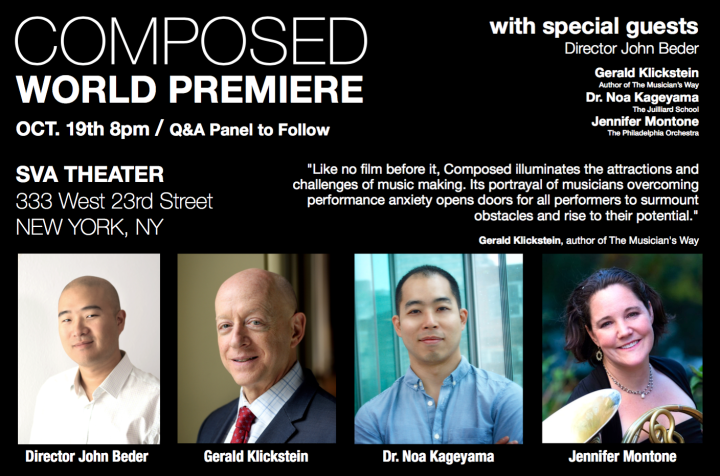
Documentary ‘Composed’ announces world premiere with special guests on October 19th 2016 in New York City

A feature film exploring performance anxiety, ‘Composed’ will premiere at the SVA Theater, New York, with special guests Dr. Noa Kageyama, Gerald Klickstein, and Jennifer Montone

‘Composed’ is a documentary film which features musicians and mental health experts from the US and UK, including members of major US orchestras like the New York Philharmonic, Cleveland Orchestra, Philadelphia Orchestra, Los Angeles Philharmonic and many more. The film utilizes these musicians and experts to discuss the issue of performance anxiety; what it is, why it happens, and what we can do to address it. Musicians in the film share candid stories and perspective on what causes these fears and doubts, as well as what’s worked for them to address such issues.

“Like no film before it, Composed illuminates the attractions and challenges of music making. Its portrayal of musicians overcoming performance anxiety opens doors for all performers to surmount obstacles and rise to their potential.”

Gerald Kilckstein, author of The Musician’s Way

Following the screening, Beder will be joined by three of the film’s cast for an audience Q&A. Dr. Noa Kageyama is a performance psychologist, a violinist, and a staff member at The Juilliard School. Gerald Klickstein is the author of The Musician’s Way and founder of the Music Entrepreneurship and Career Center at Peabody Conservatory. Jennifer Montone is the principal horn of the Philadelphia Orchestra and faculty member of the Curtis Institute and The Juilliard School.

Tickets are available now for the premiere and can be purchased through the Composed website or through SVA Theater’s events page.

getinline

John Beder is a percussionist, classical musician, and filmmaker based out of his hometown of Boston, MA. ‘Composed’ is a documentary about understanding and addressing performance anxiety through the lens of classical musicians. Learn more at www.composeddocumentary.com.

Contact

John Beder, Bed Productions LLC
617 383 4407; info@bedrocklab.com facebook.com/composedkickstarter; twitter @composedfilm

(Source: Composed press release)