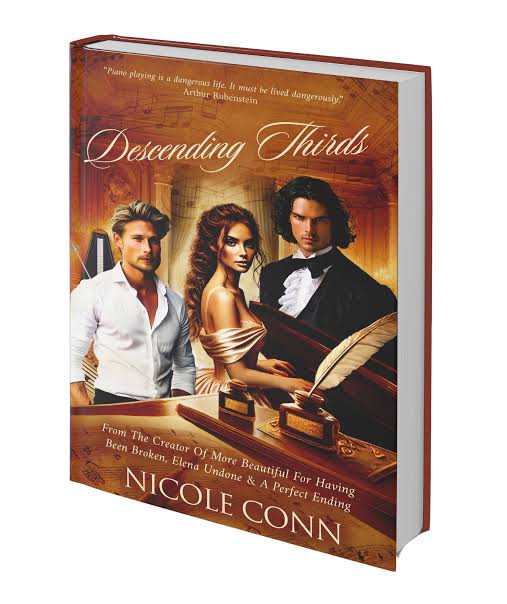
In 1965, Alexandra von Triessen arrives at the International Ketterling Competition knowing that one performance could make her career – or expose every weakness she has spent a lifetime learning to conceal. In this rarefied world, perfection is merely the starting point. Forty of the world’s most gifted pianists have come to battle for a prize that promises fame, fortune, and artistic immortality. Alexandra is one of the few women among them—and unlike the men surrounding her, she has no taste for combat.
There she meets Sebastian D’Antonio: magnetic, ambitious, dangerously charming, and born for the spotlight. He offers her passion, glamour, and a place beside him at the center of the musical world. But behind Sebastian stands his enigmatic brother Conrad – a restless composer of staggering genius who wants nothing from fame, yet understands Alexandra’s music, her loneliness, and her deepest desires in ways no one else ever has.
What begins as a contest between virtuosos becomes an intimate war between love and loyalty, talent and ambition, truth and myth. Bound together by music, Alexandra, Sebastian, and Conrad are drawn into a decades-spanning triangle of desire, rivalry, sacrifice, and betrayal – where the most beautiful creation may conceal the most devastating secret.
Descending Thirds is a sweeping, sensual novel about the violence beneath beauty, the loneliness of genius, and the terrible price of becoming unforgettable. It asks the question every artist – and every lover – must eventually answer: Do you choose the life that brings you applause, the person who promises you devotion, or the truth that sets your heart on fire?
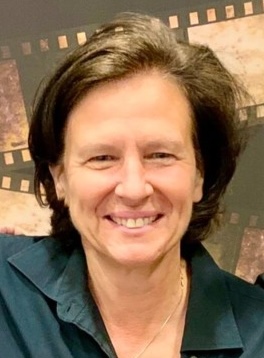
Interview with author of Descending Thirds, Nicole Conn
Who or what inspired you to pursue your creative career?
My first concert hall was the floor beneath my mother’s piano.
As a child, I would lie underneath it while she practiced Beethoven and Chopin for hours. I felt the vibrations move through the floor and into my body before I had any intellectual understanding of what I was hearing. Music entered me as sensation, emotion and story. Long before I understood harmony or musical form, I understood that music could say what ordinary language could not.
My mother was a brilliant pianist and later became a lauded teacher. She gave me far more than an appreciation of classical music. She taught me, simply by playing, that art can hold grief, desire, fury, tenderness and contradiction all at once. Even as Parkinson’s began taking command of her hands, her relationship with the piano endured. That was extraordinarily painful to witness, but also profound. Her body was becoming less dependable, yet the music remained part of her identity. It made the relationship between memory, the body and artistic expression very real to me.

I came to filmmaking and writing through that same desire to express the inexpressible. Film gave me image, language, silence, performance and music—all the elements through which interior life can be revealed. And I’ve always considered the score the soul of a film.
Descending Thirds grew directly out of that inheritance. It is dedicated to my mother, who gave me classical music; to my daughter Gabrielle, whose birth sparked the most compelling muse; and to my son Nicholas, who is non-verbal and extremely Special. I played classical music that was put in his isolette in the NICU. While he cannot communicate, his passion for classical music inspires me every day.
Link to GirlTalkHQ regarding my Mother
Who or what have been the most significant influences on your career?
My mother remains the beginning of everything. Beethoven and Chopin were part of the atmosphere of our home, almost like another language spoken in the family. Through her, I learned that music was not decoration. It was an emotional necessity.
The composers who shaped Descending Thirds were also significant influences on me personally. I’m mad for Bach as is Conrad in the novel, our genius savant. Beethoven embodies the battle between limitation and will. Schubert carries an ache that can become indistinguishable from beauty. Rachmaninoff gives us emotional sweep without apology. Prokofiev is danger, volatility and modernity. Debussy taught me about colour and atmosphere, and Chopin about intimacy – the ability to make something whispered feel enormous.
But my musical influences are not limited to composers. Cinema taught me to think musically. A film has rhythm, phrasing, counterpoint, repetition, crescendo and silence. A cut can function like a percussive strike; a sustained shot can be a held note. Dialogue has tempo. Characters can move in harmony or dissonance. I have always written and directed with an awareness of those things, even when there is no literal music playing. And I always use one or two composers to be the backbone of every project I do and listen to them incessantly from pre-production right through to editing.
The central musical idea in Descending Thirds comes through Conrad: that music is already everywhere – the wind, footsteps, machinery, conversation and the spaces between sounds. In the novel he hears the legato movement of water, the rhythmic exchange of tennis balls, leaves becoming snare drums in the wind, and even the pizzicato of a coffee maker.
More recently, Mary Jane Wells and Sally Bishop Melbourne have influenced how I understand my own work. Mary Jane revealed rhythms, humour and emotional undercurrents in the prose that even I had not fully heard. Sally gave an audible life to music that had previously existed only in my imagination. Both reminded me that collaboration does not diminish an artist’s vision. With the right people, it expands it.
What have been the greatest challenges of your career so far?
The greatest challenge has been keeping faith with the original impulse of a work while surviving the practical realities required to bring it into the world. In other words – funding!
Independent filmmaking teaches you very quickly that artistic vision and commerce are uneasy but unavoidable companions a thread pursued throughout the novel. You may begin with something deeply personal, but eventually that work must pass through financing, production, distribution, marketing and an industry that often wants certainty from an art form built upon risk. The challenge is knowing where to compromise and where compromise would damage the reason the work exists.
Descending Thirds presented another kind of challenge. I carried and refined the story for approximately twenty-five years. I had to translate music into language without turning the book into a musicology lesson. The technical details had to be credible, but the emotional experience had to come first. I want readers to fall in love with classical music. They shouldn’t need conservatory training to understand what Alexandra experiences when she performs.
Perfectionism has also been a lifelong challenge. And while pursuing it, not feeling entirely like an imposter. Both issues that Alexandra experiences as an artist. Yes, we must push ourselves to the limit, but perfectionism can also become a form of paralysis or cruelty.
That pressure is not confined to classical music. Film and publishing have their own versions of it. The work is never finished enough, financed enough, marketable enough or safe enough. My challenge has been to continue making things despite that.
Of which works are you most proud?
My book Descending Thirds, and especially the extraordinary audiobook created with Mary Jane Wells and Sally Bishop Melbourne.
The novel is probably the longest and most complex “score” I have ever written. Music is not simply its setting. It is the language through which the characters love, compete, betray one another, conceal themselves and, occasionally, tell the truth. The challenge of the audiobook was to make that musical dimension audible without overwhelming the narrative.
Multi Award winning Voice Artist, Mary Jane Wells did far more than narrate the book. She performed it. She gave the characters distinct inner lives but never reduced them to voices or theatrical effects. Alexandra’s reserve, Sebastian’s magnetism, Conrad’s stillness, Chandra’s irreverence and the many other tonal and cultural distinctions had to coexist within one performance. Mary Jane brought emotional precision, intelligence and an extraordinary sense of musical timing to the language. Her ability to deliver every shade of nuance and subtext makes the listener experience so much more depth than I knew was possible.
Mary introduced me to Sally Bishop Melbourne who then undertook something I had once thought impossible: she composed the music the two brothers, Sebastian and Conrad compose. They couldn’t be more different and so she had to imagine what Conrad and Sebastian would create, how their musical identities would differ and how those differences would reveal character. The audiobook contains more than seventy musical moments, bringing together passages from the classical repertoire with Sally’s original compositions.
Several of the classical works were drawn from my mother’s repertoire, so the finished recording became personal on multiple levels. It brought together my mother’s musical legacy, the fictional world I had carried for so many years, Mary Jane’s performance and Sally’s original music. A side note: Sally had suffered the passing of her son, Will, a few years earlier and had been in a state of depression. Composing for the two brothers created in her a new zest for life and creativity.
Descending Thirds has become so healing on so many levels. It was so lovely to see and hear the excitement in her voice and music as she would share the pieces with me.
The moments of which I am proudest are those in which the boundaries disappear—when narration, character, classical music and original composition become one dramatic language. It is one of the rare occasions when the finished work became larger than the version I had heard privately in my imagination.
What kind of things in regular life inspire your creative ideas?
I always write what I know—not necessarily as literal autobiography, but from emotional truths I have lived at the very deepest level. My films, scripts and the documentary I made about my son, Little Man, have grown out of some of the most extreme experiences of the human condition: love, disability, motherhood, sacrifice, grief, survival and the complicated ways people try to make themselves bearable to themselves. My next feature, do we not grieve, explores the severe trauma I experienced after the loss of my sister—my best friend—to an extremely violent suicide. I am drawn to the moments when our carefully constructed selves begin to fracture: how do we handle fear, tragedy, the unexpected and who do we become under the klieg lights during those events in our lives.
I believe this emotional honesty is why many people watch my films repeatedly. The circumstances may not mirror their own lives, but the feelings ring true, resonate and can become part of their healing.
My children remain an enormous source of inspiration: Gabrielle’s birth awakened the first impulse that became Descending Thirds, while Nicholas’s experience of classical music reminds me that our most powerful responses to art are often immediate, instinctive and beyond explanation.
What is your definition of success?
Success is completing a work without betraying the reason it came to you—and then allowing it to reach another person.
Awards, reviews, sales and recognition matter. Anyone who says they do not matter is probably being slightly disingenuous. Art requires an audience, and artists need practical ways to continue working. But those things cannot be the final measure.
My deeper concern is whether the work has emotional integrity. Did I tell the truth of the story as fully as I could? Did I resist making it safer merely to make it easier to sell? Did I always ask the question, “what is the best thing for this specific project?” And what survives the distance between what I imagined and what I was capable of creating?
Then there is the audience. Success occurs when someone recognizes part of themselves in the work—even when their life bears no obvious resemblance to the characters’ lives. A reader may know nothing about international piano competitions but understand Alexandra’s fear of not being enough. Someone may never have composed a note but recognize Conrad’s desire to create without becoming a commodity. Another person may see in Sebastian the terrible distance between ability and the art of packaging and commerce.
But for me probably the greatest measure of success are those fans who have written and told me they have seen one of my films ten times, fifty times. They watch one of my films weekly. And those fans who use my films to heal from their own broken stories.
What advice would you give to young or aspiring musicians?
Learn your craft so thoroughly that technique becomes freedom rather than confinement. Practise with discipline, but do not confuse punishment with discipline. They are not the same thing.
Protect the part of yourself that first responded to music before you understood whether you were playing it “correctly.” Technique is indispensable, but technique alone cannot explain why one performance leaves us admiring and another leaves us changed. In Descending Thirds, Alexandra’s first teacher tells her that anyone can execute notes, but not everyone possesses the soul or feeling for music. She also makes it clear that the gift does not excuse the work: practice, practice more, and then practice again.
Be absolutely passionate about your craft. If you’re not, then the piano, writing, making films becomes a massive amount of work without reward. It’s too competitive and arduous not to be driven by a relentless compulsion to do the work.
What do you feel needs to be done to grow classical music’s audiences?
Classical music does not need to become less profound. It needs to become less forbidding.
We need serious, sustained music education in schools, access to instruments and live performance, affordable tickets and programs that reach people where they actually live. A child should not require affluent parents or proximity to a major city to encounter an orchestra or touch a piano.
We also need better storytelling. Tell audiences what was emotionally at stake when a piece was written. Reveal the human being inside the monument. I found while researching for Descending Thirds incredible stories about so many composers. They were not just marble busts. They were ambitious, difficult, desirous, frightened, funny, competitive and frequently chaotic. I loved their flawed humanity.
Descending Thirds and its audiobook are my attempt to create an entry point to classical music. A listener may arrive because of the searing triangular love story and discover Rachmaninoff; another may arrive for the music and become absorbed in the characters.
The tension between accessibility and artistic truth is examined repeatedly in the novel. One character argues that the performer’s job is to excite the public and make people like the music; another asks whether a musician’s obligation is instead to remain true to how they feel it. I do not think those aims have to be enemies. Accessibility is not simplification. It is invitation.
What’s the one thing in the music industry we’re not talking about which you think we should be?
The human cost of excellence. We celebrate the prodigy, the winner, the standing ovation and the apparently flawless performance. We are less willing to ask what was required psychologically to produce them. Humiliation is still sometimes defended as rigorous teaching. Anxiety is treated as weakness. Physical injury, isolation, eating disorders, substance dependence and depression can be regarded as unfortunate but almost predictable by-products of serious artistic life.
Young musicians are often taught to make their entire identities dependent upon ranking, casting, competitions, reviews and access to a field with very few places at the top. They are told to become singular while simultaneously being trained to satisfy institutions, juries, conductors, managers, audiences and algorithms. That is a nearly impossible psychological contradiction.
We also need to discuss how easily image can eclipse artistry. Charisma, mythology and marketability have always influenced musical careers, but contemporary media can intensify that pressure until the artist becomes a brand performing an approved version of the self. Descending Thirds explores all these dynamics — the danger of a world in which perception, promotion and commercial mythology begin to carry as much authority as the music itself. Sebastian even argues that audiences prefer the beautiful myth—that performers such as he make music accessible because they embody what people want to believe.
There must be room for ambition, discipline and exacting standards. But we should be able to distinguish rigor from cruelty and excellence from self-destruction.
What next? Where would you like to be in 10 years time?
The immediate next chapter is to bring Descending Thirds to the screen as a limited series. The novel was always intensely visual to me: the competition halls, the opposing pianos, the orchestra’s and concert halls, Antonia’s mythological gardens, the changing decades and, above all, the physical experience of music passing through the characters. A limited series would allow the story the time it needs. It could preserve the psychological complexity of Alexandra, Sebastian and Conrad while finally allowing audiences to hear the music that governs their lives. I pitch it as an Epic Emmy Prestige Limited Mini-Series.
I’m also in development on my next feature, do we not grieve and publishing my next novel, Armand’s Tango in 2027.
What is your idea of perfect happiness?
Spending as much time with my extended intended family of six adult children and my precious granddaughter, Ocean. I identify first and foremost as a Mom or “Granny CoCo”.
Creating. I have been blessed in my life to have so many people make it possible for me to continue making films, shows, and writing books. I am further blessed by a workaholic muse. I am utterly passionate about my work and am extremely grateful for this endless drive.
The other things I am passionate about are the 4 P’s: Puppy (Lady Bugs) Puzzles, Poker and Pot!
What is your most treasured possession?
I’ve never been a “thing” person. My treasured possessions are my family!
What is your present state of mind?
Grateful, restless, slightly overwhelmed and deeply determined.
Completing Descending Thirds after carrying it for twenty-five years might have felt like an ending. Instead, the book, audiobook and developing screen adaptation have made it feel like the beginning of an entirely new creative life. I am trying to remain open to that without becoming so consumed by the destination that I fail to hear what is happening along the way. Process has always been key for me.
Descending Thirds by Nicole Conn is available now in paperback and audiobook format
Audiobook Trailer: https://descendingthirds.com/descending-third-audiobook/
Paperback Trailer: www.descendingthirds.com