26-apr-soul-zisso-contemporary-voices-web-131063328970695992Who or what inspired you to take up composing, and pursue a career in music?
When I was 14 I started writing songs and realised I had so much music in my head that I didn’t know how to write down, as I couldn’t play any instruments. This led to a ‘eureka’ moment where I just knew that composition was what I was meant to do in life, which resulted in my deciding to go away to boarding school to study for an A Level in music from scratch when I was 15. 

Who or what were the most significant influences on your musical life and career as a composer?
My teachers (both composition and instrumental/vocal) and friends have had the most significant positive impact on my career. They have taught and supported me, always being honest and therefore helping me improve and acknowledge both the good and bad. 

What have been the greatest challenges of your career so far? 
Having only started studying music at age 15, my greatest challenge was catching up with everyone else: first with general music and performing and then with composition. This meant always making sure I was working harder than everyone around me, and not giving up even when it meant not seeing the light at the end of the tunnel for years and years on end.  

What are the special challenges/pleasures of working on a commissioned piece? 
Each piece is different and special in its own way. I treat the compositional process as a type of meditation, seeing the players playing in the hall inside my head, hearing what they’re playing and how it works spatially in the space. Once the initial idea of the piece is established, it’s all about answering all the different questions about what the piece is trying to do and how, until I can hear the whole structure in my head and can write it down.

What are the special challenges/pleasures of working with particular musicians, singers, ensembles and orchestras?
Every different instrumentation brings with it lots of possibilities and new ideas, which is always exciting. Working with musicians I know and admire is particularly great as it’s easier to write a piece that is influenced by them as players / singers and has that added element of being written especially for them. I find writing pieces for myself to perform (as a soprano) the most challenging – it’s like a constant battle between my performer side wanting to perform strange extended vocal techniques and my composer side needing to justify every choice compositionally.

Which works are you most proud of? 
Poke – a piece for large mixed ensemble I wrote two and a half years ago for a workshop with BCMG. Even though it was the only piece I’ve written in the last three years that has only been workshopped rather than performed, I worked on it for a solid three months and am very proud of the level of detail and complexity in it. I hope it’ll someday get a proper performance. 

From the Darkness, for symphony orchestra – this was my first attempt at writing an orchestral piece fresh from finishing my undergraduate studies and my chance to use all I’ve learned about orchestral writing from sitting in on weekly rehearsals and watching countless concerts (another attempt to catch up, this time by a 1st study singer catching up on orchestral knowledge). I’m still proud of this piece because it shows how much I’ve progressed in just a few years, from a singer who couldn’t tell apart oboe and clarinet colours to using the orchestra in ways I haven’t even seen being done before. 

Who are your favourite musicians/composers?
Ligeti, Beethoven, Prokofiev, Radulescu, Saariaho

What is your most memorable concert experience? 
A few years ago I was fortunate enough to have my first orchestral piece ‘From the Darkness‘ chosen to be workshopped and then performed by BBC National Orchestra of Wales. The experience of having my piece played by one of my all-time favourite orchestras when I didn’t think it even stood a chance to be chosen was surreal and overwhelming, one which gave me hope for the future and that I would never forget. 

What do you consider to be the most important ideas and concepts to impart to aspiring musicians? 
That pieces of music need to have a reason to exist, be it an idea or structure that comes across – there’s no point to writing pieces that just sound pretty without having something to say. 

Where would you like to be in 10 years’ time?
Working professionally as a freelance composer and teaching composition at a University / Conservatoire 

What is your most treasured possession?
I have a few items that, to someone who doesn’t know me, might seem childish and bizarre but actively help me compose. These include a ‘touchy-feely’ hamster book, a squeezable orange octopus toy (with its knitted hat), and my personal scores for the Berio Sequenza III for female voice and Beethoven’s ‘Moonlight’ Sonata (which are both symbolic in reminding myself I can overcome massive challenges when I set my mind to it)

How do you work?

I usually compose in what I like to call my ‘office’, which is essentially sitting on the floor in the hallway of the Conservatoire, opposite the composition notice board. It may sound bizarre (and passers-by keep wondering what I’m doing there or assume I’m queuing for a practice room), but it really helps to think about new pieces away from a piano or any other instruments at first in order to get a clear idea in my head of what I want the piece to sound like and do. The sound of lots of different students practising nearby actually becomes a kind of white noise that helps clear my head and I really prefer it to silence, and lots of people walk by so it doesn’t feel too alone. To add to the weirdness, I’m usually surrounded by my ‘composition aides and mascots’ which help me deal with stress – quite often I’ll be sitting there hugging my copy of Berio’s Sequenza III and petting my hamster book. I heard I’ve become quite a mystery for pianists who frequently practice on that floor.
How would you describe your compositional language?

I really like using different types of microtones to explore less common soundworlds. My pieces used to be mostly harmonic-series based but in the last year or two I’ve been frequently experimenting with other microtonal soundworlds, which feels like exploring a wealth of unexplored territory. As part of my doctoral research at Birmingham Conservatoire I am researching microtonal singing in order to create my own unique microtonal language that will incorporate voices as well as instruments, which is why I’m currently trying out lots of different ways of using microtones. Another side of my compositional language is influenced by my work as a performer – using extended techniques and/or a greater sense of acting/performing, especially for voices.


Carla Rees and Xenia Pestova premiere Hidden Elegy for alto flute and piano at The Forge, Camden, on 6th September 2016. Further information and tickets here

Ever since commencing on her music studies at the relatively late age of 15, Soul has been dedicated to her dream of becoming a composer. She graduated from Cardiff University, studying with Arlene Sierra and Robert Fokkens and for a brief time studying with Alison Kay, before commencing on a Masters and later a PhD in composition at Birmingham Conservatoire under the tuition of Joe Cutler and Howard Skempton.

Her music, which has been described as “curiously original” (Wales Online) and having “real character and sensitivity” (Wales Arts Review), has been performed by the likes of BBC National Orchestra of Wales, Orchestra of the Swan, Xenia Pestova and the Fidelio Trio across the UK, Europe and Canada in a wide range of venues including Wells Cathedral, Hoddinott Hall and Stratford Town Hall, and festivals such as the Cheltenham Music Festival, Occupy the Pianos and Frontiers new music festival.

Her interests range from the use of different microtonal soundworlds and textures to children’s books and the exploration of various extended techniques. She is also interested in writing for dance and has composed music for Rambert Dance’s Vintage Rambert project.

In addition to composing, Soul is also a singer, specialising in performing contemporary repertoire, including Berio’s Sequenza III for female voice. She is a member of Via Nova chamber choir, has performed as both soloist and choral singer across the UK (including at the Wigmore Hall and at the Huddersfield Contemporary Music Festival) and abroad and is committed to promoting new music, which includes premiering many new pieces, particularly ones for solo unaccompanied voice.
www.yfatsoulzisso.com

crmasy4waaawday

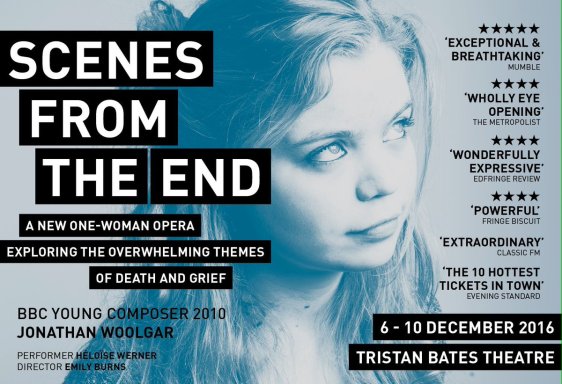
‘Scenes from the End’ by British composer Jonathan Woolgar is a one-woman opera focusing on grief in a variety of forms, from the abstract to the deeply personal, from the philosophical to the everyday. It explores big ideas – the notion of “the end” and what it might mean at different times and in different forms – concepts far bigger and complex than our individual comprehension can easily grasp or make sense of; and the frustration of the individual in a state of grief, surrounded by people whose prosaic or patronising attempts at offering “comfort” merely compound one’s sense of loss and anger.

ywtdacbiHeloise Werner is a young soprano and cellist with a particular interest in new music and music as drama. She is co-director of contemporary ensemble The Hermes Experiment and a member of new vocal ensemble SHARDS. ‘Scenes from the End’ developed from previous collaborations with Jonathan Woolgar and Heloise’s interest in exploring the boundaries between theatre and singing, and how that might work in a one-woman show.
Each of its three parts has a specific musical and textural focus. The first part explores grief for the end of the universe, a concept so vast we cannot possibly understand nor process it. The second part grieves for the human species and explores the arrogance of humankind (“We have done well, but we forgot to survive“), and, to my mind at least, offers a comment on our reckless plundering of the earth’s resources and man’s seemingly insatiable need to wage war on others. The final part grieves for an individual life, the pain of personal grief and the griever’s frustration at those around her who seem unable to respond appropriately (“Do not speak to me……but, stay with me“).

Sparsely staged, with only a chair and stool as props, the work has an immediacy which is arresting and very powerful. Heloise’s voice has a piercing clarity and depth, one moment beautiful, the next visceral and freighted with distress. The sung episodes are interspersed with spoken words (whispered, shouted), and gasping and panting, which calls to mind the gulping sobs of a grieving person who almost cannot cry any more. There are also recorded episodes, Heloise’s voice heard hauntingly from a distance, and percussion. Quotations are projected onto a screen which inform and expand on the narrative. The work is direct and thought-provoking with a raw intimacy enhanced by the simple staging and small size of the venue: one is close enough to see the broad range of emotions passing across Heloise’s face as she performs.

While the performance unfolded, the sounds of Hampstead Road filtered into the theatre – people talking, the rumble of traffic, a police or ambulance siren – reminding us, perhaps appropriately, that human life in all its humdrum and everyday continues.

‘Scenes from the End’ is at Tristan Bates Theatre, London WC2 from 6-10 December 2016.

Further details and tickets here


heloisewerner.com

“Listening to music, for me, is like inhabiting a landscape – an inner world, bounded by an intricate web of feelings, memories, expectations and associations that are brought to life through the properties of sound and rhythm” – Douglas Finch

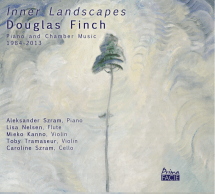
inner_landscapes_cdcoverInner Landscapes, the first ever recording of composer and pianist Douglas Finch’s piano and chamber music, is a compelling collection of ten works which capture an ‘inner world’ of a particular landscape – in Canada, Germany, North Wales and New York. Finch was drawn to the art of Canadian painter Emily Carr (1871-1945), who has long been one of his favourite painters, in particular for her landscape paintings of the west coast of British Columbia which evoke feelings of “loneliness and quiet rapture”, and his music explores similar themes of solitude, mourning and spiritual longing.



Performed by Canadian flautist Lisa Nelsen, pianist Aleksander Szram, cellist Caroline Szram, and violinists Mieko Kanno and Toby Tramaseur, the music spans Finch’s compositional output from his early 20s, when he lived in Canada, to the present, after he moved to the UK in 1993. A renowned improviser, most of the pieces on this debut CD grew out of ideas resulting from his improvisations.

I recently heard British pianist Steven Osborne perform music by Morton Feldman, and I was immediately struck by a similar stillness and sense of time suspended in Douglas Finch’s music, with its carefully chosen and exquisitely placed sounds, delicate droplets of notes, plangent bass interjections and haunting melodic fragments. The piano’s resonance and decay is used to great effect – elusive and meditative in Ruins (1984) ‘Calm’, or declamatory and insistent in ‘Quick March’. In the last movement of Ruins, Finch takes the circling fragment from ‘Die Krähe’ from Schubert’s Winterreise to create his own Winter’s journey – a piece inspired by a gloomy day walking around an old castle on the Rhine, whose spare instrumentation and spooling melodies reflect the desolation of Schubert’s winter traveler. Other pieces on the disc have some kind of relation to a particular place: ‘Fantasy on a Russian Folk Song’ emerged out of the North Wales coastal town of Pwllheli – “practically the whole of the wildly ecstatic final section came to me while walking on the beach during a fierce gale” (DF). I am familiar with this part of North Wales, having holidayed there frequently as a child, and for me the music expresses the rugged, landscape, long empty beaches and changeable weather.

The three ‘Chorales’ on the disc reference the Lutheran Chorale tradition of J S Bach and Cesar Franck, and utilise the piano’s unique nuance and decay. Fragmentary, terse, and introspective, they express in their briefness a profound sense of contemplation, solitude and lamentation. It is the restraint in this music that makes it particularly arresting.

The launch of Inner Landscapes is on Monday 20 June at The Forge, Camden. Drinks from 7pm, performance at 7.30 to include selections from the CD and improvisations by Douglas Finch. Further information and tickets

Inner Landscapes is available from Prima Facie Records. CD notes by Douglas Finch and Aleksander Szram

Meet the Artist……Douglas Finch


The only magazine dedicated to contemporary classical music culture in the UK and Ireland
Celebrating and showcasing performers and composers


I’m really excited about this project, a new magazine focusing exclusively on contemporary classical music

We have a vibrant culture of contemporary classical music here in the UK and Ireland – full of committed performers, composers and supporters – and it would be great to see contemporary classical music understood and enjoyed more widely alongside its sister arts. Sounds Like Now will be a focal point and a cultural hub where people can:

  • Get to know the performers – what they’re doing, how they approach and what they think about the music and culture
  • Get to know the composers, established and new – what makes them tick?
  • Get to know the music, from those who know and love it
  • Find out what’s being performed, where and when
  • Find new repertoire including the latest publisher releases and selections by expert musicians
  • Find new recordings and get help discovering what’s already out there

If you’re a performer, composer, producer or promoter of new music, then Sounds Like Now will be there to share and celebrate your work. It will include;

  • Profiles of key performers and composers
  • Essays and reports from artists and commentators
  • Guides to key ideas and current trends in contemporary music
  • Interviews
  • Concert reviews and previews
  • Recording reviews
  • New music releases from publishers
  • Thorough UK-& Ireland-wide event listings
  • Q & A with contemporary music lovers outside the sector

Sounds Like Now will be an outward-looking publication which encourages more musicians and listeners to venture into the wonderfully rich and rewarding world of contemporary music.

Sounds Like Now will be a bi-monthly print and digital publication, available by subscription.

So whether you’re a seasoned new-music-head or wanting to venture in and could do with a guide, Sounds Like Now is for you!  Visit the Sounds Like Now crowdfunding page to find out how you can be part of this exciting new project.

www.soundslikenow.net