
Guest post by Amy Boyes
Especially loved in Canada, the music festival has been a fixture in our communities for decades. These are not the raucous music festivals held on lawns with big stages and four hundred portapotties that most people associate with the term “music festival.” These local competitions are hosted for the educational benefit of young performers.
Amy Boyes has adjudicated music festivals from as far east as Prince Edward Island and as far west as Manitoba. She teaches piano and theory in Ottawa, Canada.
In this guest post, Amy reflects on the sights, sounds and smells of rural Canadian music festivals while confronting out-dated practices. Both a love letter and criticism of competitive music festivals, Amy explores the history and transformative power of the music festival on developing musicians.
“Your destination is on your right,” my phone chirps. And what a destination this old Anglican church is. Two thousand square feet of nave, chancel and vestry, capped with a turret and a bell tower, supported by buttresses in an otherwise residential neighbourhood cast long shadows over the street.
I shut off my phone’s GPS, step out of the car and look around. The morning air is fresh. Birds sing and runoff trickles from a grungy snow pile on the curb, down the street to the storm sewer. I step across an uneven concrete walk and, at the top of three steps, push open the church’s heavy wood door. Carved with a cross, the door hangs from decorative iron hinges. Despite my efforts to dull the effects of its automatic stopper, the door bangs shut.
“Good morning!” I cheerfully call to the volunteer at the admission table.
Music festivals are impossible to run without volunteers. Often seniors, these volunteers are reliable and dedicated. Unafraid of ice or cold weather, they do their bit. This particular volunteer looks nearly ninety, with paper-thin skin and a cardinal on her mauve sweater. I step around her table, heading to the main area where I expect to find the festival coordinator.
“Excuse me, Miss!” The volunteer waves a program at me frantically. “There’s an admission fee.”
I stop. “I’m sorry. I should have introduced myself. I’m Amy Boyes, the adjudicator.”
“But you look too young to be an adjudicator!”
I smile and wonder how old I’ll be before my baby face has enough wrinkles to imply experience. What about the lines around my eyes? Don’t they scream “over thirty?” And if I look too young to do the job now, how many prime, productive years will I have before I look too old?
I step into the sanctuary, across thin red carpet to a desk wedged between the narrow wooden pews favoured by generations long gone. Creaky and uncomfortable though they be, pews give a certain grandeur, a reverential aura.
I find the festival coordinator and introduce myself in a low voice. We chat softly because the church is quiet. Dead quiet. As the two of us work out the details of marking, assessment sheets, certificates, and provincial recommendations, we use pianissimo voices, careful not disturb, not to give away secrets. My job is to be objective. I will listen, write comments, and give feedback. I will do my best to inspire, teach and encourage. I will be a guest teacher, of sorts.
But there’s another duty I’m not so fond of, that of judge and juror.
I sometimes wonder if by adjudicating I’m encouraging an outdated cultural attitude. The practice of identifying and rewarding young musicians is dangerously subjective. If I were to hear a class on two consecutive days, I might mark it differently. It’s just one performance, a tiny glimpse into a much larger picture. After all, I don’t know if the student began playing six months ago or has been playing for six years. I don’t know if the student has the making of something marvellous or will stop practicing forever two weeks from now.
I’m making a judgement that may be disregarded by the student or taken to heart for years to come. I can make them want to practice or I can make them never want to play again. I always hope they listen to my more constructive words, my kindest encouragements. But I never know.
Only a few people sit in the pews, just the four or five performers in the first class, flanked by parents and grandparents. But the tall ceilings and old wood act as an echo chamber for whispers and dropped books. Nerves are evident. Young performers are anxious about playing. The festival coordinator is anxious about the organization. I’m anxious the dreadful coffee I drank at the Days Inn at breakfast is going to finish my stomach.
The church is three degrees too cold, so coats are left on. Crinkly, polyester taffeta ski jackets; wool, slightly sweaty, pea coats; flannel plaid button-ups, with a few dog hairs clinging, in from the country—the coats remain. It’s only the first week of April after all, and it doesn’t matter if the festival is held in Moncton, Kingston, Boissevain, Moose Jaw, Red Deer, or Penticton, the church will be cold.
The church has a smell too, an elixir of dust, mould, old wood, and two week-past Good Friday dinner. Every church smells the same—United, Anglican, Presbyterian. Old church smell has ecumenical leanings.
I sit at the desk and begin signing certificates. As I scrawl, Amy Boyes, Amy Boyes, Amy Boyes, on one certificate after another, I imagine the back of my head being inspected. Do we like this adjudicator? I imagine people thinking. Perhaps last year’s adjudicator didn’t have much to say or too much to say. I picture them wondering if I’ll be amusing or if I’ll drone on and on about sonata form and compound metres.
At nine o’clock, the festival coordinator greets the assembled in a loud but welcoming voice. The festival coordinator is “thrilled” to introduce me. She may have had a sinking feeling at the sight of me, but she wears excitement well, like a good makeup job—brightening the eyes, widening the smile. She reads my biography, forging through degrees, institutions, associations and organizations like she practiced, which she may well have. During this recitation, I write cheerful comments on assessment sheets for performances yet to come: “Thanks so much for playing today!” or “What an enjoyable performance!” I write to distract myself from the banality of my biography and nagging self-doubt. Is that really all I’ve accomplished? What a thin biography. Never performed in Europe. Or the States. Didn’t study abroad either, for that matter.
The festival coordinator introduces Carl, an elderly gentleman sitting in the front row. Carl will announce the classes and performers. And so he does.
With a voice so profound in its depths that Sam Elliot’s would seem flippant in comparison, Carl recites the first class’s name and number, always a cryptic code filled with Ps and Ks. It’s a class of Baroque pieces. Grade 4.
“Olivia Reedman will now play ‘Rigadoon in A minor’ by Babell,” announces Carl.
Olivia knocks a hymn book off the pew rack as she makes her way from the very back of the sanctuary to the grand piano at the front of the room. She wears a sleeveless fuchsia frock with gold sequins, perhaps a recent Easter treat. On her feet, she wears bright green Sorel boots. Maybe her Sunday School shoes were forgotten at home in the early morning rush.
Olivia approaches the big and black piano with bold, gold letters, “Y A M A H A,” slowly, even reverentially. She mounts the bench and may find it too close to the keys for she looks at her little toes, jammed into the carpet, with panic in her eyes. The bench is heavy which seems to discourage her from moving it. Moving it might make noise and she’s likely terrified of that. Olivia lifts her hands onto the keys with a tentative gesture like she’s only just been given these hands and they are a bit new to her. With an E to A4 pickup, Olivia’s right hand begins with her left hand following two beats later.
BRIGHT! SHINY! LOUD! The sound seems to shock Olivia, for her head whips up and her eyes pop wide. Notes ping from the Yamaha then pong against the wood panelling in the back of the hall. The second phrase is to be played more quietly than the first, but Olivia plays the second phrase exactly like the first. It’s a stream of loudness, spirting from the open piano, spraying up into the open rafters, showering down on us.
Then new things happen. Repeated notes. Forte. More forte! The notes echo from the back wall like shots in the night. Olivia appears to panic. She speeds up. Then she must notice the hammers drilling up and down inside the grand piano, for she stares at the mechanism as she plays—up, down, hammer here, hammer there. Perhaps she’s never seen inside a grand piano before for she seems mesmerized. She’s making this huge, black beast work! All by memory! All with her own hands!
Suddenly, everything stops. And that’s it. The piece has ended.
Olivia slides off the bench looking slightly stunned. She faces the smattering of applause throughout the church, quickly dips her head in lieu of a bow, and then scampers back to her pew.
I applaud, then return to the assessment I’m writing, my pencil scratching in the now silent church. The performance was lovely, I quickly write. You have beautiful stage manners. Now, could you try to make a bigger difference in the volume between phrase one and phrase two? The two phrases are an echo of each other… a parallel construction with a slight twist on the second cadence. The ear needs contrasting dynamics. Could you also try to shape the loud, repeating notes in the second section? Again, an enjoyable performance. Good choice of tempo but aim for steadier playing. Nice memory work.
I nod at Carl, who has been steadily watching me. I’m ready for the next performer.
The first music festival in Canada took place in Edmonton, Alberta, in May 1908. Over two days, musicians from Edmonton and throughout the province competed at the MacDougall Methodist Church. The final evening’s mass choir concert saw over two thousand people packed into the charmingly-named Thistle Rink. Eager volunteers had decorated the walls with bunting and bear skins, of all things.
Undoubtedly it was a mixed event, staged long before the era of television and YouTube. A sample of Handel, for example, was followed by a rousing rendition of “Annie Laurie.” Mendelssohn; by “I Sing to Thee Songs of Araby.” Regardless, Alberta’s thirst for culture was evident and contagious. Following the successful 1908 event, music festivals sprung up across Canada. Alongside grain elevators and oil wells, lumber mills and fishing shacks, communities only boasting two struggling churches, a school, a post office and a grocery store mounted music festivals. These events were good for the students, and they were good for the town.
However, Canada’s oft-capricious weather often conspires against culture. In the dead of winter in Manitoba where I grew up, someone must blow snow out of the laneway, hope the municipality plowed the highway, start the four-wheel-drive truck, bundle everyone up and head to town in a howling blizzard. Whether it be for music lessons, coffee house performances, choir practices, band rehearsals, or music festivals, every trip to town is an investment. Every action is deliberate.
It is this deliberateness, however, that drove volunteers in Edmonton in 1908 to turn a curling rink into a concert hall and hang bear skins on the walls. It is what keeps music festivals alive today.
After all five students play, Carl asks them to come up to the front pew. They are more relaxed now, chatting and smiling at each other. They sit in the same order as they performed which is a god-send for me. I can never keep performers straight unless they’re in order.
Olivia Reedman. Emily Foster. Cayden Johnson. Xiao Chen, and Olivia Boyd. I review their names in the program as I walk to the front of the room.
“Well, what a treat it is to be with you all this morning!” I begin. I speak in the general direction of the performers in the front row, but with a loud enough voice to carry to the rest of the audience. None of the performers return my smile. They look wary, suspicious even.
This segment of the festival is generally my favourite part. I talk with the kids, asking questions about themselves and the pieces they play. I talk about key signatures, harmonic scales, leading tones. I work slowly—they are still quite young, after all, out of their comfort zones and likely feeling a bit stressed. I have to gain their confidence before they’ll respond.
“So what key this piece is in?” I ask, assuming the title of the piece, “Rigadoon in A minor” has illuminated them already.
I get blank stares, so I turn the score around and lower it to their eye level.
“Do you see a key signature?” I ask, pivoting the book slightly so everyone can see.
After a moment of excruciating silence, Emily says, “There isn’t any.”
“Very good, Emily!” I congratulate. “So what scales or keys only use the white notes?”
“C?” says the boy named Cayden with noticeable doubt in his voice.
“Absolutely!” I respond. “C major only has white keys.” I walk over to the piano and play a C major scale. “It sounds rather cheerful, doesn’t it?” I play it again and all the performers in the front row politely nod. “Now, let me play its sad cousin, A minor. It uses all the same notes as C major, but it begins on an A.”
I play the A minor scale in natural form and suddenly Olivia R. pumps her hand up into the air.
“I know now! I forgot before!”
“Go ahead, Olivia,” I say.
“Rigadoon is in A minor and it uses a G# because it’s in harmonic form which means you raise the 7th note of the scale!”
Most of the heads bob up and down enthusiastically. This was common knowledge after all. Everybody knows this stuff, I’m sure. We had to dig for it.
I push further. The G# disappears in the middle section as the piece modulates to the relative major, C major. Suddenly, the piece is lighter, brighter. Forte is marked as the tonality is uplifted, cheerful even. This section could be played more brightly.
I walk them through all the dynamic markings on the score, demonstrating a variety of sounds on the piano as I go. I ask for a volunteer and Olivia R. returns to the bench. I give her some suggestions for dynamic changes and phrase shaping. She makes an attempt and although the results are not wildly better than her initial performance, at least she’s worked with a new teacher and a different perspective, even for a few minutes. She smiles when she’s finished. Perhaps she enjoyed herself.
I’m already running two minutes behind schedule as I tack on a few words about the importance of a steady tempo and consistent articulation. Then I finish with my least favourite part—announcing a winner.
The practice of marking is subjective and outdated, a surviving feature from an era where all effort was quantified and marks were printed in the local newspaper. In reality, I know Olivia R.’s missed dynamics are no worse a sin than Cayden’s rushed tempo or Emily’s tiny memory slip, or Olivia B.’s detached legato line. All these errors are typical for a young performer. Anyone of these students, with consistent practice and good teaching, has the capability of becoming a solid, dependable performer. The concept of a winner at this stage is absurd. However, Xiao’s performance was as close to perfection as one hears at the elementary level. It was steady and clean, with well-shaped phrases and crisp, lively tempo. She probably practices twice as much as everyone else in the room and should be rewarded for her effort. She deserves a first place ribbon and the applause that comes with it. There’s nothing subjective about that.
I take a big breath and call out the results. Third place for Olivia Reedman. Second place for Cayden Johnson. First place for Xiao Chen.
There is enthusiastic applause from the audience and a mixture of expressions from the students. Elation. Disappointment. Typical reactions in competitions.
I hand out certificates and ribbons, congratulating and confusing names and books as I often do. We shake each other’s cold hands and I wish them a good day at school. They thank me and that’s it. One class down. A full week’s to go.
I return to the adjudicator’s table and signal the start of the next class. However, there’s a slight problem, I’m told. The first student is running late; their country road flooded this morning with spring runoff. They’re taking a circuitous route into town so that the student will perform at the end of the class.
No problem, I say, then smile. I picture myself, twenty-five years ago, being driven into a minuscule prairie town from a hog farm in rural Manitoba. Parka zippered over an Easter dress. Sunday school shoes under my arm. Bulky Sorels on my feet. Humming my little piece under my breath.
And so it continues.
 Amy Boyes is a private music teacher in Ottawa, Canada. Her time is split between teaching, examining, adjudicating, and writing. Her work has been featured in the American Music Teacher Magazine, the Piano Magazine (Formerly Clavier Companion), the Canadian Music Teacher Magazine, No Dead Guys Blog, Melanie Spanswick Blog, The Columbia Journal and The Humber Literary Review. Amy holds a Bachelor of Music from Brandon University, Master of Music from the University of Alberta and diplomas in piano performance and teaching from the Royal Conservatory and Trinity College, London.
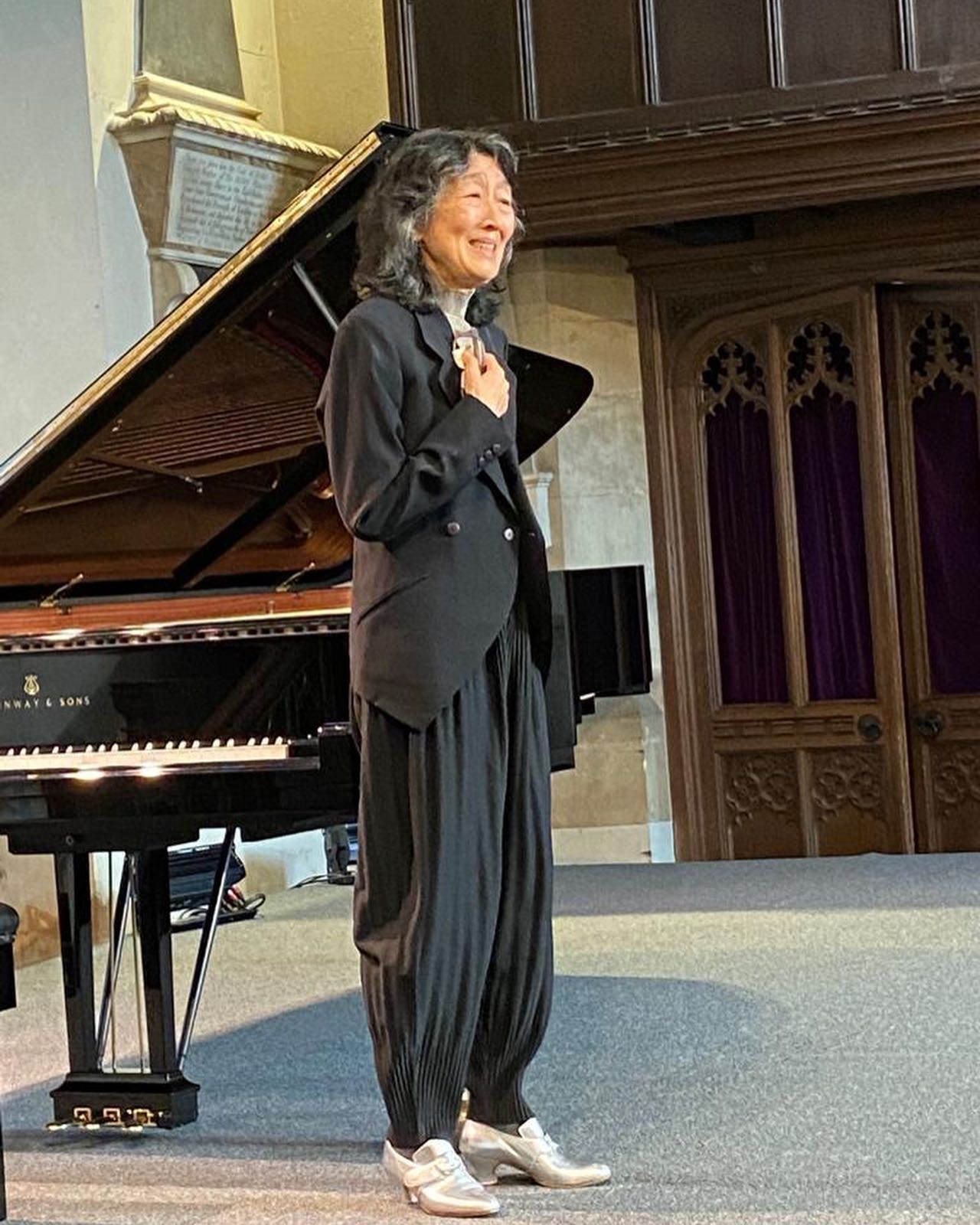 Schubert isn’t a showy composer, and nor is Uchida a showy performer. For this concert, she was dressed soberly in a dark fluid trouser suit, but there was a glint of showiness in her footwear – the most elegant silver shoes which lent a roccoco flair. Of course, the superb camera work allowed one to enjoy such details: to get up close and personal with the performer as the camera lighted on her hands and face, revealing myriad expressions, often unconscious, and which perhaps offered a glimpse to the personality beyond the notes.


 For this, its 47th year,




 The Cross-Eyed Pianist