There is more to being a musician than simply creating and/or performing music.
Musicians are here to educate too. They are the professionals, the experts — and they should share their knowledge and wisdom with the rest of the world. It is a duty for them. The listeners in fact do not know as much they think they do, and musicians are here to help guide them towards what is true. Musicians should promote quality and help the listeners distinguish their taste. In the cultural world, the musicians’ role is of utter importance, as musicians are also educators.
In fact, musicians are on a constant mission. They are indeed, all in their own ways, educators, whether they do it consciously through teaching, or unconsciously by the mere act of composing and performing their music. Each work, each performance is an opportunity to educate the listeners. To promote new sounds and ideas. Musicians spend a lifetime understanding the language of music, the history of music and deciding what the future of music is. They are the direction-takers and decision-makers, and they should remain as such. For music is to grow and develop, to uncover new territories, to surprise and discover the unknown. And somehow resist the human nature of wishing for comfort and repetition; even in art.
Therefore, musicians should not create what the listeners want; this is a mistake that is done too often. Musicians must not bend to the wishes of their listeners. They must not accept familiarity and repetition of ideas. Musicians should carefully decide what material to create; what message and information, as well as emotion, to bring to the listeners. Their role is of utmost importance. They are the drivers of music progress. They are the bringers of novelty.
To learn, listening is not enough. One has to practice and devote. And sacrifice. And it is in the sacrifice that musicians do — the sacrifice of time, energy and attention — that they automatically become leaders and influencers. It is this sacrifice which places the true musicians in front of their audience. Music takes devotion. And if the price is high, the reward is immense.
Today the concept of musicians as educators is more important than ever as they often forget that they are first and foremost artists — rather than perhaps industry actors. Their role is to create, perpetuate, educate and through this improve the cultural world. Their role is to guide and lead.
Doug Thomas is a Franco-British artist based in London.
His main medium of expression is music; since founding NOOX — or North of Oxford St., his own production studio — in 2015, Doug has composed, performed, recorded and produced multiple projects, both featuring his own music and other artists’ too. Additionally, he has worked with multiple independent labels and collaborated with artists from other disciplines.
An aspiring polymath, Doug also ventures in the world of visual arts, through photography and various sketching works. He also designs his own project’s artworks and images. Finally, Doug writes articles, reviews and often interviews his musical peers.
Doug is a lover of food and drink, and this often appears in his universe too.
“Music allows me to express ideas and feelings in a unique way. Each piece I compose is an attempt in finding balance between intellect and beauty, within the limits of my own language and experience. More than a language, music is a way to engage with the above.”
Guest post by Julian Leeks, director of Sound World
Imagine a future in which it’s almost impossible for enthusiastic, musically gifted children to reach their potential. A future in which state education is completely devoid of music. A future in which the amateur choirs and orchestras that have flourished for decades in towns, cities and villages up and down the country, have all but vanished.
A future in which the music teachers, the freelance performers and the talented, dedicated amateurs who form the backbone of our country’s musical life, have all become endangered species. What would our musical culture look like then? Every aspect of music would be affected: from Friday night pub bands to the London Sinfonietta and from primary school nativities to Oscar winning films.
How would we fill the void left by the musicians? AI perhaps? The very thought makes me shudder. But we don’t really need to worry about that now, do we?
Well, it may be closer than you think.
At the risk of sounding like a prophet of doom, bellowing “The end is nigh!” at passers by, I believe we may be sleepwalking towards a future in which there are insufficient musicians and music teachers to sustain a viable musical culture. I’m concerned that the status of music has declined significantly in our increasingly visually oriented society. A society which values “output” and wealth generation above an inner life and well-being, and one in which decisions of consequence are made on the basis of quantitive data at the expense of qualitative understanding.
But where is the evidence to support this warning?
In deference to the prevailing trend, let’s start with the numbers.
Between 2007 and 2013, the number of pupils taking GCSE music has nearly halved. The decline is even steeper at A’Level where a disproportionate number of candidates are privately educated (28% and rising year on year), despite accounting for just 6% of the total school population. Research predicts that A’Level music will disappear from state schools completely by 2033. Just nine years from now.
The most recent ABRSM study reported the lowest ever number of children taking instrumental lessons since records began. Between 2014 and 2020 there has been a 15% decline in the number of children currently playing an instrument and an 11% decline in the number of those taking instrumental lessons. During the same period, the report reveals an increase in the amount of available work for music teachers, suggesting an even more marked decline in teacher numbers.
There has also been a very significant shift towards whole class teaching at the expense of individual lessons, artificially inflating the numbers recorded for overall participation. Data suggests that this method of teaching does not translate into children’s continuing interest in playing music.
So, those are the numbers and they don’t look good. But do they chime with our experience of the nation’s musical life today? Maybe not.
But while music might look and feel like it’s thriving, the wealth of bands, orchestras, concerts and gigs provides only a superficial sheen of good health. What we see today isn’t a predictor of our musical future its a reflection of our educational past. If we want to imagine the future of music we have to think about our educational present. And we’ve seen how that’s going.
Of course there are always a few, super-talented, autodidactic outliers, but the vast majority of working musicians, regardless of genre, had at least some input from a knowledgable, motivating music teacher. It’s how we pass on the wisdom of generations; virtual lessons via YouTube or elsewhere don’t come close.
So why isn’t everyone talking about this?
This kind of generational knock on effect is hard to perceive due to shifting baseline syndrome. For those unfamiliar with this idea it can be summed up as follows: every generation perceives its own experience as representing a normal or acceptable baseline against which subsequent change can be measured. But for each generation that follows the baseline may be quite different, meaning any further changes will be measured against quite different acceptable norms.
To bring it back to music and the numbers described above, if the trajectory continues unchecked for successive generations, even though no single generation will experience any sudden, dramatic loss of music, the outcome – the gradual, inexorable depletion of musical activity – is inevitable.
But even musicians might not be aware of this. Surrounded by musical activity both at work and in the home, whilst constantly meeting a wildly disproportionate number of musical children, their experience is totally at odds with the broader reality and may lead to a degree of complacency.
It may also be the case that a lot of musicians feel they’re doing enough already, just by being musicians. Understandably, they may not wish to become activists or campaigners. But increasingly, many are starting to think that simply being a musician is no longer enough. After all, if musicians won’t stand up for music, why would anyone else?
To return to my main theme, how long could we go on if the number of children learning music were to halve every 15 years or so (and by extension, the number of teachers available to teach each subsequent generation). I don’t know what the critical mass for musicians is, the point below which we really experience the loss of music as described in my opening paragraphs. But if current trends are allowed to continue it can’t be that far off. One generation? Two maybe?
And once it reaches that point the damage would take many decades to repair, even with the very best intentions of a government with very deep pockets.
Which is why, over the past year, we’ve been making A land without music? a podcast series about the value of music and what we can do to safeguard it for future generations.
It’s been a huge privilege to meet some wonderful guests for the series and their insightful and engaging contributions are what make the series; and it seems fitting to note that, as music education becomes evermore the preserve of a wealthy elite, hardly any of the musicians I spoke to came from what might be described as privileged backgrounds.
Unless, that is, we’re talking about a very different kind of privilege; the privilege of opportunity. It’s what gave them the chance to discover music and to grow that seed of discovery into a life-long, life-sustaining passion. Crucially, it was opportunity which was indifferent to the financial or social status of people’s parents. It was there for everyone.
Would they have had such opportunities had they been growing up today? Probably not. To quote Jess Gillam, “So much untapped potential, and so much untapped happiness.”
Never, in the history of publishing, has so much human misery been created by one book. pic.twitter.com/4dEGv0gSZh
— Ron Manager Remembers Nottingham and Stuff (@ronmanagernottm) April 7, 2024
I retweeted it because it amused me. But looking at that red cover with the simple outline of a recorder also brought a Proustian rush of memories – of about 20 children sitting in a sun-filled classroom at Maney Hill Primary School in Sutton Coldfield in the early 1970s, with the book open flat on the table in front of us, each clutching a brown plastic recorder from which we attempted to draw sweet – and often not-so-sweet – sounds!
I confess I loved the recorder. It was easy to play and portable so you could take it round to your best friend’s house and play London’s Burning or Three Blind Mice in a round together. I loved the green Dolmetsch box that the recorder arrived in, and the special fluffy cleaning device.
My interest in, and enthusiasm for the recorder was encouraged less by school recorder playing and more by my father, himself a very competent amateur clarinettist and recorder player. Our joint enthusiasm was undoubtedly helped by David Munrow, whose radio and TV programmes about early music inspired us to improve our recorder playing, explore new repertoire and different instruments too (I had a very pretty blonde wood alto recorder in addition to the treble). At the same time, I was beginning my piano studies, and I have very happy memories of making music at home, with my dad and with other recorder-playing school friends. Later, at secondary school, I was sufficiently proficient in the recorder (though I never took any grade exams) to join the Recorder Group which performed mostly Renaissance and Baroque repertoire. It was one of many fantastic musical opportunities I enjoyed at a state comprehensive school in the early 1980s: how lucky we were then!
That image of The School Recorder Book brought a flood of memories for me so I posted it on Twitter and asked people to share their own reminiscences of playing the recorder at school. The response has been incredible – I never imagined that I would “go viral” online with a post about learning the recorder (to date, the post has received over 116K views)! So many wonderful memories shared (some not so positive!) – there isn’t room to include them all here, so I will include a selection and you can read the rest via my original post.
The first person to reply was concert pianist Sir Stephen Hough with a less than positive memory:
I do remember it. And the ghastly shrieking sound it helped produce at Thelwall County Primary … it would be interesting to know if anyone actually got into music by learning the recorder in this way.
Started learning at 8. At 12, went to Saturday morning local music college to play. Took Trinity College grades up to 8, then Diploma; A level music, and entered first ever BBC Young Musician (1978). And met my husband!
HEATHER
Many, many other people responded with comments about how the recorder had encouraged their interest in music, got them reading music, and led them to move on to other instruments. For some it was an important gateway into music which eventually led to a professional career in music:
Recorders are cheap for schools and parents to buy and are a great way to give children their very own musical instrument. They’re also a gateway to other instruments and a way to make notation come to life! And they can sound really good!
OLIVIA
This book laid the foundation of a joyous musical journey for many of us whose life would be so much poorer for not learning an instrument! If it was still compulsory in schools we wouldn’t be in half the mess we are!
PHIL
I learned with this at school in the early 80s, and remember my delight when the notes on the page finally matched up to my fingers and the sound I made! Went on to the next book in private lessons, took up treble, exams up to grade 8, learned tenor and bass, am still playing.
SERENA
Still have my original recorder and case from the 1970s! This instrument was responsible for starting my musical and teaching career. The book really helped me understand notation, pitch and rhythm before taking up the piano and violin. pic.twitter.com/Efqs7jtbQQ
Learning recorder in primary school was such an integral part of my musical education. We were so lucky to have a really enthusiastic head teacher who encouraged us to learn. She played classical music as we entered assembly and wrote the name of the piece on the blackboard.
MARK SIMPSON, composer & clarinettist
Flipping LOVED it – played for hours. Mum introduced me (a primary teacher who taught recorder in class w/ this book) and then I learnt with my class when I was 9/10. I’m convinced it made me a better singer (breath, phrasing etc) and nowadays a better broadcaster!
KATIE BREATHWICK Classic FM presenter
I received over 500 replies to my original tweet, and a few reminiscences by email too. I’m so grateful to everyone who shared their recorder memories, even the less savoury ones, such as recalling the taste and smell of the disinfectant in the bucket where the school recorders lived between lessons! The overriding message from all of this is that playing the recorder at school laid the foundations for a love of music, the ability to read music, the inspiration to go to learn other instruments, to teach music or to pursue a career as a performing musician (“I wanted to be Michala Petri!” declared one enthusiastic respondent to my original tweet).
Of course there is a serious side to all this ‘recorder love’. Today children learn instruments like the ukelele or ocarina at primary school and the recorder has rather fallen out of favour. Yet it’s one of the most logical, simple instruments to play and makes a pleasant sound from the get go. The reasons given for learning the ukelele are identical to those for the recorder: indeed, learning any musical instrument helps with concentration, cognition, memory, self-confidence, and a host of other valuable life skills.
Today music teaching in schools is declining at an alarming rate and recent statistics on music education make for depressing reading. Only 5,000 students in England took A level music in 2023, down 45 percent since 2010 [1]. If this downward trend continues, in less than 10 years no students in the state sector will be taking music A level, and learning music will become the preserve of the privately-educated, specialist music schools, and those who can afford private tuition. Not only does this decrease the pool of potential professional musicians and music educators, it also confirms the tired cliché that music, in particular classical music, is an elite activity. The impetus has to be from bottom up – from early years education where enthusiastic, creative teaching fosters an interest in and love of music from a young age.
Reversing the decline in music education will take sustained, collaborative efforts from a range of different organisations, partners, and funding bodies across the music sector. A diverse and thriving music sector, with a representative workforce and equal opportunities for children and young people to consider meaningful careers in music, was not built overnight. It is the work of decades of trust building with children and families and careful, considered, and consistent offering of opportunities for young people to develop their skills over many years. The best time to reverse the decline in music education and address representation issues in the music sector is not when young people reach adulthood, but during childhood.
The Day the Music Dies? Why time is running out to tackle the decline in UK music education
You can read all the responses by clicking my original tweet and scrolling down.
If you remember this book, please share your memories about learning the recorder at school, playing at home, playing in ensembles etc. Also how it encouraged your interest in music, if applicable (I'm researching an article). pic.twitter.com/L2Q5EOplrg
I’ve always loved the ceremony of nine lessons and carols from the Chapel of King’s College, Cambridge. For me, someone who doesn’t really “do Christmas”, the opening notes of Once in Royal David’s City signal the start of Christmas.
The Christmas “music” which fills shops, cafes and other spaces in the run up to the festive season is mostly trite and trashy with irritatingly catchy tunes which quickly become an unshakeable earworm.
Christmas carols are, however, another kind of music, in a special, much-loved league of their own. Aside from the poetry of their texts, there are the lovely memorable melodies (some carols such as In the Bleak Midwinter have several versions) and rich harmonies, often underpinned by wonderful organ playing. I’m not a churchgoer, but I do love the music of the Christmas festival.
When I was at secondary school in the early 1980s (a large state comprehensive school in Hertfordshire), we always performed Handel’s Messiah at Christmas and a few days later had our own ceremony of nine lessons and carols, performed in the church next door to the school by the senior choir and orchestra, pupils and staff (the Headmaster always read the final lesson, booming “IN THE BEGINNING WAS THE WORD…!” at us in stentorian tones). In addition to traditional carols (marked “All” in the service sheet), we sang other Christmas songs, many of which were taken from ‘Carols for Choirs’ (my particular favourites were Adam Lay YBounden (Boris Ord’s version) and Torches by John Joubert). I loved singing in the choir and playing in the orchestra, with that special sense of common purpose and a shared enjoyment and excitement in the music we were performing.
At the time, the huge amount of music which went on in my school was taken for granted. The school prided itself on its music provision and I remember this was one of the main factors which influenced my parents’ decision in applying to the school – and I’m very glad they did. The music department was run by an energetic and hugely committed teacher, (whose enthusiastic teaching inspired me, in part, when I became a piano teacher, and who retired only a few years ago). As well as two choirs and orchestras, a madrigal choir, recorder group and various other smaller ensembles, there was plenty of provision for instrumental lessons (I learnt the clarinet so that I could join the senior orchestra), plus opportunities to go on European tours with the orchestra or sing at the Royal Albert Hall (as I did when I was about 15).
Looking back, I now realise that I was very privileged to have access to and be surrounded by so much music at school, and also at home, and to be encouraged in my love and practice of music by inspiring music teachers and supportive parents. Music was very much a part of my day-to-day life and I never considered it particularly special or privileged (though I was teased a lot at school for being “good at music”). With the serious erosion of music provision in our state schools, what I enjoyed in my teens is now very much the preserve of a comfortable middle-class upbringing, and music and music lessons are in danger of becoming the exclusive preserve of the better off.
The benefits of learning a musical instrument are well-documented and I have observed and experienced many of them at close quarters through my teaching and my own studies when I returned to piano lessons as an adult. Learning a musical instrument equips us with important life-skills. If you can perform in a student or school concert or a public music festival, you can also stand up before a room of people and give a paper at a conference. Music stimulates brain function and can improve memory, cognitive and motor skills, concentration, time management and organizational skills, and creative thinking. Playing an instrument is both stimulating and therapeutic, as the physical activity of playing releases the same “happy hormones” (endorphins) which sportspeople enjoy. Learning and playing a musical instrument fosters self-expression, and can bring a deep sense of fulfillment and personal achievement. Meanwhile, playing in an ensemble, orchestra or band, or singing in a choir, offers a wonderful sense of a shared experience while also encouraging team building, sociability and cooperation. For children with special needs or learning difficulties such as dyslexia and ADHD, music can offer an important outlet and allow them to shine when they may be struggling in other areas of their school life.
We need music, and we need committed, skilled and enthusiastic people to encourage and train the next generation of musicians and to foster an appreciation of and excitement in music, whatever the genre. The devaluing of music, along with the other arts, by former education secretary Michael Gove and continued by the current encumbent and this philisitine government in general, is an outrageous attack on a crucial aspect of our cultural landscape and heritage. Music and arts education is simply not safe in this government’s hands.
We need music. Support music in schools, music hubs, local ensembles, national orchestras. Encourage your children to learn music, sing in a choir, join a band, form their own band, go to concerts, talk to musicians. Write to your MP and urge him or her to take music education seriously. Listen, engage, and above all enjoy. Please.
The Cross-Eyed Pianist is free to access and ad-free, and takes many hours every month to research, write, and maintain.
If you find joy and value in what I do, please consider making a donation to support the continuance of the site

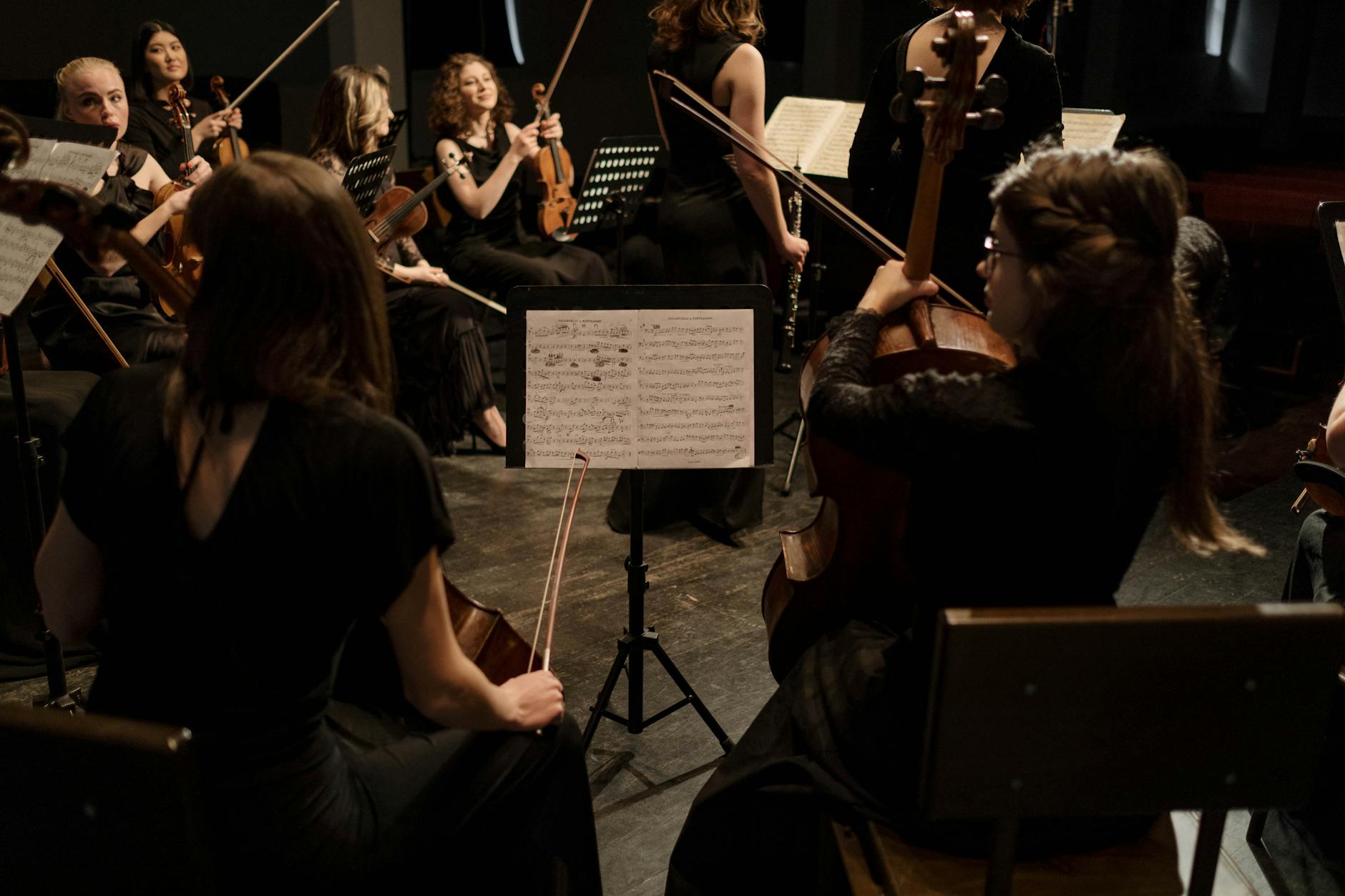


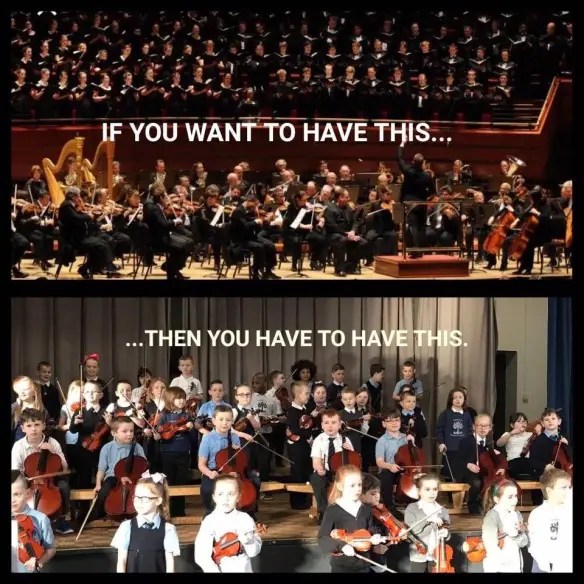
 When I was at secondary school in the early 1980s (a large state comprehensive school in Hertfordshire), we always performed Handel’s Messiah at Christmas and a few days later had our own ceremony of nine lessons and carols, performed in the church next door to the school by the senior choir and orchestra, pupils and staff (the Headmaster always read the final lesson, booming “IN THE BEGINNING WAS THE WORD…!” at us in stentorian tones). In addition to traditional carols (marked “All” in the service sheet), we sang other Christmas songs, many of which were taken from ‘Carols for Choirs’ (my particular favourites were Adam Lay YBounden (Boris Ord’s version) and Torches by John Joubert). I loved singing in the choir and playing in the orchestra, with that special sense of common purpose and a shared enjoyment and excitement in the music we were performing.



 The Cross-Eyed Pianist